

RevOps Starter Guide – Building a Successful RevOps Roadmap

Consider a soccer game. We know the key parts of a team are the players and the coach. If we’re to draw a comparison, “sales” is the striker, while “RevOps” is the coach that analyzes, strategizes, and develops the game plan to win more games.

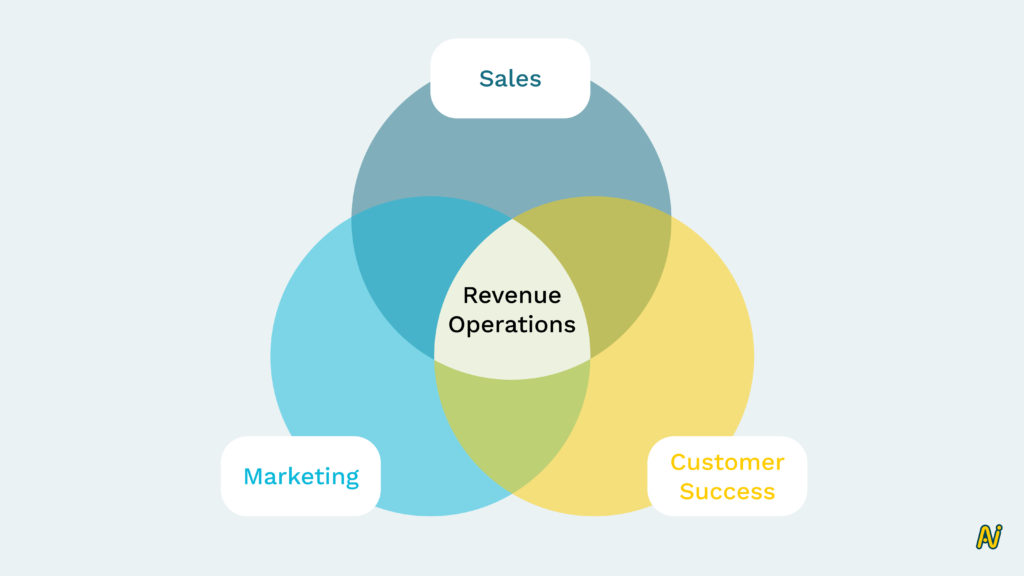
In the real world, RevOps helps your organization run an interconnected business. It streamlines the end-to-end revenue process and GTM functions. It, consequently, breaks down operational silos and improves efficiency and predictability.

Businesses today understand what RevOps is better than ever, and adoption has followed. A 2026 survey of over 1,200 B2B companies found 78% now have a dedicated RevOps function, up from 48% in 2023 and 30% in 2021. RevOps has gone from an emerging bet to close to the default operating model for B2B companies with real growth ambitions.

With data’s growing significance and an increasingly complex tech stack, organizations are relying on RevOps to maximize revenue generation by strategically removing sales roadblocks. And align the entire organization towards a single goal – revenue generation.

That’s where a RevOps roadmap comes in.

If you don’t know how a RevOps roadmap helps, let the expert rein you in. We spoke to Briana Yarborough on The Revenue Lounge podcast to find out what is a RevOps framework and how businesses can create one.

Briana is a seasoned RevOps leader and co-founder of a RevOps solution in development. She serves as an advisor and executive leader for several high-growth startups. She’s also an active thought leader of RevOps in multiple communities and was recognized as one of the Top 25 trailblazers in the space.

Look at the full discussion below and keep reading to know more about building a revenue operations roadmap.

What is a RevOps Roadmap?

A RevOps roadmap, in its simplest form, is a strategic visualization of your team’s upcoming projects.

  • For leaders, it’s a goal-oriented tool communicating the clear scope of activities and outlining how these activities tie back to revenue. It enables managers to align the team and focus on activities that maximize the value of converting prospects to buyers.
  • For reps, it is a source of truth to highlight “what” work is being done and “why.”
briana y
Briana Yarborough
VP, RevOps at Pontoon Solutions

Revenue operations is about aligning the entire organization across the customer's life cycle.
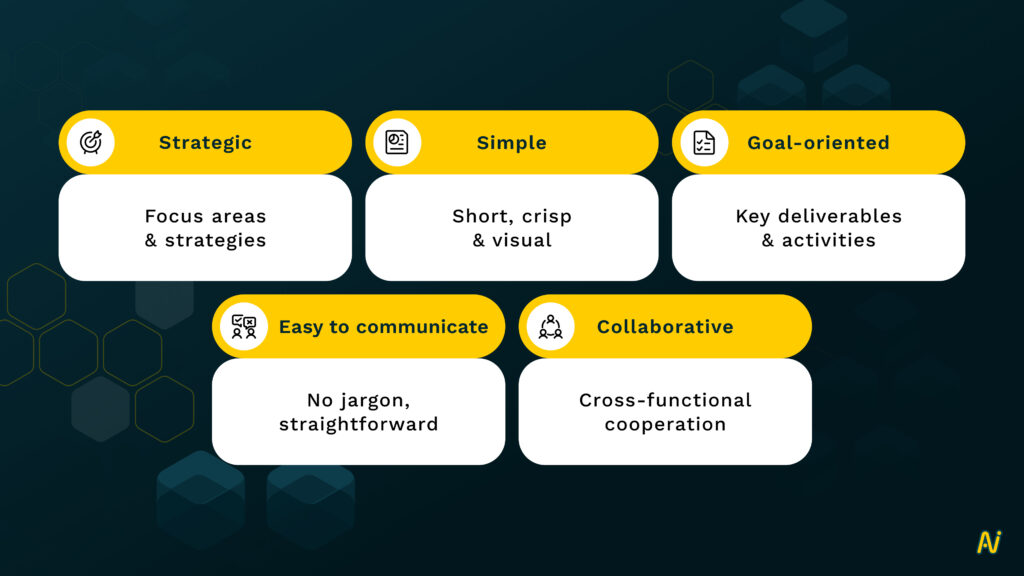

A RevOps roadmap can be followed seamlessly when everyone on the team understands it. Therefore, it’s important to get these 5 attributes right when creating an effective roadmap:

  • Strategic: Focus areas and strategies
  • Simple: Short, crisp, and visual
  • Goal-oriented: Key deliverables and activities
  • Easy to communicate: No jargon, straightforward
  • Collaborative: Cross-functional cooperation

Get our latest insights into your inbox

A RevOps Roadmap Clears The Path To Revenue Success

Adding a strategic layer of RevOps to your Go-to-market functions connects all activities which otherwise exist separately in a vacuum.

Here are some key reasons why you need a RevOps framework:

1. Prioritization

One of the primary benefits of having a RevOps roadmap is giving teams the necessary visibility. They can prioritize high-impact projects and focus on those that positively affect revenue. Teams can avoid off-plan requests that distract them from hitting predictable targets.

Additionally, it doesn’t let your weekly meetings run in divergent directions based on unhinged queries from Sales or Marketing teams.

2. Alignment

A GTM alignment is possible when teams improve buying experience by breaking down cross-functional silos.

Through sales and marketing alignment, the RevOps roadmap serves as a single source of truth to unify people, processes, and platforms. This alignment drives full-funnel accountability and helps you grasp inconsistencies and develop a baseline for improvement.

Mark Hudson
Principal Consultant, RevOps Consulting LLC

Without a roadmap, your path to success is fraught with dangers, and you do not have a clear sense of direction and can make a wrong turn or fail to reach your destination.


3. Understanding

A roadmap helps you dive deeply into the “why” behind revenue generation activities, including business goals and supporting resources.

Start as early as you possible can, even if you have a one-person team. You can understand what your priorities are and then begin to earmark things to accomplish in Q1, Q2, Q3, Q4.


briana y
Briana Yarborough
VP, RevOps at Pontoon Solutions
It provides clear definitions for and sets up the priority of each project, timeline, and initiative to measure progress effectively. Simultaneously, a RevOps roadmap restricts confusion among different departments.

Also, a roadmap empowers leaders to develop a vision for the business and ensure a solid system is in place to make this reality.

Now that you know what a RevOps roadmap is, are you inspired to build one for your business yet? Let us help.

Creating a Successful RevOps Roadmap

You can strategically and tactically achieve the roadmap to a successful RevOps plan with several key steps and considerations in place. For beginners, it’s best to start with the 4 primary phases.

But remember – a RevOps roadmap will differ for each organization based on its maturity stage and resources.

You can't truly start to just come in and do what worked at another company. Every business model is different; every organization is different. If you don't have the context, you can't implement (the RevOps roadmap).


briana y
Briana Yarborough
VP, RevOps at Pontoon Solutions
For this blog, we’ll dive into a summarized version of a beginner’s RevOps framework.

Phase 1: Discover

Research is pivotal in understanding the problems in relevant operational areas before solving them. The initial analysis, aka discovery, seeks to lay down the “state of play” before designing the roadmap.

Discovery presents a comprehensive awareness of stakeholder expectations and gaps in the customer journey, starting with a thorough audit.

Use these questions to set the direction of your roadmap for stakeholders:

  • Does each team clearly understand what they’re working on?
  • How does the team determine the next best steps?
  • Can each operational initiative be mapped back to a gap felt by customers?
  • Is there a shared understanding of the company’s goals/values?

It not only helps identify the problem but also the reasons for the problem and the missing link. Discovery gives you insights to narrate the stories behind the roadmap more effectively. You can also incorporate this information into ongoing and forthcoming projects.

For me the first steps (for creating a roadmap) are to listen to all of my stakeholders. I want to go out there, understand the business operations even better past the interview phase and evaluate the current state of affairs.


briana y
Briana Yarborough
VP, RevOps at Pontoon Solutions
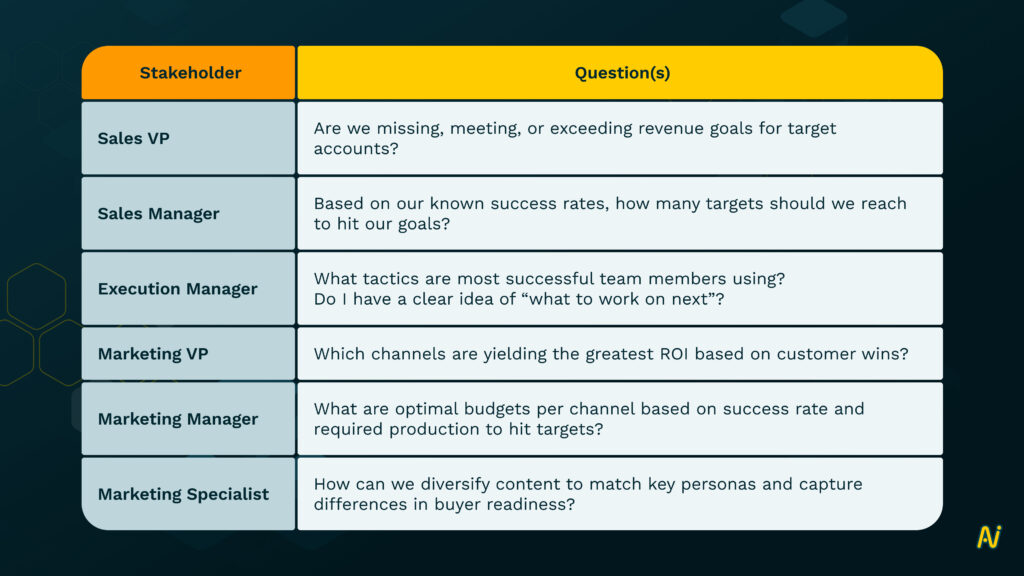
Interview relevant stakeholders such as the VP, managers, and executives in sales, marketing, and frontline operations. For this task, you can use surveys, one-on-one interactions, and team feedback.

Here are some key questions for individual stakeholders:

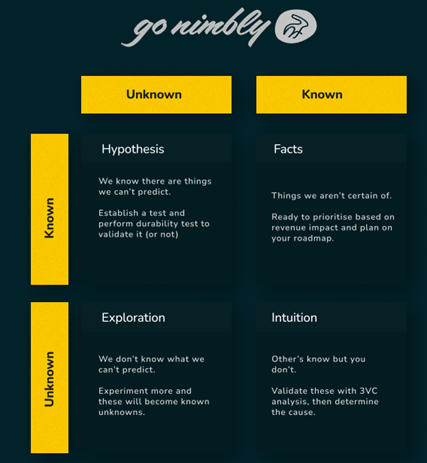
These questions will help you find the blind spots and leverage proven methods like Rumsfeldian Knowledge Matrix or 3VC. The Rumsfeldian Knowledge Matrix places gaps in four categories and maps what you know and don’t know.

Rumsfeldian Knowledge Matrix

Moving on to the 3VC analysis (Volume, Velocity, and Value), you can analyze the sales pipeline and identify the gaps adversely affecting revenue.

Next, you can list down the existing processes across the organization. A process audit includes looking at your teams’ approach to, for example, lead scoring. Using a process audit, you can learn more about how inbound marketing works, the system and strategies, the connectivity of disparate systems across channels, and more.

A growth mindset is imperative to close gaps and improve the buyer journey. View the current gaps and challenges as learning opportunities, and focus on framing a clear plan to generate predictable revenue.

Revenue operations mindset equals growth mindset equals continuous improvement.


briana y
Briana Yarborough
VP, RevOps at Pontoon Solutions
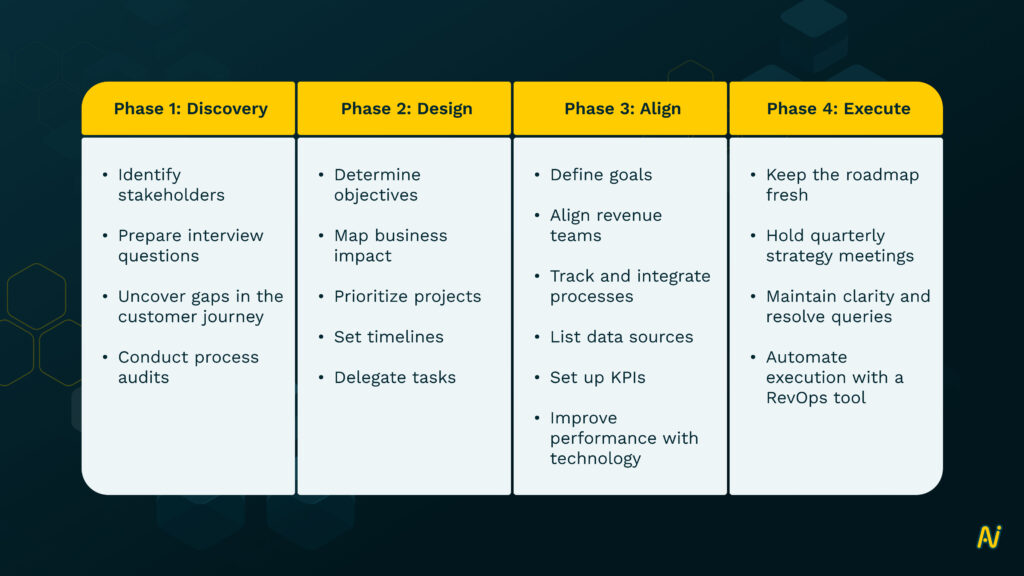
Checklist for “Phase 1: Discovery”

Phase 2: Design

Once you’ve passed through the discovery phase, it’s time to move on to designing the RevOps roadmap with all the information you possess.

The must-have components of your roadmap are:

  • Projects, aka strategic undertakings, to bring in predictable revenue
  • The business impact of these projects on your organization
  • Prioritize projects using a sequential order from those delivering maximum value to those with the lowest impact. Taking a gap-first approach is recommended by identifying customer gaps and measuring their impact.
  • Preparing ship dates for release as agreed upon by all stakeholders
  • Information about teams or stakeholders involved in each project

Start designing your RevOps roadmap by laying down objectives, establishing timelines, and delegating work.

a. Objectives

Using insights from Phase 1 (discovery), you can map out short- and long-term objectives across all revenue teams, tying your goals together. These objectives can be short and straightforward (quick wins), cross-functional (encompassing multiple teams), or comprehensive (longer-term strategic planning).

To begin, layer your interview insights over the buyer journey for your organization. This, along with clean data, will help create a complete picture of the gaps and lead back to more quantitative goals.

Throwing a revenue target and saying hey double the revenue by year over year, t is not enough. There are a lot of other objectives within an organization. Tying what you're doing from a priority standpoint to that is also a part of those first steps.


briana y
Briana Yarborough
VP, RevOps at Pontoon Solutions

For example, you can use CRM to track won or lost deals. Dive into the system for comprehensive information on contact data and deal health. If a deal is going sideways due to a lack of multithreading, you could list this as a gap in the RevOps process.

Leverage insights from the discovery phase and align them with company objectives to prioritize projects.

Again, it’s important to note that there’s no one-size-fits-all approach to setting goals. They will differ based on the organization’s maturity of processes and systems.

b. Timelines

Without a clear deadline, any project or roadmap is doomed for failure.

Determine the amount of work required for each project and attach timelines to each target and delivery. Also, assign priority levels based on these timelines.

Break each objective into smaller, time-bound milestones. It makes them more accessible and achievable for teams. Ultimately, small wins translate into significant triumphs.

While defining a timeline, account for possible derailments, risks, and interdependencies that could delay your achievements.

c. Delegate

Working in traditional teams and silos, an incorrect delegation of tasks isn’t unheard of. A RevOps roadmap changes this by bringing the 2 Es to the table – experience and area of expertise.

For instance, analyzing, defining, and strategizing marketing-related projects is best suited for a marketing leader rather than sales. 

Revenue leaders work on the strategy to keep teams from losing clarity on projects. Simultaneously, execution specialists execute the strategy based on determined timelines in a way that brings in positive results. 

During delegation, have the RevOps team oversee projects. It ensures accountability and encourages alignment, particularly when teams aren’t keen on working together.

Checklist for “Phase 2: Design”

Phase 3: Align

A significant organizational transformation calls for company-wide alignment and comprehension of the “what” and “why” behind a RevOps roadmap.

Therefore, before executing the roadmap, removing any barriers between sales and marketing teams is important. Both teams need to march in lockstep toward a common goal.

And it’s not just sales and marketing; all your stakeholders must be invested in the revenue operations process. They must align on all critical projects every single time, considering they have a stake in the business’s overall success.

Change can be intimidating, and teams could be wary of future things. Kicking off RevOps with an approachable and easy-to-understand visual map makes the process more seamless. It excites and encourages teams enough for them to work towards improving the buyer experience.

Without Revenue Operations, teams are departmentally siloed and working with their head down, with their own priorities and their own objectives. RevOps comes in as sort of the glue behind all o the operations.


briana y
Briana Yarborough
VP, RevOps at Pontoon Solutions

Checklist for “Phase 3: Align”

Phase 4: Execute

A RevOps roadmap helps businesses reconstruct revenue pipelines with significant efficiency gains, organizational efficacy, customer centricity, cost savings, and growth if executed well.

It’s this phase that determines if the roadmap becomes:

  • An effective reference document of the RevOps process, keeping both frontline and backend teams highly focused on revenue generation

OR

  • A dumping ground for inbound requests from across the organization, abandoned by teams only a few weeks into implementation

Executing a RevOps roadmap isn’t a one-time event but a continuous process. It involves constantly updating the roadmap as projects move forward and new developments come to light. Stakeholders must also be involved in the process throughout its execution to ensure that their needs are met, and they can focus on the ultimate goal which is revenue success.

Continue to have conversations with stakeholders and say - here's what I'm thinking tell me if there's something that has been tried in the past that didn't work out didn't pan out too well or if there are things that are here in this roadmap that I need to clarify for you so that we're all in alignment.


briana y
Briana Yarborough
VP, RevOps at Pontoon Solutions

Hold quarterly or monthly strategy meetings to plan projects for the next quarter and keep refreshing your roadmap. Manually monitoring and tracking all projects across teams could be time-consuming.

However, given RevOps’s growing importance, several project management or RevOps tools are now available. Use the best-suited one for your organization to execute the roadmap better.

Now there are tools available that help get access to the information in more real time because they connect via API into these systems. I think that's phenomenal. It makes our jobs easier because we have been doing it the long way for such a long time.


briana y
Briana Yarborough
VP, RevOps at Pontoon Solutions

Stakeholders and teams could also have queries popping up during the execution. Utility meetings come in handy to revisit the roadmap and update it, resolve queries, and maintain clarity of the objectives at all times.

Checklist for “Phase 4: Execute”

Clean Data Lies at the Helm of a Successful RevOps Roadmap

Modern businesses are zooming out and turning to RevOps as a holistic solution for increasing organization-wide, predictable revenue. Clean data and a CRM void of data leaks make this seamlessly possible.

The number one thing you can do to get an accurate view of data across departments and the organization is to, based on your business model, make sure that you have integrated systems. Make sure, if there are companies with multiple contracts, you have unique identifiers that connect across the customer journey as well.


briana y
Briana Yarborough
VP, RevOps at Pontoon Solutions

Getting an accurate view of data across all revenue generating teams is the first step to aligning and executing a successful RevOps roadmap. This requires having a single technology spine that allows for a free flow of data and insights through various stages of the buyer journey.

That requirement has gotten more literal since this guide first published. The “Automate” step in Phase 4 used to mean picking a tool that saves a RevOps team manual work. Increasingly, it means picking a tool that’s safe to let an AI agent act on directly — because the same roadmap data that used to just inform a quarterly planning meeting can now feed an agent that updates records, flags risk, or triggers a workflow with a lot less human review sitting between the data and the action. A roadmap built on incomplete or stale CRM data used to just produce a weaker plan. Now it can produce automated decisions built on that same weak foundation, at a speed nobody catches in time.

Nektar’s Data Foundation closes that gap automatically by capturing email, meeting, call, and calendar activity across every revenue team and writing it natively into your CRM, so the roadmap you build in Phase 1 and 2 is grounded in what’s actually happening in your pipeline, not what happened to get manually logged.

We hope this guide helps you create your own RevOps roadmap. 

Learn from the best enterprise RevOps leaders in our podcast The Revenue Lounge.

Enjoyed our content? Follow Nektar on LinkedIn

In this blog

Clean up your Data foundation with Nektar before building a RevOps function

Scroll to Top

Just one more step