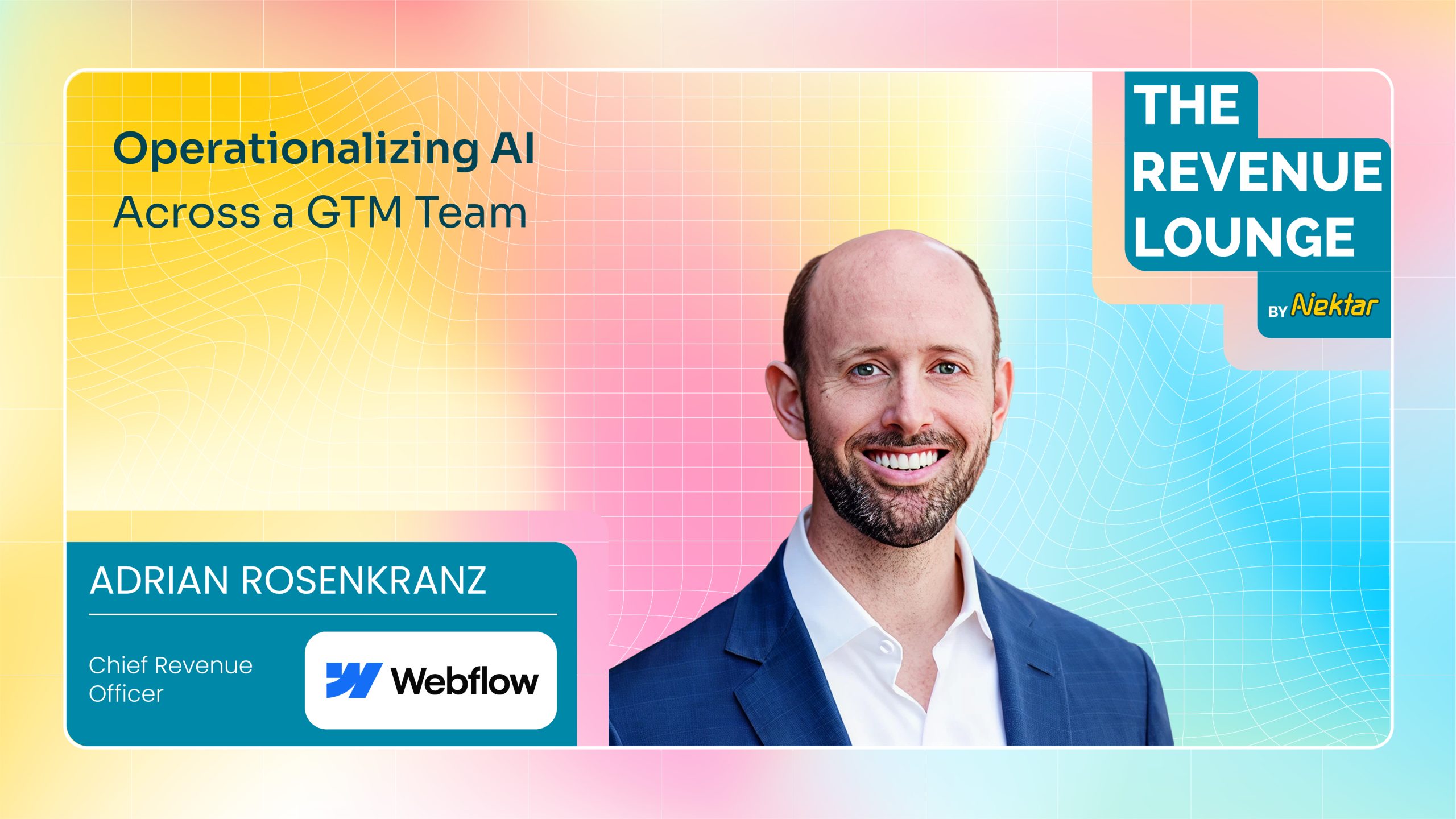
How to Operationalize AI Across a Go-to-Market Team
A conversation with Adrian Rosenkranz, Chief Revenue Officer at Webflow.
Executive Summary
Every board meeting has an AI agenda item. But most organizations are still figuring out which questions to ask, let alone how to answer them. In this episode of The Revenue Lounge, Adrian Rosenkranz, CRO at Webflow, offers one of the most practical frameworks on how a revenue leader should actually think about operationalizing AI, not as a technology project, but as a deliberate re-architecture of how a go-to-market team spends its time.
The core principle: the only metric that matters is customer time. Every AI investment should be evaluated against one question: Does this help my team get in front of customers more often and show up better when they do?
From there, Adrian’s framework covers how to draw the line between what AI should own and what humans must control, how a shared organizational “handbook” makes individual AI use more powerful rather than less, why governance is an accelerant not a constraint, and what the real competitive moat looks like when every company has access to the same models.
The conversation includes a detailed breakdown of what he’s personally testing, what hasn’t worked, and why the future of AI in go-to-market is actually a question about humans.
Adrian Rosenkranz came to Webflow about a year and a half ago after leading global sales at Tableau, a multi-billion dollar operation spanning SMB through enterprise. His path there was deliberately nonlinear: sales, strategy, marketing, demand generation. And he’s now running a go-to-market organization at Webflow that combines sales, marketing, RevOps, support, success, and partnerships under one roof. It’s a structure that puts him in a strategic position to observe how AI touches every function, not just one.
The One Question Every CRO Should Be Asking About AI
Most AI conversations in the boardroom start with “What’s the opportunity?” Adrian starts with a different question: What’s preventing my team from being with customers?


Adrian Rosenkranz
Chief Revenue Officer
How do I help my teams and the people in my organization be with customers more? That's the number one metric. And so as I walk my way back to that, what prevents people from being with customers more? Well, it's drafting, it's research, it's data prep, it's searching, surfacing up what's changed."
The practical implication is significant. It reframes every AI use case evaluation. Instead of asking “Is this cool?” or “Is this efficient?”, you ask whether it removes friction between a rep and a customer conversation. That filter eliminates a lot of noise and focuses investment on the things that actually move the needle.
It also sets up a simple top-level KPI: Are we getting more customer calls? Is our team spending more time in front of customers? Everything else like campaign conversion, CSAT, time saved on admin is a sub-metric that tells you whether you’re moving in the right direction.
Drawing the Line: What AI Should Own, What Humans Must Control
The question of where human judgment ends and automation begins isn’t a one-time decision. It’s a moving line that shifts as models improve, as trust in outputs builds, and as use cases evolve. Adrian’s framework for where to draw it is one of the clearest we’ve encountered.
Adrian Rosenkranz
Chief Revenue Officer
Any action that's harder and harder to reverse and you can only have a one-way door through, then most likely we need more and more human ownership on it.
Reversibility is the operative concept. Low-stakes, high-reversibility tasks like drafting a follow-up email, summarizing a call, or pulling prep notes for a meeting, are strong candidates for full automation. High-stakes, one-way-door decisions or anything public-facing, anything that affects a customer relationship, anything that involves committed guidance, need a human checkpoint.
He’s put this into practice personally. Every evening, an agent pulls all of his call transcripts from the day, classifies them as internal or external, and drafts appropriate responses like Slack recaps with action items for internal meetings, follow-up emails with next steps for external ones. It drops into his queue as drafts, ready to review and send. Every morning, a separate agent reviews his calendar, pulls the prep documents his team has created, adds external research, and surfaces suggested questions and areas of likely friction for each meeting.
The point isn’t just efficiency. It’s that he shows up to every customer conversation fully prepared, without spending an hour doing the preparation himself.
The Shared Handbook: Why Individual AI Use Gets Stronger with Organizational Context
One of the most distinctive ideas Adrian introduces is the concept of a shared organizational handbook which is a centralized, living body of context that every individual’s AI use draws from.
The problem it solves: most AI use in a go-to-market org is isolated. A rep builds a great personal workflow for researching prospects. A CSM figures out how to draft renewal summaries from call transcripts. But each person is starting from scratch on the parts that should be consistent. How contracts are structured, what fields in Salesforce mean, how the company defines an MQL, what the ICP looks like this quarter.
Adrian Rosenkranz
Chief Revenue Officer
The thing I was really struggling with is how do I make sure that when anyone in my org asks a question, we actually make sure we go through a shared handbook first? Because there's only going to be a handful of people who know exactly how all the contracts are stored and what the definition is.
The architecture he’s building: a shared user context that loads on every prompt for every person in the organization, maintained by the teams who own those workflows. RevOps owns the Salesforce definitions and metric logic. Legal and RevOps jointly own the contracts knowledge base which is an aggregation of every negotiation the company has ever done. This makes it possible for a salesperson or CSM to get accurate guidance on special terms without pulling in a legal resource every time. Product marketing owns the ICP, which is no longer a static document but a continuously updated file fed by an agent that processes real customer conversation transcripts.
The result is that individual customization and organizational consistency stop being in tension. A rep can build their own voice, their own prospecting workflow, their own prep ritual, but when they ask a question that has a definitive organizational answer, they get it right.
Prefer to go deeper on AI-powered Buying Group Intelligence?
Why Governance Is an Accelerant, Not a Constraint
The conventional objection to governance is that it slows things down. That guardrails prevent teams from experimenting and innovating. Adrian’s experience is the opposite. Governance, done right, is what makes it safe to give individual contributors real latitude.
Local innovation is amazing. But empowering them to innovate is about how they show up for customers better.
Adrian Rosenkranz
Chief Revenue Officer
The key distinction is between governance on deterministic questions and governance on open-ended ones. For deterministic questions, what are the special terms on this contract, what’s our definition of a qualified opportunity, what does our current ICP look like. There is one correct answer, and the organization should own delivering it accurately every time. Without that, people get wrong answers and slow down. With it, they can move fast because they trust the output.
For open-ended questions, how should I approach this account, what angle should I take in this proposal, individual judgment and local innovation are exactly right. The governance doesn’t touch those.
The practical failure mode Adrian observed when they first turned AI on broadly was instructive: without shared context and clear permissions, people got answers that were technically plausible but organizationally wrong. Not malicious errors but gaps between what the model knew and what the company actually does. Fixing that wasn’t about restricting AI. It was about making the context it drew from more complete and more accurate.
The Infrastructure a Modern GTM Organization Actually Needs
When pressed on what the core infrastructure looks like, Adrian is specific. Three components, each necessary, none sufficient alone.
Permissions and auditability. When AI agents are taking actions like drafting communications, updating records, surfacing recommendations, you need to know who can do what and what has happened. The audit trail matters as much as the capability. Without it, you can’t diagnose errors, you can’t build trust in the outputs, and you can’t scale.
Shared building blocks. Reusable skills and workflows that multiple teams draw from the contracts knowledge base, the ICP document, the sales methodology definition. These are owned and maintained by the teams closest to the underlying domain, not by a central IT function. The RevOps team owns the Salesforce context. Legal and RevOps own the contracts layer. Product marketing owns the ICP. Each team has an assignment. If everyone does their assignment, the play works.
I played football in college and we always said: worry about your assignment. If you do your assignment and someone else does their assignment, the play goes well. That's where we're moving. Each team has to do their assignment really well and maintain it so the system works.
Adrian Rosenkranz
Chief Revenue Officer
Connected, defined data. Connecting systems is necessary but not sufficient. Data that’s connected but undefined creates as many problems as data that’s siloed. If you give your team access to Snowflake data without semantic context, what each field means, how each metric is calculated, they’ll get wrong answers confidently. The definition layer is as important as the connection layer.
Mimecast identified $80M+ in pipeline after using Nektar to fix their data foundation.
Learn how Mimecast improved GTM visibility, powered AI with trusted customer context, and generated measurable revenue impact with Nektar
What Hasn't Worked (And What That Teaches Us)
Adrian is unusually candid about where AI has underperformed, which makes his insights on what does work more credible.
His most recent experiment: a follow-through agent that scans his Slack threads overnight, identifies conversations that need a response, and drafts replies. When he wakes up, he has 20 to 25 draft responses waiting. He sends roughly one.
The gap is internal context. External-facing AI works well because it draws on rich, structured data like call recordings, deal history, contract history, support case history. Internal AI runs into a wall because so much of what matters internally lives in unstructured Slack threads that lack the connective tissue to make a response contextually accurate.
With external, I have call recordings, a combination of deal history, contract history, support case history, I have all this stuff. And so that was my big aha moment: I have to figure out how to make the data more effective, because the internal one has a way harder time getting it accurate.
Adrian Rosenkranz
Chief Revenue Officer
The contrast is instructive. His weekly forecasting agent which combines internal forecast call transcripts with actual deal data works well precisely because it draws on both structured and unstructured data in a way that maps to how humans actually think about forecast calls. The Slack drafting agent fails because it’s missing the background context that a human would have.
The lesson: the quality of AI output is a direct function of the quality and completeness of the context it draws from. Automating over incomplete data doesn’t save time. It creates review work.
How to Measure Whether Any of This Is Actually Working
Measurement is where AI investments most commonly go wrong. Organizations instrument outputs like tokens consumed, time saved, and tasks completed, without connecting them to business outcomes.
Adrian’s approach is deliberately top-down. The north star metric for go-to-market AI is customer time: are we getting more customer calls? Is the team spending more hours in front of customers as a result of AI handling what would otherwise occupy those hours?
Below that, each function has its own leading indicators. In sales, it’s the volume of customer conversations. In marketing, it’s campaign conversion and whether AI-assisted content creation is producing better experimental results. In support, it’s whether CSAT from AI-handled tickets is at parity with or ideally above the human baseline.
I don't have an aggregated view. I have an aggregated opinion that AI for go-to-market should mean you're with customers more. And that's the measure I would use for success.
Adrian Rosenkranz
Chief Revenue Officer
The framing is useful: one lagging indicator that reflects the ultimate goal, multiple leading indicators that tell you whether you’re on track. Simple enough to communicate, specific enough to act on.
The Real Competitive Moat When Everyone Has the Same Models
As AI becomes commoditized, when every company has access to the same foundation models, the same tools, the same workflows, what creates durable competitive advantage?
Adrian’s answer is counterintuitive. The moat isn’t in the AI. It’s what the AI doesn’t have.
What is it that an LLM doesn't have that is within your business? That's your moat. It doesn't have the people on your team and the creativity of putting those people together. It doesn't have the customer relationships you have. It doesn't have your systems of record, it doesn't have your context.
Adrian Rosenkranz
Chief Revenue Officer
The implication is that the inventory of things an LLM can’t replicate like team composition, institutional knowledge, relationship history, proprietary context, is exactly where organizations should be investing. Not to protect against AI, but to give AI something worth working with.
But there’s a prerequisite: AI fluency. Organizations that have built internal capability through builder days where entire teams spend a day constructing their own workflows, through shared skills libraries, through deliberately maintained shared context, will extract disproportionately more value from the same models than organizations that haven’t.
The biggest moat of all is how do you turn intelligence into results? We've seen all over the place, people burned through their entire token budget and don't have the outcomes they wanted. If you can't turn intelligence into results, you don't have an advantage at all.
Adrian Rosenkranz
Chief Revenue Officer
The Bottom Line
Adrian Rosenkranz’s framework is unusually grounded for a conversation about AI because he consistently anchors it in one thing: human time with customers. Everything else is a means to that end. The shared handbook, the governance infrastructure, the connected data, the fluency investment, none of it matters if the output isn’t more effective customer conversations.
The reframe he offers toward the end of the conversation is worth sitting with. When asked what the best revenue organizations understand about AI that most companies don’t, his answer was: it’s the wrong question. The better question is what they understand about humans, where human judgment, human relationships, and human creativity will remain irreplaceable, and how to design AI systems that amplify those things rather than try to replace them.
In a world where 58% of web traffic is already non-human, that clarity about what humans uniquely bring isn’t just philosophy. It’s strategy.
Know a revenue leader, CRO, or RevOps practitioner with a sharp point of view?
We’re looking for practitioners with real experience operationalizing AI in go-to-market.
Never miss an episode! Subscribe to The Revenue Buzz newsletter to get weekly episode updates.
If you liked what you read, please share it with your peeps.
In this blog
Get the Revenue Lounge Brief
3 takeaways from every new episode, straight to your inbox.