
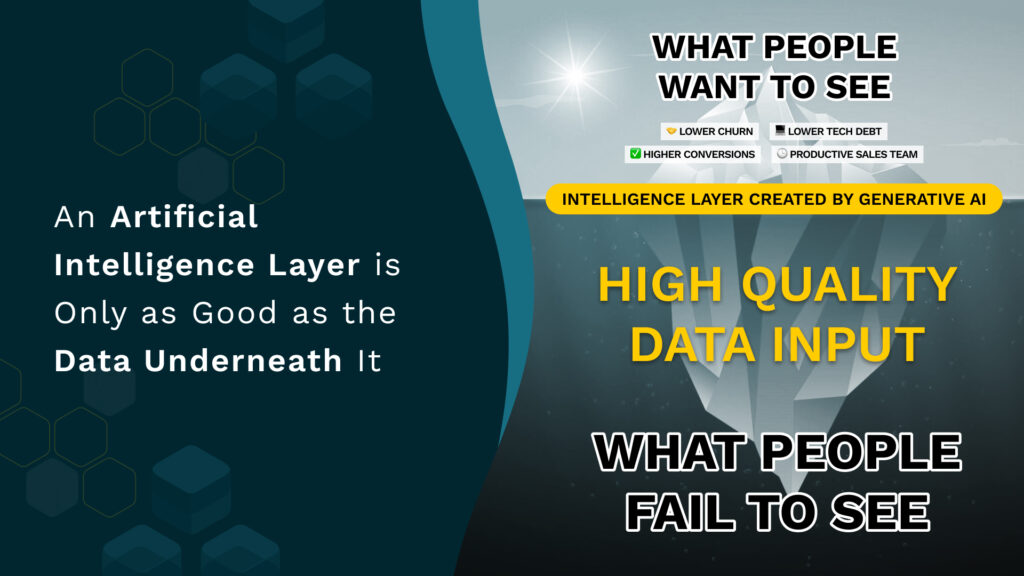
An Artificial Intelligence Layer is Only as Good as the Data Underneath It
- CRM
- 12 min
- Updated: August 7, 2026
The sales tech market has consolidated hard over the past two years, and the AI layer sitting on top of it has moved from a differentiator to table stakes. What customers actually want hasn’t changed underneath that shift: technology that helps close more revenue and closes the gaps that exist across the customer lifecycle, from lead to opportunity to renewal.
Tools that give unified visibility across the full funnel, built on clean, complete data and aligned teams, are the ones that win. An intelligence layer is what gets a company closer to its revenue targets, but only if the data underneath it can actually support it.
Get our latest insights into your inbox

What Is an Intelligence Layer?
An intelligence layer is what unlocks the patterns that have long been trapped inside disconnected databases and applications. It makes use of data streaming continuously into your systems and surfaces insight at the moment it’s actually needed, adapting and evolving rather than staying static.
Done well, it marries historical context with the constant flow of new data about accounts, opportunities, and prospects, offering predictive signals about what will actually move the buying journey forward at any given point. Those signals make real-time, proactive engagement possible instead of a reactive scramble after the fact.
This is the system of action that determines who wins in sales tech: which solution delivers the best insight in a single interface that serves as a rep’s actual point of decision and point of action. Whether it’s deciding who to reach out to, which deal to prioritize this week, or which stalled deal to revive, an intelligence layer surfaces a predictive list of next actions that pushes a team toward close, keeping customer-facing teams focused on the highest-value, most-likely-to-convert accounts.
The Real Story: It's Not Just About the Algorithms
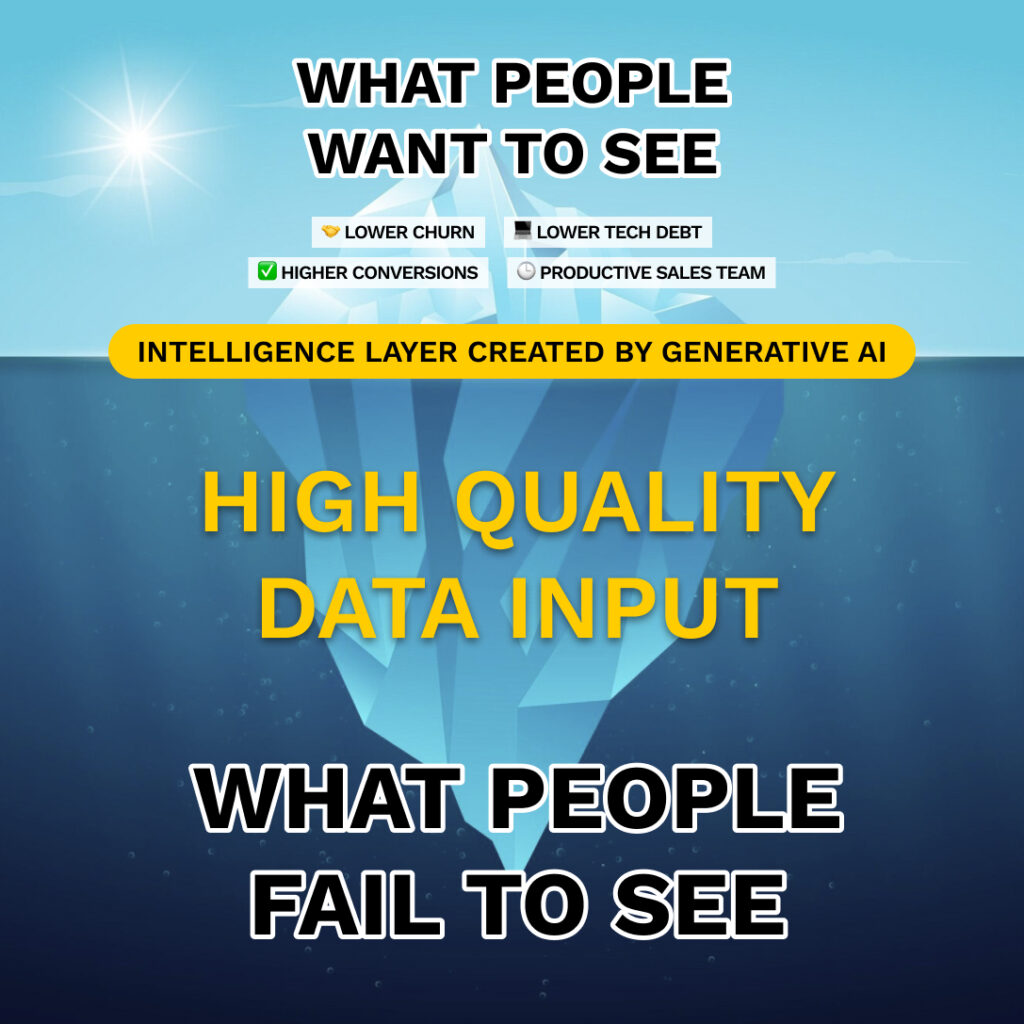
The intelligence layer will keep winning in this category. But its usefulness depends entirely on the data underneath it, because AI needs meaningful, accurate input to recommend anything that actually improves revenue outcomes. Building a real intelligence layer requires a solid data layer underneath it first. Without that, even the best model in the world can’t undo what bad data does to revenue.
Most businesses are still struggling with exactly this. Modern Sales Pros’ State of Your CRM Data report, produced with BuzzBoard, found only 6% of respondents highly confident in their own CRM data, 58% citing data accuracy as the top barrier to collecting quality data, and 37% saying poor-quality data directly leads to poor conversion rates.
The questions revenue leaders actually need to ask: What will my data source be when I deploy an AI agent against it? Do I trust the quality of that data? Is it clean and accurate enough to drive reliable insight for the business? For a company unsure of the answer, adding even the most advanced AI solution to the stack doesn’t improve revenue outcomes. It adds tech debt on top of an already shaky foundation, and prevents the intelligence layer from delivering anything close to what it promises.
See How Mimecast generated $150M+ in pipeline and attributed $10M in revenue by fixing their GTM AI foundation
Bad Quality Data Leads to Poor Conversions
Incomplete and inaccurate contact data has a direct, measurable impact on conversion rates, and therefore on revenue. Without the right data and insight, demand generation and sales teams can’t reliably get the right leads into the funnel, nurture them down it, identify the most viable prospects to engage, or run genuinely personalized outreach.
This is exactly where the intelligence layer has to converge with real data to close an organization’s actual revenue gaps. Accurate, rich, complete account data is the foundation an AI-driven sales organization is built on, and companies that skip investing in that foundation won’t hold up against the pace of change in today’s sales environment.
Characteristics of Good Quality Data
Data quality rests on a specific set of characteristics. Good data is:
- Accurate, reflecting what’s actually true, not what was assumed or guessed.
- Automated, captured without depending on a rep remembering to log it.
- Complete, covering the full picture of an account, not just the fragments a rep happened to enter.
- Timely, current enough to reflect what’s actually happening right now, not what was true weeks ago.
Together, these characteristics are the basis for good decision-making. A quality dataset is what supports AI that actually works, since any model is only as good as what you put into it.
Checklist to Assess Your Data Quality
If you think your data quality is already good, it’s worth checking again with this specific set of questions, organized by funnel stage.
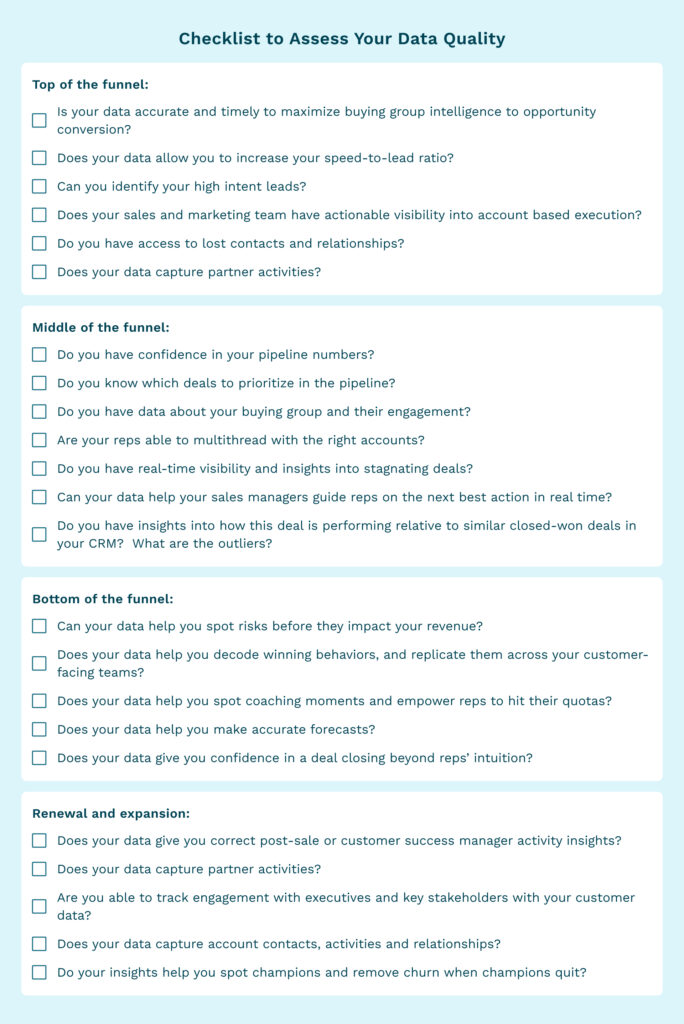
If the answer is no to any of these, it’s worth checking the actual state of your data hygiene directly rather than assuming it’s fine.
With the right data strategy, these gaps are fixable.
Dive deeper with our AI readiness checklist to see where you stand when it comes to your data foundation.
Why This Matters More Now Than It Did a Few Years Ago
The core argument here hasn’t changed. What’s changed is what’s riding on it. Salesforce’s April 2026 Headless 360 initiative made every core Salesforce capability available as an API or MCP tool specifically so AI agents can read, write, and execute workflows without a person opening a browser first. That’s a real shift in what bad data actually costs. A gap in the checklist above used to just produce a slightly-off report a manager could catch. Fed into an agent acting on that same gap directly, updating a field, prioritizing an account, flagging risk, the same gap becomes a wrong automated decision, at a speed nobody catches in time.
Data quality isn’t just about having a lot of data to feed the system. It’s about trustworthy, complete data underneath it, because that’s the only thing that actually determines whether an intelligence layer delivers what it promises or just adds sophisticated-looking noise on top of a shaky foundation.
Frequently Asked Questions
Q. What is an AI or intelligence layer in a sales tech stack?
It’s the layer that turns raw, continuously streaming account and opportunity data into predictive, actionable insight, surfaced at the moment a rep or manager actually needs it, rather than a static report reviewed after the fact.
Q. Why does data quality matter more for AI specifically than for a human reading a report?
Because AI amplifies whatever data it’s given rather than correcting for gaps in it. A human reading an incomplete report can sense-check it or ask a follow-up question; an AI agent acting on the same incomplete data typically doesn’t, especially once that agent is executing actions directly rather than just displaying information.
Q. What are the core characteristics of good CRM data?
Accurate, automated, complete, and timely. Data that’s accurate but manually entered, or complete but stale, still produces unreliable AI output, all four characteristics need to hold together.
Build the Data Foundation Before You Build the Intelligence Layer
An intelligence layer is only as good as what’s underneath it. Nektar’s Data Foundation automatically captures the email, meeting, call, and calendar activity most CRMs are missing, with zero rep effort required, so the intelligence layer built on top of it, Daisy AI or otherwise, actually has something real to work from.
Get a free CRM scan to see how your own data stacks up against the funnel-stage checklist above.
Enjoyed our content? Follow Nektar on LinkedIn