


5 Ways to Improve Your Sales Pipeline Visibility
- Sales
- 12 min
- Updated: July 30, 2026
Driving sales pipeline in an organization is like driving a vehicle. You have a goal, a rough map of how to reach your destination, and you want to avoid roadblocks and reach the end point quickly.
Navigating a sales pipeline without proper visibility is like driving a car through the night without headlights. You might have a general idea of where you’re going, but you can’t see the obstacles or opportunities directly ahead.
The scale of the resulting forecasting problem is well documented. 93% of sales leaders can’t forecast revenue within 5%, even with two weeks left in the quarter.
More recent research adds sharper detail: 7% of sales organizations achieve forecast accuracy of 90% or higher. A separate analysis of 270,912 closed-won opportunities by XANT Labs, representing $18.1B in revenue, found only 28.1% closed within 5% of their 90-day forecasted amount, with the average 90-day prediction missing by more than 31%.
A lack of visibility can result in overestimating financial performance, leading to missed targets, misaligned resources, and poor decision-making. Without clear visibility into the pipeline, sales teams can’t prioritize leads effectively, resulting in missed opportunities and lost revenue. Poor visibility also makes it harder to identify and fix inefficiencies in the sales process, leading to longer sales cycles and lower customer satisfaction.
Get our latest insights into your inbox

What Is Sales Pipeline Visibility?
Sales pipeline visibility means seeing and understanding the various stages of a company’s sales process, from lead generation to closing deals, with that information available to every revenue team, sales, marketing, finance, product management, and customer success, not just sales alone.
Visibility into the pipeline lets sales managers and reps track the progress of opportunities, identify bottlenecks, and make informed decisions about resource allocation and strategy. A typical sales pipeline runs through several stages:
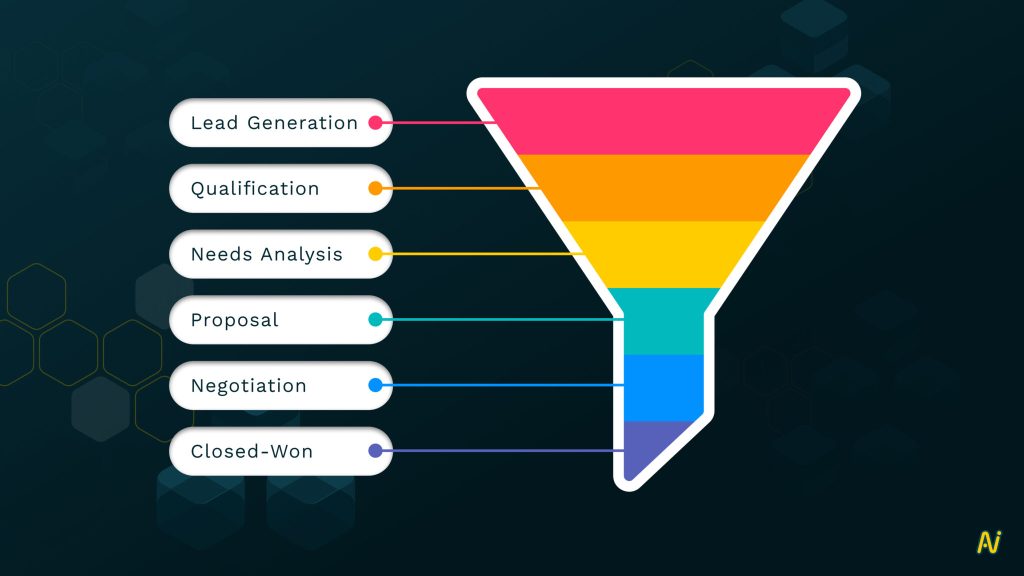
1. Lead generation
The first stage: identifying potential customers through cold outreach, email campaigns, or social channels.
2. Qualification
Gathering information on budget, timeline, and decision-making process to confirm a lead is actually a good fit before investing further time.
3. Needs analysis
Working with the prospect to understand their specific needs and challenges, and how the product or service addresses them, shaping a pitch and proposal around their actual situation rather than a generic template.
4. Proposal
Presenting a specific solution, with pricing and details, built around what the needs analysis surfaced.
5. Negotiation
Addressing concerns or objections directly, adjusting the proposal or offering incentives as needed to move the deal forward.
6. Closed-won
The prospect agrees to buy, converting from potential customer to paying client.
Good pipeline visibility means tracking and analyzing every opportunity at every one of these stages, which is what makes accurate forecasting, planning, and process improvement possible in the first place.
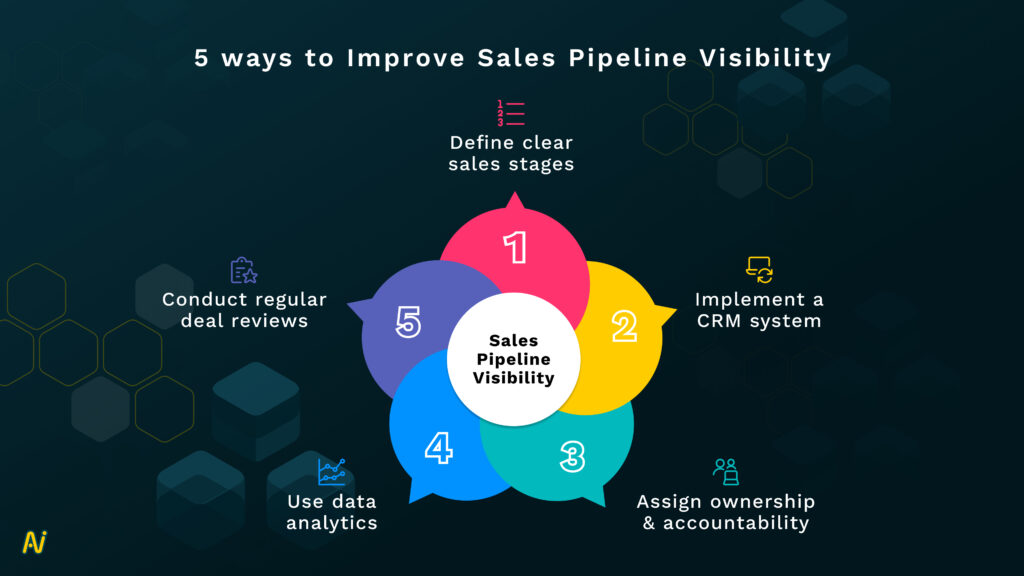
5 Ways to Improve Sales Pipeline Visibility
1. Define clear sales stages
Clearly defining each stage, with specific criteria for when a deal moves to the next one, is the foundation everything else builds on. With clear stages, teams can accurately track where each deal actually sits and prioritize effort on the ones most likely to close. Analyzing conversion rates between stages produces meaningfully more accurate forecasts than a single end-to-end win rate, and clear stages promote accountability by making it obvious who’s responsible for moving a specific deal forward.
2. Implement a CRM system
A CRM is essential infrastructure for pipeline visibility. Dedicated platforms like HubSpot centralize customer and prospect data so sales teams can track and manage every deal from a single system, rather than piecing it together across spreadsheets and inboxes. Reps can view a deal’s status alongside its tasks, notes, and documents in one place. Implementing a real CRM system can increase sales productivity, improve customer relationships, and make the whole pipeline more efficient to manage.
3. Assign ownership and accountability
Assigning a clear owner to every deal ensures someone is actually responsible for moving it forward, rather than it drifting between reps or falling through the cracks entirely. Accountability goes a level deeper: specific team members responsible for specific tasks within the process, one person scheduling meetings, another preparing proposals, so nothing depends on someone remembering to volunteer for it. Together, ownership and accountability streamline the sales process and improve visibility, supporting better deal tracking, more accurate forecasting, and more effective decisions.
4. Use data analytics
Analyzing conversion rates, win/loss ratios, and sales cycle times surfaces exactly where the process is actually breaking down, turning a vague sense that “deals are taking too long” into a specific, addressable bottleneck. Tracking KPIs like deal size and cycle length over time reveals patterns a single quarter’s snapshot can’t show.
Data analytics also sharpens forecasting directly: analyzing historical data and current trends produces a materially more accurate prediction of what will actually close than gut feel, supporting better resource allocation and decision-making. And it supports segmentation and targeting, identifying which prospect types convert best and which strategies actually work for them, so effort gets allocated where it has the best odds of paying off.
5. Conduct regular deal reviews
Reviewing the pipeline on a real cadence surfaces deals that are quietly stuck, letting a manager step in and unblock them before they go cold entirely. Regular reviews also create a natural coaching moment: watching how a rep is actually handling their deals reveals exactly where they need support, far more specifically than a generic training session could. Over time, recurring reviews surface patterns in what’s working across the whole process, not just in one deal, letting a team adjust strategy based on real evidence instead of anecdote.
A visible pipeline adds real, measurable value to an organization’s revenue, but the actual key to sustained visibility is clean data underneath it. Organizations with clean data have a meaningfully easier time achieving real pipeline visibility than organizations layering visibility tools on top of messy CRM records. Here’s a closer look at why.
The Role of Clean Data in Sales Pipeline Visibility
Clean data directly determines how accurate and transparent the sales process actually is. A few specific ways it shows up:
Accurate buyer information. Complete, current, deduplicated buyer data means reps actually understand their customers and can personalize their approach, without the risk of contacting the same buyer twice under two different records and creating exactly the kind of friction that damages trust.
Targeted outreach. Segmenting by industry, job title, location, buying history, and behavior lets teams build outreach that actually speaks to a specific group, rather than one generic message sent everywhere.
Accurate forecasting. Clean data enables reliable historical analysis, letting teams spot real trends and patterns rather than noise, which supports better resource planning and performance tracking against actual, achievable targets.
Multithreading. Clean, complete contact data lets reps engage multiple stakeholders on the same account simultaneously and keep track of where each relationship actually stands, rather than defaulting to a single point of contact because that’s the only one clearly logged.
Better reporting. Reports built on accurate, current, consistent data actually reflect reality, which supports faster, better decisions and stronger cross-departmental collaboration around one shared source of truth.
Improved deal tracking. Clean data makes it possible to actually track individual deal progress, spot bottlenecks, and make informed calls about how to move a specific deal forward.
Enhanced pipeline management. Reliable data about prospects, leads, and opportunities keeps the whole pipeline genuinely healthy, letting a team focus effort on the opportunities actually worth pursuing.
Efficient resource allocation. Clean data directs effort toward the most promising opportunities, maximizing return on the team’s time and surfacing roadblocks early enough to actually do something about them.
Why Pipeline Visibility Matters Even More With AI in the Mix
Everything above has always mattered. What’s new is what pipeline data increasingly feeds. A growing share of CRM data, including exactly the stage, ownership, and activity fields pipeline visibility depends on, is now read and acted on directly by AI agents rather than displayed for a person to review first. A deal sitting in the wrong stage, or missing recent activity, used to just make a forecast slightly optimistic. Fed into an agent acting on that same data directly, prioritizing outreach, flagging risk, updating a forecast category, the same gap becomes an automated decision made on bad information, with nobody reviewing it before it’s acted on.
Frequently Asked Questions
Q. What’s the biggest driver of poor sales pipeline visibility?
Incomplete or inconsistent CRM data. Even well-defined sales stages and disciplined deal reviews can’t produce real visibility if the underlying activity and stage data isn’t accurate, since every downstream process (forecasting, reporting, resource allocation) inherits whatever gaps exist in the data feeding it.
Q. How accurate is the average sales forecast?
Not very. Gartner has found only about 7% of sales organizations achieve forecast accuracy of 90% or higher, and separate analysis of hundreds of thousands of closed-won deals found fewer than a third closed within 5% of their 90-day forecasted amount.
Q. Does a CRM alone solve pipeline visibility?
Not on its own. A CRM is necessary infrastructure, but visibility depends on the data inside it actually being complete and current. A CRM populated with manually-entered, partial activity data produces the same blind spots a spreadsheet would, just in a more organized-looking format.
Q. Why does pipeline visibility matter more now than a few years ago?
Because a growing share of CRM data now feeds AI agents acting on it directly, rather than a person reviewing a report first. Gaps that used to just produce an optimistic forecast can now produce a wrong automated decision, with less human review standing between the data and the action.
Improve Your Sales Pipeline Visibility With Nektar
Organizations use automation tools like Nektar to build real pipeline visibility rather than layering another dashboard on top of the same incomplete data. Nektar’s Data Foundation automatically captures revenue activity data from email, meetings, and calls throughout the buyer lifecycle, filling the gaps traditional CRM entry leaves behind, with zero rep effort required. Daisy AI turns that captured data into the specific signals pipeline visibility actually depends on.
With Nektar, you can:
- Effortlessly track untouched or inactive opportunities, so sellers prioritize strategic, high-value deals with timely follow-ups
- Track poorly multithreaded opportunities and make sure sellers are consistently engaging the whole buying committee, not just one contact
- Spot real deals sooner by monitoring how frequently buyers are actually engaging back
- Instantly spot deals with poor momentum when they’ve stalled in the same stage
- Improve forecast accuracy by identifying which opportunities are likely to slip before they actually do
Get unmatched visibility into your existing deals with Nektar.
Enjoyed our content? Follow Nektar on LinkedIn