
8 Steps to Maintain CRM Data Hygiene
- CRM
- 10 min
- Updated: August 17, 2026
A CRM is one of the steepest investments in your tech stack, and even the most expensive or functionally superior one won’t work if the data inside it isn’t clean. A CRM needs good-quality data to actually do its job, and that’s a question of quality, not volume.
Dirty CRM data shows up in plenty of forms: incorrectly entered data, duplicate records, data that never made it in at all, or data that’s simply no longer relevant. Every one of these turns a CRM into a cost center that depletes value over time rather than creating it.
Making CRM data hygiene a real priority is necessary to hit revenue goals, and manual cleanup sessions aren’t the answer. You need a genuine strategy for dealing with bad data, and the right technology to support it. This guide covers what CRM data hygiene actually means, why it matters, what ignoring it costs, and eight steps to a real strategy, drawn from RevOps practitioners who’ve made data hygiene their focus.
Get our latest insights into your inbox

What Is CRM Data Hygiene?
Multiple sources push data into a CRM every day, and your GTM team uses that data to draw insight and make real decisions. CRM data hygiene is the ongoing process of making sure the data entering and staying in your CRM is clean, complete, and accurate, at all times, not just after a cleanup project.
If the data is full of errors, every action sales, marketing, or customer success takes on top of it falls flat, or worse, leads directly to revenue leakage. A properly built CRM data hygiene strategy keeps data clean and enriched continuously, which means the workflows your GTM team runs on top of it deliver real returns consistently, not just right after a cleanup.
The Impact of Poor CRM Data on Your Revenue
Missing data is a large piece of the problem, but far from the whole picture. Your CRM is likely infested with several distinct data quality issues:
1. Stale Data
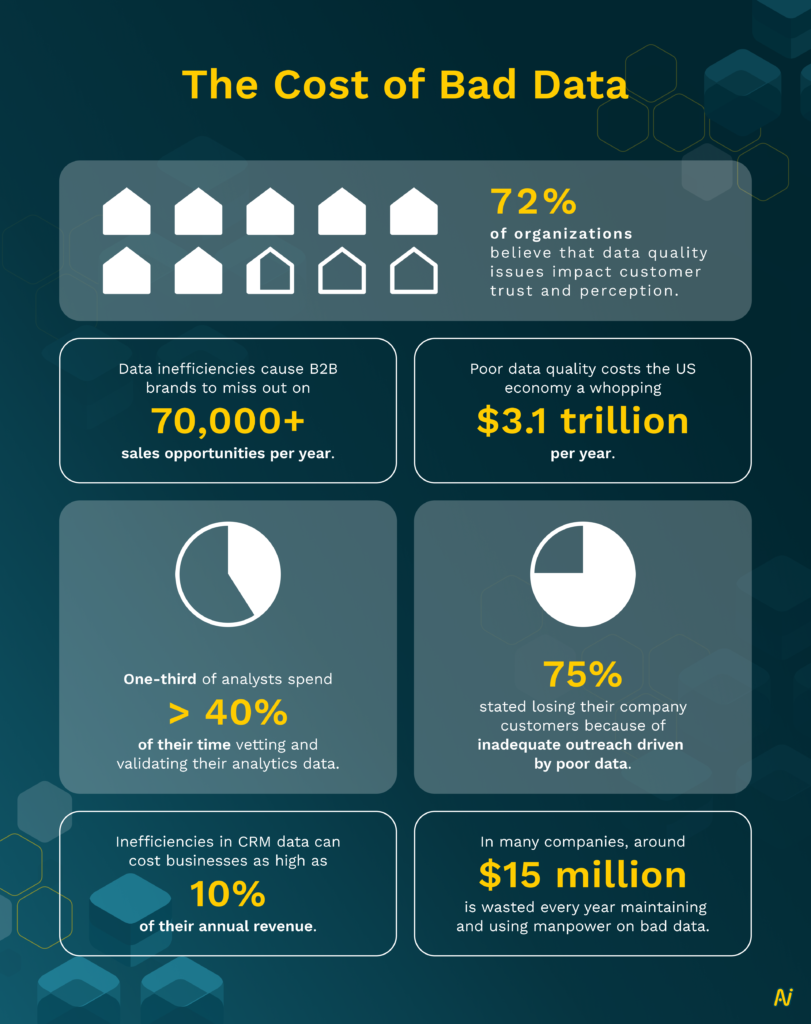
CRM data decays fast. Current research puts typical annual decay at around 22.5%, with some industries and record types running as high as 70%, tech and healthcare contacts tend to decay faster than finance, for instance.
2. Incorrect Data
Human data entry is inherently error-prone. Most organizations still depend on reps to manually update CRM data, and reps end up entering incorrect information as a simple matter of course, not because anyone’s being careless.
3. Irrelevant Data
Customer data keeps changing. People leave roles, companies grow past a segment, mergers and acquisitions happen, or a buyer moves to a competitor, and none of these changes automatically make their way into the CRM.
These inefficiencies compound into real financial cost. Gartner’s widely cited estimate puts the average cost of poor data quality at $12.9 million per organization annually, and IBM research, cited by Harvard Business Review, puts the total cost of bad data to US businesses at approximately $3.1 trillion a year.


Asia Corbett
Senior RevOps Manager, Bread Financial
Another big challenge for Revenue Operations teams is missing data. It's the manual versus automated piece. What information is our revenue teams having to manually enter into the system. And if they don't do that, or do it incorrectly, that affects the data integrity of your operations.
How Poor CRM Data Hygiene Makes You Bleed Revenue
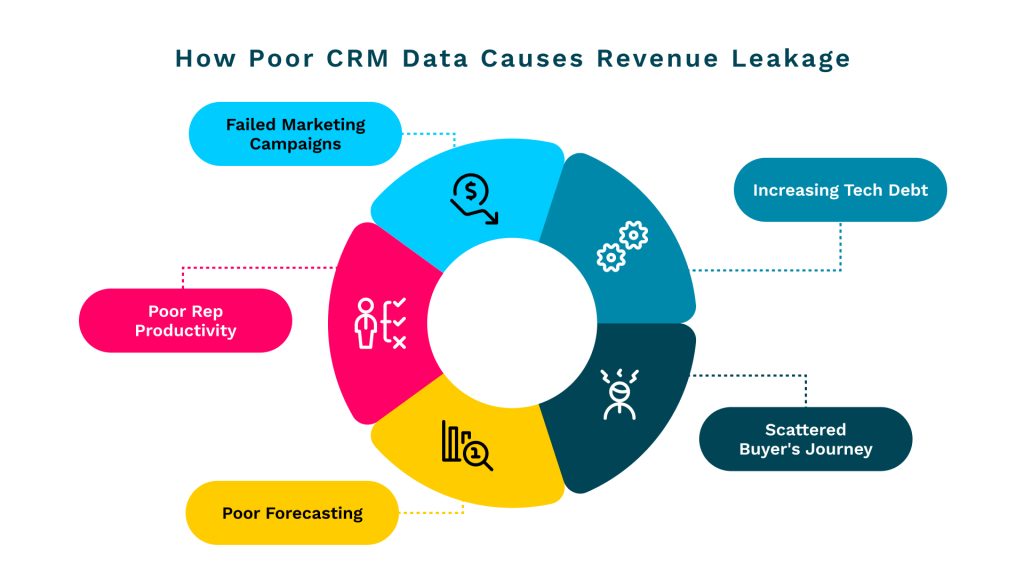
1. Increasing Tech Debt
Every tool in your stack performs only as well as the CRM data feeding it. Poor-quality data means those tools fail to deliver the value or ROI they were bought for, and over time, the stack bloats with tools quietly not earning their keep.
2. Scattered Buyer's Journey
Poor-quality CRM data creates a false picture of where a buyer actually is. A rep selling based on the CRM’s stage while the buyer is genuinely somewhere else entirely means both sides fall out of sync, and that mismatch is exactly where opportunities get missed.
3. Poor Forecasting
Insight built on bad CRM data fails to predict revenue accurately quarter after quarter. That failure has a direct, compounding effect on resource allocation, and eventually on revenue itself.
Asia Corbett
Senior RevOps Manager, Bread Financial
If you don't have good data, you can't forecast. If you can't forecast, you can't build a scalable and repeatable sales motion. You don't know what your pipeline is going to be. Or what money is going to come in.
4. Poor Rep Productivity
Reps spend real time on manual CRM entry, or hunting for data the moment a report is due. Bad data also distorts prospecting directly, since reps may be reaching out to the wrong people from the start based on what the CRM tells them.

Rosalyn Santa Elena
Founder, The RevOps Collective
The manual entry aspect has a huge impact on rep productivity. it's not just the time that it takes for them to manually put the data, but the employee satisfaction and motivation factor gets affected too. With data not being in systems like CRM, reps have to spend a lot of time looking for that data.
5. Failed Marketing Campaigns
Bad CRM data produces a string of campaign failures that can genuinely damage brand reputation. An ABM campaign built on a list of stale contacts, for instance, spends real budget on an idea that was never going to convert.
Asia Corbett
Senior RevOps Manager, Bread Financial
You can't run any marketing campaigns if you don't have any contact information in your CRM. And it could be mixed with other data. And if there's not some governance around it, your marketing manager just goes like - Oh! I'm just going to pull this list and I'm going to put them in a campaign or sequence. What about all the people that failed because they don't have email addresses? There's some downstream impacts there. If you don't have good data, you can't run marketing campaigns. That affects your funnel.
Why Is Bad CRM Data So Common?
Given how many clear advantages good CRM data offers, why do organizations still struggle to prioritize it? Have they accepted it as unfixable, or are they simply unaware of the scale of the problem?
Nobody expects their CRM to have a great data. Everyone takes it as a given. But everybody knows it needs to be better. And everyone is trying to get a strange where it's more useful.
Rosalyn Santa Elena
Founder, The RevOps Collective
It’s genuinely both. Most organizations recognize their CRM data quality is a problem worth fixing, but fail to build the reliable processes and systems that would actually deliver ROI on that recognition. A few specific reasons this keeps happening:
1. Lack of Leadership Buy-In
A large majority of leadership teams don’t treat CRM data quality as a high-priority initiative, either because they’re unaware of the real revenue impact of data leakage, or because they simply can’t find the time to address it.
Asia Corbett
Senior RevOps Manager, Bread Financial
On a leadership site, it's really about the culture of supporting revenue operations in this endeavor. What leadership can do is create a space and time for revenue operation teams to focus on the data governance effort.
2. No Solid Data Governance Strategy
Data quality depends on real governance, the framework that aligns people, process, and technology around keeping data accurate, complete, and current in real time. Most organizations don’t have this in place, and Gartner has separately found that only around 3% of data across the organizations it studies meets basic quality standards.

Melissa McCready
Founder & CEO, Navigate Consulting Group
First of all, I think having control of the data is really the biggest data challenge. From knowing where the data originated to who can modify it, what process drives the data collection, the data quality itself and data governance.
3. No Audit Process at a Regular Cadence
CRM data is constantly changing: people leave, contact information updates, companies get acquired, new tools replace old ones. Most organizations don’t evolve their processes and infrastructure to keep pace with that dynamism, leaving CRM data to stagnate rather than stay current.
4. Over-Reliance on Manual Processes
Manual processes are inherently error-prone. Depending on reps to manually enter CRM data reliably produces missing or incorrect records, and treating manual cleanup as a one-time event doesn’t fix the underlying problem either. The result: teams end up spending far more time hunting for data than actually analyzing it.
Expert Advice: How to Pave the Way Toward CRM Data Hygiene
As a revenue operations leader, here’s where to start.
1. Stop Hoarding Data
Most organizations care about having a lot of data, which leads them to care about too many things at once, not all of them useful. Focus instead on a handful of data points that genuinely matter, be precise and consistent about maintaining them, and make sure each one has a clear, objective source of truth.

Jacki Leahy
Founder, Activate the Magic
A lot of operations get really screamy when I am like let's download an archive this whole chunk of irrelevant, outdated data. And they are like... but, but, but... and really being just super clear about what accounts do we actually care about. Let's get really rigorous about our account scoring. And if it is outside our purview, archive that do not care about that. If it falls below that line, get it out. It's an "Of course!" when you want to pay for that enrichment.
2. Look for Data Rule-Breakers
Build the practice of actively looking for anomalies in your CRM data hygiene checks. When you find one, investigate why it happened and how to prevent a recurrence, fix the immediate issue, and set up continuous monitoring so the same anomaly doesn’t quietly reappear.

Vinny Poliseno
Co-founder and VP, RevOps Strategy and Architecture at ScaleMatters
Look for data roll breakers. There's actual data coming in. We are expecting this flow or Apex trigger or class to fire a particular way. But it's not. How do we find that out? Why did it happen? Was it an end user who did something weird? Was it a new web form that got created that didn't have hidden fields? Is it a process that, just from an automation standpoint, is not firing the way we expected it to? Figure out what the potential route causes, fix that data, put a fix in place and continuously monitor it. When you have got so many humans interacting with records, you have to keep a pulse check on what's going on.
3. Make Compelling Use Cases for Leadership
If leadership doesn’t currently prioritize data quality, building a real use case is how you change that. Pick a relevant example, show the concrete benefit, and present it clearly, even a simple report or dashboard works. If certain deals are consistently getting stuck, work backward from that specific number to show leadership exactly where the fix needs to happen.
Revenue operations folks always ask how do they get a seat at the strategy table? It's like, well, when you get to the table, bring a story, add value. If you're going to sit at the table just to listen, then you're not going to get invited to the table. Come to the table, come to the discussion, have an opinion, have a perspective. And most importantly have recommendations. I always come to the table with hey this is what I'm saying, this is what we should be doing and here are the pros and cons of doing that and then be able to offer solutions. And then your real value is totally for bringing those thoughts to the table but also now you're the best person also to go execute upon that and keep everybody aligned and marching to that decision. Be more consultative and don't just go to that table and occupy that seat, reading a report, go with insights.
Rosalyn Santa Elena
Founder, The RevOps Collective
4. Have a Solid Strategy Around Your CRM
Like every other tool in the stack, a CRM needs a real strategy to actually deliver ROI. Go back to basics: what do you actually want from it? A solid roadmap up front prevents most of the problems that come from a blind investment. Ask directly what the use cases are, how you’ll measure ROI, and what the plan looks like for configuration, rollout, process updates, implementation, policy, and enablement.
Have a roadmap for your CRM along where you want to go with it. Have processes that you can continue to iterate. Have policies around the working of the CRM and how you're going to drive adoption. Train the team and communicate with teams and enable them to follow the processes.
Rosalyn Santa Elena
Founder, The RevOps Collective
5. Have a Data Governance Strategy
Making data a genuine strategic asset requires an overarching governance strategy around it, ensuring integrity as data flows in, through, and out of the system. Don’t let your CRM become a textbook case of garbage in, garbage out; build a governance strategy that keeps data clean, accurate, usable, and secure.
When you're trying to keep your data clean, there has to be some good data governance. You want to be careful about what you allowed to be manually input in certain things because if that's flowing into your center of truth, it could really have an impact. I think that's really important because when you have so many sources pushing in, it can be conflicting or it can fail or something else. The goal is to have the most up-to-date, correct, actionable data, so if you go to pull something, you can make choices based on that. And not have to worry about the data. So one of your biggest challenges is all those different tools and all those different outside sources pushing in and how do you control that and make sure that what is coming in is the most reliable.

Trent Allen
RevOps Manager at Maxio
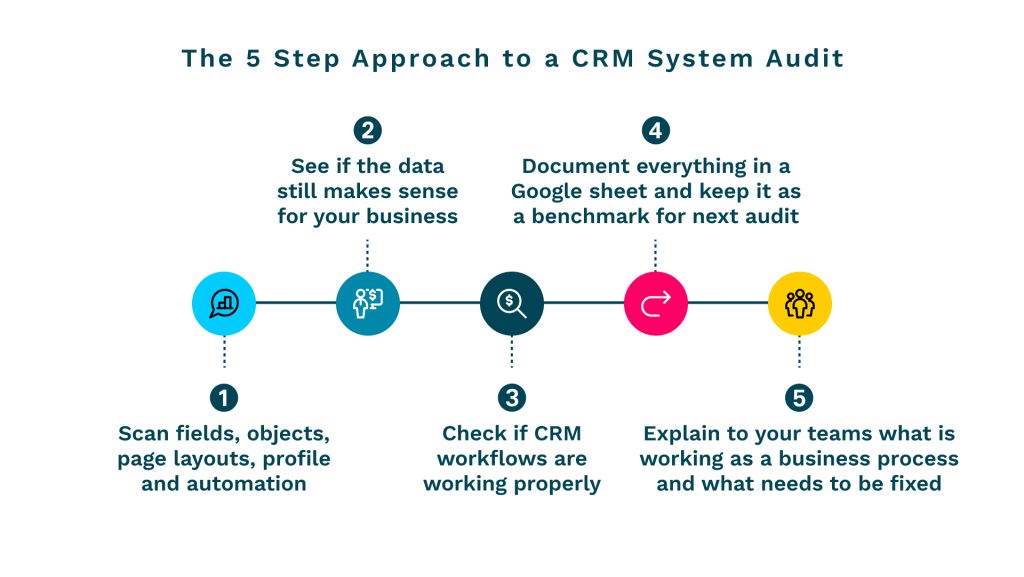
6. Carry Out a CRM Audit
A CRM should go through regular audits like any other tool the RevOps team owns: checking fields, completing data lists, verifying integrations. If the CRM is your single source of truth, you also need to audit every tool feeding data into it.
7. Automate Manual Processes
Automating how data flows into the CRM, gets captured, and gets enriched is critical to scaling the business. Automate the manual processes standing between reps and actually selling, CRM data entry being the classic example, and invest in enrichment tools to keep constantly-changing data current.
8. Get a Reliable Tech Partner
A tech partner that automates CRM data entry, captures missing contacts, and enriches them, without asking your GTM teams to lift a finger, is what makes the rest of this list actually sustainable. Tools that work silently in the background, invisible to the people using the CRM day to day, solve the adoption problem by design: there’s nothing for anyone to remember to do.
With clean, accurate, complete CRM data in place, a business can realize real strategic benefits: improved forecasting, better GTM alignment, increased sales productivity, more successful ABM campaigns, and higher ROI from the rest of the tech stack.
Why This Matters Even More With AI Agents in the Mix
Everything above has always mattered for revenue. It matters more now because of what this same data increasingly feeds. A growing share of CRM data now gets read and acted on directly by AI agents, prioritizing an account, flagging risk, updating a forecast, rather than a person reviewing it first. A stale or incorrect record that used to just mislead a manager can now produce a wrong automated decision, at a speed nobody catches in time. The eight steps above were always worth doing for revenue’s sake; they’re increasingly a precondition for using AI safely on top of your CRM at all.
Frequently Asked Questions
Q. What’s the difference between a CRM data cleanup and CRM data hygiene?
A cleanup is a one-time event, scrubbing existing bad data out of the system. Hygiene is the ongoing discipline of keeping new data clean as it enters, which is what actually prevents the same problems from reaccumulating a few months after a cleanup finishes.
Q. How much does poor CRM data actually cost a business?
Gartner’s widely cited estimate is $12.9 million per organization annually, and IBM research cited by Harvard Business Review puts the total cost to US businesses at roughly $3.1 trillion a year. The exact number for your organization depends on size and how directly the leakage traces back to specific lost deals.
Q. Why is CRM data hygiene still a low priority for so many organizations?
Usually a mix of two things: leadership genuinely being unaware of the scale of the revenue impact, and organizations recognizing the problem but never building the governance and automation needed to actually fix it, rather than repeat one-off cleanups.
Q. Does automating CRM data capture actually solve the hygiene problem, or just delay it?
It solves the root cause. Manual entry is what introduces most of the errors and gaps driving poor hygiene in the first place; automating capture removes that dependency entirely rather than making the same manual process marginally faster.
Make CRM Data Hygiene a Priority Today
It’s never too late to start fixing CRM data quality, and the ripple effects touch every part of the business, higher revenue, more productivity, and a foundation solid enough to actually support AI on top of it.
Get a free CRM scan to see how Nektar’s Data Foundation can put your own CRM data hygiene on autopilot.
Enjoyed our content? Follow Nektar on LinkedIn