
6 AI for Customer Success Use Cases
- CSOps
- 12 min
- Updated: August 3, 2026
Efficiency has been the dominant theme in tech stack decisions for several years running: if a tool doesn’t clearly improve ROI, it gets cut. That pressure lands hardest on customer success, where the difference between a renewed account and a churned one increasingly comes down to one thing: a genuinely meaningful relationship with the customer.
The numbers back up why that relationship matters so much. Acquiring a new customer costs five to ten times more than retaining an existing one, and existing customers are consistently easier to sell to than new prospects, since they’ve already validated your product and built trust with your team. With that much upside on the table, AI has become the obvious lever for customer success teams to reach for, the question is where it actually earns its keep.
AI can meaningfully improve net retention rate (NRR) and the customer success processes underneath it. Yet adoption has historically lagged the opportunity: the Customer Success Collective’s State of Customer Success 2023 report found 66% of customer success professionals weren’t using AI in their role at all, a real gap at the time, and one worth checking against more current research given how much AI tooling has advanced since. This guide covers why AI matters for customer success specifically, and six concrete use cases to build around.
Get our latest insights into your inbox

How Has Customer Success Changed?
- Customer behavior keeps shifting. Preferences, pain points, and priorities evolve continuously, which means CS has to be agile and quick to adapt rather than running a fixed playbook indefinitely.
- Remote and hybrid CS is the norm. More customer success roles operate remotely than ever, and the tools and processes supporting them have to work as well outside an office as inside one.
- Digital-led operations are standard. Onboarding is increasingly automated, and generative AI in chatbots resolves customer questions using real account context rather than a generic script.
- The growth outlook has shifted from acquisition to resilience. Businesses have moved from “growth at all costs” toward driving more value from existing customers and existing tools, which raises retention’s importance relative to new-logo growth.
- Churn prediction has become a genuine discipline. Monitoring customer health to catch potential churn early, so a CSM can intervene before sentiment turns, is now a core CS function rather than a reactive afterthought.
Why You Need AI for Customer Success Now
Retention matters more than ever, and continuously proving value to customers, efficiently, is the harder half of that job. The challenge is scale: the sheer volume of customer behavioral data generated daily makes it genuinely difficult for a CSM to find the signal that actually matters, and even when the data is found, translating it into an unforgettable customer experience takes more than access, it takes the right tooling to act on it.
Left unaddressed, that gap shows up as customers who feel forgotten, unclear on how to get value from your product, and quietly disengaging. The upside of closing it is real: even a 5% increase in customer retention can increase revenue by 25-95%.
A few more reasons AI earns its place in a CS stack specifically:
- It automates workflows without replacing the human relationship, cutting reliance on manual data entry so CSMs spend more time actually building relationships.
- It surfaces more accurate, complete data from a pile most humans can’t realistically comb through manually, cleaner data means sharper insight.
- It flags sentiment shifts, positive to neutral to negative, and suggests next-best steps to course-correct before the relationship actually sours.
- It highlights new ways for customers to get value from your product, driving additional value continuously rather than only at renewal time.
- It shifts CS from reactive to proactive, since a health-score change is visible before a support ticket or a cancellation notice ever arrives.
6 Use Cases of AI for Customer Success
1. Track and Evaluate CSM Activities
Most CS leaders can tell you how many accounts a CSM owns. Far fewer can tell you, with any real precision, what that CSM actually did on those accounts last month, or whether it worked. Activity tracking in CS has historically meant a task log or a calendar count: how many calls, how many emails, how many meetings. That tells you volume. It doesn’t tell you whether the activity was any good.
The distinction matters because CSM effectiveness varies enormously even at the same activity volume. Two CSMs can each log fifteen customer touchpoints in a month, one spending that time in surface-level check-ins with a low-influence contact, the other running structured business reviews with the actual economic buyer. A dashboard counting fifteen touchpoints treats both CSMs identically. A CS leader trying to coach, staff, or forecast off that dashboard is working from a genuinely misleading picture.
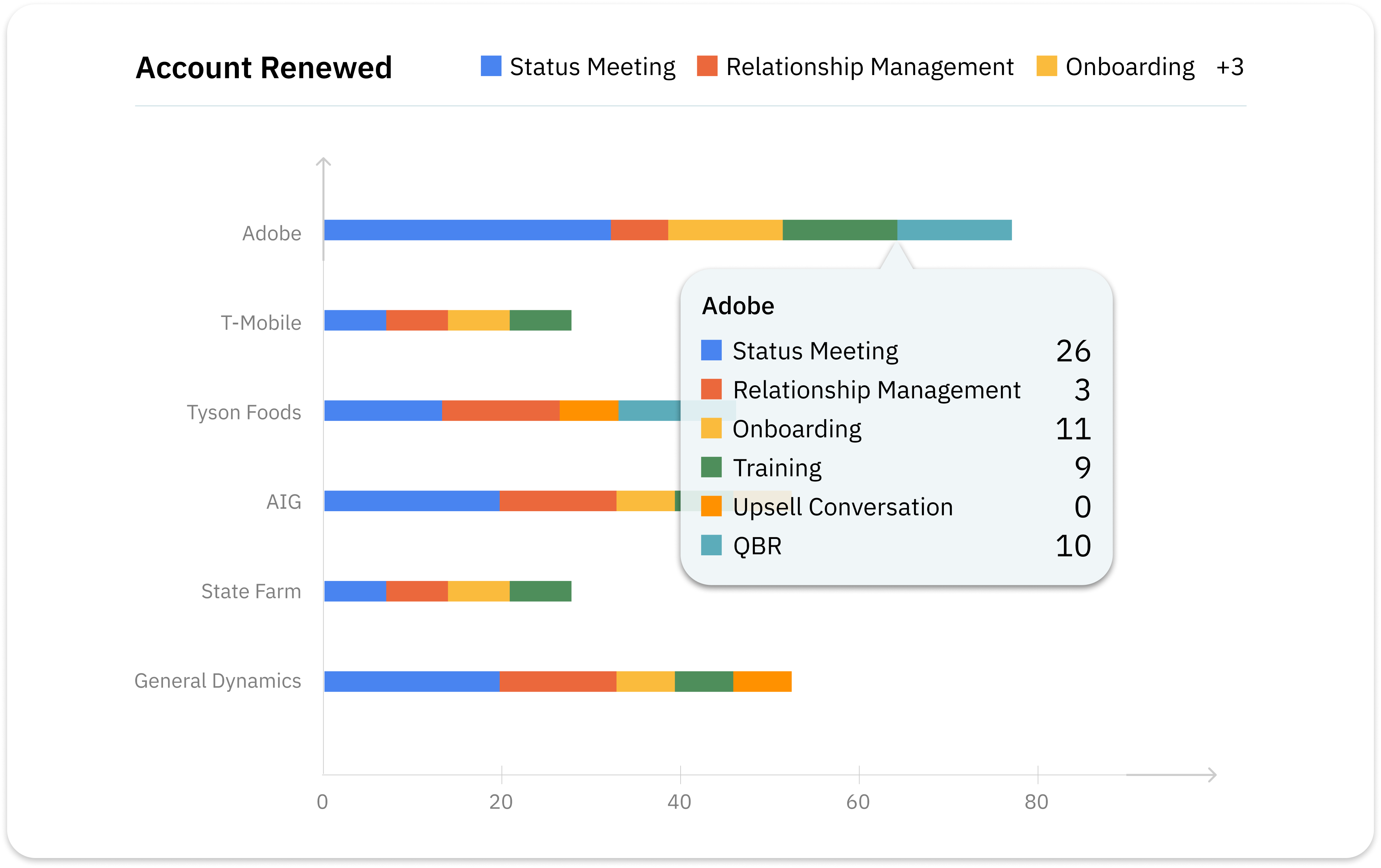
This is where Nektar’s CSOps capability is built to do more than log activity, it evaluates it. Every customer interaction is treated as a chance to understand its actual impact on revenue growth or churn mitigation, not just as a box checked on an activity report. Specifically, Nektar:
- Monitors whether activities are actually taking place, closing the gap between what a CSM reports doing and what the captured email, meeting, and call data actually shows happened, without requiring the CSM to self-report.
- Assesses effectiveness with detailed insight, not just a raw count. The same underlying data that shows an interaction happened also shows which persona was involved, when it happened relative to the renewal timeline, and what kind of meeting it actually was, a QBR, a support escalation, a casual check-in, each of which carries a different signal about deal or account health.
- Surfaces patterns a manager can actually coach against. Once activity is tied to persona, timing, and meeting type, a CS leader can see, account by account and CSM by CSM, whether engagement is concentrated in low-influence check-ins or genuinely reaching the stakeholders who matter, and use that as the basis for specific, targeted coaching rather than a generic reminder to “engage more.”
For a CS org managing a large book of accounts across several CSMs, this is the difference between a monthly activity report that confirms work happened and a genuine performance signal that tells leadership which specific behaviors are actually protecting revenue, so coaching, staffing, and account reassignment decisions are based on real engagement patterns instead of a raw activity count that treats a low-value touchpoint the same as a high-value one.
Where to start: Pick your two or three highest-risk renewals this quarter and compare CSM activity volume against activity quality on each: how many touchpoints happened, versus how many actually reached the stakeholders who influence the renewal decision. If the two numbers tell different stories, that gap is exactly what a raw activity count would have hidden from you.
2. Monitor Renewal Group Activity
Automated capture means CS activity, emails, meetings, calls, gets logged without a rep manually entering it, and gets attributed to its source in seconds rather than requiring a CSM to reconstruct the history by hand. That gives a team consistent engagement with every account and every relevant stakeholder over time, complete visibility into stakeholder interactions at the contact and activity level, and early alerts when an account has gone quiet, sometimes surfacing a coaching opportunity as well as a churn risk.
This is exactly the category platforms like Gainsight, Totango, and ChurnZero are built around, automatically tracking engagement recency and depth across a renewal group rather than relying on a CSM’s memory of the last touchpoint. Renewal conversations that start only when the renewal date is close are starting too late; consistent, tracked engagement throughout the relationship is what actually protects the renewal.
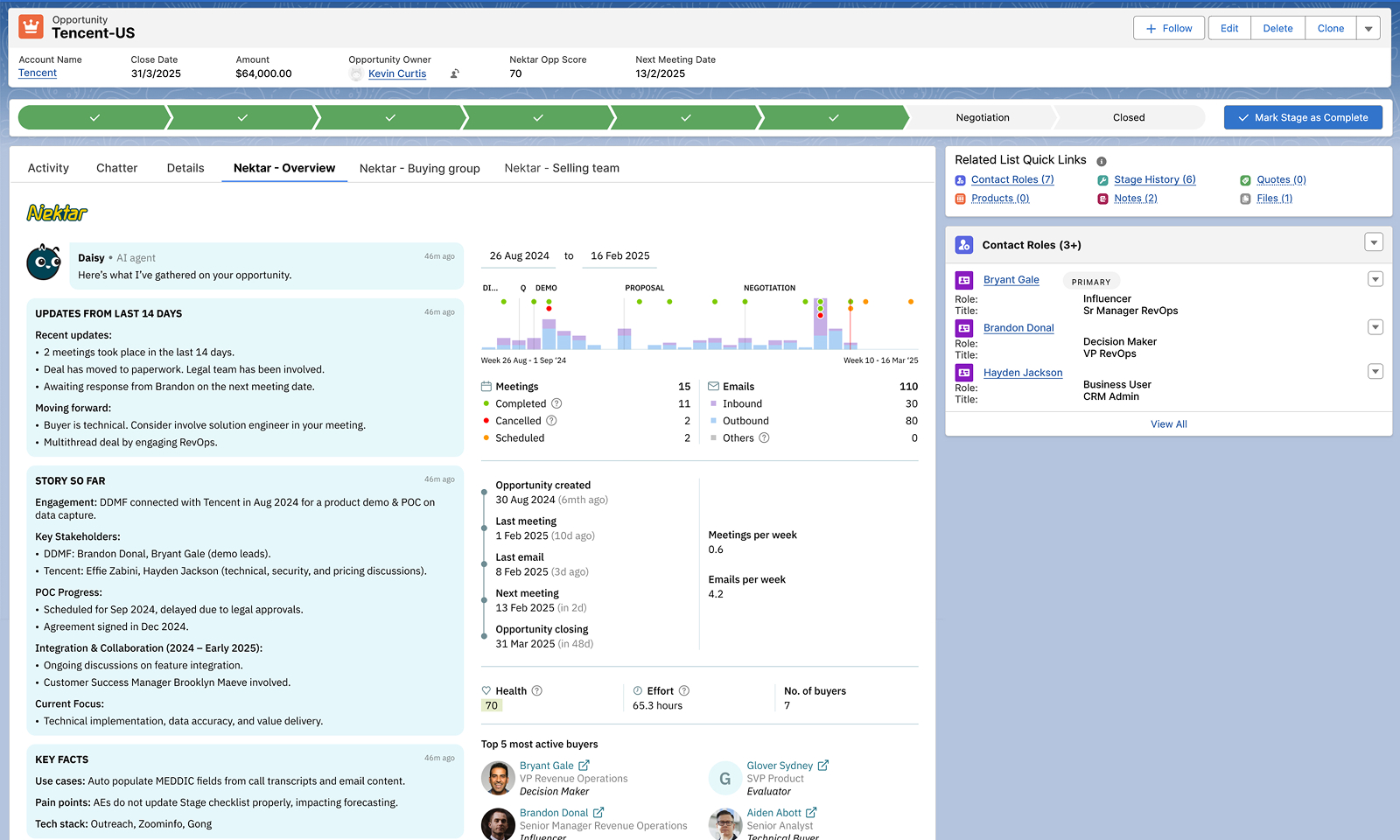
Nektar’s own CSOps product is built specifically around this problem: influencing the renewal outcome by monitoring engagement quality, not just engagement volume. A common, uncomfortable finding once a CS team actually gets this visibility is how often their own CSMs are single-threaded, sometimes two or three organizational levels away from the actual economic buyer, without anyone on the team realizing it. Nektar tracks which personas a CSM is actually engaging, when those interactions happen, and the nature of each meeting, and specifically flags whether decision-makers are showing up to QBRs and business reviews at all, letting a team adjust its playbook before a renewal conversation rather than discovering the gap during one.
Where to start: Pick one clear trigger first, no meaningful contact with a renewal-critical stakeholder in 30 days, for instance, and route it as an automated alert to the account’s CSM before building out a broader engagement-scoring model. A single reliable trigger a team actually acts on beats a sophisticated model nobody trusts yet.
3. Prioritize and Personalize
Integrating CS data with CRM-adjacent tools (conversation intelligence, sales enablement, support platforms, messaging tools, surveys) gives a complete view of the customer journey rather than a CS-only slice of it. With contact-level insight into interests, preferences, purchase behavior, and changes inside the buyer’s own organization, AI can generate real-time, account-specific recommendations rather than generic playbook steps.
Automated health scoring, with rules-based triggers and recommended playbooks, needs little to no rep input to maintain, and lets CSMs prioritize the right accounts at the right time based on actual engagement data rather than a gut read of who seems unhappy. Even so, the industry’s own current thinking is candid about a real risk here. Philipp Wolf, CEO of Custify, argued in a 2026 industry roundup that a health-scoring system unable to explain why a customer is at risk, and what specific action would change that, is little more than “expensive noise,” no matter how sophisticated the underlying model is.
Where to start: Before rolling out an automated health score, make sure it can answer two questions for any given account: why is this score what it is, and what specific action would change it. A score that can’t answer both isn’t a foundation to build coaching or interventions on yet.
4. Spot Single-Threaded Accounts
Modern buying (and renewal) decisions involve a group, not one person, and understanding each stakeholder’s role is core to effective customer success. AI can flag single-threaded accounts directly, cases where multiple stakeholders are actually engaging with your team but their contact details never made it into the CRM or CS platform, letting a CSM move from a single champion relationship to genuine multithreaded coverage of the account.
Automatic account mapping ties each newly discovered contact to the right account with role, email, and phone number, and the same visibility surfaces expansion opportunities early: a customer whose sales team just grew, for instance, may be a strong near-term fit for an add-on they haven’t asked about yet. None of this is a solo effort, multithreading an account well usually means coordinating with marketing and sales too, not just CS acting alone.
This is also where a long, unfiltered contact list actually becomes usable. Most Salesforce accounts accumulate contacts added by different GTM teams at different points in the customer journey, marketing, sales, onboarding, support, with no easy way to tell which of them are actually influential today. Nektar’s CSOps capability identifies and surfaces the most engaged, influential contacts out of that full list specifically for digital CS campaigns, so outreach targets the people actually driving the renewal decision rather than everyone who’s ever appeared on the account.
Where to start: Run a quick audit of your current renewal pipeline: how many opportunities have only one or two contacts attached? That number, more than any dashboard, tells you how exposed your renewal book actually is to a single departure, and it’s usually a larger share of the book than teams expect once they actually look.
5. Reduce customer churn
The global benchmark for acceptable churn sits around 5%, yet a meaningful share of organizations run well above that. Predictive analytics let AI flag churn risk early enough to actually intervene, sometimes pulling in executive leadership for a strategic save rather than leaving it to a single CSM. AI can also scan customer preferences, transaction history, sentiment, and broader market signals across channels to surface trends a person would likely miss, and specifically flag when a critical stakeholder, a champion, leaves the client’s organization, a moment that derails or stalls a large share of renewals if nobody notices in time.
Tracking where that champion goes next (another account in your portfolio, or a new target account entirely) turns a relationship risk into a potential new opportunity. The same visibility extends to executive engagement in QBRs specifically: knowing who attends, and who consistently doesn’t, shows you exactly where to invest in stronger relationships before a renewal conversation, not during one.
Nektar’s churn mitigation capability is built around this same principle: a champion leaving or a decision-maker quietly disengaging is a leading indicator, visible in activity and meeting-attendance data well before it shows up as a support ticket or a cancellation notice. Because that data is captured automatically from real email and meeting activity rather than a manually updated CRM field, the warning arrives early enough for a strategic intervention to actually work, not after the account has already mentally moved on.
Where to start: Don’t wait for a full predictive model before acting. A simple rule (no exec attendance at the last two QBRs, plus declining usage) is a legitimate intervention trigger on its own, and it gives a team practice acting on early signals before a more sophisticated model is layered on top.
6. Automate Support
AI can handle the genuinely repetitive parts of support directly, routine queries, ticket creation, simple requests, freeing CSMs for the conversations that actually need a human. Current resolution rates give a realistic sense of what to expect: Intercom’s own published case studies for its Fin AI agent report real-world resolution rates in the 42-50% range in typical deployments, climbing towards 60-70% in more mature implementations, not the near-total automation some vendor marketing implies.
Notably, Salesforce signed a definitive agreement in June 2026 to acquire Fin (Intercom’s AI agent, now its own corporate entity) for roughly $3.6 billion, a signal of how central AI-driven support resolution has become to the broader CS and CRM stack.
It’s also worth knowing this space has already produced a well-publicized cautionary tale: Klarna announced in 2024 that AI would replace roughly 700 support roles, then its CEO publicly acknowledged in 2025 that quality had suffered from over-indexing on cost, and the company rehired human support staff alongside its AI system rather than replacing humans outright. Klarna’s AI assistant still handles roughly two-thirds of inquiries today, the lesson wasn’t “AI support doesn’t work,” it was that a hybrid model, AI handling volume, humans handling complexity and relationship-sensitive conversations, outperforms full automation.
Where to start: Deploy AI support for a narrow, well-defined ticket category first (password resets, billing questions, documentation lookups) and measure real resolution rate against that category specifically before expanding scope. Treat any resolution-rate claim from a vendor as a ceiling, not a guarantee, until you’ve measured it against your own ticket mix.
Why This Matters More With AI Agents Acting on the Data Directly
Everything above depends on the same underlying requirement: activity and account data that’s actually complete. That’s always been true, but the stakes have changed. A growing share of CS data now feeds AI agents that act on it directly, flagging a churn risk, triggering an outreach sequence, updating a health score, rather than a person reviewing the signal first. A gap in that data used to just mean a CSM missed a warning sign. Fed into an agent acting on it directly, the same gap can mean a churn signal never gets raised at all, or gets raised against the wrong account, with no human in the loop to catch it before the renewal is already lost.
Deploy AI for Customer Success on a Foundation of Clean Data
The biggest barrier to using AI well in customer success isn’t the AI itself, it’s data quality. AI is only as useful as the data it’s reasoning over, and most CS teams are still relying heavily on manual data entry: only a minority of customer success processes today are meaningfully automated. Asking CSMs to manually log and analyze a growing pile of customer data is exactly the wrong use of their time.
Nektar’s Data Foundation automatically captures CSM activity across email, meetings, and calls, structuring it against the right account with zero rep effort. Daisy AI turns that captured data into the signals covered throughout this guide: single-threaded account detection, champion-movement alerts, and health scores grounded in real engagement rather than a static rule.
With Nektar, customer success teams get:
- Automated capture of CSM activity across email, meetings, and calls
- Single-threaded account detection for earlier churn warnings
- Real-time alerts on champion movement, so an account transition becomes an opportunity, not a surprise
- Contact-level activity visibility across every stakeholder in a renewal group
- Fast implementation with zero rep adoption required
Get a free CRM scan to see how complete your own customer success data actually is, or explore customer churn mitigation to see how Nektar surfaces retention risk before it becomes a lost renewal.
Frequently Asked Questions
Q. What’s the biggest barrier to using AI effectively in customer success?
Data quality, not the AI itself. Most CS teams still rely heavily on manual activity logging, which means the data feeding any AI tool is incomplete by default. Automating capture at the source is what actually unlocks reliable AI-driven insight.
Q. How does AI help with churn prediction specifically?
By continuously monitoring engagement signals (email and meeting frequency, sentiment, health scores, stakeholder activity) rather than relying on a CSM noticing a problem manually. This surfaces risk early enough to actually intervene, rather than after a cancellation notice arrives.
Q. What’s a single-threaded account, and why does AI help with it?
A single-threaded account is one where your team’s relationship depends on a single stakeholder or champion. If that person leaves, the relationship is exposed. AI can detect other stakeholders already engaging with your team, even if they were never manually added as a CRM contact, letting a CSM multithread the account before it becomes a risk.
Q. Does AI replace customer success managers?
No. AI automates the data capture, monitoring, and repetitive support tasks that eat into a CSM’s time, but it doesn’t replace the judgment and relationship-building a CSM brings to a strategic account conversation. The goal is freeing CSMs to spend more time on the relationships that actually need a human.
Enjoyed our content? Follow Nektar on LinkedIn