
7 Elements of a Successful Deal Review
- RevOps
- 13 min
- July 20, 2026
Knowing the ins and outs of your deals is what makes revenue predictable. A good deal review tells you what’s actually happening in your pipeline, where to pivot, and which risks to get ahead of before they cost you the quarter.
It’s also one of the most commonly botched rituals in sales. Most deal reviews are unplanned, ad-hoc sessions that interrogate a rep instead of helping them win. The result is the same as it’s always been: inaccurate forecasts, missed targets, and reps who dread the meeting instead of using it.
The first question to ask is what’s riding on getting deal reviews right. Before the advent of AI, the data a deal review runs on used to be interpreted by a human. Probably a manager reading a stage field, applying judgment, and catching the obvious gaps.
Cut to present times, that same data now feeds AI agents that update opportunity stages, flag deal risk, or trigger next steps directly inside Salesforce, with a lot less human judgment sitting between the data and the action. A deal review built on incomplete data used to produce a bad meeting. Today it can produce a bad decision made by software, at a speed no manager can catch in time.
This guide presents a seven-element framework for what a deal review actually needs to look like now.
Get our latest insights into your inbox

What Is a Deal Review?
A deal review is a meeting between a sales manager and a rep about the deals in that rep’s pipeline. It assesses the probability of closing, and agreeing on next-best actions for anything that’s stuck. Done well, it’s a coaching tool. Done badly, it’s an interrogation that produces a status update nobody trusts.
What's Actually Changed
The mechanics of a deal review haven’t changed. What has changed is the environment it runs in:
- Buying committees are bigger, and reps see less of them. Gartner puts the average B2B buying group at 6 to 10 stakeholders, most of whom your rep will never speak to directly, and none of whom show up in Salesforce unless someone manually adds them as a contact.
- AI agents are now acting on the data a deal review used to just discuss. Salesforce’s April 2026 Headless 360 release made every core Salesforce capability available as an API or MCP tool specifically so agents can read, write, and execute workflows without a human in the loop. When a stage field, a close date, or a forecast category is wrong, it’s no longer just misleading a manager in a Friday pipeline review. It’s potentially misleading an agent that acts on it before anyone notices.
- The data gap deal reviews have always fought is now measurable at scale. Most CRMs are missing a large share of what actually happens in a deal: meetings that never got logged, stakeholders who were never added, activity that lives in someone’s inbox instead of the opportunity record. That gap used to just make forecasts optimistic. Now it’s the input layer for automated decisions.
None of this changes what a good deal review is for. It changes what “good data going into the review” needs to mean.
Why You Still Need Deal Reviews
Selling has only gotten harder to do by “feel” alone. Longer cycles, bigger buying committees, and more channels for a deal to quietly go sideways all mean a manager’s instinct is a weaker substitute for actual pipeline data than it used to be. Here’s what a deal review still gives you that nothing else does:
1. Identify risks and opportunities early
A good deal review surfaces deal risk before it’s a lost deal. It answers questions like which stakeholders have gone quiet, which deals haven’t had a meeting in weeks, or which “commit” deals don’t actually have the engagement to back that up. Sales teams that catch this early can act on it; teams that find out at quarter-close can’t.
2. Align with cross-functional teams
Deal reviews often surface why a deal is stuck for reasons the rep alone can’t fix. Maybe it needs a solutions engineer in the next call, a piece of marketing collateral, or executive air cover. A good review turns that into an action item instead of a shrug.
3. Increase rep accountability
Every deal review should end with a clear next step for the rep, and a regular cadence to follow up on it. That consistency, not the interrogation, is what actually makes reps more accountable over time.
4. Gain executive support
Executive deal reviews are where a rep can borrow leverage they don’t have alone. An exec-to-exec relationship, a strategic sponsorship, a connection nobody on the account team knew existed are few examples. That only works if the review actually surfaces who’s in the room on the buyer’s side, which depends on the buying committee being visible in the first place.
5. Develop sales reps through targeted coaching
A deal review tells a manager exactly where a rep needs help, not in the abstract, but on this specific deal, this specific gap. A rep who hasn’t followed up in 30 days needs different coaching than one who’s engaged the wrong stakeholder. Specific coaching, from specific data, is what actually moves a rep’s win rate.
Why Most Deal Reviews Still Fail
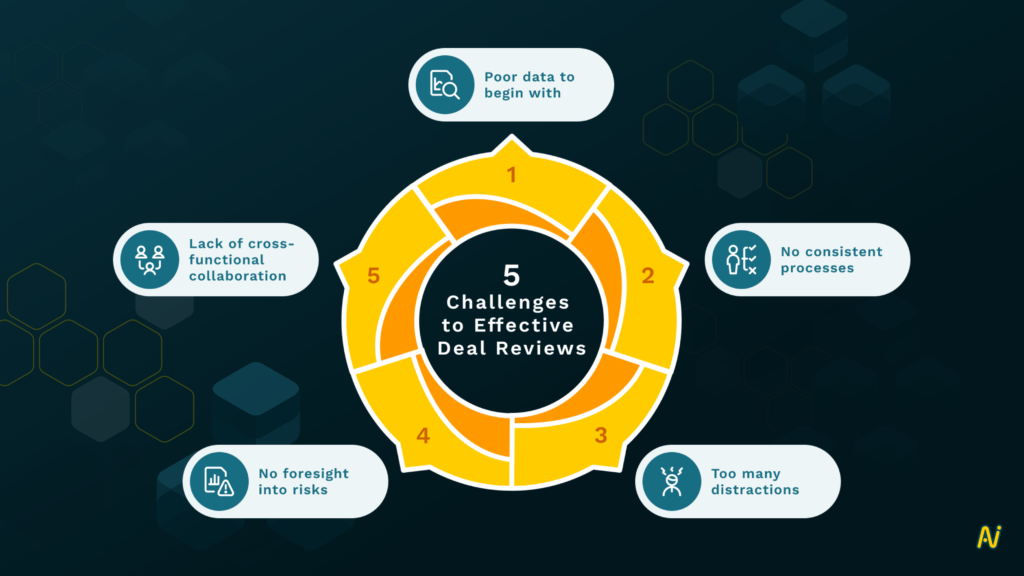
1. Poor data to begin with
This is still the root cause behind most failed deal reviews, and it matters more now than ever. Most organizations’ deal data lives in silos across sales, marketing, and customer success, and a large share of what actually happens in a deal never makes it into the CRM at all. That used to mean a deal review ran on an incomplete picture. Now, with AI agents reading and acting on that same CRM data, an incomplete picture doesn’t just produce a bad meeting. It produces bad automated decisions with nobody checking the work first.
2. No consistent process
Deal reviews that happen on an ad-hoc schedule, with no fixed agenda, don’t build the muscle memory that makes them useful. Cadence matters as much as content.
3. Too many distractions
Understanding one deal’s real health often means checking a conversation thread, an email, and a buying-committee map, usually across three or four disconnected tools. Every extra tab a manager has to open is a reason the review takes longer and covers less ground.
4. No foresight into risk
Deal reviews built on instinct and guesswork can’t tell you which deals are actually going to close. Without visibility into engagement and buying-committee coverage, “committed for this quarter” is a guess dressed up as a forecast category.
5. Lack of cross-functional collaboration
Sales, marketing, and customer success too often operate with separate goals and separate data. A deal review that only reflects the sales team’s view of a deal misses context the other functions already have.
The 7 Elements of a Successful Deal Review
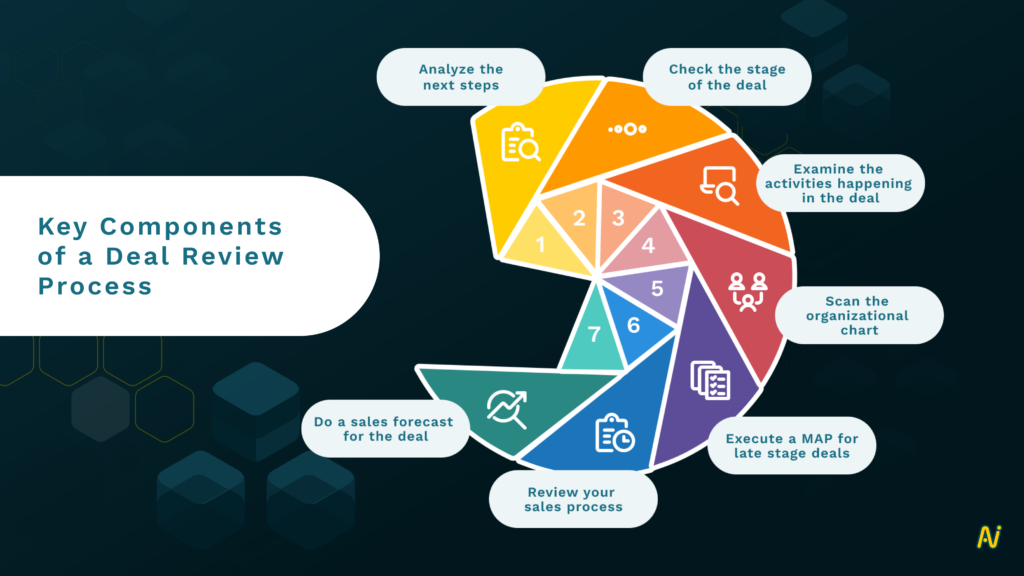
1. Analyze the next steps
Start with the opportunity pipeline and check whether what’s written matches what actually happened in the last conversation with the prospect. Next steps might be sending a case study, sharing pricing, or looping in a technical resource. The point is that they’re specific and tied to what the buyer actually said, not generic.
This used to mean a manager re-reading rep notes and cross-referencing an inbox. AI-generated summaries can now surface this in seconds instead of requiring a manager to reconstruct it from memory.
2. Check the stage of the deal
Look at what stage the deal is actually at, not just what’s written in the field. This is one of the places AI has changed the review most directly: it’s now possible to detect when a deal’s Salesforce stage doesn’t match what the underlying activity actually shows. An opportunity marked “discovery” when the email thread already includes a proposal and next steps around a signature.
That mismatch used to only surface when a sharp manager happened to read the right email. Now it can be flagged automatically, which matters more than it sounds like, since a wrong stage is exactly the kind of field an AI agent might act on without a human catching the error first.
3. Examine the activities happening in the deal
Emails sent, meetings booked, calls made, and just as importantly, how the buyer responded to them. A deal with no activity in 30 days is a risk regardless of what stage it’s sitting in.
Modern deal-intelligence platforms score this automatically. They categorize deals as hot, warm, cold, or stale based on recent engagement across 30/60/90/180-day windows, rather than requiring a manager to reconstruct activity history by hand.
4. Scan the organizational chart
The average B2B buying group runs 6 to 10 stakeholders. Your rep needs to know who they’re actually talking to: a technical buyer, an economic buyer, a champion, or a stakeholder with no real influence over the decision, sometimes called a detractor.
Multithreading or engaging multiple stakeholders instead of one is one of the more consistent patterns in deal data across industries: deals with broader buying-committee engagement close at meaningfully higher rates than single-threaded ones.
Ask, in the review itself: what does the buying committee actually look like? Who are we talking to right now? How strong is that relationship, and how often are we actually engaging them? Buying group intelligence that automatically maps who’s actually engaged versus who’s listed as a contact, is what turns this from a guess into a real answer.
5. Execute a mutual action plan for late-stage deals
A mutual action plan (MAP) aligns your team and the buyer on the sequence of events that needs to happen for a deal to close, each one scheduled, each with a clear success criterion. Late-stage deals, proof-of-concept evaluations, and solution-validation discussions all need one; without it, “we’re waiting to hear back” becomes an indefinite state instead of a tracked plan.
6. Review the sales methodology
Whether your team runs MEDDIC, MEDDPICC, BANT, or Challenger, the deal review is where you check whether the reps are actually completing what the methodology requires, not just claiming to.
This is one of the clearest places AI has changed the mechanics of the review. Daisy AI, for instance, auto-fills MEDDIC/MEDDPICC fields directly from call transcripts and email threads instead of requiring a rep to fill them in manually after the fact. It flags gaps like an unidentified economic buyer, or a missing technical decision criteria as part of the deal’s health score rather than something a manager has to notice by reading through notes.
Teams running a disciplined methodology also increasingly track the mix of meeting types in a deal: discovery versus demo versus proof-of-concept versus negotiation, since a healthy mix correlates with deal progression in a way that meeting count alone doesn’t.
7. Forecast the deal
Once you’ve worked through the rest of the review, the final step is forecasting: has the rep committed to this quarter or next? What’s the estimated size? What’s the close date, and is the confidence behind that number actually backed by engagement data, or is it a gut call?
This is where incomplete data does the most damage. A forecast field that’s wrong doesn’t just embarrass a manager in a QBR. If an AI agent is reading that field to prioritize outreach, allocate resources, or brief leadership, the error compounds silently. Chainguard’s CRO put it plainly: Nektar’s telemetry became critical to reducing rep ramp time and scaling the team with confidence in the underlying data, rather than around it.
Deal Reviews in the Agentic Era
The seven elements above haven’t changed in years, and they won’t change soon. A deal review is fundamentally about people, coaching, and judgment. What’s changed is where the raw material for that judgment comes from.
For most of the last decade, the fix for a bad deal review was better discipline: a stricter cadence, a clearer agenda, more rigorous notes. That’s still true. But it now sits on top of a second, quieter problem: the CRM data a deal review runs on is increasingly also the data an AI agent acts on directly, with no manager standing between the field and the action. A stage that’s wrong, a stakeholder who was never added as a contact, an email thread that never made it into the opportunity record, these used to just make a Friday pipeline review a little less useful. Now they’re the difference between an agent making the right call and a confidently wrong one.
That’s the shift behind Nektar’s own product direction.
- Data Foundation automatically captures every email, meeting, call, and calendar event across your team and writes it natively into Salesforce. No rep effort, no behavior change required, live in under two weeks.
- Time Travel retroactively corrects historical records as new context arrives, closing gaps that a point-in-time capture tool can’t touch.
- Daisy AI surfaces the signals this guide has referenced throughout like MEDDPICC auto-fill, next-steps summaries, deal risk flags, stage-vs-activity mismatches, and engagement scoring directly on the Salesforce Opportunity tab, so the deal review starts from a materially more complete picture than a manager reconstructing it from memory and three open tabs.
Frequently Asked Questions
Q. How often should deal reviews happen?
Weekly for active pipeline is the most common cadence, with a lighter-touch review for early-stage deals and a more rigorous one, often including a mutual action plan for late-stage or strategic opportunities. Consistency of cadence matters more than the specific frequency.
Q. What’s the difference between a deal review and a pipeline review?
A deal review typically goes deep on one or a handful of specific opportunities like stakeholder mapping, methodology completeness, next steps etc. A pipeline review looks across the full book of business at a higher level like coverage ratios, stage distribution, forecast category rollups. Most sales organizations run both, at different cadences.
Q. Can AI actually run a deal review?
Not on its own. AI can surface what a manager used to have to piece together manually like activity summaries, stage-mismatch flags, buying-committee gaps, MEDDPICC completeness. But the judgment calls that make a deal review valuable (is this champion credible, does this rep need coaching, is this deal really worth the exec air cover) still require a human conversation.
Q. Why does incomplete CRM data matter more now than it used to?
Because AI agents increasingly read and act on CRM data directly: updating stages, flagging risk, triggering workflows without a human checking the work first. Incomplete or inaccurate data used to just produce a misleading report a manager could catch. Now it can produce an automated decision nobody catches until it’s already been acted on.
Run Your Next Deal Review With Complete Data
A deal review is only as good as the data underneath it. Nektar exists to fix the root cause most failed deal reviews share incomplete, siloed, or stale pipeline data automatically, without asking reps to change how they work.
With Nektar, a deal review starts with:
- Clear visibility into buying-committee coverage and stakeholder engagement, via Buying Group Intelligence
- Automatic MEDDPICC field completion and deal-risk flags from Daisy AI
- Meeting intelligence visibility into who actually joined, exec presence, meeting type, instead of a rep’s recollection
- Forecast and pipeline health scoring built on complete engagement history, not gut feel
See what your own pipeline data actually looks like with Nektar’s free analysis.
Or hear more from revenue leaders directly on The Revenue Lounge podcast.
Enjoyed our content? Follow Nektar on LinkedIn