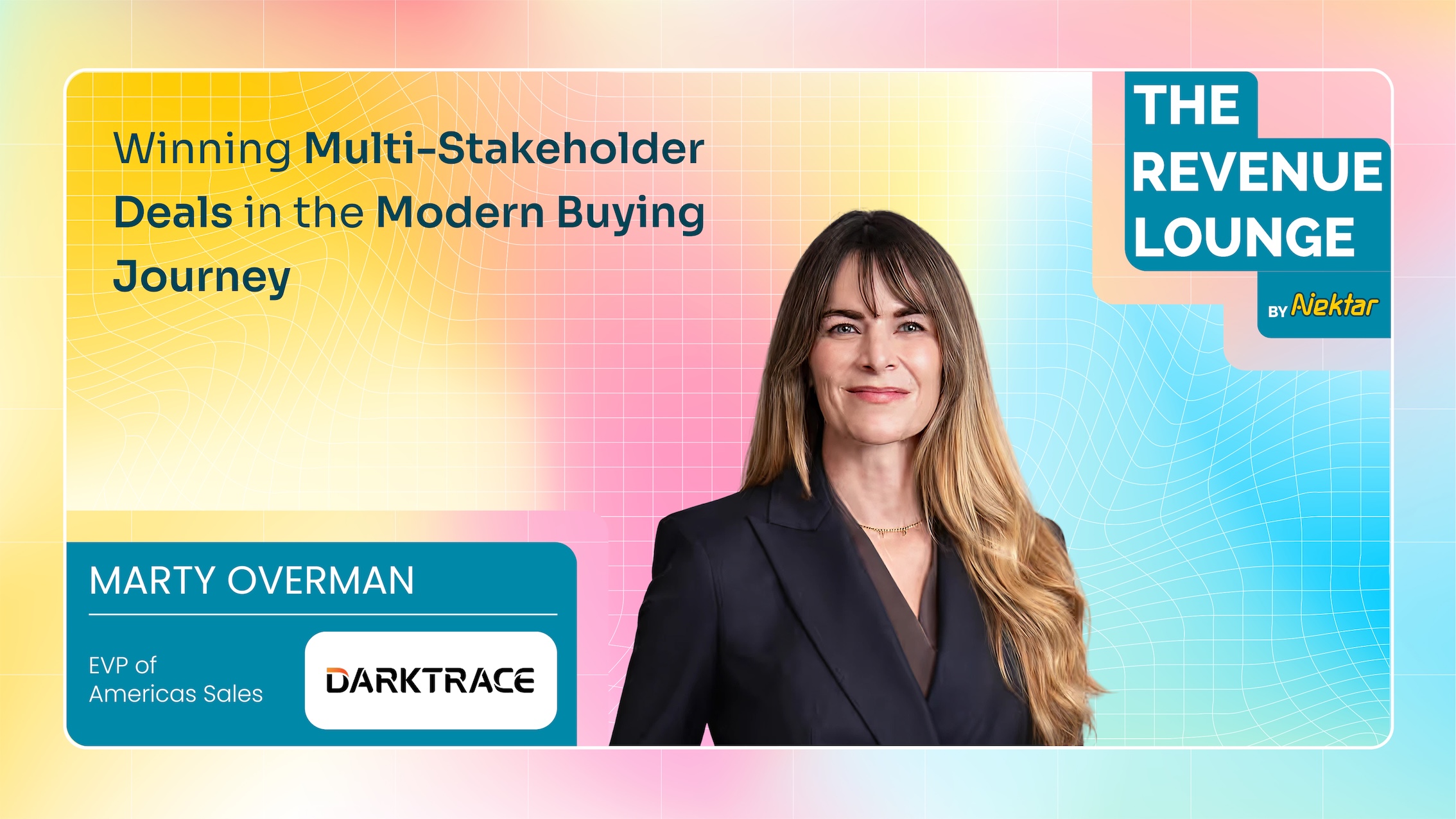
Winning Multi-Stakeholder Deals in the Modern Buying Journey
A conversation with Marty Overman, EVP of Americas Sales at Darktrace.
Executive Summary
Enterprise buying has fundamentally changed. Most sales teams haven’t caught up. In this episode of The Revenue Lounge, Marty Overman, EVP of Americas Sales at Darktrace, draws on two decades in cybersecurity to explain why the old playbook is broken and what the best sellers are doing instead.
The core shift: buyers arrive informed. By the time they engage a rep, they’ve researched the product, talked to peers, and formed a view. The rep who shows up to pitch has already lost the room. What buyers need now is a sense maker. Someone who understands their specific problem well enough to show how a solution actually works in their environment, not just on a spec sheet.
Marty’s framework centers on the distinction between product experts and problem experts. Product expertise is table stakes; problem expertise requires genuine curiosity, the right questions, and the discipline to orchestrate the right internal resources at the right moments across a long buying cycle.
The conversation also covers the deal signals that matter most (single-threaded engagement is a red flag; multi-functional coverage is the fix), the metrics most teams get wrong (pipeline is the easiest to fake; retention is the hardest to recover from), and what sales leaders need to build right now to stay ahead of a market changing faster than any enablement program can keep up with.
Introduction
The enterprise sales environment has changed. Buyers are more informed, CFOs are more skeptical, and the old playbook of showing up with a data sheet and running a demo is no longer enough. Marty Overman, Executive Vice President of Sales for the Americas at Darktrace, has spent two decades navigating the cybersecurity market. From Cisco in its early days through Palo Alto Networks, McAfee, and now Darktrace’s AI-driven platform. In a recent conversation on The Revenue Lounge, she offered a candid look at what’s broken in enterprise selling today, and what the best teams are doing differently.
The Buying Environment Has Fundamentally Shifted
To understand where we are, you have to understand how we got here. During COVID, enterprises spent aggressively on remote access, cloud solutions, and SaaS tools, often without the time or discipline to evaluate whether purchases fit together. The result was a lot of tech debt, half-deployed products, and frustrated security teams overwhelmed by tools they never fully adopted.
Now, the pendulum has swung.


Marty Overman
Executive Vice President of Sales
CFOs are looking at it, CISOs are looking at it, anybody who's got any responsibility for a P&L is saying, do we actually have to spend this money? Because we bought that stuff four or five years ago, we overbought, we overspent.
That scrutiny isn’t going away. Marty is quick to point out that this isn’t primarily a macroeconomic story. Companies still have the capital. The shift is behavioral. Every dollar now has to justify itself against competing growth investments, and buyers have learned from their own missteps. Sellers who don’t account for this reality will lose deals they used to close easily.
Buyers Don't Need You Early. They Need You Smart
Research consistently shows that buyers now prefer to conduct significant research before engaging a sales rep. A widely-cited Gartner figure puts roughly 60% of buyers preferring a rep-free experience up to a certain point in their journey. Marty doesn’t push back on this. She builds her coaching around it.
The implication isn’t that sellers are irrelevant. It’s that the moment they enter the conversation has changed, and so has the value they need to bring.
Marty Overman
Executive Vice President of Sales
The more information that's available, the more a human has to help cut through some of that and help make sense of it. You don't necessarily need a salesperson anymore, you need a sense maker.
By the time a buyer wants to engage with a rep, they’ve already checked the spec sheet. They’ve talked to peers. They may know your product better than a junior rep does. What they can’t get from a spec sheet is clarity on whether it actually solves their specific problem, in their specific environment, given everything else they’ve already bought and deployed.
That’s the opening for a great seller.
The Problem Expert vs. the Product Expert
Marty draws a sharp line between two types of sellers: product experts and problem experts. Product expertise is table stakes. Anyone can memorize features and fire up a polished demo. Problem expertise requires something harder: genuine curiosity about the customer’s world.
Marty Overman
Executive Vice President of Sales
Being a problem expert requires you to ask the questions and to seek to understand.
Her analogy here is useful. The best doctors don’t show up already knowing the answer. They ask questions about when the pain started, how the injury happened, what movements make it worse. They’re not doing this to fill time. They’re taking in information that shapes a treatment plan. A seller who rushes to pitch before understanding is like a doctor who prescribes before diagnosing.
The practical coaching implication: when you’re talking to a customer, your job is not to inform them about your product. It’s to understand their problem well enough that you can show them what the product actually does for them, how it transforms their workflows, reduces pressure on their team, and integrates with what they already own.
See how leading GTM teams build complete buying groups without relying on manual CRM updates with Nektar
Demonstrating Operational Reality, Not Just Capability
One of the more actionable practices Marty describes is what Darktrace calls a workflow impact assessment, conducted during a proof of value (POV).
The problem it solves: buyers have been burned by products that did the thing on paper but never got fully deployed because nobody mapped out how the tool would actually slot into existing operations. Teams are overwhelmed. Nobody’s getting more headcount. A product that adds complexity rather than reducing it will sit unused and won’t renew.
Marty Overman
Executive Vice President of Sales
Really being able to show them how they’re actually gonna work with and interact with the tool. It just improves the likelihood that you’re gonna use it.
Her car analogy lands: she bought a new car with an advanced driver-assist feature, ignored the training session, got frustrated when it didn’t work intuitively, and turned it off. When renewal came, she didn’t re-subscribe. The feature was real. The capability existed. But without the operational onboarding, adoption never happened.
The takeaway for sellers: requiring a POV isn’t enough. The POV has to be structured around the customer’s actual workflows, not your product’s showcase features. Show them what it looks like on a Tuesday morning when your tool catches something. Walk them through the alert they’d receive, the action they’d take, the time they’d save.
Buyers aren’t just purchasing innovation. They’re purchasing confidence that the innovation will work in their environment.
The Art of Orchestrating Expertise
Enterprise deals are rarely won or lost on the strength of one relationship. Marty makes the case for thinking of the best sellers as orchestrators. People who know when to bring in the right expertise, at the right moment, for the right stakeholder.
Marty Overman
Executive Vice President of Sales
Their customers aren’t choosing a technology necessarily. They’re not choosing a single person. They’re choosing a company to partner with.
This means building a deliberate map of who you bring in throughout the sales cycle: solutions engineers, AI analysts who use the product in actual operations, incident managers who can walk through what a real compromise looks like, and various levels of technical support. Each of these touch points builds credibility by exposing the customer to people who aren’t salespeople. And who bring domain depth that a single rep can’t replicate.
Marty calls this “breadcrumbing”: leaving customers with something valuable to consume at each stage, keeping your company top of mind without overstaying your welcome. In enterprise cycles that can run 18 months to three years, maintaining meaningful engagement requires intentionality.
The doctor analogy applies again. You want the doctor who’s treated six ACL tears this week and knows exactly which specialist to send you to, which PT protocol to prescribe, and what your recovery timeline looks like. That doctor doesn’t personally solve your whole problem, but they know who does.
Multi-Threaded and Multi-Functional: The Deal Health Signals That Matter
When inspecting a deal, Marty has a clear red flag: a single engaged stakeholder.
Marty Overman
Executive Vice President of Sales
If I see that there’s really only one stakeholder engaged, I’m very concerned about that deal.
The familiar coaching point is to be “multi-threaded” or engaged with multiple people inside the account. But Marty adds a layer that often gets missed: being multi-functional. Five contacts in the same department is not multi-threaded in any meaningful sense. The risk is that when you’re not in the room, they’re all aligned. But they can’t actually move the deal forward because procurement, operations, or legal hasn’t been brought in.
When a champion says “don’t go talk to procurement yet” or “don’t engage operations,” that’s not protection. That’s a signal. It usually means the seller hasn’t proven enough value to the champion for them to want to expose the opportunity to internal scrutiny. Treat it as such.
The Metric That's Most Overrated (and Most Underrated)
Asked for her take on the most overrated GTM metric, Marty’s answer was unambiguous: pipeline.
Marty Overman
Executive Vice President of Sales
Pipeline is such a dangerous metric because it’s so easy to fake, it’s so easy to fluff.
The comfort pipeline problem is real: reps leave deals open not because they’re active but because closing them would expose coverage gaps. The result is a pipeline number that feels healthy but tells you nothing about what will actually close. Worse, if you’re not doing deep inspection on each opportunity, understanding the real buying motion, the actual stakeholders, the legitimate next steps, the number can actively mislead your forecast.
On the flip side, the most underrated metric: customer retention.
“You can’t outrun customer churn.”
Early-stage and scaling companies are especially prone to fixating on new logos and pipeline coverage while quietly letting customer health deteriorate. Churn compounds. A customer who doesn’t get value doesn’t renew, doesn’t expand, and often becomes a reference that works against you. The discipline of treating retention as a first-class metric, not a CS team’s problem, is what separates companies that scale sustainably from those that sprint and stall.
What Sales Leaders Should Be Building for Right Now
Asked what most sales leaders aren’t thinking about that they should be, Marty’s answer was change tolerance.
The pace of market change in AI, in cybersecurity and in buyer behavior means that enablement content can be outdated within months. Teams that are brittle in the face of change will fall behind. The coaching point she’s already delivering to her team: things they’re told in March may need to look different by August. That’s not a strategy failure. That’s the market.
We may tell you something in March that come August needs to look different. That doesn’t mean we’re histrionic. It means that the market is changing at an incredible rate.
Marty Overman
Executive Vice President of Sales
What she looks for in hiring, at every level, is curiosity. Not process orientation alone. That has its place. But the combination of systematic execution and genuine hunger to learn. The rep who asks what podcasts to listen to and actually listens. The leader who reads across domains and brings those connections into their team conversations. Curiosity is the best leading indicator of adaptability.
Want more tips on Multi-threading? Scroll below for more related resources.
Subscribe to The Revenue Lounge Brief for quick insights on every new episode.
If you liked what you read, please share it with your peeps.
In this blog
Get the Revenue Lounge Brief
3 takeaways from every new episode, straight to your inbox.