
How RevOps Can Transform Data Hygiene for Companies
- CRM, Revops
- 10 min
- Updated: August 11, 2026
Organizations increasingly recognize the indispensable value of data in driving growth. But the sheer volume, velocity, and variety of that data pose real cleaning challenges, and data hygiene issues quietly hinder decision-making, customer experience, and operational efficiency across the board.


Trent Allen
Revenue Operations Manager, Maxio
As a RevOps team, you need to be able to help all teams. A big part of it is making sure all the different tools and systems are connected. RevOps is there to plan, help with processes, building process paths and writing those out. It is also the keeper of truth. When it comes to numbers, we need to ensure that people have actionable data, and we help them with the best process to move forward.
In this piece, we revisit our conversation with Trent Allen, Revenue Operations Manager at Maxio, the financial revenue operations platform, discussing how RevOps offers a strategic approach to data hygiene and unlocking the value trapped behind it.
Listen to the full conversation here:
Get our latest insights into your inbox

What Is Data Hygiene?
Data hygiene refers to the practices and processes that keep data clean, accurate, and reliable, maintained and improved across its entire lifecycle, from creation to disposal. Implementing real data hygiene measures minimizes errors, inconsistencies, redundancies, and the other issues that quietly erode data’s integrity and usefulness.
Data hygiene matters specifically in RevOps because it’s what makes accurate, reliable, high-quality data available across every revenue-related function. Clean data is what actually enables informed decision-making, since accurate insight depends entirely on the data feeding it.
What Is RevOps, and What Role Does Data Hygiene Play in It?
RevOps, short for Revenue Operations, is a strategic approach that aligns and integrates a company’s sales, marketing, and customer success teams, optimizing revenue generation by breaking down silos, improving collaboration, and streamlining process across all three functions.
RevOps teams typically work on aligning sales and marketing strategy, implementing and optimizing sales process, managing and analyzing customer data, and applying technology to improve operational effectiveness. By aligning sales, marketing, and customer success, RevOps drives a cohesive, coordinated approach to revenue, better communication, fewer inefficiencies, and genuinely data-driven decisions.
Coordinating across departments depends directly on the cleanliness and accuracy of the data those departments share, which is exactly where data hygiene comes in. RevOps recognizes that high-quality data is the precondition for good decisions, and works to cleanse and maintain data integrity, eliminating errors, duplicates, and inconsistencies along the way.
Trent Allen
Revenue Operations Manager, Maxio
I think a big part is making sure all the different tools and systems are connected and that the data is passing between them fluidly, so that the end-user can save their time.
How Can RevOps Facilitate Data Hygiene?
A company’s data is like a garden, a vast expanse of potential that still requires meticulous care to actually thrive. RevOps steps in as the expert gardener, with the tools and strategy to keep data hygiene genuinely intact.
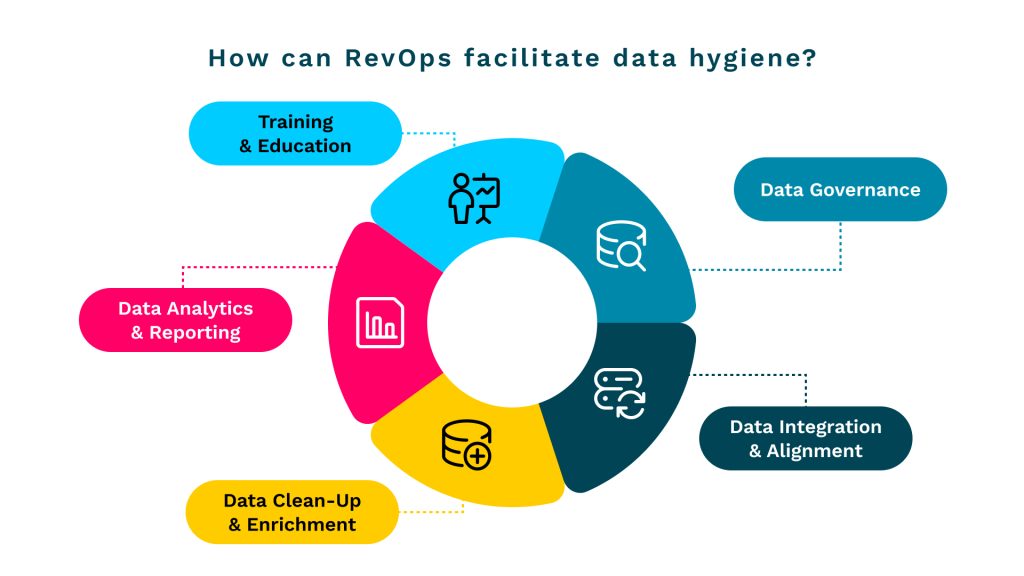
A few specific ways RevOps contributes:
1. Data Governance
RevOps establishes data governance policies and standards across the organization, defining data quality metrics, validation rules, and ownership responsibilities. Clear guidelines are what make data management consistent and effective rather than ad hoc.
2. Data Integration and Alignment
RevOps teams work to integrate data from sales, marketing, and customer success systems, identifying and resolving inconsistencies, redundancies, and inaccuracies as data from different departments comes together. This is what actually improves data integrity and produces a genuine single source of truth.
3. Data Cleanup and Enrichment
Reviewing and updating customer and prospect information, eliminating duplicate records, and correcting errors or inconsistencies directly, this is what enhances data accuracy and reliability at the record level, not just in policy.
4. Data Analytics and Reporting
Data analytics tools and techniques surface insight into customer behavior, revenue trends, and sales performance. Analyzing that data is also how RevOps identifies patterns, anomalies, and data quality issues in the first place, information that directly informs how to fix hygiene problems and improve overall data quality.
5. Training and Education
RevOps trains employees across departments on data hygiene best practices, entry standards, maintenance procedures, and why data quality actually matters. Raising data literacy across the organization is what builds a genuine culture of data hygiene, rather than a policy nobody actually follows.
Trent Allen
Revenue Operations Manager, Maxio
I think a big part is making sure all the different tools and systems are connected and that the data is passing between them fluidly, so that the end-user can save their time.
Benefits of Having a Data Hygiene Strategy
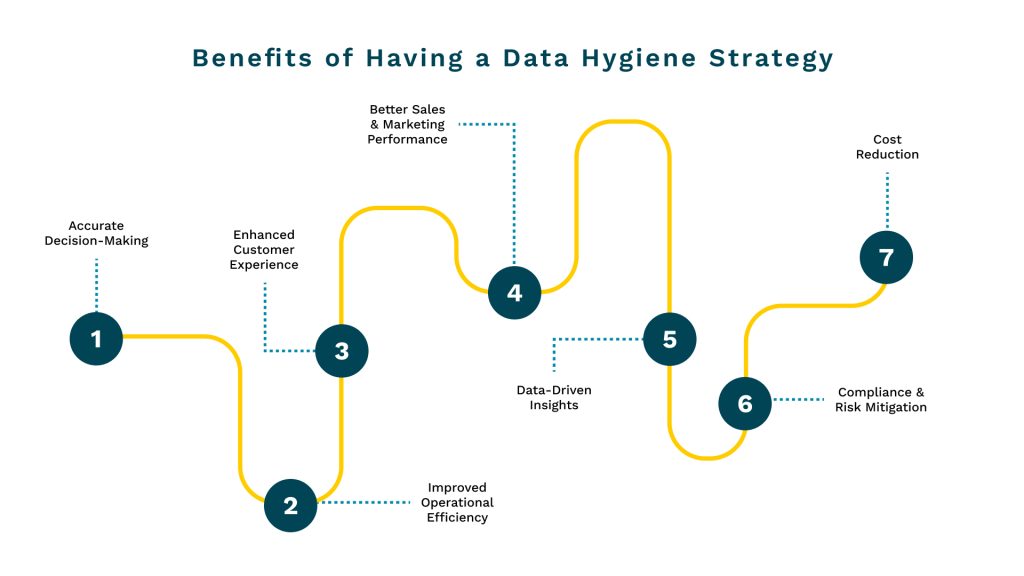
1. Accurate Decision-Making
Clean, accurate data is a reliable foundation for informed decisions. Trusting the data means trusting the insight built on top of it, at every level of the organization.
2. Improved Operational Efficiency
Data hygiene minimizes errors, redundancies, and inconsistencies, which streamlines process and lets employees access and use relevant information quickly, saving real time and resources.
3. Enhanced Customer Experience
Clean data gives a genuinely holistic view of the customer, supporting a personalized, tailored experience built on accurate understanding of their needs, preferences, and behavior.
4. Better Sales and Marketing Performance
Clean, reliable data gives sales and marketing accurate insight into buying patterns and trends, enabling targeted campaigns, more effective lead generation, and better sales forecasting, which ultimately drives revenue growth.
5. Data-Driven Insights
Data hygiene is what makes real data analysis and reporting possible. Clean data supports meaningful analytics, letting an organization identify trends, patterns, and opportunities that actually support strategic planning.
6. Compliance and Risk Mitigation
Maintaining data hygiene matters directly for regulatory compliance, especially in industries with strict data protection and privacy requirements. Clean data reduces the risk of errors or breaches that could lead to real legal or financial consequences.
7. Cost Reduction
Poor data hygiene wastes resources, time spent correcting errors or working around inaccurate information. Investing in real data hygiene practice reduces the costs tied to inaccuracy, redundant effort, and inefficient process.
Trent Allen
Revenue Operations Manager, Maxio
One of the biggest challenges in RevOps is to work with all the different tools and the different external sources of data. How do you control them to make sure that what's coming in is the most reliable? Data governance is the secret sauce for RevOps success and it definitely helps if you have an extremely clean CRM so that your team is not worried about filtering through that information.
Why This Matters Even More With AI Agents in the Mix
Everything Trent describes above has always mattered for good decision-making. It matters more now because of what this same clean data increasingly feeds. A growing share of CRM data now gets read and acted on directly by AI agents, prioritizing an account, flagging risk, updating a forecast, rather than a person reviewing it first. RevOps’ role as the centralized pillar of truth isn’t just about better reporting anymore, it’s a real precondition for using AI safely on top of that same data.
Frequently Asked Questions
Q. What’s the difference between data hygiene and data governance?
Data governance is the framework, the policies, standards, and ownership rules that define how data should be managed. Data hygiene is the ongoing practice of actually keeping data clean, accurate, and current within that framework. Governance without hygiene is a policy nobody follows; hygiene without governance is inconsistent and hard to sustain.
Q. Why is RevOps specifically well-positioned to own data hygiene?
Because RevOps already sits across sales, marketing, and customer success, the exact functions generating and depending on the same data. That cross-functional position makes RevOps a natural single source of truth, rather than each department maintaining its own partial, inconsistent version of the data.
Q. How does data hygiene affect AI adoption specifically?
AI amplifies whatever data quality it’s given rather than correcting for gaps in it. A RevOps function that’s already built strong data governance and hygiene practice has a real head start on deploying AI safely, since the data it would feed an AI agent is already more trustworthy than an organization starting from scratch.
About Nektar
Nektar ensures pristine CRM data through robust data governance and automated data validation and cleansing. By establishing clear data standards and ownership, Nektar maintains consistency and accountability, putting CRM data hygiene on autopilot.
Nektar’s Data Foundation automatically captures and integrates full-funnel activity from email, calls, meetings, and Slack, making clean, accurate contact data available to every frontline team without manual effort. Time Travel retroactively corrects historical records as new context arrives, and Daisy AI surfaces the specific signals a real single source of truth depends on, buying-group visibility, deal risk, and engagement scoring, directly inside Salesforce.

Tim Seamans
VP, AI Acceleration & Transformation
With Nektar, we unlocked GTM context for our AI apps, driving $2M indirectly attributed expansion revenue and uncovering $80M+ in additional pipeline by unifying previously selected signals and engagement data.
If prioritizing better data is on your roadmap this year, get a free CRM scan to see how complete your own CRM data actually is.
Enjoyed our content? Follow Nektar on LinkedIn