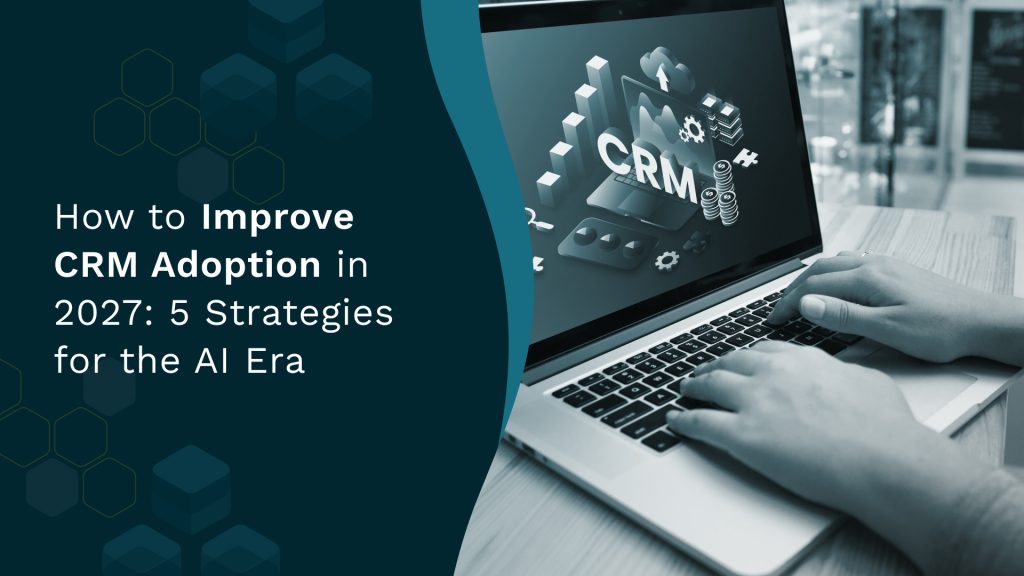
How to Improve CRM Adoption in 2027: 5 Strategies for the AI Era
- CRM
- 9 min
- October 27, 2026
Executive Summary
For two decades, companies have tried to fix CRM adoption by changing rep behavior: more training, stricter mandates, incentives for logging activity. The results have barely moved. In 2027 the problem matters more, because the CRM’s most demanding users are no longer managers reading dashboards. They are AI agents that act on CRM data directly. The fix is to stop treating reps as the CRM’s data entry layer. Capture activity automatically, give reps useful context back, and measure adoption by how complete the data is rather than how often reps log in.
The numbers explain why reps resist. Salesforce’s State of Sales 2026, a survey of 4,050 sales professionals, found the average seller spends only 40% of the week selling. The rest goes to meetings, prospecting, planning, quotes, and manual data entry. Every minute spent updating the CRM is a minute not spent with a buyer, and reps know it.
The result shows up in the data. In Validity’s State of CRM Data Management in 2025, 76% of CRM users said less than half of their organization’s CRM data is accurate and complete, and 37% said poor data quality had cost them revenue directly.
Get our latest insights into your inbox

What is CRM Adoption?
CRM adoption is the degree to which a sales organization actually uses its CRM as the system of record: whether customer interactions, contacts, and deal updates make it into the system, and whether people and tools rely on that data to make decisions. Low adoption shows up as missing activity, sparse contact roles, stale opportunities, and forecasts nobody trusts.
Why CRM Adoption Keeps Failing
The root cause has not changed since the first sales CRM: the system depends on reps to type in what happened. Reps are paid to sell, so data entry loses every time it competes with a buyer conversation. Three patterns make it worse.
First, the work is invisible to the rep. Logging an email helps the forecast, the manager, and marketing attribution, but rarely helps the rep close the deal in front of them. Second, reps often see the CRM as a surveillance tool, a record of their activity that will be used against them in a pipeline review. Third, stacks keep growing. Sales teams use an average of eight separate tools and each one creates another place where customer context lives outside the CRM.
Training, mandates, and incentives address none of these. They ask reps to do more of the work they already avoid.
What AI Agents Changed
The CRM now has a new class of user. Agentforce, Microsoft Copilot, and custom agents read and write CRM records directly, and Salesforce’s April 2026 Headless 360 launch opened the full platform to agents through APIs and MCP tools. These users never skip a field. They also never question what they find.
That makes incomplete data far more expensive. A manager reading a sparse opportunity can call the rep. An agent prioritizing pipeline, drafting outreach, or scoring risk acts on the gap with full confidence.
In Salesforce’s 2026 research, 51% of sales leaders using AI said disconnected systems are slowing down their AI initiatives, and high-performing teams were far more likely to prioritize data hygiene (79%) than underperformers (54%). Gartner now advises sales leaders to build a centralized context layer connecting enterprise data, systems, and seller judgment before scaling agents.
So the goal of CRM adoption has shifted. It used to get reps to use the CRM. Now it is to ensure the CRM reflects reality, whether or not reps touch it.
5 Strategies to Improve CRM Adoption in 2027
1. Take data entry off reps completely
The most effective CRM adoption strategy is to stop depending on reps for data. Automatic activity capture writes every email, meeting, calendar event, and call into the CRM, associated with the right contact, account, and opportunity, with no clicks, plugins, or “add to CRM” buttons. Partial automation that still asks reps to approve or tag each activity tends to decay within a quarter, so look for capture that requires zero rep behavior change.
This matters most when teams grow fast. Chainguard scaled its sales team from 50 to 430 reps in under six months with Nektar capturing activity in the background, so every new hire had complete CRM coverage from day one without any logging training.
2. Capture contacts and buying groups automatically
Opportunity contact roles are where manual adoption breaks down most visibly. Reps add the champion and maybe one other person, while finance, security, IT, and executive sponsors never make it into the CRM. Automate contact creation for anyone a rep emails or meets with, assign buyer roles, and associate them with the right opportunity. Managers get an honest view of multi-threading, and marketing gets the full list of people sales actually engaged.
3. Give reps something back in the flow of work
Reps engage with the CRM when it saves them time. Once activity and contacts are captured automatically, use that data to hand reps useful context where they already work: an account summary before a call, recent engagement across the account team, the stakeholders who have gone quiet, and AI-drafted follow-ups grounded in what actually happened. The CRM stops being a reporting chore and becomes a source of prep.
This also helps with the surveillance problem. When reps see the data working for them, it reads less like monitoring. Be transparent about what is captured and how it is used, and use privacy controls to exclude personal or sensitive communications.
4. Consolidate where customer data lives
Every tool that holds its own copy of customer interactions makes the CRM less complete. Map which tools capture email, meetings, and calls today, decide which one writes the system-of-record activity to the CRM, and deduplicate the rest. Salesforce’s 2026 research found more than 80% of sales teams without a unified platform plan to consolidate their stacks. The goal is fewer places for reps to look and one place for agents to read.
5. Measure adoption by data completeness
Login counts and dashboard views measure the wrong thing. Track the outcomes adoption is supposed to produce:
- Share of customer interactions captured in the CRM
- Average contacts per account and contact roles per opportunity
- Share of open opportunities with three or more engaged buyer roles
- Opportunities with no two-way interaction in the last 30 days
- Time for a new rep’s accounts to reach full activity coverage
These numbers tell you whether the CRM is ready for the agents and forecasts that depend on it, which is the question adoption programs were always trying to answer.
Stop Asking Reps to Fix the CRM
CRM adoption programs have spent years trying to change how reps work. The teams getting it right in 2027 change how data gets into the CRM instead. Salesforce is the system of record.
Nektar makes sure that record reflects what actually happened with your buyers: it captures every customer interaction across email, calendar, meetings, and calls, structures it with machine learning, and writes it natively into Salesforce. Reps change nothing, and Time Travel™ backfills 12+ months of historical activity on day one, so the CRM is complete from the start for every rep, manager, and AI agent that depends on it.
Frequently Asked Questions
Q.What is CRM adoption?
CRM adoption is how fully a sales organization uses its CRM as the system of record, measured by whether interactions, contacts, and deal updates are captured and relied on for decisions.
Q. Why do sales reps resist CRM adoption?
Most resistance comes from manual data entry. Salesforce's 2026 research found sellers spend only 40% of their week selling, and logging activity competes directly with time spent on buyers. Reps also often see the CRM as a monitoring tool rather than something that helps them sell.
Q. How can you improve CRM adoption without changing rep behavior?
Automate activity and contact capture so the CRM fills itself, give reps useful context back in the tools they already use, consolidate where customer data lives, and measure adoption by data completeness rather than logins.
Q. Why does CRM adoption matter more with AI agents?
AI agents act on CRM data directly and do not question gaps. Incomplete records lead to wrong recommendations at scale, which is why Salesforce found 51% of sales leaders using AI say disconnected systems are slowing their AI initiatives.
Enjoyed our content? Follow Nektar on LinkedIn