10 Best Account Based Marketing Tools for 2026
- Marketing
- 10 min
- Updated: July 16, 2026
Account-based marketing tools have gotten better at execution but are not easier to run at scale. Multi-channel ABM campaigns still require real coordination between sales and marketing, and the tools in this category exist to make that coordination less painful, whether that means better targeting, better personalization, or better reporting on what’s actually working.
Two things are worth knowing before you evaluate anything on this list. First, this category has consolidated meaningfully in the last few years, several tools that used to be independent are now part of larger platforms, and it’s worth knowing which is which before you sign a contract expecting the standalone product. Second, ABM’s underlying data problem has gotten a new dimension: as more marketing and sales tools add AI features on top of account and contact data, that data has to be genuinely accurate, not just directionally useful, or the AI layer amplifies whatever gaps are already there.
Get our latest insights into your inbox

What is ABM?
Account-based marketing flips the traditional funnel. Instead of casting a wide net and qualifying leads down to a smaller set, marketing and sales work together from the start to:
- Identify high-value accounts that fit ICP criteria
- Engage them with personalized content
- Find and map the actual decision-makers involved
- Move them toward closure together
- Stay engaged post-sale to capture expansion opportunities
ABM isn’t one-and-done selling. It’s built around customer lifetime value, which is also why the data behind it has to stay accurate well past the initial close.
Uncover hidden first-party contacts to drive your ABM efforts with Nektar
- Map buyer group intelligence hidden in sales conversations
- Create personalized ABM Campaigns
- Discover hidden pipeline from first-arty contacts
10 ABM Tools for 2026
- 6sense Revenue AI, predictive account intelligence and journey orchestration
- HubSpot Marketing Hub, omnichannel personalization for HubSpot-native teams
- Demandbase, account-based experience across three integrated modules
- Terminus (now part of DemandScience), multi-channel ABM with native email-signature marketing
- RollWorks, ABM built around paid ad execution
- Foundry Intent (formerly Triblio), intent data and web personalization bundled with Foundry media
- Vainu, sales intelligence and account data for list building
- Apollo.io, prospecting, engagement, and ABM in one platform
- Uberflip, content personalization and distribution for ABM
- Alyce by Sendoso, AI-personalized corporate gifting for account engagement
Overview of the 10 Best ABM Tools
1. 6sense revenue AI
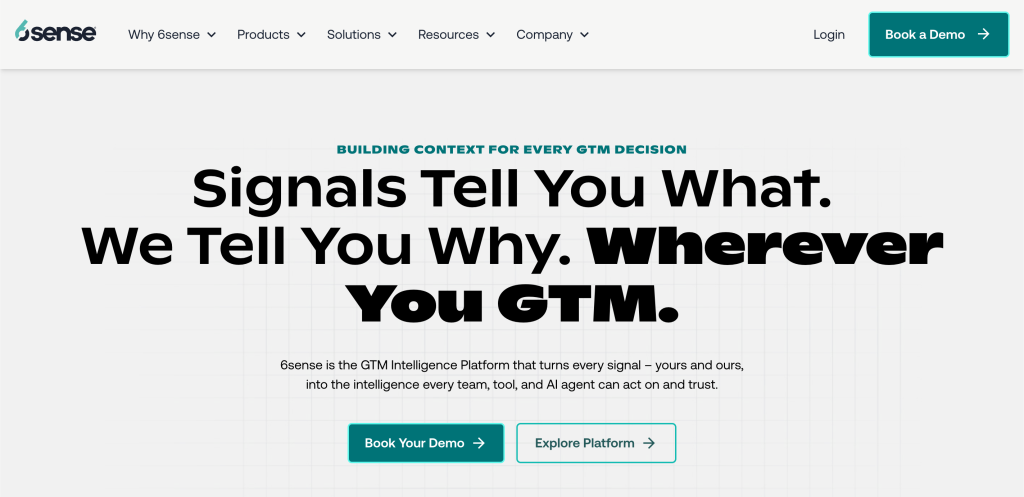
6sense helps marketing teams identify high-value accounts, predict where they are in the buyer journey based on account activity, and engage them with the right message at the right touchpoint.
Features: automatically updates contact lists with additional firmographic information, segments accounts into behavioral cohorts, tracks activity across channels and attributes it back to the account.
Pricing: Custom, based on users and use case.
2. HubSpot Marketing Hub
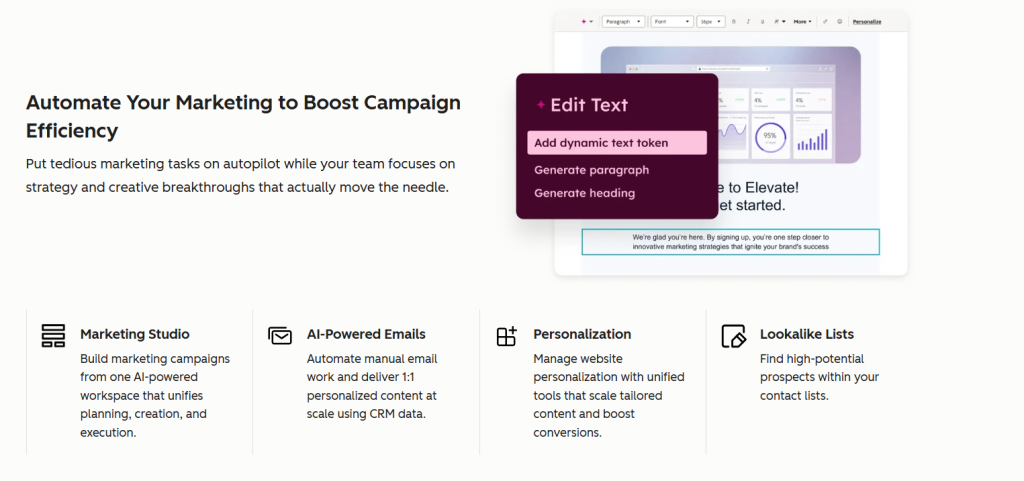
HubSpot Marketing Hub is an omnichannel marketing solution with particularly powerful personalization tools. You can use them to set up and automate hyper-targeted messaging across multiple touchpoints to reach and engage with specific prospects.
Features: automatically segments contact lists based on customer criteria, spots prospects who mirror your top customers through lookalike lists, personalizes messaging across landing pages, emails, socials, and more.
Pricing:
- Marketing Hub Starter: $7/user/month
- Marketing Hub Professional: $800/month
- Marketing Hub Enterprise: $3,600/month
- Free marketing tools with limited features are also available
3. Demandbase
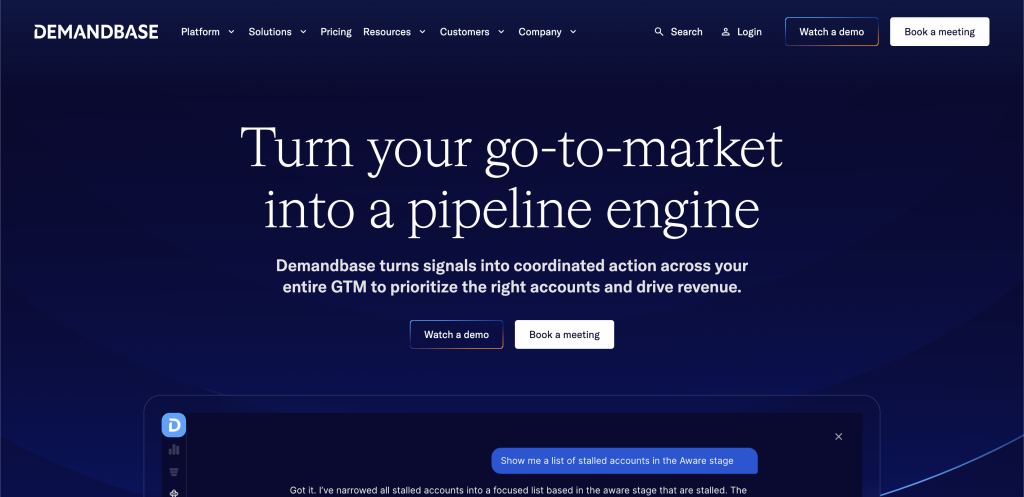
Demandbase runs on the Account-Based Experience concept across three connected modules: ABX Cloud for ABM strategy, Advertising Cloud for campaign management, and Data Cloud for integration support.
Features: account-level insights for campaign execution, support for multiple ad formats across global markets, straightforward integration with existing stacks.
Pricing: Custom, based on use case and team size.
4. Terminus (now part of DemandScience)
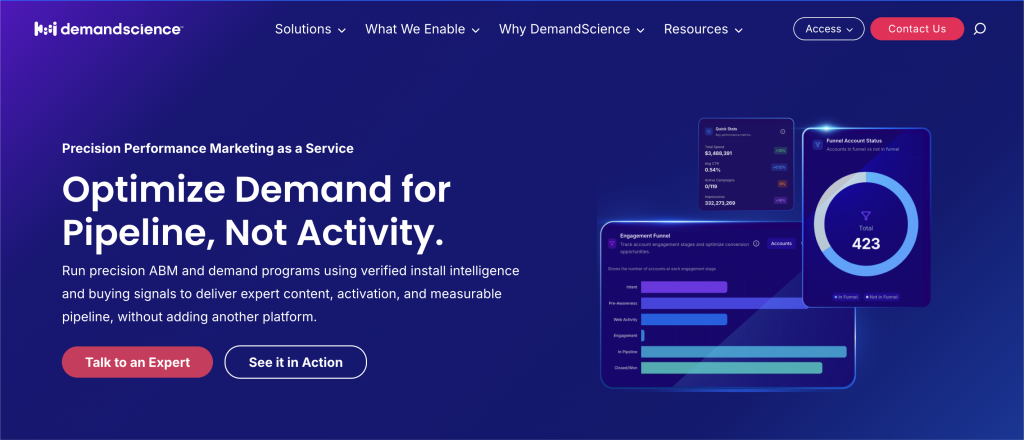
Terminus merged into DemandScience in November 2024. The product continues to operate under the Terminus name, now backed by DemandScience’s broader B2B data and demand-generation assets, and still includes the native email-signature marketing (via its earlier Sigstr acquisition) that differentiates it from most other platforms on this list, turning every outbound employee email into an addressable ABM surface.
Features: in-depth segmentation including buyer intent, multi-channel campaign support (ads, chat, email signatures, web personalization), a built-in B2B CDP.
Pricing: Quote-based; third-party buyer data puts mid-market packages around $40,000 to $80,000 annually, with enterprise tiers higher.
5. AdRoll ABM (formerly RollWorks)
RollWorks was fully rebranded to AdRoll ABM in August 2025, when parent company NextRoll unified its AdRoll and RollWorks brands into one platform. It’s the same product, team, data, and pricing as before, just operating under the AdRoll name, and remains a good fit for marketers who rely primarily on paid ads for account-based lead generation.
Features: targeting recommendations based on historical campaign performance, account-to-decision-maker mapping with contact information, contextual account signals like org changes, mergers, and acquisitions.
Pricing: Starter plan around $975/month; contact sales for other tiers.
6. Foundry Intent (formerly Triblio)
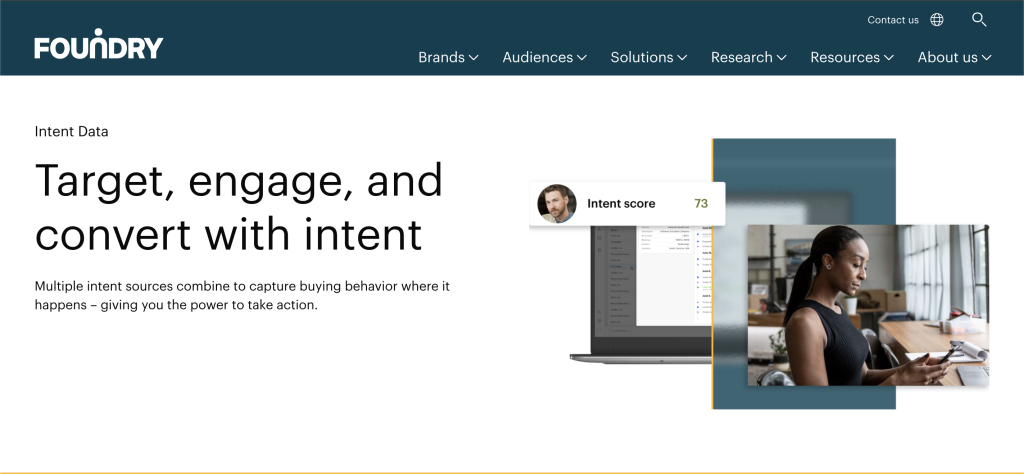
Triblio was acquired by IDG, now Foundry, back in 2020, and the product has been sold as Foundry Intent for several years. If you’re evaluating this expecting the independent Triblio product, know upfront that pricing and packaging now tie more closely to Foundry media-spend commitments than the standalone product used to. It’s a strong fit specifically for enterprise tech and IT vendors already buying Foundry/IDG content syndication, since its intent data draws from IDG’s own editorial coverage areas (security, cloud, enterprise software) and is noticeably weaker outside them.
Features: visual, drag-and-drop campaign builder, intent- and activity-based conversion probability scoring, web personalization bundled with Foundry’s media inventory.
Pricing: Tied to media-spend commitments; contact Foundry directly.
7. Vainu
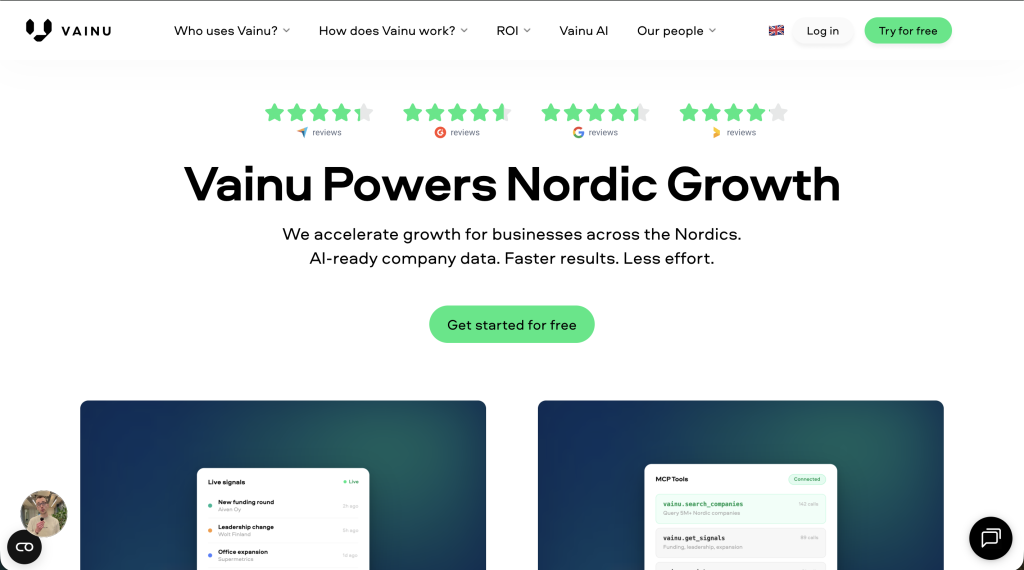
Vainu is a sales intelligence tool for finding high-value accounts from its global company database, speeding up list-building with contextual account information.
Features: targeted contact lists built from ICP filters, automatic updates as new contacts are found, a single consolidated view of contacts stored across other tools.
Pricing: Free trial available. Team plan around €4,200/year, Business around €9,900/year, Global around €12,000/year, custom Enterprise pricing.
8. Apollo.io
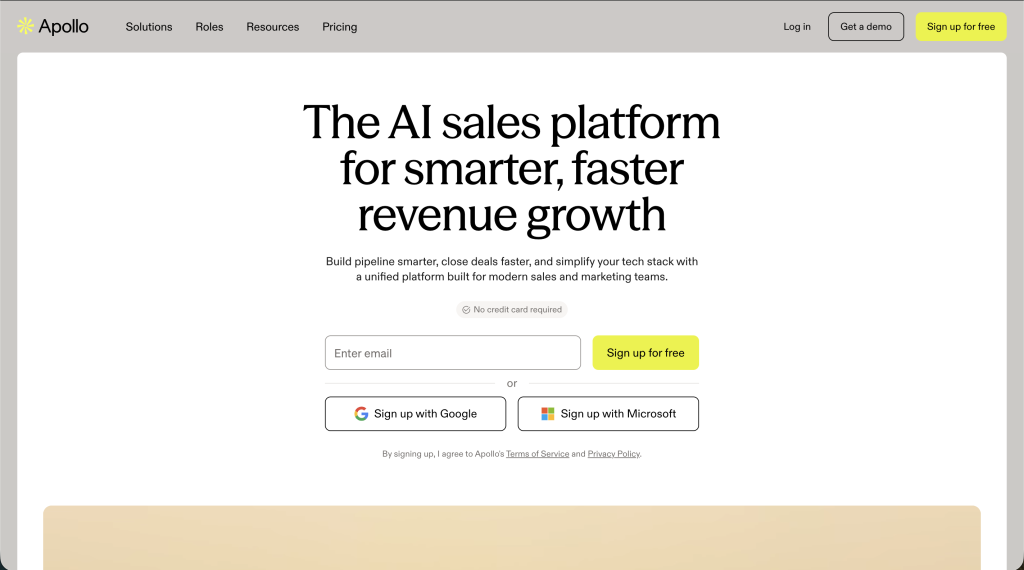
Apollo.io combines prospecting, campaign orchestration, and sales engagement, letting you push personalized messaging to target contacts while optimizing the broader revenue motion as you go.
Features: a lead database of roughly 250 million people and companies, an Engagement Suite for building ICP-based sequences, an Intelligence Suite for tracking, analytics, and targeting.
Pricing: Basic around $49/month, Professional around $99/month, custom enterprise plans, and a free tier with limited features. Confirm current tiers directly, since Apollo has adjusted pricing and credit structures more than once in the past two years.
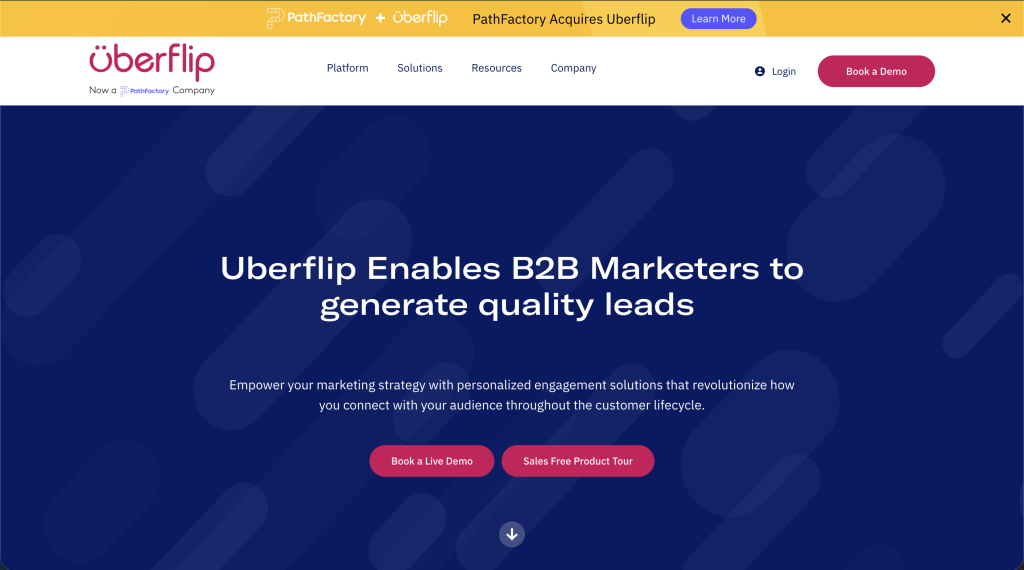
9. Uberflip
Enjoyed our content? Follow Nektar on LinkedIn
Uberflip is a content creation, curation, and distribution platform built to help marketers deliver relevant messaging at the account level.
Features: aggregates and serves personalized content based on intent data, built-in analytics for measuring content performance and planning strategy around it.
Pricing: Custom, based on users and features.
10. Alyce by Sendoso
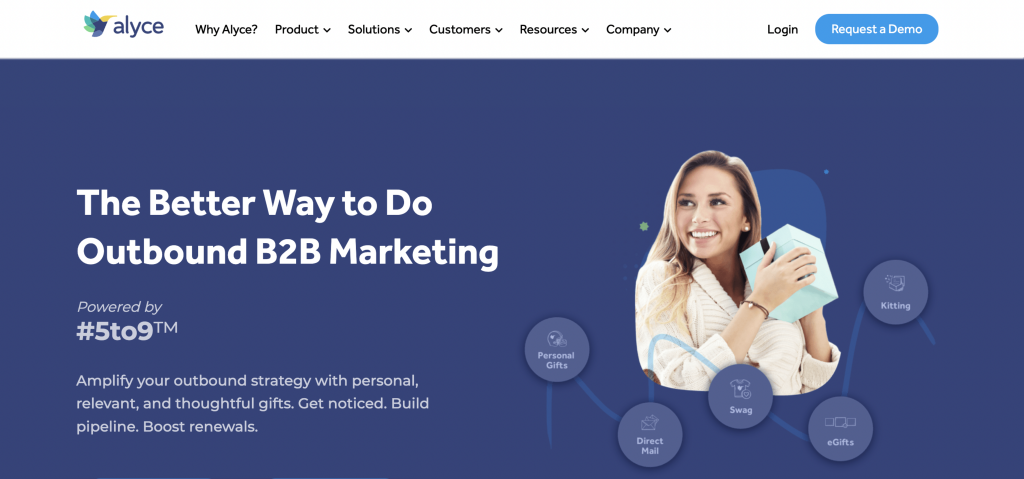
Alyce was acquired by Sendoso in February 2024 and now operates as Alyce by Sendoso. It’s an AI-powered gifting platform with ABM as a core use case, offering personalized gifting to engage, convert, and retain target accounts, including Alyce’s original “5-to-9” personalization approach (gifting based on a recipient’s interests outside of work), now paired with Sendoso’s broader fulfillment network and AI gifting tools.
Features: CRM integration and inventory management, built-in analytics for tracking spend, conversion, and ROI on gifting campaigns.
Pricing: Custom, based on use case and volume.
|
Tool
|
Core Strength
|
Best Fit
|
|---|---|---|
|
6sense Revenue AI
|
Predictive journey scoring
|
Enterprise teams wanting AI-driven account prediction
|
|
HubSpot Marketing Hub
|
Omnichannel personalization, HubSpot-native
|
Teams already running HubSpot as their marketing system of record
|
|
Demandbase
|
Full ABX suite across three modules
|
Teams wanting strategy, ads, and data integration bundled
|
|
Terminus (DemandScience)
|
Native email-signature marketing
|
Teams with large outbound/CS teams wanting a unique channel
|
|
RollWorks
|
Paid-ad-first execution
|
Teams whose ABM motion runs primarily through advertising
|
|
Foundry Intent
|
IDG-derived intent data
|
Enterprise IT/tech vendors already buying Foundry media
|
|
Vainu
|
Account data and list building
|
Teams needing a consolidated view of contacts across tools
|
|
Apollo.io
|
Prospecting + engagement + ABM
|
Teams wanting one platform across the outbound motion
|
|
Uberflip
|
Content personalization
|
Content-heavy ABM programs
|
|
Alyce by Sendoso
|
AI-personalized gifting
|
Account engagement via strategic gifting
|
How ABM Actually Works
Marketers running ABM think of buyers as companies first, individuals second. Marketing and sales jointly identify target businesses, nurture every contact inside the buying committee, and engage the actual decision-makers with messaging built for their specific context, not a generic campaign. It takes more research and coordination than traditional demand gen, but the deal sizes involved tend to justify it.
The Big Challenges of ABM
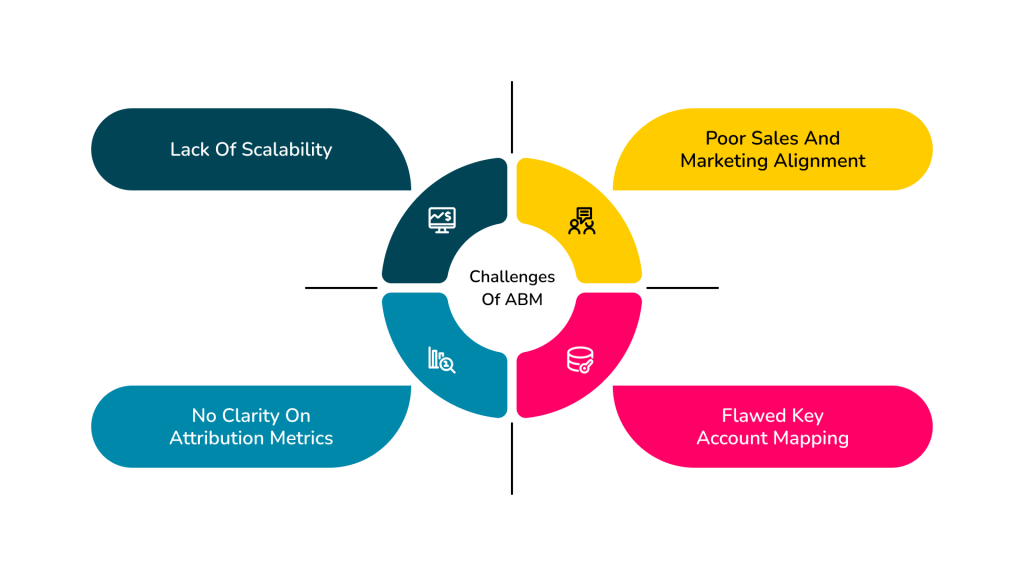
Poor sales and marketing alignment. Different KPIs, different processes, and incomplete or inaccurate lead data all compound into a program where sales and marketing are technically running the same motion but working from different pictures of it. Integrating workflows and syncing campaign reporting closes most of this gap.
Flawed key account mapping. Many ABM programs fail to identify the actual right contacts inside a target account, which quietly caps campaign performance regardless of how good the content is. The fix is putting buyer behavior in the context of the account’s actual org structure and business goals, which depends on having the right underlying data in the first place.
No clarity on attribution. As channels multiply, the underlying activity data gets messier, and multiple buyers with different needs make clean attribution genuinely hard. The right ABM tool helps, but only if it’s working from complete data rather than whatever got manually logged.
Lack of scalability. ABM is high-touch by design, which makes relevant messaging at scale a real tension. A base content template that hits key talking points, iterated per buyer journey, is the standard fix, alongside choosing a tool actually built for scale rather than bolting scale onto a boutique tool.
Every challenge above gets sharper once AI enters an ABM stack. An AI-driven account scoring model, a lookalike-list feature, an AI-personalized gift recommendation, all of it works from the same underlying contact and account data that ABM has always depended on. If that data is incomplete or wrong, the AI layer doesn’t correct it. It amplifies it at scale, recommending the wrong lookalike accounts or personalizing a message based on a stale account profile, and doing so faster and more confidently than a human would have.
This is also where ABM’s data problem intersects with a much larger shift happening across the whole revenue stack: sales and marketing tools increasingly feed AI agents that act on account and contact data directly, not just report on it. Getting that data right isn’t just a targeting-quality question anymore. It’s a governance question.
None of the platforms above fix a problem that sits underneath all of them: most CRMs are missing a large share of the actual buying-committee activity happening inside a target account, meetings that never got logged, stakeholders nobody added as a contact. An ABM tool can only segment, score, and personalize based on the data it has access to.
Nektar isn’t an all-in-one ABM platform. It’s the layer that makes sure the contact and activity data your ABM stack runs on is actually complete. Buying Group Intelligence automatically surfaces first-party contacts hidden inside sales conversations, meetings, and emails, uncovering buying-committee members an ABM tool would otherwise never know existed, and mapping how engaged each one actually is. That feeds directly into more accurate targeting and personalization, since a lookalike-list feature or an account-scoring model is only as good as the contact data it’s built on.


Dan Jiao,
VP RevOps & Strategy, Signifyd
By far the most impactful tool to understand our buyers and their influence. Almost immediately we got the visibility we needed for a long time
Frequently Asked Questions
Q. What’s the difference between ABM tools and general marketing automation?
General marketing automation optimizes for volume, lead capture, and nurture at scale across a broad audience. ABM tools are built around a much smaller, named list of target accounts, with personalization and coordination between sales and marketing built into the workflow rather than added on top of it.
Q. Is Triblio still a standalone ABM tool?
No. Triblio was acquired by IDG (now Foundry) in 2020, and the product has been sold for several years as Foundry Intent, bundled with Foundry’s media and content offerings rather than as an independent ABM platform.
Q. Did Terminus shut down?
No. Terminus merged into DemandScience in November 2024 and continues to operate, including its native email-signature marketing capability, as part of DemandScience’s broader platform rather than as a fully independent company.
Q. How does AI change what to look for in an ABM tool?
The core evaluation criteria haven’t changed, targeting accuracy, personalization depth, integration with your CRM, but the stakes of incomplete data have gone up. An AI-driven feature (account scoring, lookalike lists, personalized content selection) built on incomplete contact or account data produces confidently wrong output rather than a cautious one, so verifying how a tool sources and maintains its account data matters more now than it used to.
Choosing the Right ABM Tool for Your Stack
Start by identifying the actual gap in your current stack: is it reporting, or is it execution? If you need to close gaps in prospect data, prioritize a tool that can clean and integrate CRM data. If you’re trying to grow pipeline, prioritize segmentation and targeting depth. If you’re trying to expand into new markets, prioritize analytics and data management.
A few questions worth asking directly of any vendor on this list: Can the tool run email, advertising, and landing-page campaigns using your actual customer data? Does it support multiple attribution models if you sell more than one product? Can it identify key accounts and decision-makers and adjust messaging accordingly, or does that require manual work on your end?
Either way, the data underneath the tool has to come first. Get a free CRM scan to see how much of your own buying-committee activity is currently visible, and how much is hiding in sales conversations your ABM stack has never seen.