
Best Revenue Intelligence Tools

12 Best Revenue Intelligence Tools for 2026

Revenue intelligence uses AI to capture and analyze customer interaction data like emails, calls, and meetings across sales, marketing, and customer success. It turns raw activity into insight you can act on, throws light on which deals are actually healthy, which reps need coaching, and where the pipeline is quietly leaking.

For most of this category’s history, revenue intelligence fed a human decision-maker who applied judgment before acting on what the data said. Increasingly, that same data now feeds AI agents that directly update CRM fields, flag risks, and trigger workflows with a lot less human judgment sitting between the insight and the action. 

Gartner projects 40% of enterprise applications will include task-specific AI agents by the end of 2026. That raises what “good revenue intelligence” needs to mean: not just insight a person can use, but data clean enough for an agent to act on without making things worse.

Get our latest insights into your inbox

What Is Revenue Intelligence?

Revenue intelligence is a data-backed, AI-driven approach to understanding and forecasting revenue. It pulls raw interaction data from across your revenue functions like sales, marketing, customer success, and turns it into insight: which deals are trending toward close, which are stalling, and what a rep should actually do next.

How Revenue Intelligence Platforms Create Impact

1. It integrates siloed data

Most organizations have sales, marketing, and customer success data trapped in separate systems. Revenue intelligence pulls it into a single, continuously updated source of truth rather than treating data cleanup as a one-time project.


Rosalyn Santa Elena
Founder, The RevOps Collective

I have seen a lot of companies try to clean up their data through third parties as a one-time event. But you can't approach your data as a one-time action. It's an ongoing and iterative process.


2. It closes the gap between what’s logged and what actually happened

A large share of buyer-seller activity never makes it into the CRM at all. Meetings go unlogged, or nobody adds key stakeholders as a contact. Revenue intelligence automates that capture instead of relying on reps to remember.

3. It surfaces deal risk before it’s a lost deal

Multithreading gaps, stalled engagement, missing buying-committee coverage are all visible in interaction data well before they show up as a lost opportunity in the pipeline report.

4. It improves rep coaching

Instead of an interrogation-style deal review, revenue intelligence gives managers specific, data-backed coaching moments like this deal has gone quiet, or this rep hasn’t engaged the economic buyer, rather than generic advice.

5. It drives more predictable revenue

As much as 80% of sales organizations miss the mark on revenue forecasting by 25% or more. The primary underlying reason is dirty data. Without an accurate forecast, your teams won’t have any direction for revenue strategies. Using revenue intelligence, you can create quality forecasts to help your team budget, strategize business growth, set long-term goals, and secure funding.

Also, given their use of AI, your forecasts are void of bias resulting from less manual intervention.

Asia Corbett
Senior RevOps Manager, GTM, Bread Financial

If you don't have good data, you can't forecast. If you can't forecast, you can't build a scalable and repeatable sales motion. You don't know what your pipeline is going to be, or what money is going to come in.


12 Best Revenue Intelligence Tools for 2026

  1. Nektar: GTM data foundation and AI signal layer
  2. Salesforce CRM Analytics: native Salesforce analytics and predictive insights
  3. HubSpot Sales Hub: CRM and sales engagement for HubSpot-native teams
  4. ZoomInfo Chorus: conversation intelligence backed by B2B data
  5. Xactly: revenue intelligence tied to incentive compensation
  6. Mediafly Intelligence360 (formerly InsightSquared): revenue analytics and forecasting
  7. Revenue.io (formerly ringDNA): sales engagement and conversation guidance
  8. Kluster: forecasting and pipeline process standardization
  9. Salesloft: sales engagement, now part of Clari + Salesloft
  10. Akoonu (RevWorks): native Salesforce forecasting and pipeline intelligence
  11. Cien: AI-driven sales performance analytics
  12. Aviso AI: agentic forecasting and revenue execution

Overview of the 12 Best Revenue Intelligence Tools

1. Nektar
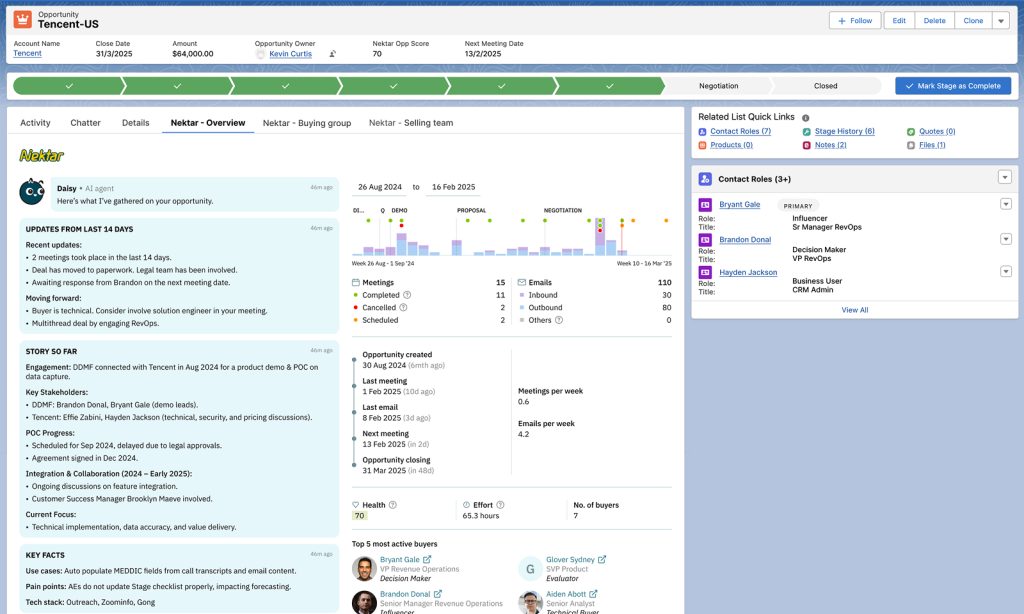
Nektar is the GTM telemetry platform that automatically captures every customer interaction and delivers clean data to your CRM, data warehouse, and AI applications, all with zero manual entry or adoption friction.

It makes Salesforce safe for AI execution. As more of your GTM stack, be it Agentforce, Clari, your own AI agents, starts acting on CRM data autonomously, the CRM has to be complete and correct, continuously, or every agent built on top of it inherits the error.

Nektar flows this valuable data directly into core business systems like Salesforce, Snowflake, Claude and your entire stack, ensuring customer insights are accessible across all GTM teams & downstream AI initiatives.

Pankaj G
Head of GTM Systems, Nektar

Nektar solved our biggest CRM data problem: incomplete and inconsistent activity data in Salesforce. Contacts were missing from opportunities, engagement history was spotty, and any report built on activity data was unreliable. Now activities flow into Salesforce automatically and land on the right accounts and opportunities, with contacts created and linked as opportunity contact roles without anyone touching a keyboard.


Notable features: zero-rep-effort capture, buying-group intelligence, Time Travel™ retroactive correction, Daisy AI signal library (39 signals across 8 categories), vendor-neutral integration alongside your existing sales stack.

Pricing: Custom, based on team size and scope. A free CRM scan will show how much of your own pipeline activity is currently missing.

2. Salesforce CRM Analytics
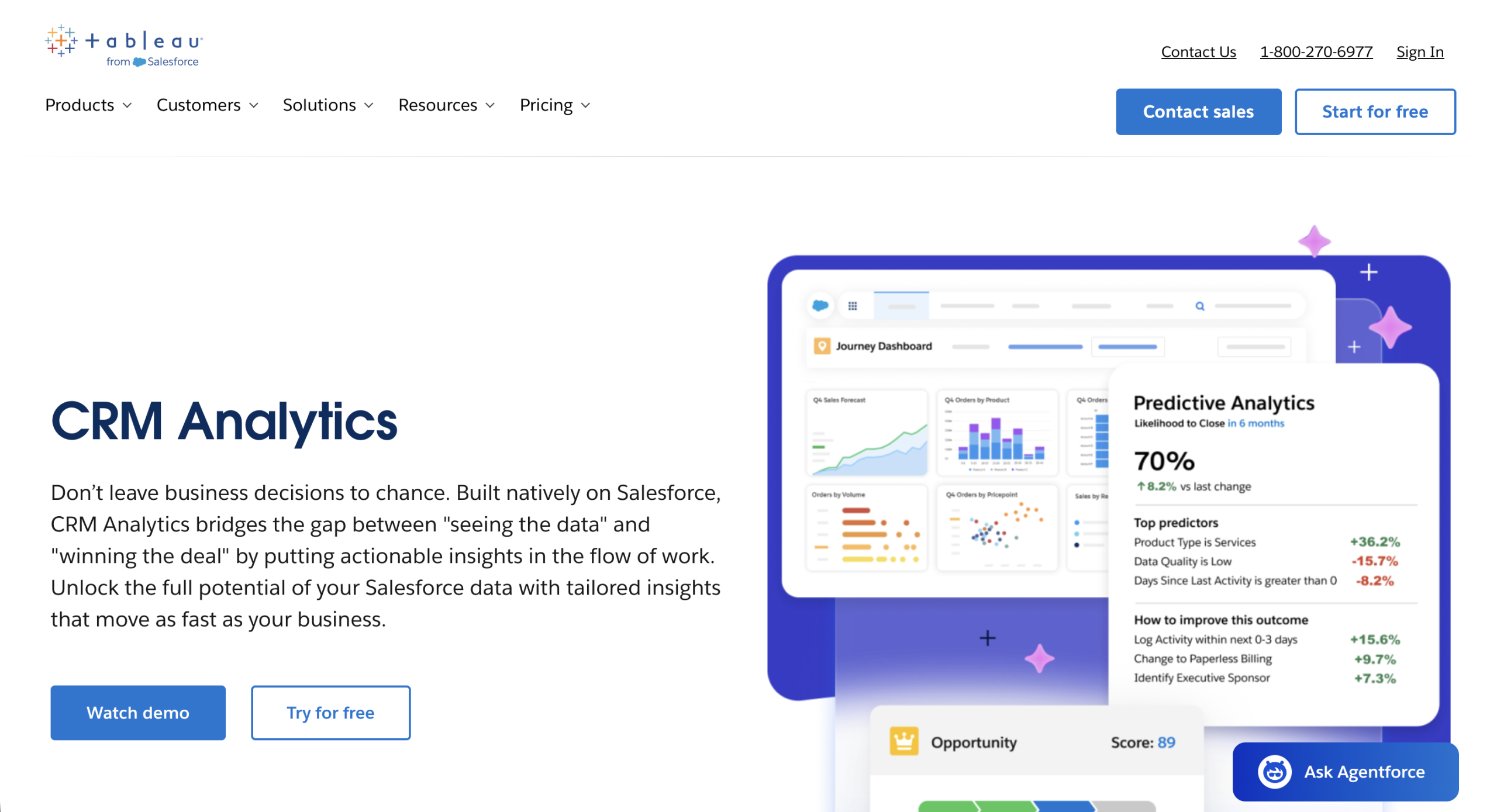
Salesforce CRM Analytics (formerly Einstein Analytics, then Tableau CRM) remains Salesforce’s native analytics layer: predictive insights and next-best-action recommendations embedded directly in the flow of Salesforce work. It’s evolved to connect with Data Cloud and Tableau Next, positioning it as part of Salesforce’s broader agentic analytics push rather than a standalone BI tool.

Notable features: predictive analytics natively embedded in Salesforce, Slack integration for surfaced insights, inherited Salesforce security and governance, connection to Data Cloud for agentic use cases.

Pricing: Tiered by edition; the Revenue Intelligence-focused package has historically run around $200/user/month confirm current pricing directly with Salesforce, since packaging shifts with each release.

3. HubSpot Sales Hub
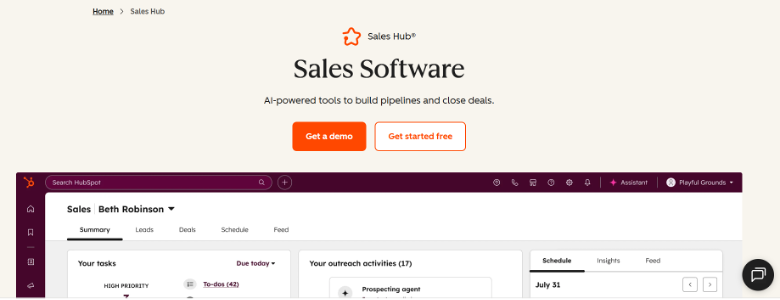
HubSpot Sales Hub centralizes sales activity, pipeline management, and conversation intelligence for teams running on HubSpot, with a free tier and paid tiers scaling up from there.

Notable features: sales automation and sequencing, conversation intelligence, meeting scheduling, deep integration across HubSpot’s broader product suite.

Pricing: Free tier available; paid tiers start around $20/seat/month, scaling with automation and reporting needs. Check HubSpot’s current pricing page, since tiers and seat structures have changed multiple times in the past year.

4. ZoomInfo Chorus
Chorus

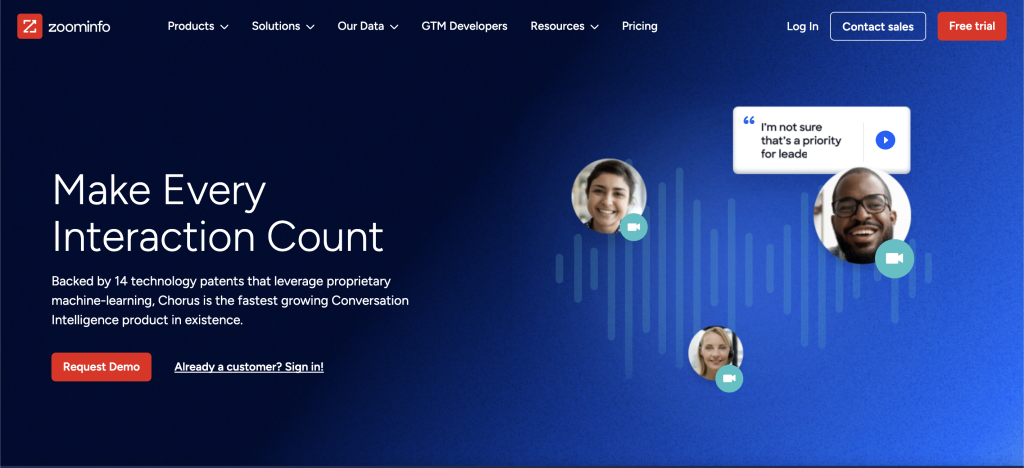
Chorus has been part of ZoomInfo since 2021 (not Zoom, a common mix-up) and now runs on ZoomInfo’s broader B2B data layer, the GTM Context Graph. It transcribes and analyzes sales calls for buying signals, risk language, and competitive mentions.

Notable features: conversation intelligence backed by ZoomInfo B2B data, deal-risk and momentum alerts, coaching dashboards, integration with ZoomInfo’s broader GTM platform.

Pricing: Custom, quote-based.

5. Xactly
Xactly

Xactly combines incentive compensation management with revenue intelligence — forecasting, pay-performance analytics, and market benchmarking aimed at aligning rep incentives with revenue outcomes.

Notable features: forecasting and pipeline management (Xactly Forecasting), pay-and-performance analytics (Xactly Insights), market benchmarking, cross-system data integration.

Pricing: Custom, quote-based.

6. Mediafly Intelligence360 (formerly InsightSquared)
Mediafly

InsightSquared’s standalone product was retired in January 2023 after Mediafly’s 2021 acquisition; its capabilities now live inside Mediafly Intelligence360, spanning conversation intelligence, activity capture, forecasting, and RevOps dashboards.

Notable features: AI-powered forecasting, live pipeline management, call recording and transcription, interactive RevOps dashboards.

Pricing: Custom, quote-based; third-party sources cite a starting price around $65/month for lower tiers, with most enterprise deployments quote-based.

7. Revenue.io (formerly ringDNA)
revenue io

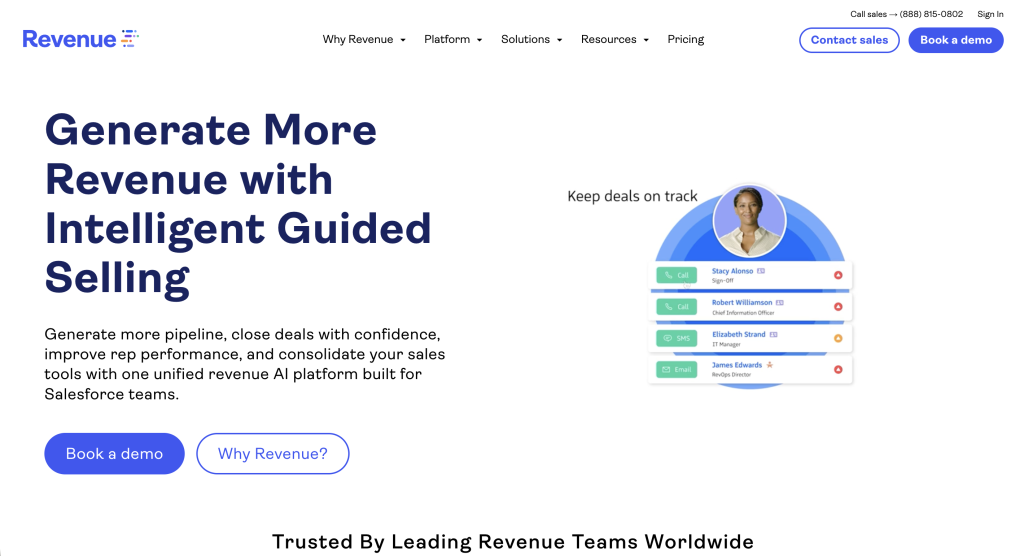
Revenue.io logs sales engagement activity and delivers real-time conversation guidance — nudges reps toward the next best action based on what’s actually happening on a call.

Notable features: conversation intelligence and live nudges, sales forecasting, coaching insights, multichannel playbooks.

Pricing: Custom, quote-based across four packages.

8. Kluster
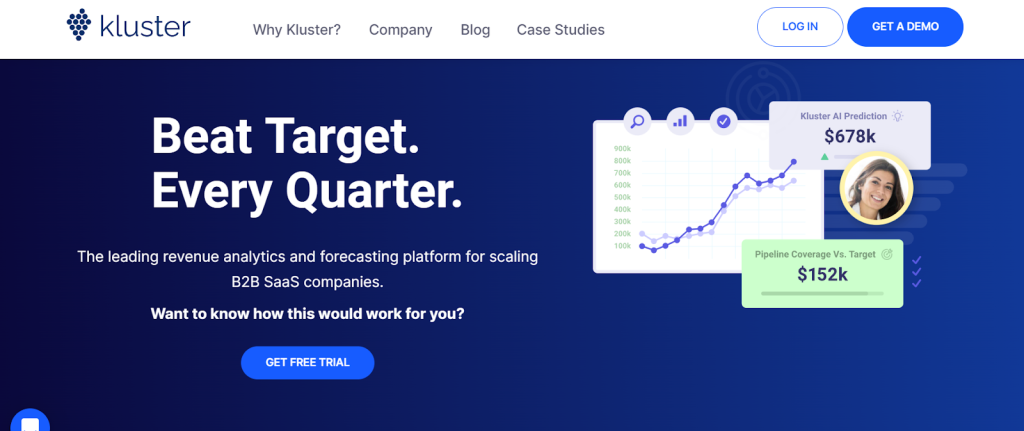
Kluster standardizes the forecasting and pipeline-review process with consistent cadence, repeatable reporting, and pipeline-change analysis rather than a rebuilt process every cycle.

Notable features: live forecasting, revenue analytics, pipeline-change tracking, security alerts for pipeline anomalies.

Pricing: Custom, with a free trial available.

9. Salesloft
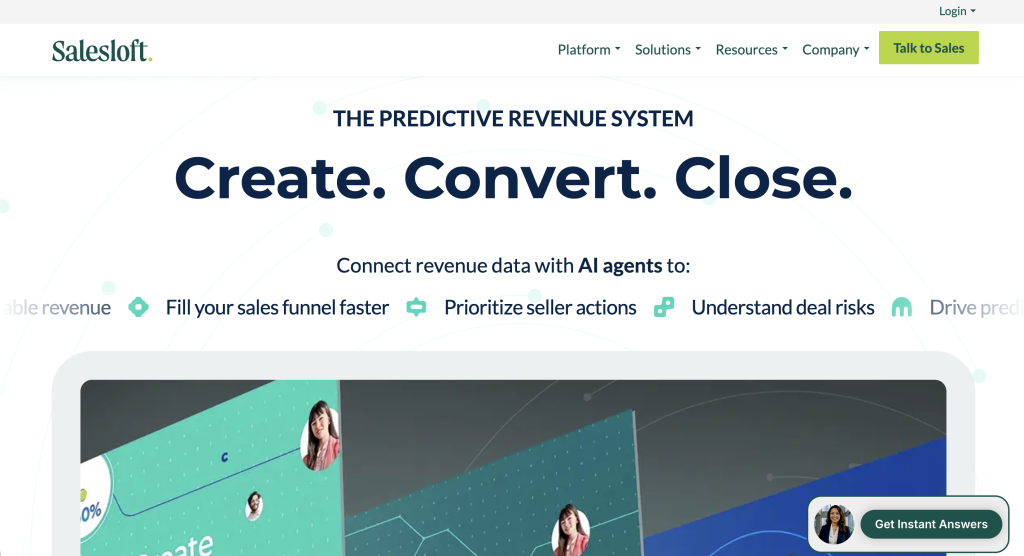
Salesloft, now part of the combined Clari + Salesloft entity following their December 2025 merger, remains a leading sales engagement platform with offerings like cadence automation, dialer and messaging, and forecasting for outbound-heavy teams.

Notable features: automated multichannel cadences, dialer and messenger, sales forecasting, coaching workflows.

Pricing: Custom, quote-based.

10. Akoonu (RevWorks)
akoonu

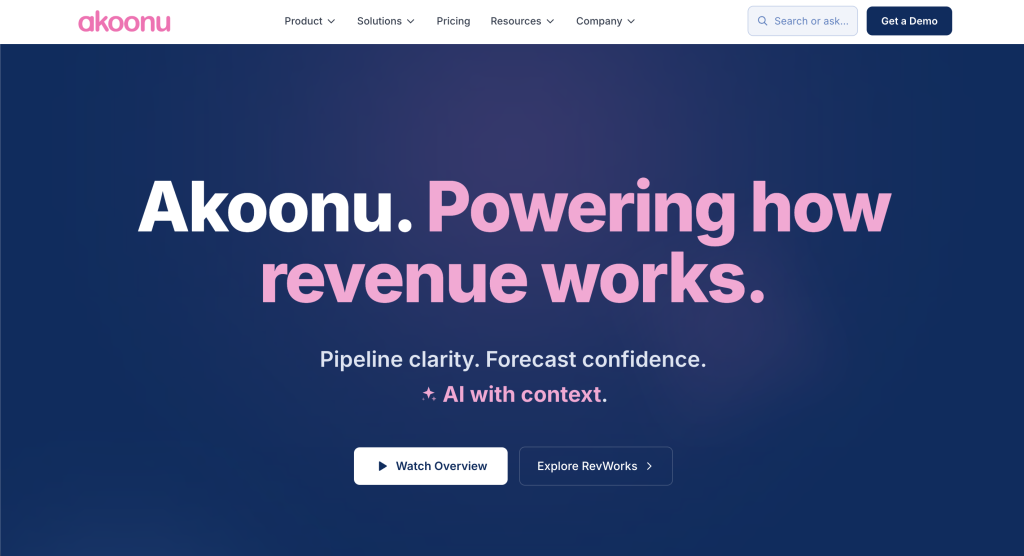
Akoonu, rebranded around its RevWorks platform, builds forecasting and pipeline intelligence 100% native to Salesforce. No external data sync, live Salesforce data throughout, with an AI assistant (Oonu) layered on top for deal-level context and risk flags.

Notable features: native Salesforce forecasting with structured submission cadence, pipeline reviews and scenario modeling, quota management, AI-generated forecast digests.

Pricing: Starts around $50/company/month for base tiers; RevWorks AI tier priced separately. Org-wide pricing rather than per-seat.

11. Cien
Cien

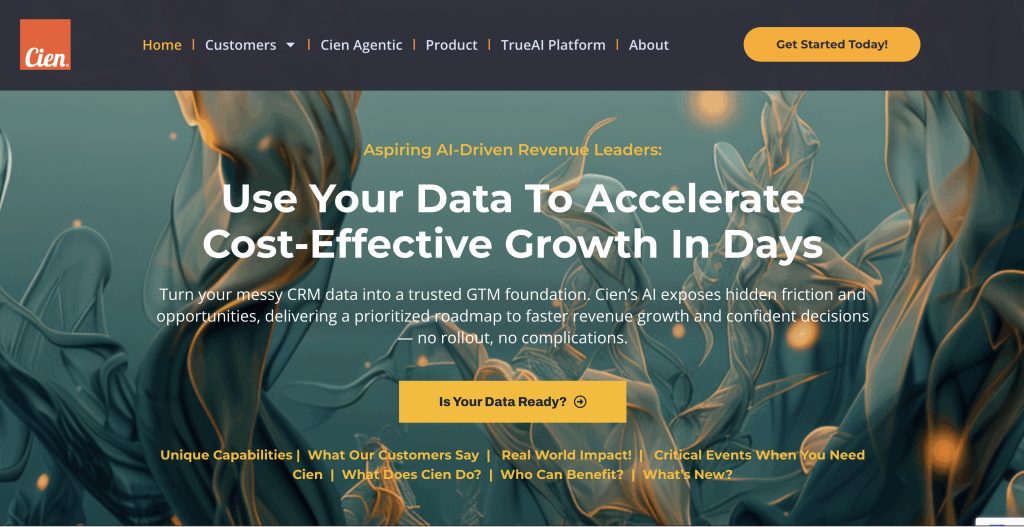
Cien analyzes sales performance data to identify what’s actually driving (or blocking) quota attainment, factoring in behavioral and human elements alongside raw activity metrics.

Notable features: sales performance dashboards, rep scorecards, deal prioritization, coaching intelligence.

Pricing: Historically around $500/month flat for a single team, or $49/month per user for a full sales organization; confirm current tiers directly.

12. Aviso AI
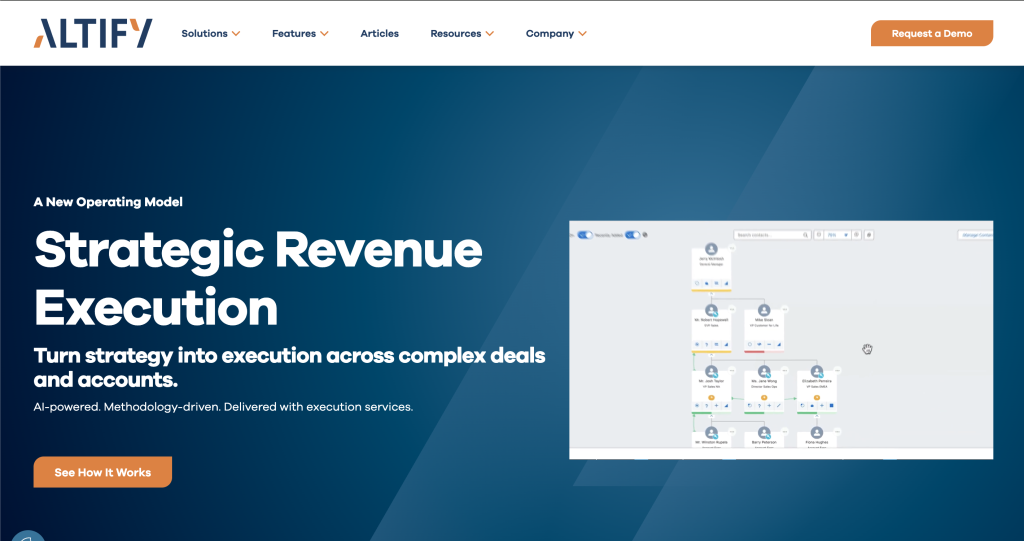
Aviso has moved from a pure forecasting tool into an agentic revenue platform built around MIKI, a conversational orchestrator that queries pipeline data and triggers CRM updates directly, alongside a library of 50+ pre-built revenue agents.

Notable features: MIKI conversational AI orchestrator, predictive forecasting, real-time deal coaching, no-code agentic workflow builder.

Pricing: Custom, quote-based.

Revenue Intelligence Tools Compared

Tool
Core Strength
Best Fit
Nektar
CRM data completeness + AI signal layer
Salesforce-first teams building on AI
Salesforce CRM Analytics
Native Salesforce predictive analytics
Teams already deep in the Salesforce/Data Cloud ecosystem
HubSpot Sales Hub
CRM + sales engagement natively bundled
HubSpot-native teams
ZoomInfo Chorus
Conversation intelligence + B2B data
Teams already on ZoomInfo
Xactly
Revenue intelligence tied to compensation
Aligning rep incentives with revenue outcomes
Mediafly Intelligence360
Full-stack revenue analytics
Teams wanting forecasting + conversation intel bundled
Revenue.io
Real-time conversation guidance
Outbound-heavy teams wanting live call coaching
Kluster
Forecasting process consistency
Standardizing pipeline review cadence
Salesloft
Sales engagement and cadence automation
Outbound-heavy teams, now part of Clari + Salesloft
Akoonu (RevWorks)
Native Salesforce forecasting
Teams wanting forecasting with zero data sync outside Salesforce
Cien
AI-driven sales performance analytics
Diagnosing what's actually driving quota attainment
Aviso AI
Agentic forecasting
Teams wanting AI agents built into forecasting

How to Roll Out Revenue Intelligence Tools

  1. Understand rep needs first. Figure out where reps actually lose time before choosing a tool to fix it.
  2. Involve reps early. Adoption depends on reps understanding why a tool matters to them specifically, not just to leadership reporting.
  3. Match tools to actual capabilities needed. Not every team needs conversation intelligence, forecasting, and activity capture from the same vendor. Assess what’s actually missing first.
  4. Define your data sources. Know where your revenue data currently lives before evaluating a tool meant to unify it.
  5. Pilot before committing. Use demos and trials, and ask specific questions about data completeness and integration depth rather than generic feature checklists.
  6. Train reps on the “why,” not just the “how.” Deployment doesn’t end at purchase. Reps need to understand the specific use cases that make the tool worth their time.

Frequently Asked Questions

Q. What’s the difference between revenue intelligence and RevOps software?

RevOps software is the broader category: process, planning, and cross-functional alignment. Revenue intelligence is a subset focused specifically on analyzing interaction data (calls, emails, meetings) to surface deal risk and coaching signals. Most RevOps stacks include at least one revenue intelligence tool.

Q. Does Nektar replace conversation intelligence tools like Chorus?

No. Nektar focuses on capturing complete email, meeting, and calendar activity and structuring it in the CRM. It’s vendor-neutral and typically runs alongside a conversation-intelligence tool rather than replacing it.

Q. Why does revenue intelligence matter more now than it did a few years ago?

Because a growing share of the data it produces now feeds AI agents that act on it directly: updating CRM fields, flagging risk, triggering workflows with less human judgment in between. Incomplete or inaccurate data used to just produce a misleading report; now it can produce a wrong automated decision nobody catches in time.

Scale Your Revenue Engine With Trustworthy Data

Revenue intelligence tools are only as good as the data feeding them. Before layering on forecasting, conversation intelligence, or agentic AI, it’s worth confirming the underlying activity data is actually complete. Most CRMs are missing a large share of what’s genuinely happening in a deal.

Get a free CRM scan to see the gap between what’s logged and what’s actually happening in your pipeline, or explore Daisy AI and GTM Telemetry for the full picture of what Nektar surfaces once that gap is closed.

Enjoyed our content? Follow Nektar on LinkedIn
In this blog

See the gap between what's logged and what's actually happening in your pipeline

Revenue intelligence tools empower you to boost revenue growth.

The right revenue intelligence tools can help you nurture leads and retain customers with an exceptional experience. 

And its critical role in the RevOps process is expanding as the economy progresses on a whirlwind journey. 

According to Gartner’s recent report, by 2025:

  • 70% of all B2B seller-buyer interactions will be recorded or analyzed to collect competitive, deal, and market insights using AI, ML, and NLP.
  • 75% of B2B sales companies will switch traditional sales playbooks with AI-based guided-selling solutions.

Deploying a revenue operation and intelligence (ROI&I) tool is the best next step for your business. So, let’s find out more about.

revenue intelligence tools

What is Revenue Intelligence?

Revenue Intelligence is a data-backed, AI-driven approach to selling. 

It uses AI to track, analyze and forecast revenue so you can adapt to a constantly changing business environment quickly. 

But, how does revenue intelligence help you survive and thrive? 

It leverages raw data from multiple sources of your revenue functions (including marketing, sales, customer success, and finance). AI transforms this data into powerful insights to accelerate your sales cycles and grow revenue.

RO&I tools facilitate the activity data capture from buyer-seller interactions in an increasingly complex selling process. You can easily use this information to coach reps to anticipate buyer needs.

Qualitative insights, courtesy of revenue intelligence tools, direct your decision-making with the help of historical and real-time data.

How do Revenue Intelligence Platforms Work in B2B Sales? (With Examples)

We’ve already seen the overall impact of revenue intelligence in B2B sales. But how exactly does it create this impact? Let’s find out.

1. Integrates Siloed Data

For 90% of organizations, data silos are a considerable challenge to business growth.

Revenue intelligence solves the siloed data problem by integrating data from multiple sources into a single source of truth.

Even better is that RO&I tools can do this continuously, in real-time, so that you can keep data silos at bay regularly. That’s impressive, considering RevOps experts advocate for ongoing data cleaning processes.

I have seen a lot of companies try to clean up their data through third-parties as a one-time event. But you can’t approach your data as a one-time action. It’s an ongoing and iterative process.

Rosalyn Santa Elena, Founder at The RevOps Collective

In the real world, reps use multiple tools with different dashboards. Plus, data comes in from multiple sources in revenue teams—sales, marketing, and customer success. 

RO&I tools can gather, clean, match, and enrich revenue information in the CRM and across the tech stack. 

You can use this integrated data for informed decision-making, coaching, team alignment, revenue forecasting, and much more.

Revenue intelligence ensures that clean data exists in your tech stack (particularly the CRM), which becomes a solid foundation for all your revenue activities.

2. Champions Frictionless Buying Experience

A solid data foundation, in turn, ensures you can share information between revenue teams seamlessly.

Each team gets complete access to integrated, unified, consistent data about customer touchpoints, interactions, and feedback.

Its impact can be seen in a frictionless buying experience

Without access to complete contact data across touchpoints, revenue teams—marketing, sales, and customer service–give and receive ineffective handovers. At each sales funnel stage, buyers may have to share the same information repeatedly, leaving them frustrated.

Since revenue intelligence makes data available across the tech stack, it reduces friction between handoffs and aligns teams on each buyer’s journey.

3. Seals Revenue Leaks

95% of CRM users and stakeholders blame data quality issues for seriously impairing their ability to leverage the CRM fully.

Revenue intelligence software straighten out the problem through automation. They automate contact data capture, thus, eliminating manual errors by those who enter information in the CRM.

In the process, you get complete information on each buying group member’s requirements. This gives you insight into which leads are most likely to convert

Revenue intelligence collectively ensures there are no blind spots or missed opportunities in the revenue pipeline.

For example, without accurate contact details, reps may not have complete information on stakeholders and their needs. As a result, they reach out to the buyer group with incorrect and irrelevant information that doesn’t serve their purpose.

RO&I tools can plug these revenue leaks by:

  • Improving multithreading
  • Giving in-depth information on buyers across the pipeline
  • Sending deal alerts for hot opportunities 
  • Guiding sellers with specific deal insights 

4. Improves Rep Productivity

Imagine a scenario where managers overestimate reps’ abilities to sell. They could assume that reps are enterprise sellers and have a well-equipped skillset. 

But the fact is that even the best can get better with continued coaching and mentoring.

Instead of using seller data in an interrogation-style deal review, revenue intelligence tools give you the insights to replace the approach with a guidance-style review. 

You can guide reps to use the best-selling processes or motions. This not only increases conversion but also accelerates the sales cycle to close more leads faster.

Plus, with revenue intelligence, you can track reps’ performance and productivity. 

5. Helps Drive Predictable Revenue 

As much as 80% of sales organizations miss the mark on revenue forecasting by 25% or more. The primary underlying reason—dirty data

If you don’t have good data, you can’t forecast. If you can’t forecast, you can’t build a scalable and repeatable sales motion. You don’t know what your pipeline is going to be. Or what money is going to come in.

Asia corbett, Senior Revops manager, gtm, bread financial

Without an accurate forecast, your teams won’t have any direction for revenue strategies. Using revenue intelligence, you can create quality forecasts to help your team budget, strategize business growth, set long-term goals, and secure funding.

Also, given their use of AI, your forecasts are void of bias resulting from less manual intervention.

How to Incorporate Revenue Intelligence Tools in Operations?

Incorporating revenue intelligence into your daily operations is vital but must not be hard. Here’s an 8-step process to introducing your teams to revenue intelligence tools.

1. Connect with your reps

You must first figure out your reps’ needs and pain points. Once you’ve dived deep into their daily operations, you can understand better how to incorporate revenue intelligence tools in their workflow.

2. Involve reps in the process

To fully adopt RO&I tools, your reps must understand why these tools matter. Impress the importance of revenue intelligence and how the tools can solve their problems.

3. Select tools

Ensure the tools you select are designed with your reps’ needs in mind. Each tool must come adequately equipped with seller-centric features, including guided selling

4. Assess capabilities 

A single tool may not have all the functionalities you need to extract revenue insights effectively. 

Gartner lists down the capabilities you must look out for in its recent guide. According to this guide, your revenue intelligence tools must have the five core capabilities and a few non-core capabilities. 

Capabilities of Revenue Intelligence Tools, According to Gartner (Source)

5. Define data sources

You can define and assess your data sources based on where your data comes from during the sales process and determine their size.

6. Identify gaps

Now that you know reps’ needs and revenue intelligence capabilities, you can identify the gaps or revenue leaks in your sales funnel.

7. Select the best tool(s)

Select the tool best suited to your reps’ requirements and that can fill your revenue gaps. You can figure out the best tools from the pack by making the most of demos or free trials and asking extremely specific questions

8. Train your reps

Your role in deploying revenue intelligence tools doesn’t end at purchase. Reps need special training to understand each tool’s use cases and effectively leverage this knowledge.

Now that you’re familiar with deploying revenue intelligence tools, we’ve curated a list of the top 15 tools you should start with.

15 Revenue Intelligence Tools for 2023

Remember, each revenue intelligence tool has a unique set of capabilities. Assess and try them all before arriving at a decision.

1. Nektar

Nektar.ai is the world’s first AI for revenue operations platform that automatically captures contact and customer interaction data to unlock hidden revenue opportunities. 

Using the platform, you can transform your Salesforce into a self-healing CRM. Not just that, you can also automate CRM data entry with 95%+ accuracy and zero rep adoption. 

Nektar offers quick launch and quick value in under a week. You get access to full-funnel visibility, which improves rep productivity and drives revenue predictability. 

Notable features 

  • Aggregation of buyer contact and activities 
  • Integration from multiple sources 
  • Only 90 mins to go live
  • Plugs historical data gaps from Day 1
  • Microscopic leading indicators 
  • Contextual sorting of data
  • Customized Insights Hub
  • Seamless co-existence with current GTM tools

Pricing

Nektar.ai offers custom packages for unique business needs.

2. Salesforce CRM Analytics

Salesforce CRM Analytics acts as a unified revenue management command center. It shares predictive insights and prescriptive recommendations for not just customer-facing teams but also revenue leaders. 

The tool lets your teams collaboratively act on AI-driven revenue intelligence. 

Salesforce CRM Analytics also offers special features for specific industries.

Notable features

  • Predictive analytics 
  • Data visualization
  • Big Data services
  • Search Insights using NLP
  • Integrations with multiple data sources
  • Custom dashboards and templates
  • No-code AI

Pricing

Salesforce has 4 editions of CRM Analytics depending on your needs. The Revenue Intelligence package costs $200 per user per month.

3. HubSpot Sales Hub®

HubSpot is a great revenue intelligence tool to centralize your strategic and tactical revenue initiatives.

The Sales Hub streamlines your sales process with a frictionless user experience. It integrates your tools and data into one powerful CRM. 

HubSpot’s sales software empowers your teams to close more deals, develop meaningful buyer relationships, and effectively manage the pipeline from a unified dashboard.

Notable features

  • Sales automation 
  • Quote and CPQ functionality
  • Integration with 1,340 HubSpot tools 
  • Conversational intelligence 
  • Email templates and tracking 
  • Document management and tracking 
  • Call tracking 
  • Meeting scheduler 
  • Live chat 
  • Mobile CRM app

Pricing

HubSpot Sales Hub is available for free with limited functionality. The premium packages start at $45 per month.

4. Oracle Sales 

Oracle Sales is a comprehensive platform for the sales team to optimize their selling success for revenue growth. 

Reps can coordinate across sales channels with other team members and partners via phone or web applications. 

The platform automates the entire sales cycle so you can concentrate on building profitable customer relationships. 

Notable features

  • Account planning 
  • Sales coaching
  • Customer and contact management
  • Lead and opportunity management
  • Forecast management 
  • Self-service order tracking 
  • Multilingual and multi currency support 
  • Integration within the Oracle ecosystem 

Pricing

Choose from Oracle’s custom packages for your unique business needs. 

5. Gong

Gong uses AI to capture and analyze customer interactions. It provides complete visibility into revenue trends and gaps and shares data-backed recommendations for decision-making.

You can access granular insights into pipeline health, churn risk, customer experience, and successful seller behaviors.

Notable features

  • Call recording and speech-to-text 
  • Call analytics
  • Agent performance management 
  • Customer scoring
  • Training materials
  • Leaderboard and scorecard for reps 
  • Support for 70+ languages 

Pricing

Gong’s pricing is customized for your business requirements.

6. Chorus.ai

Chorus.ai turns more conversations into revenue with patented capabilities for conversational intelligence. 

It transcribes and analyzes sales meetings in real-time to mitigate deal or churn risks. 

You can also identify winning seller behaviors and replicate these among your teams to improve conversions.

Notable features

  • Competitive intelligence 
  • Integration with existing tools
  • Self-learning AI
  • Risk language detection 
  • Proactive recommendations 
  • Coaching initiatives dashboard 

Pricing

Chorus.ai’s pricing packages can be tailored to your needs. 

7. Xactly

Xactly offers a suite of solutions to aggregate and analyze revenue data. It leverages predictive analytics to improve revenue efficiency and workflows. 

Xactly’s revenue intelligence software unify GTM teams with technology, process, and data. It aims to grow top-line revenue without compromising bottom-line margins.

Notable features

  • Xactly Forecasting: Pipeline management, forecasting accuracy 
  • Xactly Insights: Pay and performance analytics 
  • Xactly Benchmarking: External market factors’ analysis
  • Xactly Connect: Integration of data flow among business applications 

Pricing

Xactly has custom-built packages based on your requirements.

8. Mediafly Intelligence360

Formerly known as InsightSquared, Mediafly Intelligence360 provides multiple capabilities to drive business growth under one roof. 

It offers conversation intelligence, data capture, sales analytics, KPI tracking, pipeline management, and revenue forecasting. 

The platform aims to shorten the distance between data and insights for revenue and sales leaders. 

Notable features

  • Multi-device data visualization
  • Live forecasting
  • Live pipeline management 
  • Activity tracking
  • Recording, transcription, and analysis of sales calls
  • Interactive dashboard and reports

Pricing

Pricing for Intelligence360 is customizable and available on request.

9. Groove

Groove aims to maintain complete transparency between reps, managers, and RevOps teams. 

It enables real-time Salesforce reporting and collaboration among teams on account lists. 

With its comprehensive features, the platform empowers reps and managers to align their workflows in a centralized workspace. 

Notable features

  • Live and interactive pipeline reviews 
  • Account status update
  • Record the next steps without switching tools 
  • Email, calendar, LinkedIn, and Zoom integration
  • Online scheduler
  • Auto-dialler and call logging 
  • Sales workflows
  • Template building 

Pricing

Groove provides custom pricing packages for sales leaders.

10. Revenue.io

Formerly known as ringDNA, the Revenue.io platform is built for high-performing revenue teams. 

It logs your sales engagement activities and converts the data into numbers so you can oversee operations and measure performance. 

It also shares real-time guidance and recommendations to empower reps with the insights to “engage with the right person on the right channel at the right time and with the right message.”

Notable features

  • Conversation intelligence and nudges
  • Sales forecasting
  • Coaching insights
  • Recommendations on the next best actions 
  • Buyer prioritization
  • Multichannel playbooks

Pricing

You can choose between four pricing packages based on functionalities. Pricing is available on request.

11. Kluster

Kluster helps with revenue forecasting for B2B SaaS companies. 

With its easy-to-use tools, you can define winning revenue strategies and seamlessly execute deal and pipeline management. 

The platform elevates your decision-making capabilities for revenue growth.

Notable features

  • Target planning
  • Live forecasting
  • Revenue analytics
  • Pipeline change analysis
  • Security alerts for pipeline 

Pricing

Kluster’s pricing model is customized for each organization’s needs. However, you do get access to a free trial.

12. Salesloft

Salesloft’s Modern Revenue Workspace is the only complete sales engagement system currently available for sales teams. 

It executes digital selling tasks, lets reps communicate with buyers, and offers the next best action recommendations. 

The platform enables you to reach and exceed revenue goals at each buyer journey stage.

Notable features

  • Automated and customizable cadence journeys 
  • Dialer and messenger
  • Send sales emails at scale
  • Sales forecasting
  • “Coach to Close” workflow 

Pricing

Salesloft offers personalized packages on request. 

13. Akoonu

Akoonu helps you confidently build forecasts within Salesforce with a 100% native integration. 

You can easily and efficiently monitor, review and analyze your pipeline for accurate forecasts. 

The platform supports all levels of your revenue team, from reps to leaders. 

Notable features

  • Pipeline reviews
  • Real-time deal insights
  • Easy installation and setup
  • Flow views
  • Configurable filters and fields
  • Forecast submissions and histories 
  • Deal, rep and team-level adjustments 

Pricing

Akoonu’s subscription plans start from $25 per month. 

14. Celonis

Celonis is particularly built to reveal hidden business and process efficiencies. 

Its Execution Management System finds and fixes these inefficiencies so that your data can flow freely across your systems and revenue applications. 

With a 360-degree view of your business processes, you can empower revenue teams to continually improve their performance. 

Notable features

  • 100+ process connectors
  • 500+ pre-built apps
  • 1000+ integrations 
  • Order and inventory management
  • Celonis Studio for building apps
  • Reusable data extractor builder
  • Simplified data transformation 
  • Business miner 

Pricing

You can get started with a free account to try out the tool. Other packages are custom-built for each company. 

15. Cien

Cien aims to dig into sales performance, improve productivity and increase effectiveness. 

The data-driven AI platform shares insights into causes of low quota attainment that prevent reps from achieving their goals. 

It takes into account human and behavioral elements so you can unleash bigger coaching potential and have the best one-on-one deal reviews. 

Notable features 

  • Sales performance dashboard
  • Rep scorecards
  • Fit and interest analysis
  • Deal prioritization
  • Quote forecasting
  • Coaching intelligence 
  • Value intelligence 
  • Opportunity dashboard

Pricing

Cien has two packages priced at a flat fee of $500 monthly (single team) and $49 monthly per user (full sales squad).

Scale your Business with Revenue Intelligence

Revenue intelligence will continue gathering steam as businesses find newer ways to grow. Choose the right revenue intelligence platforms to leverage insights for powerful decision-making.

But remember, at the core of it is clean data. Therefore, one of the first tools you must set up should ensure your fuel (aka data) running through the tech stack clean.

Eliminate data inefficiencies with Nektar.ai. Check out our video below to learn more. Or talk to our team.


Bhaswati

Director of Content Marketing at Nektar.ai, an AI-led contact and activity capture solution for revenue teams. With 11+ years of experience, I specialize in crafting engaging content across blogs, podcasts, social media, and premium resources. I also host The Revenue Lounge podcast, sharing insights from revenue leaders.

In this blog

Scroll to Top

Just one more step