

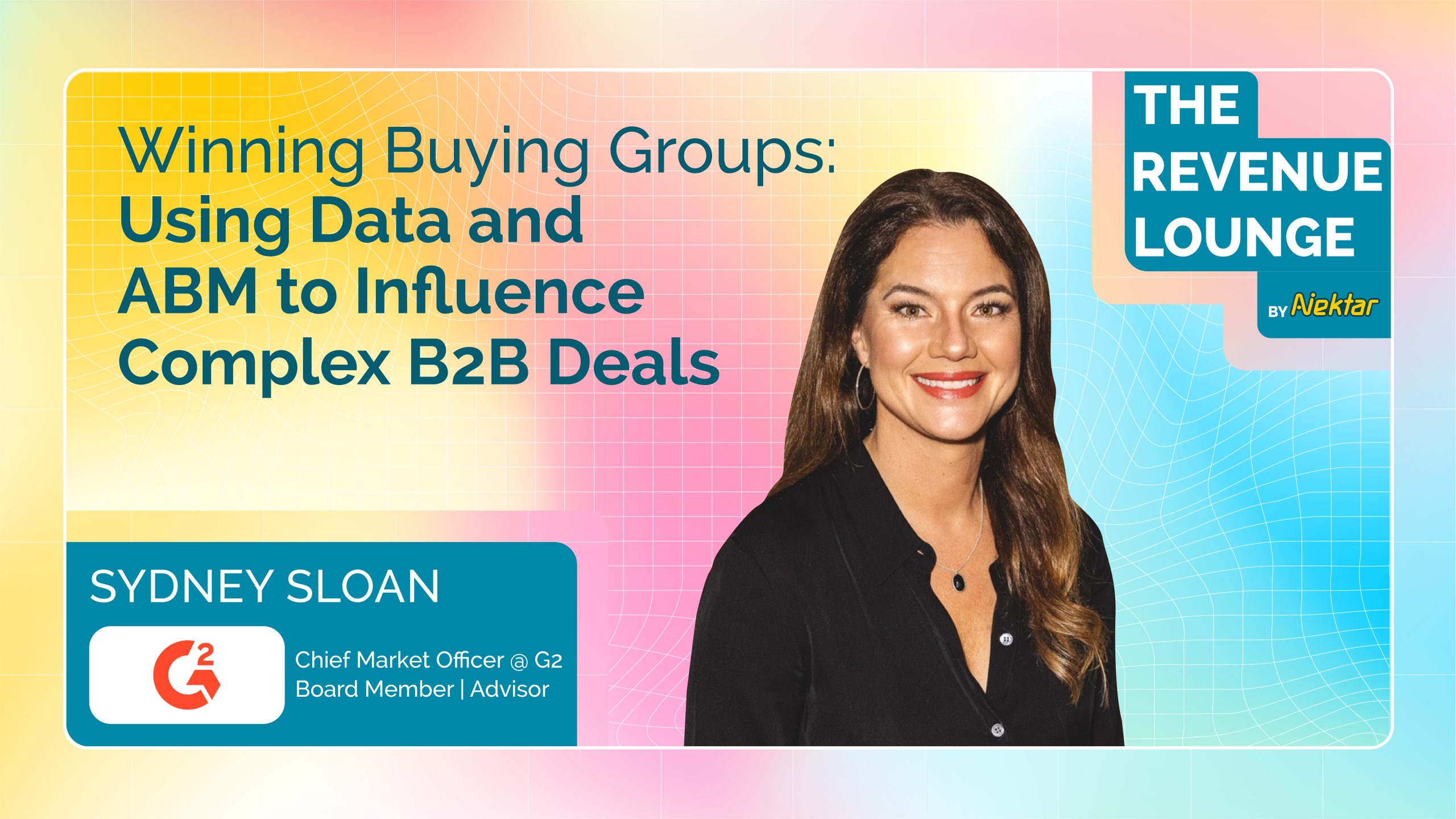

Winning Buying Groups: Using Data and ABM to Influence Complex B2B Deals ft. Sydney Sloan

Welcome to

The Revenue Lounge

How to Influence Buying Groups with Data, Intent, and ABM

A conversation with Sydney Sloan, Chief Market Officer at G2.

B2B buying has transformed.

What was once a one-on-one sales conversation is now a team sport, spanning roles, departments, and even geographies. Today’s buyers are informed, autonomous, and collaborative. They’re forming buying groups long before sales ever enters the conversation. And if your go-to-market (GTM) team isn’t aligned to this reality, you’re already playing catch-up.

In this episode of The Revenue Lounge, Randy Likas sits down with Sydney Sloan, Chief Market Officer at G2, to unpack how marketing and sales teams can evolve to influence modern buying groups. She is a 4X CMO, board member and advisor with decades of experience in driving transformative growth and innovation for high-tech companies. Sydney offers a masterclass in using data, intent signals, and segmentation to win complex deals.

Here’s a breakdown of the conversation—and why it matters.

🚨 Why Buying Groups Matter More Than Ever

The traditional lead-based model is failing. As Sydney puts it, “MQLs are noise.” They flood sales with contacts that aren’t ready to buy—leading to frustration, wasted time, and missed opportunities.

Instead, modern revenue teams must focus on identifying buying groups—clusters of stakeholders from the same account showing interest in your solution. These signals can come from downloading content, comparing vendors, visiting your pricing page, or just quietly researching on review platforms.

A single lead might lie. But a buying group rarely does.

“When you have executive alignment and more than three people in the buying cycle, close rates are 44% higher.”
– Sydney Sloan, CMO, G2


🧠 Data Is the Foundation. But it Needs to Be Smart

Sydney breaks down three types of intent data:

  1. Third-party: Activity across the open web (e.g., searches, keyword trends).

  2. Second-party: Data from trusted ecosystems like G2—category views, comparisons, reviews.

  3. First-party: Visitor behavior on your own website, CRM engagement history, and sales activity.

The magic happens when you triangulate these data sources. For instance, if someone downloaded your whitepaper (first-party), compared your product with a competitor on G2 (second-party), and searched relevant terms online (third-party)—you’ve got a red-hot buying group signal.

But here’s the catch: if your CRM is a mess or your systems are siloed, you’ll never connect those dots.


“There’s no excuse not to have tier 1 and 2 accounts built out with clean, up-to-date contacts across buying personas.”

🔁 The New GTM Playbook: From Leads to Stakeholders

Moving to a buying group strategy requires more than good data—it requires GTM alignment.

Instead of chasing individual MQLs, Sydney recommends:

  • Scoring accounts, not contacts.

  • Tracking signals at the account level to prioritize outreach.

  • Rethinking SDR metrics: focus on meetings with multiple personas, not just any meeting.

  • Partnering marketing, sales, and product around a shared account strategy.

Sydney shares how G2 moved to an account-based model where the sales team gets tailored engagement strategies based on segment (SMB, mid-market, enterprise). Every team member—from demand gen to product marketing—knows who their core personas are and how they relate to each other.

🧩 Operationalizing Buying Groups at Scale

At Forrester’s recent event, a key theme emerged: evolving from “buying groups” to “buying networks.” This includes partners, peers, analysts, and ecosystems that influence buyer decisions.

Sydney highlights a few scalable tactics to work with buying groups:

  • Persona Workshops: G2 ran hands-on workshops using real Gong quotes to help every department internalize customer personas.

  • Segmented Campaigns: Instead of generic ABM, G2 builds micro-segments like “Security companies using 6sense, not yet G2 customers,” and tailors messaging accordingly.

  • Pipeline Meetings: Marketing, sales, and SDRs review the same data together bi-weekly to troubleshoot stuck opportunities and improve velocity.

  • Deal Acceleration Programs: Everyone in stage 2 of the pipeline gets invited to bi-weekly virtual events to deepen relationships and drive conversion.

⚖️ Brand vs. Demand: It’s Not Either/Or

Many companies struggle with where to invest: long-term brand or short-term pipeline.

Sydney makes it clear: do both, early and often.

  • Brand earns you a seat at the table. G2’s Buyer Behavior Report shows average vendor shortlists are down to just three.

  • Demand capture turns that attention into pipeline.

“Brand is giving something away with no ask. Demand is giving something away to capture a contact. Different plays, both essential.”

📈 Rethinking KPIs for Buying Group Success

MQLs are out. So what’s in?

Sydney advocates for shared KPIs across marketing and sales focused on:

  • Pipeline creation

  • Closed-won revenue

  • Retention

Internally, marketing can track velocity, lead-to-meeting time, and program-level cost-per-lead. But in cross-functional pipeline meetings, everyone should speak the same language: revenue.

🧹 The Data Problem: Why RevOps Must Lead

One of the biggest blockers to activating buying group strategies is messy, siloed data. Marketing tools hoard information. Sales tools don’t sync well. And critical insights never make it to the opportunity record.

The solution? A strong Revenue Operations team.

“I’ve surrendered. Marketing Ops now sits in RevOps—and that’s a good thing. RevOps should own the data foundation.”

Clean data doesn’t just support GTM alignment—it powers AI and automation. And as Sydney warns, “Bad data trains bad agents.”

🚀 Final Takeaways: Winning with Buying Groups

  1. Buying groups are real—and they convert better. Track and engage multiple stakeholders early.

  2. Use intent signals across data types. Build workflows that treat G2 comparisons and pricing page visits as bottom-of-funnel signals.

  3. Go beyond ABM. Focus on micro-segments to tell sharper, more personalized stories.

  4. Align GTM with shared KPIs. Eliminate the MQL silo and focus on revenue outcomes.

  5. Fix your data. Clean, enriched CRM data is essential for sales, marketing, and AI.


Want to build a buying group motion that works?


Start by getting your GTM teams aligned, your data house in order, and your content strategy laser-focused on each persona in the buying network.

And if you’re still chasing MQLs, it might be time to hit pause—and rebuild for the way B2B buying actually works today.

Want to hear more stories from revenue leaders? Subscribe to The Revenue Lounge podcast to never miss an episode!

More Resources

5 Steps to Navigate Buying Groups in 2025: A RevOps Guide

5 Steps to Navigate Buying Groups in 2025: A RevOps Guide RevOps 10 min In today’s business environment, B2B buying is never just one person. According to Forrester Research, more than half of global business buyers purchase in complex buying scenarios that include more people, more departments, and generally higher price points. And this buying group can be made up of 7 to 20 people! Unlocking the power of buying groups is a crucial aspect of the B2B landscape. This blog is a synopsis of our conversation with revenue operations leader, Nandini Karkare. She is currently the SVP of RevOps at Zywave. Nandini suggests strategic steps to navigate through the realms of Revenue Operations and helps uncover the strategies, insights, and best practices that constitute a comprehensive guide to mastering the dynamics of buying groups. Read on to get actionable tips on how you can navigate buying groups in 2025 (and beyond). And implement the learnings to create a winning GTM motion. Here are the 5 steps Nandini recommends: 1. Decode Your Buying Groups The buying groups typically consist of members from departments and they all contribute different aspects. It is critical to understand the scope of decision-making including the people who play the most significant roles in making the call. Gartner’s report on B2B Buying highlights that 77% of B2B purchases involve a buying group of four or more people. PS: The key stakeholder can turn out someone altogether different from who you had building a relationship with all along. a. Capturing Buying Group Members   Effective buying group management means considering not just decision-makers but influential stakeholders across departments. Misidentifying key players or focusing solely on the main contact risks derailing the sale. (i) How can you map the entire buying group efficiently? Leverage internal and external data to identify the key players Segment the Group by Role and Influence (ii) Not everyone in the buying group holds equal power or influence. Segment them into categories: Decision-makers (who give the final heads-up) Influencers (who sway the decision) Users (who use the product and provide feedback) Budget owners b. The Role Transition Within a Buying Group   Moving the focus from a buying group to a renewal or expansion committee includes knowing precisely who remains in the relationship, as well as who becomes more active as an account grows. (i) New roles may emerge in a Buying Group Technical or operational leaders may become more influential post sale, since they are now using the product. (ii) The focus shifts from buying to renewal The interaction should be more about the return on investment (ROI) of the product placed on the market, ongoing value delivery, and ongoing needs. (iii) Alignment between the buying groups and renewal committee Leveraging the same enthusiasm and relationships generated at the first-buying stage helps in anchoring the transitions and preventing any drop-offs in engagement. Related Resource: Navigate Enterprise Buying Committees: Strategies for Driving Alignment c. Understand the Personal and Collective Priorities of a Buying Group As per McKinsey & Company, B2B buying decisions increasingly require engagement across departments, with 60% of purchasing committees including members from outside traditional procurement, like IT and HR. (i)Alignment Between C-Suite and Technical Teams Decisions aren’t Made in a Vacuum Collaboration between C-suite and technical teams ensures a holistic approach to solving customer problems, creating stronger, more sustainable relationships Their cross departmental collaboration can help with: (ii) Alignment on Strategic Goals C suite executives need technical assistance to translate their strategic vision to reality that also aligns with company-wide objectives. (iii) Technical Validation These insights guide the C-suite in making informed decisions that fit technical infrastructure and future-proofing. (iv) Cross-functional Communication Bridging the gap between these two groups involves continuous, open communication, ensuring that technical evaluations don’t delay business goals but instead support them cohesively.   iii. Understand the Product Take product demos, listen to sales calls, and use tools that show how the product is sold. This helps in understanding the customer needs better. iv. Dive into Your CRM Understand your CRM (whether Salesforce or HubSpot) to assess how the data is organized. This is to check whether it’s easy to use, and identify immediate improvements. The CRM should be the central source of truth, with other tools supporting it. The data should be unified with easier adoption for the teams. v. Build Trust Internally Establish trust within your teams by listening carefully, asking questions about how RevOps can help, and addressing quick fixes to show you’re there to help. Having this trust shows them that you’re here to support their success. Quick wins, such as small fixes that make people’s jobs easier, helps in establishing credibility early. 2. Establish Clear KPIs   i. Understanding Team KPIs It is important to ask you stakeholders about the KPIs that matter to understand their goals and what their expectations are. ii. Aligning KPIs Across Teams Different departments oftentimes work in silos. RevOps should strive to align these departments and check if these KPIs match the overall business objectives. Gaps must be closed if their KPIs don’t align. iii. Setting RevOps KPIs As you approach the end of the first 30 days, start establishing RevOps-specific KPIs that match company goals, which may involve metrics like revenue increase, conversion rates, or improvements in overall efficiency. 3. Tech Stack Audit Deep dive into the existing tools that your company is using. Identify all redundancies, and find opportunities to streamline the entire tech stack. i. Map Out Tools Compile a list of all tools used by teams, noting their purpose and how they work with the CRM. ii. Evaluate Use and Cost Determine if tools are actively used or if there are duplicates. Look for cost-saving opportunities by consolidating tools when possible. https://www.youtube.com/watch?v=sVDJ9KI1tGw&t=869s Next 30 days – Alignment and Control The next 30 days marks a shift from discovery to alignment. The goals should be to create cohesion between departments (e.g., Sales, Marketing) and laying down effective controls. The improvements need to be implemented without overwhelming the teams. This phase combines

Everything You Need to Know About Sales Territory Mapping

Everything You Need to Know About Sales Territory Mapping RevOps 10 min Successful sales strategies play a key role in achieving business goals. But what drives these strategies from inception to execution, improving sales operations and on-ground performance? Sales territory mapping.  Without the right sales territory map template, your sales team could face challenges, namely: Poor productivity Revenue mismatch or imbalance Subpar revenue performance  Poor customer experience Leading to the loss of clients, and Waste of valuable resources  So, how do you get sales territory mapping right to achieve business goals and grow your revenue? Let’s find out in this blog. Sales Territory Mapping: Setting On-Ground Sales in Motion Sales territory mapping defines and visualizes the area, sales amount, and revenue your sales team will target. It divides and categorizes customers based on specific characteristics within your ideal customer profile (ICP). A sales territory map template also helps you assign categories and customers to the salespersons best equipped to serve them.  It lets you reach the right customers in the right areas with the right characteristics to achieve targets and improve growth.  The task of aligning your sales plan with business goals in the most profitable way lies with sales managers.  From the larger business perspective, sales territory mapping is part of location intelligence. Today, location intelligence helps segment customers and find more relevant target markets for revenue success.  How Is Sales Territory Mapping Instrumental to Business Growth? A sales territory map template does more than act as a blueprint. Here are 6 more ways in which it contributes to growth.  1. Ties Back to Business Goals Sales territory mapping creates a blueprint for achieving your business goals. It clearly lays out sales targets and directs reps to the most profitable customers or verticals by strategically assigning territories. 2. Maintains Balance One of sales territory mapping’s primary objectives is to secure a balanced and fair distribution of work among sales teams. It moves and optimizes resources effectively to maximize revenue potential.  3. Increases Selling Time Reps can increase facetime with clients by cutting down time spent on planning. This is specifically made possible with sales territory mapping tools that decrease planning time from months to minutes.  4. Improves Win Rates Naturally, when reps spend more time selling, they can nurture clients better through the sales funnel. Moreover, each assignment is backed by data. This data offers more visibility into customers and prevents deals from slipping through the cracks.  As a result, reps can improve customer experience and uncover new leads to increase win rates.  5. Boosts Morale A sales territory map template encourages intelligent planning, further improving sales productivity. Additionally, when reps can increase win rates, achieve their quota, and earn more, it boosts their morale. And if reps are happy, it means your attrition rates are lower.  It’s not just that. A sales territory map template also highlights improvement areas useful for coaching.  6. Extracts Hidden Insights Sales territory mapping helps measure sales data by connecting the map to the CRM. Therefore, when multiple salespersons are involved in a deal, you can attribute the sale to the right person.  Recognizing the benefits of sales territory mapping is the first step in setting up your own template. Step two is understanding its different types.  Choosing From 5 Types of Sales Territory Mapping Conventionally, sales territories were based on locations. However, you can customize them today as per your customer, market, or even product needs.  Let’s take a look at the 5 types below.  1. Geography Geographic sales territory mapping is the most commonly used and also the oldest. It classifies your market based on, you guessed it, geographical locations—cities, states, countries, and zip codes.  For example, Sales Team A can serve Texas, while Sales Team B covers California.  To get geographic mapping right, your sales team must have a regional, cultural, and linguistic understanding of the territory they’re allocated.  It’s also important to ensure that the selected sales team is available when customers are active in the designated regions.  2. Product Product-based sales territory mapping can be used when you have multiple offerings. You can categorize and assign reps to specific products or technological offerings.  This method is useful when certain reps have in-depth expertise on specific products. For example, Team A has expertise in CRM solutions and is assigned to this offering, while Team B caters to clients looking for Digital Advertising software.   Assigning your reps to the right products will ensure they can sell to clients more convincingly.  3. Customer  The third way to divide your sales territories is based on specific customer characteristics like demographics or roles.  For instance, Sales Team A may sell to clients with a yearly revenue of $500,000. On the other hand, Sales Team B focuses on the higher margin clients with yearly revenue of $1 million and upwards.  4. Industry  Industry-based sales territory mapping assigns reps to specific industries or verticals.  It works best when your product caters to individuals or businesses from multiple industries.  For example, Team A sells to the construction industry, while Team B covers the education sector. Similarly, Team A could be selling to the education industry overall, while Team B handles specific verticals–like universities or higher education–and Team C is responsible for schools.  5. Sales Channel An upcoming type of sales territory map template categorizes territories per the sales channels your reps or clients use.  That’s because buyers now use ten or more channels, on average, as they move through the buying process. They use a combination of digital self-serve channels for certain activities and videos or in-person channels for others.  Consider this example. Team A is responsible for selling via digital channels like social media, and Team B sells through offline channels such as cold calling.  You may also get more granular by assigning reps with expertise in certain platforms to those mediums. For instance, Rep A sells via emails, and Rep B may use LinkedIn.  Knowing the key types of sales territories is awesome. But figuring out the type of

Leave a Comment

Your email address will not be published. Required fields are marked *

Scroll to Top

Just one more step