
5 Strategic Benefits of Improving CRM Data Quality
- CRM, RevOps
- 11 min
- Updated: August 13, 2026
The global CRM market continues to grow briskly, but market size says nothing about how much value businesses are actually extracting from what they’ve bought. Realizing a CRM’s true value has never really been about the CRM itself, it’s about the quality of the data living inside it, and that continues to be a major, unresolved challenge for most businesses.
Estimates on the scale of the problem vary, but they’re consistently alarming: a large share of CRM data is incomplete, stale, or duplicated in any given year, and typical annual decay runs in the range of 22.5% to 70% depending on industry and record type.
These inefficiencies cost real money, Gartner’s widely cited estimate puts the average cost of poor data quality at $12.9 million per organization annually. The problem compounds over time too: the more data that accumulates in a CRM without active management, the messier it gets, until the system that was supposed to drive growth quietly turns into dead weight.
Improving and enriching CRM data is the first real step toward realizing what a CRM was actually bought to do. High-quality data gives revenue leaders a genuinely solid foundation, one that holds up even through downturns and market uncertainty. This guide covers the real cost of poor CRM data, and five strategic benefits businesses see once they fix it.
Get our latest insights into your inbox

Low-Quality CRM Data Leads to High Costs
Beyond the obvious cost of storing stale, incorrect, or missing data, several hidden costs quietly drain revenue: higher cost per customer, lower conversion rates, reduced revenue, and thinner margins. Forrester’s research has found that persistently low-quality data across enterprise systems robs leaders of real productivity, since they end up continuously re-verifying data just to trust it enough to act on.
Any decision made on poor-quality data is inherently risky, whether it’s a marketing campaign, sales-marketing alignment, pipeline forecasting, or buying-committee strategy. A few specific ways this shows up:
1. Frustrated Sales Reps
Reps have a genuinely conflicted relationship with their CRM: valuable when it works, resented for the manual entry it demands. A majority say they’d consider leaving their role if their organization doesn’t invest in fixing CRM data quality. Every hour spent on manual entry is an hour not spent building the relationships that actually drive quota.
2. Incorrect Sales Forecasting
Accurate forecasts let leaders allocate resources efficiently and maximize returns. Poor-quality data produces forecasts that are wrong in ways that compound, and the result is resources spent chasing outcomes that were never realistic in the first place.
3. Poor ROI From the CRM
The CRM remains one of the largest tech investments most businesses make, and most fail to extract full value from it because the underlying data is riddled with inefficiencies. Left unaddressed, a CRM stops being an asset and starts becoming a quiet source of revenue drain.
4. Failed Marketing Campaigns
Customers expect real-time, personalized messaging, and poor-quality data turns that expectation into a liability. A campaign built on a list of stale contacts spends real budget on an idea that was never going to convert, and repeated failures like this damage brand reputation over time.
How to Improve CRM Data Quality
Fixing data quality at the root is the first step toward the kind of GTM alignment revenue leaders actually want. That means investing in technology that doesn’t add pressure to sales, marketing, or customer success teams, but instead works quietly in the background while those teams focus on their actual jobs.
CRM data entry is the clearest example of where this matters. It’s still largely manual, which eats rep time and introduces exactly the kind of error, or missing information, that costs deals. The fix isn’t just automating entry, it’s automating entry and enrichment together, so GTM teams always work from data that’s both current and complete, with a layer of intelligence on top that actually helps teams scale.
5 Strategic Benefits of Improving CRM Data Quality
1. Accurate Visibility of the GTM Funnel
Accelerating pipeline development requires sales, marketing, and customer success working from the same high-quality data. With accurate, reliable CRM data, the entire organization references one shared, data-driven picture instead of three partial ones, closing a lot of leakage at the root.
Everyone gets clear answers to the questions that actually matter: how many qualified leads are genuinely in the pipeline, which contacts are most likely to engage, and which leads should actually be disqualified. If a deal is stuck at a specific stage and the data shows that sharing a case study at that exact point tends to accelerate similar deals, sales and marketing can act on that together, and both sides can see the impact of the collaboration directly in the pipeline. Marketing also gains confidence in the leads it hands to sales, and capturing previously missing contacts gives inside sales a whole set of people they didn’t even know existed to reach out to.
2. Increased Focus on Deals That Actually Convert
Pipelines bloat over time with opportunities that add little real value, often because reps resist dropping a deal even after activity has gone quiet, assuming a bigger pipeline always looks better. The truth is the opposite: every minute spent on a deal that’s not really live is a minute not spent on one that could actually close.
Complete, accurate CRM data tells you specifically which deals need to come out of the pipeline, freeing the team to focus resources on the accounts that are genuinely live. Sales managers get a clear picture of exactly where the pipeline is bloated, can act quickly on stalled deals, and can build a more predictable quarter as a result. Tracking rep activity data directly is a strong leading indicator here, showing which deals are real and which just look real on paper.
3. High Engagement With the Buying Committee
Selling is fundamentally about relationships, and the B2B buyer is no longer one person. Gartner’s research puts the current average at 6 to 10 stakeholders per deal, with enterprise deals frequently reaching 17 or more, and a large share of those stakeholders sit outside IT entirely. Losing a key stakeholder mid-deal (through a job change, for instance) derails a meaningful share of opportunities that would otherwise have closed.
Without the right data, sellers are left guessing at who’s actually in the buying group and who the real decision-makers are, which leads directly to lost deals, misdirected outreach, and wasted hours preparing materials for the wrong person. Real intelligence on key buyers is what lets sellers build and maintain genuinely strong account relationships, giving them visibility into exactly which personas need to be targeted to influence the buying group at the account or opportunity level. Tools like Nektar automatically capture and match contact information to the right opportunity, which has a direct, outsized impact on who gets targeted in the buying committee and how that engagement actually happens.
4. Hyper-Personalized ABM Campaigns
Spray-and-pray marketing is over. Buyers expect messaging tailored to their specific pain points, delivered through their preferred channel, at their preferred time. Forrester has found that buyers respond most positively to sellers who are knowledgeable and directly address their needs, and personalization has been shown to meaningfully increase both revenue and marketing spend efficiency.
Powerful ABM campaigns depend heavily on CRM data quality, and data quality remains a genuine obstacle to doing personalization well, a large share of revenue leaders still don’t feel confident in their ability to deliver personalized, omnichannel experiences at scale. With trustworthy CRM data, GTM teams get the intelligence and accuracy personalization actually requires, replacing mass email with lower-volume, more targeted outreach that invests in what converts rather than what merely clicks. Enriched CRM data lets organizations reach each customer segment with a genuinely meaningful omnichannel approach and execute ABM strategy at real scale.
5. Reduced Operational Cost of Bad Data
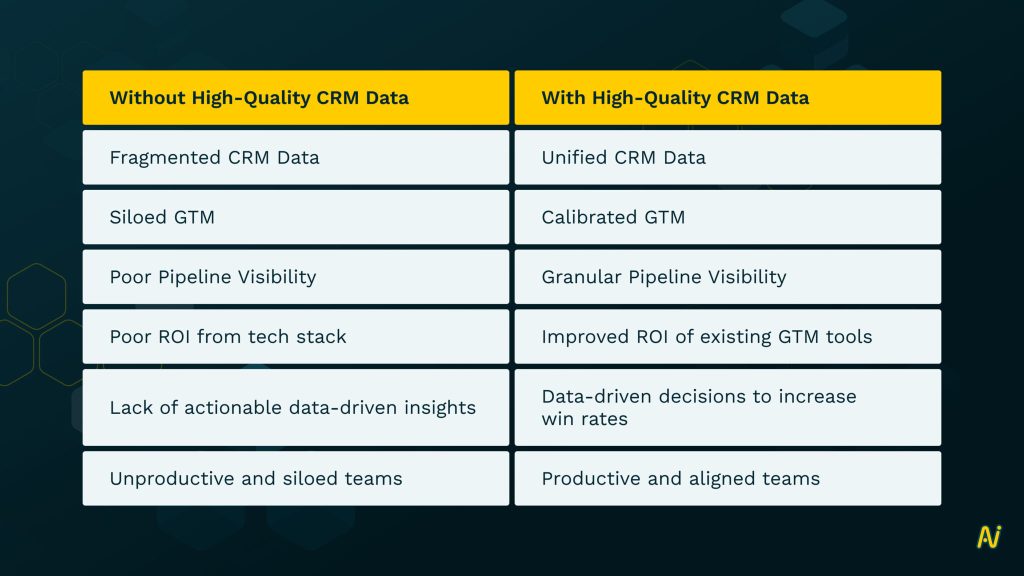
More dirty data means more problems, and the resulting revenue losses show up as customer churn, failed campaigns, and lower team productivity. IBM research, cited by Harvard Business Review, puts the total cost of bad data to US businesses at approximately $3.1 trillion annually, and Gartner’s per-organization estimate runs $12.9 million a year.
Data management costs grow right alongside data volume, and cleansing itself becomes a real financial burden as the problem compounds. Inaccurate data driving an ABM campaign, for instance, can raise customer churn, increase email bounce rates, or simply target the wrong people entirely, all of which push operational costs up while eroding CRM ROI and rep productivity. Clean, automatically enriched data reduces these risks directly, and consistent CRM data management can meaningfully cut both storage and management costs over time while giving reps back the hours they’d otherwise lose to manual entry.
Why This Matters Even More With AI Agents in the Mix
Every benefit above has always mattered for revenue. What’s changed is what this same clean data increasingly feeds. A growing share of CRM data now gets read and acted on directly by AI agents, prioritizing an account, flagging risk, updating a forecast, rather than a person reviewing it first. The five benefits above used to just make a revenue team more effective. Increasingly, they’re also what determines whether an AI agent acting on that same data is working from an accurate picture or a badly distorted one.
Frequently Asked Questions
Q. What’s the biggest strategic benefit of improving CRM data quality?
It depends on the organization’s specific bottleneck, but buying-committee engagement and GTM funnel visibility tend to have the most direct, measurable impact on win rate and forecast accuracy, since both address gaps that otherwise show up as lost or stalled deals.
Q. How many stakeholders are typically involved in a B2B buying decision?
Gartner’s current research puts the average at 6 to 10 stakeholders, with enterprise deals frequently involving 17 or more, and most of them outside the IT department specifically.
Q. Does personalization actually require better CRM data, or just a better marketing tool?
Both are necessary, but data comes first. A sophisticated personalization tool working from incomplete or inaccurate contact and engagement data still produces generic or misdirected outreach; the tool amplifies whatever data quality it’s given rather than compensating for gaps in it.
Q. Why does CRM data quality matter more now than it used to?
Because a growing share of that data now feeds AI agents that act on it directly rather than a person reviewing it first. Data gaps that used to just produce a misleading report can now produce a wrong automated decision, since there’s considerably less human review standing between the data and the action it triggers.
Recognize Immediate ROI With Superior CRM Data Quality
Meeting today’s customer expectations requires clean, first-party CRM data delivered across the organization in real time, turning raw customer data into the actionable insight that drives real decisions and conversations at the moments that actually matter.
Nektar’s Data Foundation automatically captures the revenue data that otherwise goes missing from your CRM, and enriches it so bad data stops being a recurring problem. Daisy AI then turns that clean, unified data into the specific signals covered above: buying-group visibility, deal risk flags, and engagement scoring.


Tim Seamans
VP, AI Acceleration & Transformation, Mimecast
With Nektar we unlocked GTM context for our AI apps, driving $2M in directly attributed expansion revenue and uncovering $80M+ n additional pipeline by unifying previously siloed signals and engagement data.
Get a free CRM scan to see if you’re missing key revenue data in your own CRM.
Enjoyed our content? Follow Nektar on LinkedIn