9 Sales Commission Software for 2026
- Sales
- 10 min
- Updated: July 30, 2026
Sales commissions remain one of the oldest and most direct motivators in a sales org, and getting them wrong, through miscalculation, delay, or disputed numbers, erodes exactly the trust a comp plan is supposed to build. Managing commissions manually, through spreadsheets, doesn’t scale past a small team, and it introduces the kind of error that turns a well-designed comp plan into a source of friction rather than motivation. That’s the job sales commission software exists to do: automate the calculation, keep it transparent to reps, and remove the manual reconciliation work from finance and RevOps.
Get our latest insights into your inbox

What Is Sales Commission Software?
Sales commission software (also called incentive compensation management, or ICM) automates the calculation and payment of sales commissions based on quota attainment, deal value, and whatever specific rules a comp plan defines, accelerators, tiers, clawbacks, SPIFs. It removes manual calculation error, gives reps real-time visibility into what they’re earning and why, and gives finance and RevOps teams an auditable, consistent process instead of a spreadsheet that only one person fully understands.
9 Sales Commission Software Platforms for 2026
- Spiff, generative AI-assisted commission plan design and management
- Qobra, no-code compensation automation for modern GTM teams
- Everstage, no-code commission platform with rep-facing analytics
- Anaplan, enterprise connected-planning platform with compensation modeling
- QuotaPath, commission tracking built for SMB and remote sales teams
- Xactly, enterprise-grade incentive compensation management
- Performio, data-first commission platform for complex, high-volume sales orgs
- SalesCookie, budget-friendly commission platform for SMBs
- OpenComp, compensation platform focused on equity and cash comp together
Overview of the 9 Platforms
1. Spiff
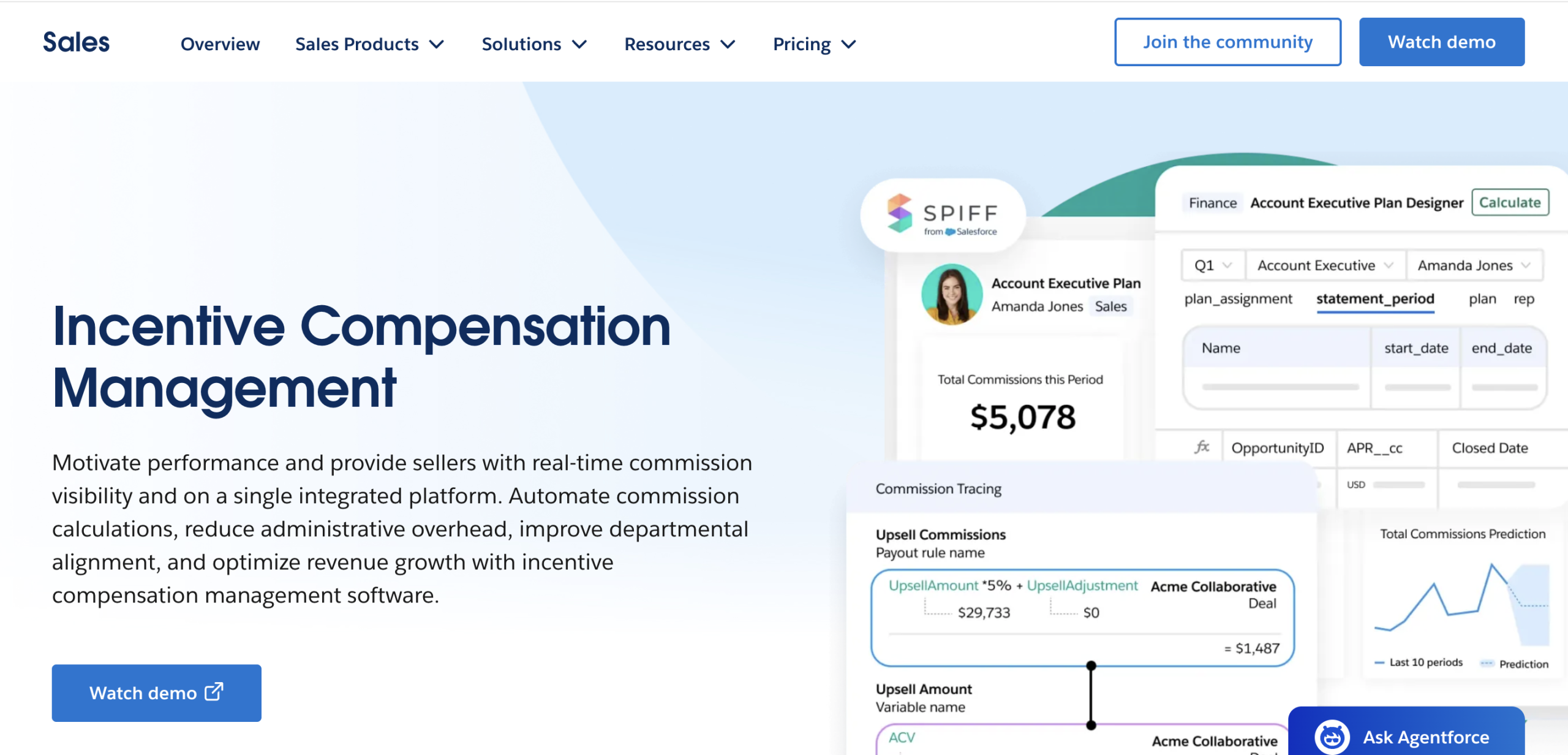
Salesforce Spiff (fully integrated into Salesforce following the February 2024 acquisition, now sold as Salesforce’s own Incentive Compensation Management product) is a well-established commission platform known for its generative AI assistant, branded Spiff Assistant, which helps admins understand and troubleshoot commission plan logic in plain language, and a Commission Estimator feature giving reps live visibility into potential earnings as they work a deal, directly inside Salesforce.
Key features: generative AI-assisted plan troubleshooting (Spiff Assistant), real-time commission estimation during active deals, no-code plan design tools, mobile access for reps.
Best for: Teams already on Salesforce wanting commission visibility built into the deal workflow itself, especially now that Spiff operates as part of the Salesforce ecosystem.
2. Qobra
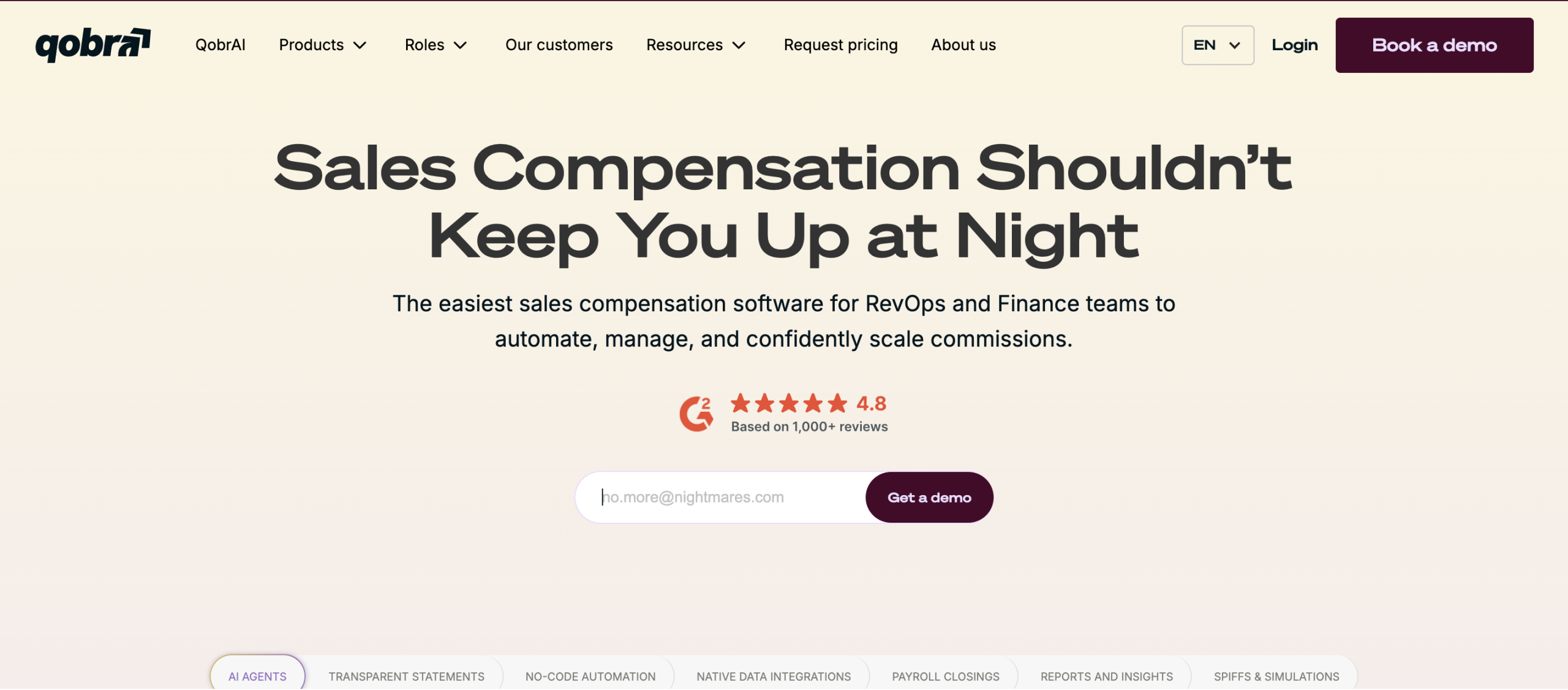
Qobra is a sales compensation automation platform built for modern GTM teams, positioning itself around eliminating spreadsheet-based commission management entirely. It automates plan design (accelerators, tiers, bonuses, clawbacks) without requiring code, gives reps real-time visibility into earnings and payout breakdowns, and supports scenario modeling for finance teams evaluating the cost impact of plan changes or new hires.
Key features: end-to-end compensation automation from plan design to payout, real-time rep-facing dashboards, scenario modeling and forecasting for finance leaders, broad integration coverage across CRM (Salesforce, HubSpot, Pipedrive), data warehouses (Snowflake, BigQuery), and HR/payroll systems.
Best for: Revenue and finance teams wanting to move off spreadsheets entirely, with strong support for both US and European payroll and compliance requirements.
3. Everstage
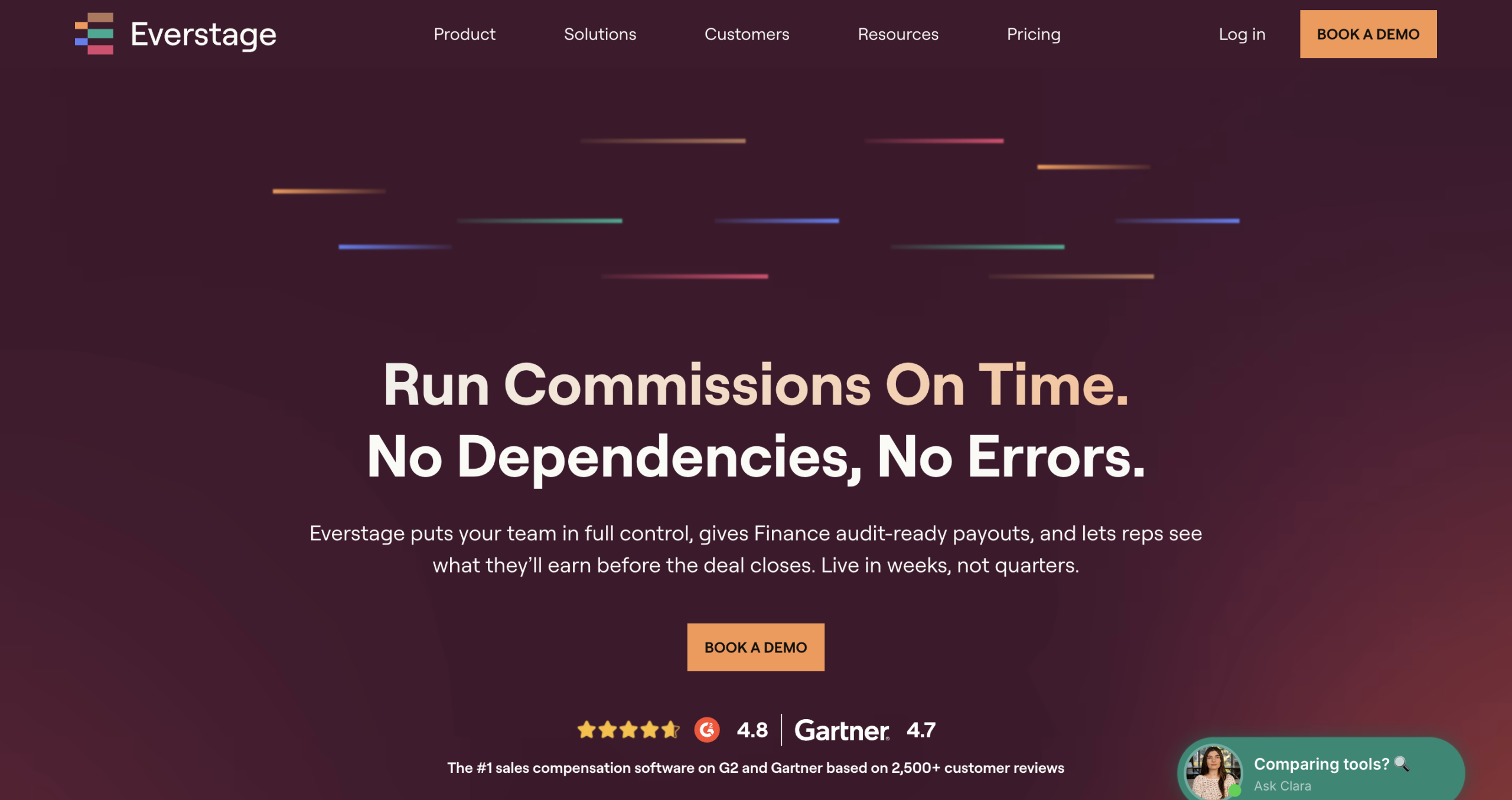
Everstage offers a no-code platform for building commission plans, SPIFs, and bonus structures without engineering support, with rep-facing tools for tracking earnings and understanding plan logic.
Key features: no-code plan and rule building, rep-facing earnings dashboards, collaboration tools for plan feedback between finance and sales leadership.
Best for: Mid-market teams wanting a no-code platform they can configure and adjust themselves without ongoing vendor or engineering dependency.
4. Anaplan
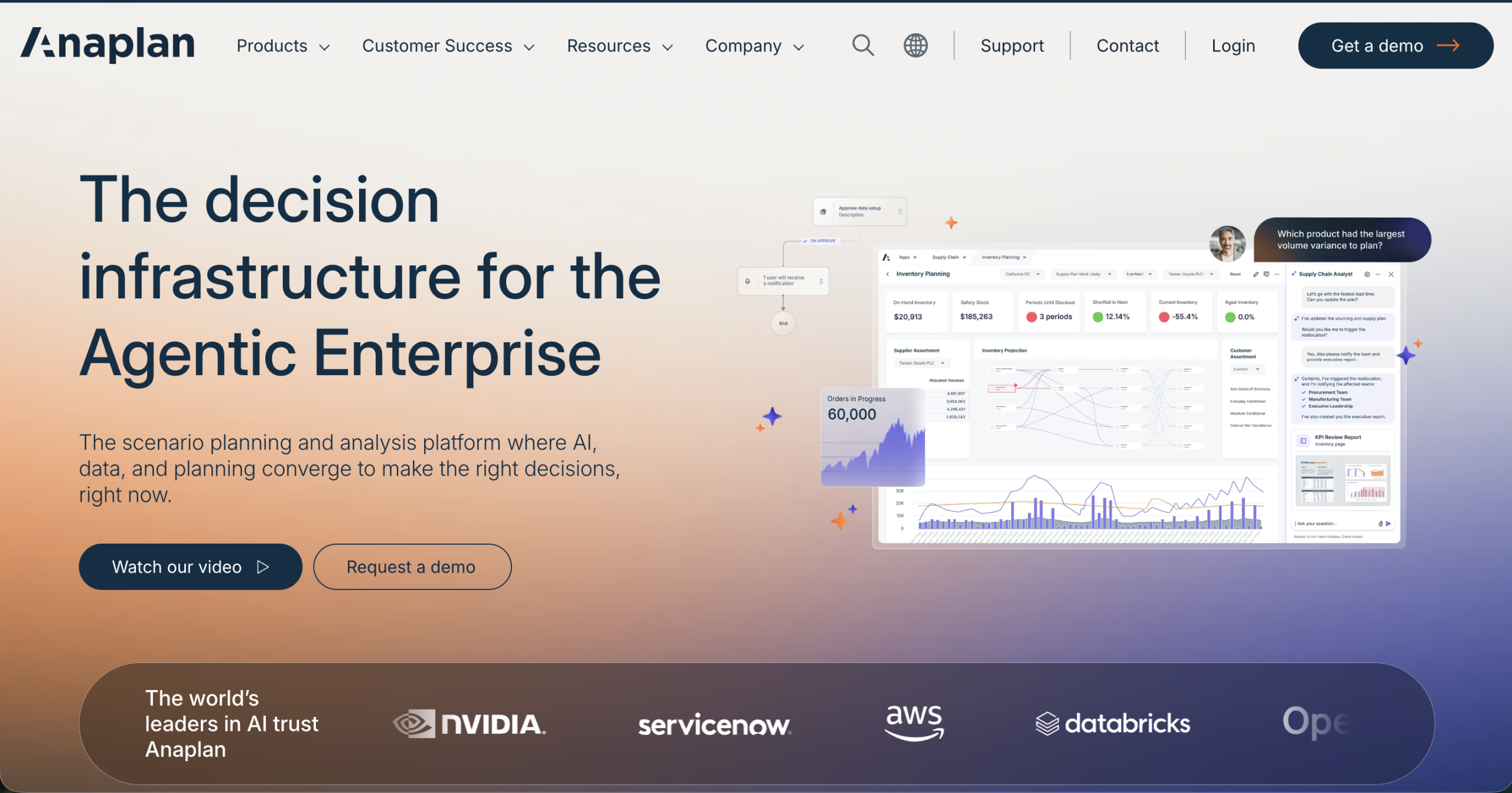
Anaplan is a large-scale connected-planning platform used across finance, supply chain, and workforce planning, with incentive compensation as one significant use case among several. Its core strength is scenario modeling at scale, useful specifically for larger organizations that need to model compensation changes alongside broader business planning.
Key features: enterprise-scale scenario modeling and what-if planning, cross-functional connected planning beyond compensation alone, strong integration with BI tools like Tableau and Snowflake.
Best for: Large enterprises that want compensation planning integrated into a broader connected-planning platform rather than a standalone comp tool.
5. QuotaPath
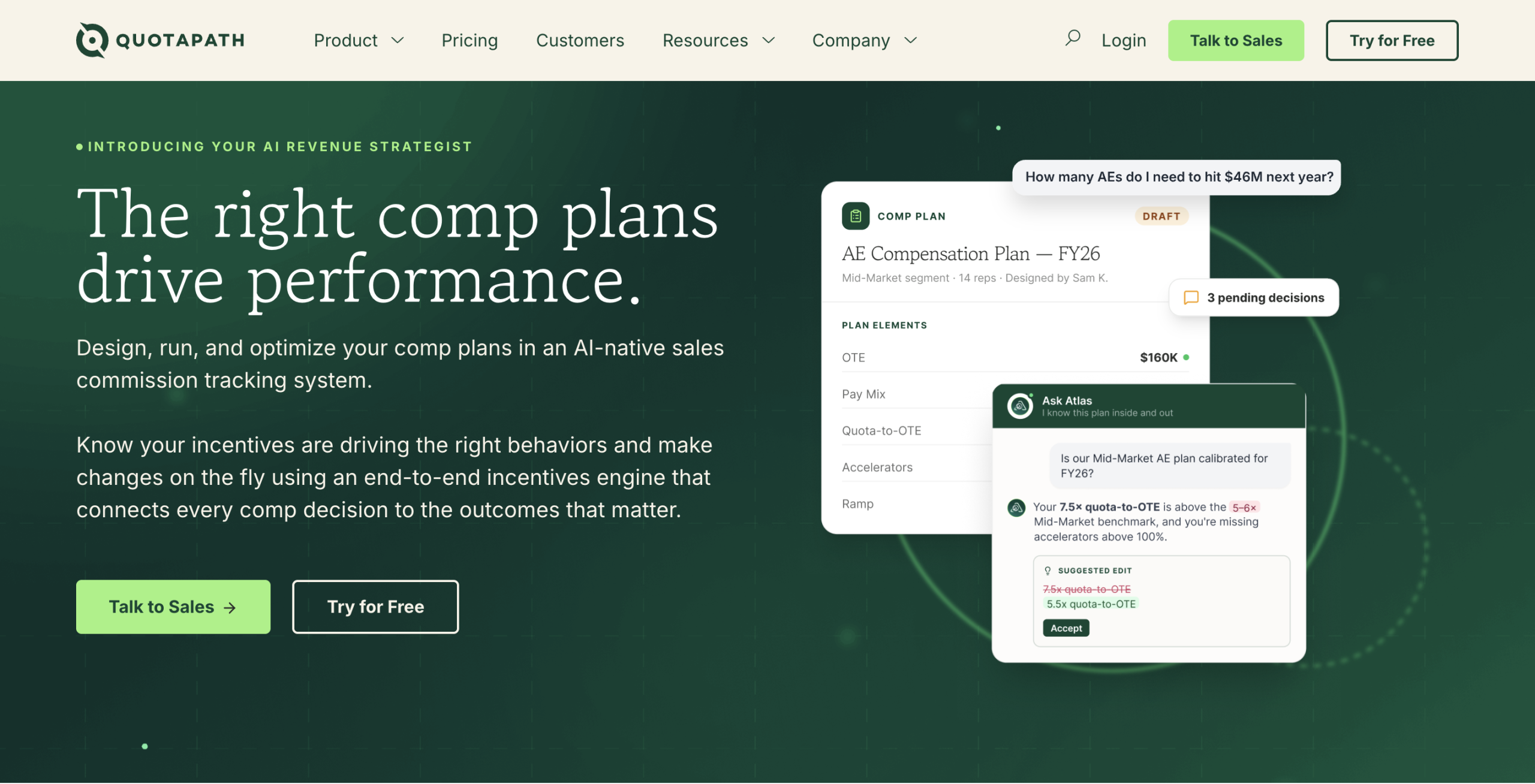
QuotaPath is built specifically for small to mid-sized businesses and remote sales teams, with a focus on affordability, transparency, and ease of setup relative to enterprise-grade platforms. It offers a free tier for smaller teams, real-time earnings tracking, and self-service rep portals where reps can model “what-if” scenarios for their own commissions.
Key features: self-service rep earnings simulator, free tier available for smaller teams, straightforward CRM (Salesforce, HubSpot, Pipedrive) and payroll (Gusto, Rippling, ADP) integrations.
Best for: SMBs and remote-first sales teams wanting an affordable, fast-to-implement commission tool without enterprise-level complexity or cost.
6. Xactly
Xactly is an established, enterprise-grade incentive compensation management platform used widely by large and Fortune 500 organizations, with strong compliance tooling for operating commission plans across multiple countries and tax jurisdictions.
Key features: enterprise-scale plan design and administration, multi-country tax and compliance support, territory and quota planning, strong security and audit-trail certifications (SOC 2, ISO 27001).
Best for: Large enterprises needing multi-country compliance and audit rigor alongside commission calculation, not just a domestic SMB use case.
7. Performio
Performio positions itself as a data-first commission platform for organizations with complex data environments, aggregating commission-relevant data from multiple CRM, ERP, and other business systems into one place, aimed at industries and teams where commission calculation depends on data scattered across several systems rather than one clean CRM.
Key features: multi-source data aggregation for commission calculation, automated approval workflows for payroll processing, audit-ready reporting.
Best for: Organizations with commission-relevant data spread across multiple systems (CRM, ERP, and others) that need a platform built to reconcile all of it, not just sync with a single CRM.
8. SalesCookie
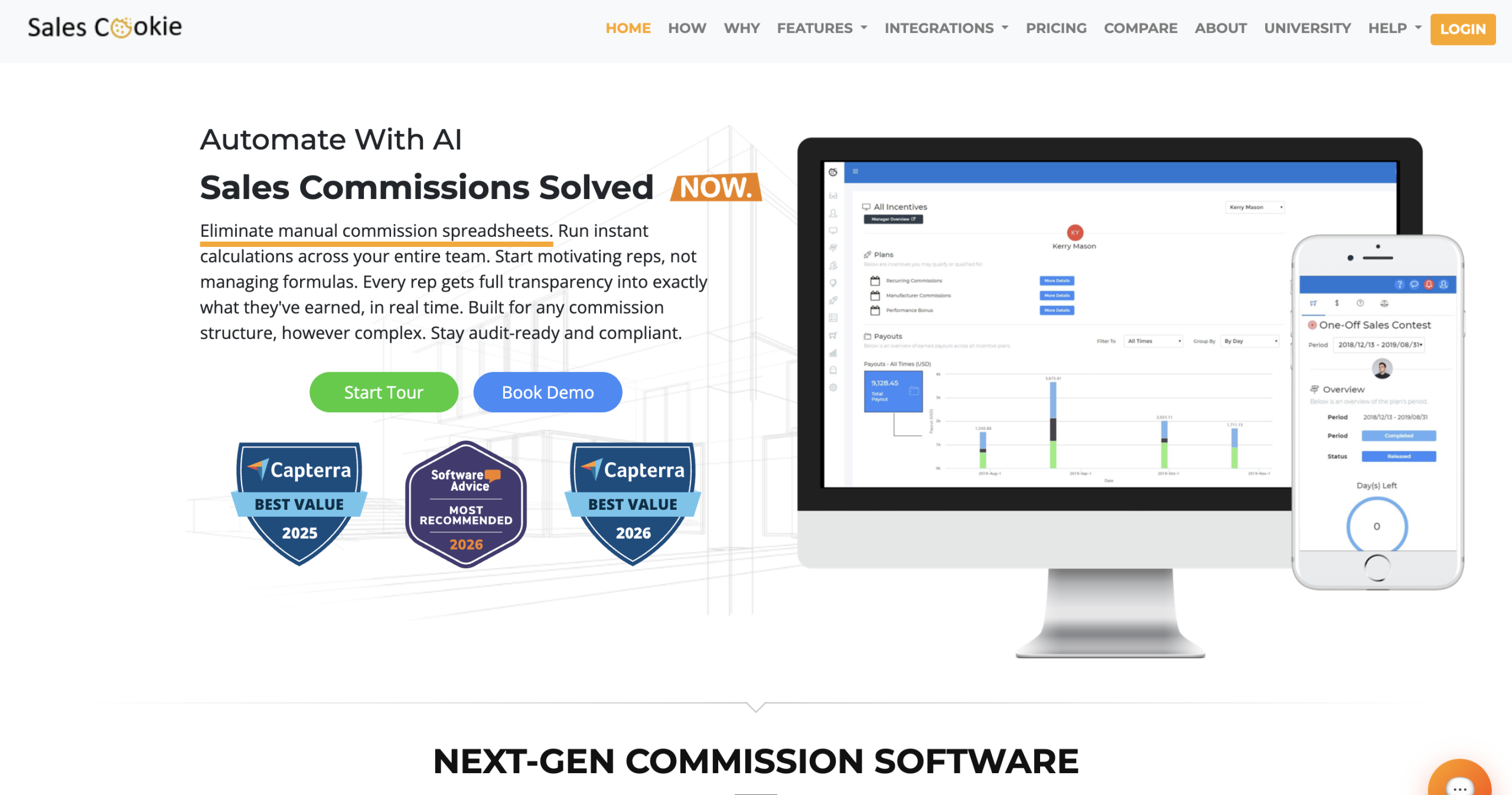
SalesCookie is a cloud-based commission platform aimed at small and mid-sized businesses, with pre-built plan templates and a straightforward, lower-cost setup relative to enterprise platforms.
Key features: pre-built, industry-specific plan templates, multi-currency support for global payouts, straightforward CRM (HubSpot, Pipedrive) and payroll integrations.
Best for: SMBs wanting a fast, template-driven setup without building a comp plan structure from scratch. Confirm current pricing directly with the vendor rather than relying on a specific figure, since SaaS pricing in this category changes often.
9. OpenComp
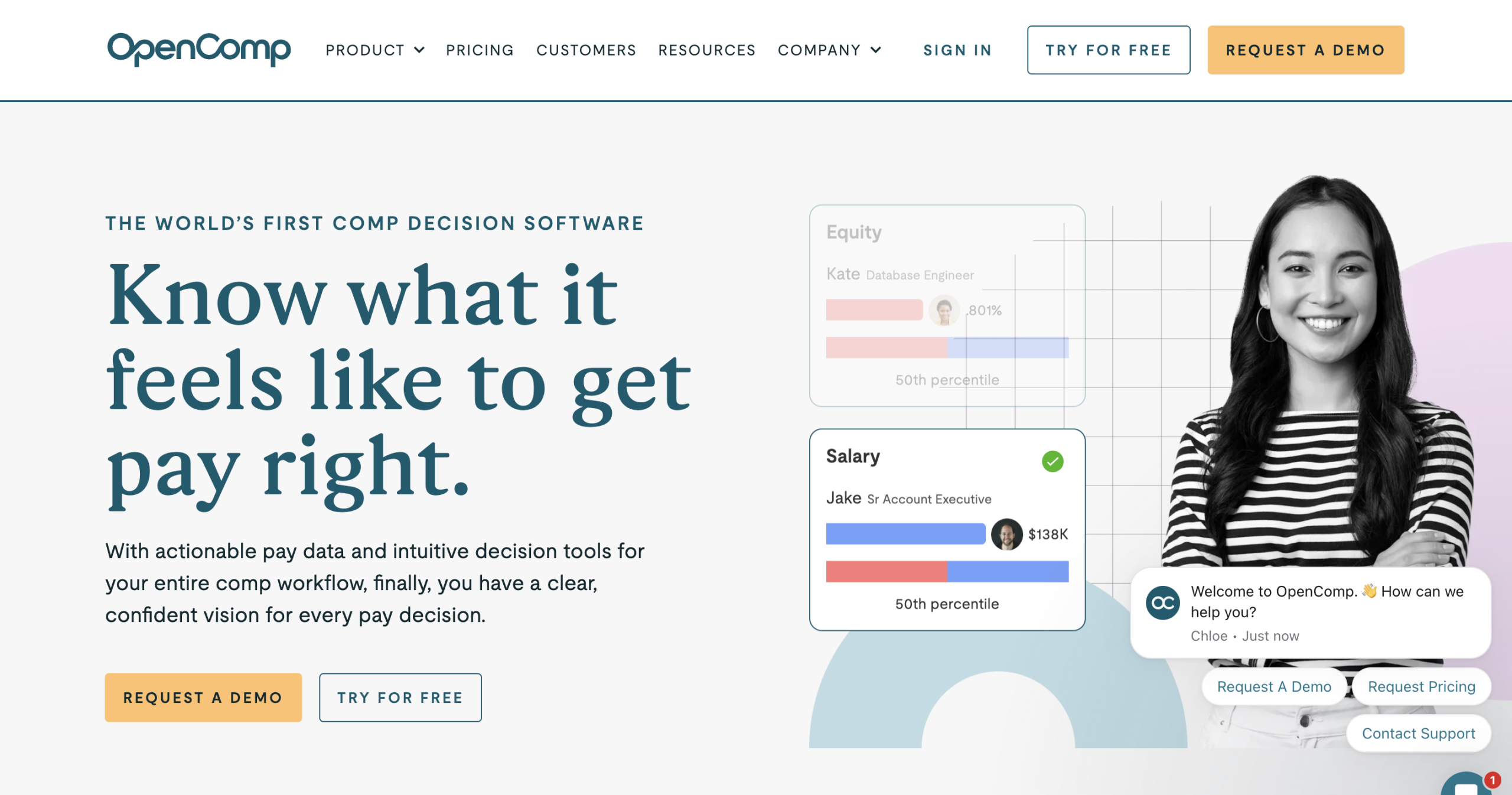
OpenComp focuses specifically on total compensation, cash commission alongside equity and RSUs, positioning itself toward mid-market and pre-IPO companies that need to manage both cash and equity compensation together, including compensation benchmarking against industry peers.
Key features: combined cash-and-equity compensation dashboards, compensation benchmarking against industry data, vesting and equity milestone tracking.
Best for: Mid-market and pre-IPO companies where equity compensation is a significant enough part of total comp that it needs to be managed alongside cash commissions, not as a separate, disconnected process.
Why Commission Accuracy Depends on Data You Might Not Have
Every platform above is only as accurate as the data it’s calculating commissions from, specifically, accurate quota attainment and deal data flowing from your CRM. This is the piece that’s easy to overlook when evaluating commission software directly: a sophisticated comp engine calculating commissions against an incomplete or inaccurate pipeline still produces a wrong number, just a wrong number calculated with more confidence and complexity than a spreadsheet would have.
This is where Nektar’s role is genuinely complementary rather than competitive with everything on this list. Nektar’s Data Foundation automatically captures the activity and engagement data that determines whether a deal is actually progressing toward the close date a commission calculation assumes, closing the gap between what a rep reports and what’s actually happening in the deal. Cleaner pipeline data means quota attainment numbers that reflect reality, which means the commission calculated against that quota is one reps can actually trust, not just one they’re told to trust.
Get a free CRM scan to see how complete your own pipeline and quota-relevant data actually is, the foundation any commission calculation on this list ultimately depends on.
Frequently Asked Questions
Q. What’s the difference between sales commission software and a CRM?
A CRM manages the sales pipeline and customer relationships. Commission software calculates and manages the payouts owed to reps based on what closes in that CRM, and the two need to work together, since commission accuracy depends entirely on accurate underlying deal data.
Q. Do I need enterprise-grade commission software as a small business?
Not necessarily. Several platforms on this list (QuotaPath, SalesCookie) are specifically built and priced for SMBs, while others (Xactly, Anaplan) are built for enterprise-scale, multi-country compliance needs. Match the tool to your actual team size and plan complexity rather than defaulting to the most feature-rich option.
Q. Why do commission calculations sometimes not match what a rep expects?
Most commission discrepancies trace back to the underlying deal or quota data, a stage marked incorrectly, an attainment number that doesn’t reflect what actually closed, rather than the commission engine’s math itself. Accurate CRM data upstream of the commission calculation is what actually prevents these disputes.
Get the Data Right Before You Calculate the Commission
The right commission software makes payouts accurate, transparent, and fast. But accuracy starts upstream, with the pipeline and quota data the commission calculation depends on.
Get a free CRM scan to see how complete your own pipeline data actually is.
Enjoyed our content? Follow Nektar on LinkedIn