
Mastering the Data Battle: A RevOps Guide to Conquer Bad Data
- RevOps
- 12 min
- Updated: August 17, 2026
Most organizations, particularly those scaling quickly, face an extensive challenge with poor-quality data. It keeps businesses from maximizing opportunity, contact, account, and intent data to actually improve revenue growth.
We discussed this directly with RevOps and data expert Melissa McCready, Founder and CEO at Navigate Consulting Group. Melissa has 20 years of experience across CRM, marketing automation, and customer success, and has consulted on more than 300 revenue and growth operations projects. From her experience, here’s what’s actually driving the bad data problem, and how to convert data from a liability into an asset.
You can listen to the full conversation with Melissa here:
Get our latest insights into your inbox

First, What Is Bad Data?
Data is the fuel that keeps a revenue engine running, but it’s not about having tons of it. It’s about having data that’s clean and complete enough to draw the right insight and make good business decisions from.

Leads being misrouted, pipeline growth failing, forecasts and accurate customer insights, plays and interactions are based on data. When hygiene isn't prioritized, there's a snowball effect, and it gets worse fast.

Melissa McCready
Founder & CEO, Navigate Consulting Group
The specific things worth worrying about: inconsistent, incomplete, inaccurate, siloed, duplicate, and non-compliant data. Bad data doesn’t enrich the revenue process, it actively undermines it. Every decision made on flawed data is a step forward and three steps back.
Why Is Bad Data Still a Challenge in 2026?
Bad data isn’t a new problem. It’s one that still needs solving, and the volume of data involved keeps growing every year, which makes the problem harder to ignore, not easier.
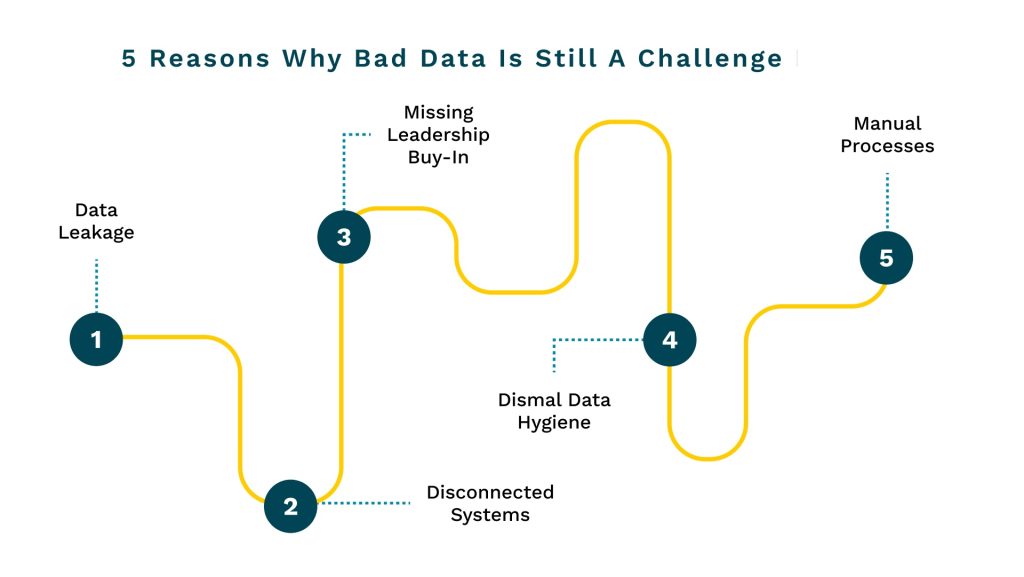
1. Data Leakage
For 48% of sellers, incomplete data is their single biggest challenge. Data is supposed to give you full visibility into your pipeline, your improvement areas, and your leading indicators, yet a large share of opportunity data never actually makes it into the CRM at all.
A few reasons this happens consistently: reps miss entering data points manually, reps aren’t trained on all of a CRM’s functionality so they skip parts of it, and complicated workflows fail to capture key information in the first place. The result is missed, poor-quality data entering the tech stack, data leakage in practice, not just in theory.
Clean data is what enables a lead’s seamless journey from first conversation all the way through to cash. It shows exactly what stage of the buyer journey a lead is actually at, and how to add value at each specific touchpoint. Situations change mid-deal too, a key stakeholder leaves the buyer’s organization, or the company gets acquired, and your contact data has to reflect that. Without regular updates, a CRM decays quietly, and you lose the ability to accurately validate who’s actually still in the buying group.
2. Disconnected Systems
It depends on how things are structured, even from an organizational perspective.
Where Sales is owning Salesforce, and customer success is owning Gainsight, and marketing is owning Marketo and Hubspot. And when they own that, what does that mean on these controls?
Melissa McCready
Founder & CEO, Navigate Consulting Group
Tools across the tech stack capture large amounts of data from buyer-seller conversations. The problem is when those tools don’t talk to each other, and the data never flows into the rest of the stack. Quality data ends up stuck in inboxes, chats, calendars, meeting notes, and call transcripts, genuinely useful information trapped in a tool nobody else on the team can see.
Without a single source of truth, a CRM connected to every adjacent tool actually uses, none of those tools deliver their full value, and you can’t build a complete picture of the buyer journey from fragments scattered across five different systems.
3. Missing Leadership Buy-In
Number one reason that data goes in, is, it starts with decisions and it starts with people making decisions about it. It really comes back to making the decisions and it is the people making the decision decisions. It's not a system where people like to blame. Who put the systems in they didn't get there on their own so it's the people.
Melissa McCready
Founder & CEO, Navigate Consulting Group
Only 19% of business leaders consider CRM data a high-priority initiative for their organization. Compounding the problem, bad data restricts managers from coaching reps effectively and limits 27% of them from hitting quota at all.
When leadership doesn’t prioritize clean data or regulate poor-quality data, the entire company bears the cost. Poor data culture trickles down from the top, and it snowballs into low-quality practices that hurt customer experience and trust well before anyone traces the problem back to its actual source.
4. No Data Governance Strategy in Place
Self-reporting and recurring data inefficiencies amplify decay, feeding teams incorrect information and building distrust in the data itself. Reps also resist dropping dead leads from the pipeline, assuming a fuller pipeline looks better, but a bloated pipeline built on stale data just skews every insight built on top of it, and reps waste real time chasing opportunities that were never actually live.
First of all, I think having control of the data is really the biggest data challenge. From knowing where the data originated to who can modify it, what process dirves the data collection, the data quality itself and data governance.
Melissa McCready
Founder & CEO, Navigate Consulting Group
Not cleaning data at regular, consistent intervals is itself a sign of missing governance, and without a governance strategy, no one actually owns the data as a single source of truth. That’s a recipe for exactly the kind of disaster this whole guide is about.
5. Over-Reliance on Manual Processes
The growing revenue tech ecosystem gives businesses more tool options than ever, and many organizations buy and deploy several at once. Reps don’t share leadership’s enthusiasm for this: 66% report feeling overwhelmed by the sheer number of revenue tools they’re expected to use, and 81% say reducing time spent on administrative work like data entry would directly improve their company’s bottom line.
Data entry still isn’t fully automated across most stacks, and the manual process it depends on creates exactly the gaps, inconsistencies, and errors that produce poor data hygiene in the first place. Instead of making the job lighter, more tools without more automation just adds to what reps have to track and update by hand.
The Impact of Bad Data on Revenue
A challenge this large has a genuinely sizable impact. If bad data is a live problem in your organization right now, here’s how it’s actually affecting the business.
1. Friction-Filled Buyer Journey
Bad data limits how well sales, marketing, and customer success can actually exchange information, and poor visibility into the customer journey means a limited understanding of where a buyer actually is and what they need. That problem compounds given buyers now engage across ten or more channels on average.
When you think of simplicity, the systems need to be set up in a way that they support and there is a tool for the person, not as extra work for them. When you can move to that, that's when you see the higher adoption rates with people using the tool and the data does get better.
Melissa McCready
Founder & CEO, Navigate Consulting Group
Poor data quality has a real, multifold impact on the customer journey: 56% of sales reps report losing existing customers and 51% report losing new deals directly due to poor CRM data quality. Without enough information on a buyer, personalization at each touchpoint becomes guesswork, and customers notice when they’re forced through repetitive motions at every stage, a clear sign the journey isn’t actually connected. In an age of self-serve and quick resolution, that friction sends buyers straight to a competitor.
A good example would be the lead lifecycle, where a lead comes in and it's not getting routed correctly. Now there is no real way to capture when a meeting was scheduled versus held versus rescheduled versus attribution on that data. And now you're converting it and you have lost all those different pieces along that lifecycle. How are you going to report it? And so attribution is broken your life cycle velocity and conversion rates are definitely impacted by that and not in the best way.
Melissa McCready
Founder & CEO, Navigate Consulting Group
2. Poor Revenue Forecasts
Bad data doesn’t just distort the current period, it corrupts your historical baseline too. Audience segments, lead personas, deal size, conversion rates, sales volume, and time-to-close can all be quietly wrong if the underlying data always was.
Forecasting is what drives strategic decisions, and bad data blurs any prediction built on top of it, especially compounded by limited visibility into what’s actually happening in the current pipeline. Leaning harder on human judgment isn’t a real fix either, human insight without reliable data underneath it is still mostly guesswork and instinct, which doesn’t hold up in a genuinely competitive, fast-moving market.
3. Operational Inefficiencies
The revenue tech ecosystem grew explosively for years, and businesses accumulated tools accordingly. Tighter budgets and slower growth since have exposed the old “more tools, more revenue” playbook as unreliable, and businesses trying to get more out of their existing stack are discovering that bad data renders much of it effectively unusable.
Data migration compounds the problem directly: migrating bad data into a new system and planning to “clean it up later” almost never actually happens. Bad data also blocks fast course correction when circumstances change, and poor governance leaves you exposed to compliance risk on top of it, a real concern given how much weight consumers now place on responsible data handling.
We have systems integrations where data strategy was not prioritized correctly so people were just like we'll clean the data after we do the migration you're just going, oh boy!, here we go again, and then people input incorrect data.
Melissa McCready
Founder & CEO, Navigate Consulting Group
4. Lower Productivity
Poor-quality data pushes reps toward searching for missing data, vetting information for accuracy, chasing multiple teams for complete context, and navigating buying committees they barely understand, all time that should go toward building profitable relationships instead. When customers don’t get the attention they need, they’re understandably unhappy with reps, which drags down morale on both sides.
Unclear data also causes reps to lose leads inside the funnel entirely, breaking the consistent follow-up that turns a lead into a customer. As bad data compounds into poor performance, reps end up frustrated and undervalued, which is a well-documented driver of turnover in sales roles specifically.
5. Failed Campaigns
Bad data blurs the ICP itself, making it hard to segment the right audience, which cascades into incorrect campaign objectives from the start. A spray-and-pray approach doesn’t work anymore, you need to get the message right on the first attempt, or the buyer moves on to a better option.
The problem compounds further once you account for the fact that a single buyer is really a group of stakeholders, not one person. It’s not enough to customize for the champion alone, every stakeholder’s specific needs matter. Contact the wrong person, or rely on a single point of contact instead of multithreading the whole buying group, and you risk losing revenue before it even has a chance to materialize.
6. Poor Decision-Making
No visibility into the pipeline means reps aren’t interacting with the full buying committee, which directly translates into missed opportunities. Sales lacks reliable insight, marketing doesn’t fully know its own ICP, and customer success can’t effectively drive upsells, cross-sells, or renewals.
Data health can be the difference between hitting your revenue targets or not. That could mean the companies missing opportunities and ultimately the potential for failure from missing out on those personalized marketing opportunities.
Melissa McCready
Founder & CEO, Navigate Consulting Group
When bad data underpins the numbers, data-driven decisions stop actually being data-driven. Leaders lose faith in the system and default to gut instinct and incomplete information instead, which undermines the return on what’s usually one of the largest tech investments a company makes.
How RevOps Streamlines Data Quality
Before getting into how RevOps solves the bad data problem, it’s worth being clear on what RevOps actually means, since everyone seems to define it slightly differently.
Revenue operations to me means customer facing operational strategy, actions and measurable results but also aligning with the overall business objectives that help accompany drive their company growth as well as their partner, employee and customer growth.
Melissa McCready
Founder & CEO, Navigate Consulting Group
Revenue growth today looks more like a bowtie than a funnel, it doesn’t end at the close, it extends well past the sale, which is itself a meaningful shift in what “revenue generation” actually means. RevOps exists to make sure no team works in a silo, winning deals together on a unified front, guarding the GTM function and getting the most out of it to actually grow revenue.
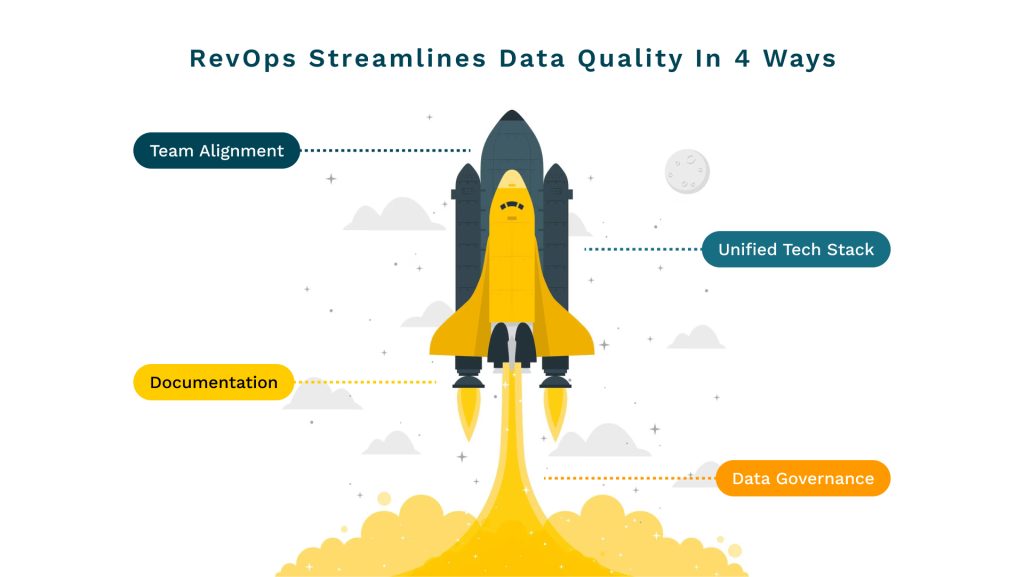
Melissa points to four specific ways RevOps streamlines clean data across an organization:
1. Data Governance
The first thing RevOps does is convert data from a liability into an asset, by providing the actual framework for a data governance program. This matters more with every new data source added and every buyer journey that no longer fits the old, linear sales funnel.
Data governance keeps information clean, usable, reliable, and secure over both the short and long term. Regularly checking data fields, integrating tools properly, and auditing each system solidifies the CRM as a genuine single source of truth, and a solid governance framework also supports automating the manual processes that capture and enrich data at scale, which is exactly the kind of case that earns real leadership buy-in.
Data strategy and governance are so important because it never goes away. It's an ongoing thing. Data is constantly moving in these systems, and we've got to be consistent about how we define all of those things. How they're moving, how they're changing and what we're using to report.
Melissa McCready
Founder & CEO, Navigate Consulting Group
2. Documentation
RevOps encourages setting up documentation early, especially if you’re just starting the revenue operations journey. It’s easy to skip this step at first, but data doesn’t wait, volume grows fast, and without documentation you end up unable to trace how different data fields connect or where leaks are actually happening.
Melissa McCready
Founder & CEO, Navigate Consulting Group
All systems and processes need a roadmap. They need documentation. They need justification for why the decisions were made as well as why they were not made.
Proper documentation for every system field should answer: where the data originates, where it integrates, who owns it, who controls it, who has access, and who can modify the record. That documentation pays off directly during handoffs at critical business points, and it also forces a clearer view of just how complicated the data process actually is, which sharpens the whole approach to keeping only clean data entering the system in the first place.
3. Unified Tech Stack
The CRM is still the center of the tech stack, but it’s rarely the only tool in use anymore, and most businesses struggle to keep that stack genuinely unified even when every tool is technically integrated with the CRM.
RevOps sets up a formal requirements review process to choose deliberately between the many available tools and functionalities: does this need to be a long-term, heavily used tool, or would something less expensive serve a narrower need just as well? Getting full use out of what you’re already paying for, and being explicit about technology requirements up front, is what keeps a stack from quietly drowning in tech debt. RevOps lays the blueprint for a genuinely unified stack, rather than one that’s merely connected on paper.
Melissa McCready
Founder & CEO, Navigate Consulting Group
I'll be like, why are you putting curtains up, and you don't even have a wall? So there are certain tools that are the curtains, and there are certain tools that are the walls, and certain tools that are really that piece of the foundation of the tech stack. The tighter your foundational tech stack, the faster you'll scale.
4. Team Alignment
Alignment means more than getting people in the same room, it means working toward shared goals with a common data language. RevOps makes this concrete through a project charter: why the RevOps effort is happening, how it keeps teams aligned around clean data, what results are actually expected, how long it will take, and which teams are involved.
Melissa McCready
Founder & CEO, Navigate Consulting Group
What fields are we pulling from, and why are our reports different? I think if you get into the nitty-gritty of it to really get into data strategy, you're going to be so much better off because you took the time to do that, and you really defined that before and figured out like, how many fields do I need to have.
That charter is what lets you assemble the right team for the job, and RevOps makes the broader change management easier across people, process, and technology, getting functional teams to genuinely commit to shared goals rather than just nod along in a kickoff meeting.
Why RevOps Is the Best Choice for Maintaining Clean Data
Deploying RevOps around these four actions produces real, measurable benefits: hitting both company-wide and team-specific goals, forecasting revenue and planning territory more accurately, optimizing market coverage toward the right audiences, more accurate lead scoring and qualification, a sharper ICP driving better-targeted campaigns, genuinely personalized content and interactions, clarity on which channels actually drive revenue, more rep time spent actually talking to prospects, better use of sales triggers and intent data to move deals to close, more confident, data-driven decision-making at the leadership level, and stronger compliance across every team.
Why This Matters Even More With AI Agents in the Mix
Every problem above has always cost revenue. What’s changed is what this same data increasingly feeds. A growing share of CRM data now gets read and acted on directly by AI agents, prioritizing an account, flagging risk, updating a forecast, rather than a person reviewing it first. A gap that used to just leave a manager with an incomplete picture can now produce a wrong automated decision, with far less human review standing between the bad data and the action taken on it. RevOps’ role in data governance isn’t just about better reporting anymore, it’s a real precondition for using AI safely at all.
Put Data Hygiene on Autopilot With Nektar
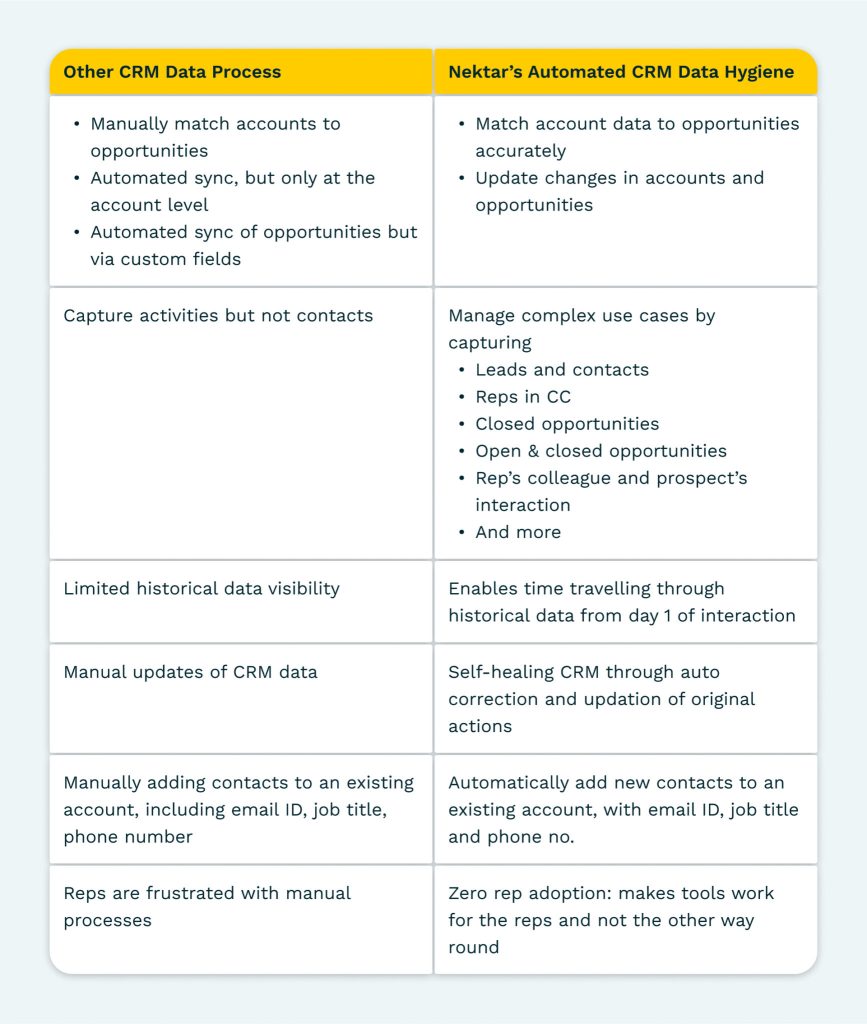
Setting up RevOps to streamline data hygiene manually can feel like a genuinely intimidating lift. Nektar’s Data Foundation was built specifically to make this easier: it automatically captures email, meeting, call, and calendar activity across a team, with zero rep effort required, closing exactly the data leakage gaps described throughout this guide. Daisy AI then turns that captured data into the signals a real RevOps function actually needs: buying-group visibility, deal risk flags, and engagement scoring, all grounded in real activity instead of whatever made it into the CRM manually.
Frequently Asked Questions
Q. What counts as “bad data” in a CRM?
Inconsistent, incomplete, inaccurate, siloed, duplicate, and non-compliant data all fall under the umbrella of bad data. Each type undermines a different part of the revenue process, from forecasting accuracy to campaign targeting to buying-committee visibility.
Q. Why does bad data persist even as companies invest more in their tech stack?
Because more tools without more automation just adds administrative burden rather than removing it. Data entry across most stacks still isn’t fully automated, and the manual process that fills the gap is exactly what introduces the inconsistency and error that produces bad data in the first place.
Q. What’s the difference between RevOps and “Growth Ops”?
They’re largely describing the same function; some practitioners prefer “Growth Ops” specifically to emphasize that the goal is driving business growth broadly, not just operational efficiency for its own sake.
Q. How does bad data specifically affect AI initiatives?
A growing share of CRM data now feeds AI agents that act on it directly rather than a person reviewing it first. Bad data that used to just produce an incomplete report can now produce a wrong automated decision, since there’s considerably less human review standing between the data and the action it triggers
Convert Data From a Liability Into an Asset
Bad data doesn’t fix itself, and manual governance alone rarely keeps pace with how fast new data enters a growing revenue org. Get a free CRM scan to see how much of your own pipeline data is currently at risk.
Enjoyed our content? Follow Nektar on LinkedIn