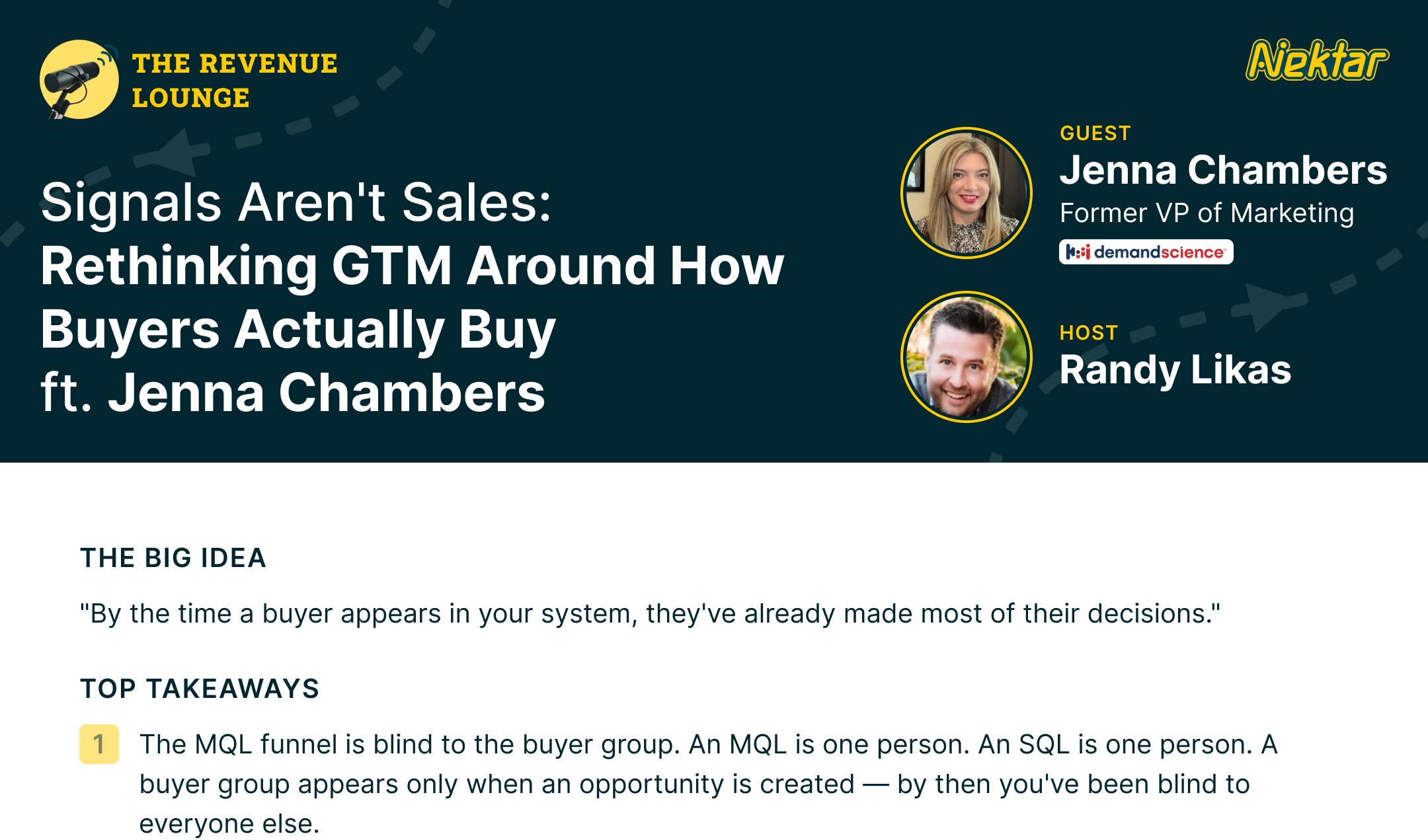
Signals Aren’t Sales: Rethinking GTM Around How Buyers Actually Buy
A conversation with Jenna Chambers, former VP of Marketing at DemandScience.
TL;DR
Short on time? We've distilled this conversation into a one-page summary. Get it in your inbox.
Executive Summary
The MQL-to-SQL-to-opportunity funnel was designed for the kind of buying journey sellers wanted buyers to be on. It has very little to do with how buyers actually buy. Jenna Chambers, former VP of Marketing at DemandScience with a career spanning marketing, sales, client services, and partnerships, brings a rare cross-functional lens to this problem.
In this episode of The Revenue Lounge, she unpacks why the linear funnel model breaks down the moment a buying group enters the picture, what the difference actually looks like between an account paying attention and an account entering a buying cycle, how to defend brand investment with data rather than passion, why business-level signals matter as much as behavioral ones, and what AI will actually change about how go-to-market teams work.
The conversation is refreshingly candid, including an admission that every company sells to non-ICP accounts, and that not acknowledging this internally creates a churn problem nobody saw coming.
Jenna Chambers built her career by moving across the go-to-market spectrum rather than up through a single track. Communications, in-house marketing, graphic design, agency client services, Martech partnerships, sales leadership, and finally VP of Marketing after a post-merger rebuild. She once thought this cross-functional path was a shortcoming. In a world where sales, marketing, and customer success need to operate as one revenue system rather than three separate departments, it turns out to be exactly the right background.
Watch the full conversation here:
Why the MQL Funnel Forgets That Buyers Are People
The funnel assumes a linear process. The buyer does not.


Jenna Chambers
Former VP of Marketing, DemandScience
The key thing is that it just forgets that buyers are people and people are human. I don't go through my life with a well-defined process. We're just people at work at the end of the day.
The funnel is an internal framework – a way for sellers to organize their work. It has nothing to do with what’s happening on the buyer’s side, where multiple people across the same account are researching different aspects of a problem, someone in the corridor has already had a conversation with a competitor, and the buying group is forming long before anyone raises their hand.
The structural flaw Jenna identifies is precise: an MQL is a person, an SQL is a person, and then the moment it becomes an opportunity, a buyer group appears. And up until that point, marketing and sales have been essentially blind to them.
The practical implication: the time between MQL and SQL is not just qualification time. It’s buyer group discovery time. Sales should be spending a significant portion of that window understanding who else is involved in the decision, so that the leap from one person to a group is less of a leap and more of a managed transition.
Marketing’s role doesn’t end at MQL handoff either, it shifts. Once an account is in motion, marketing should be expanding the buyer group: running ads to the account so more people become brand aware, building bespoke landing pages, sending relevant content to the personas who haven’t yet engaged. The goal is to make one person into a buyer group before the opportunity is ever created.
The Honest Admission Nobody Makes: You Will Sell to Non-ICP
This is the part of the episode worth the price of admission alone.
We will sell to non-ICP at certain points because of cash flow. And there's the models set up in a certain way, but at the end of the day, if you are behind on your revenue, you are gonna sell to a non-ICP account.
Jenna Chambers
Former VP of Marketing, DemandScience
Jenna is right and almost nobody says this out loud. A certain percentage of non-ICP sales is not just acceptable, it’s inevitable. Where it goes wrong is when it’s completely forgotten in future forecasts and modelling. You don’t account for the churn. You get a surprise churn number because you forgot how many non-ICP accounts you sold to last year. And poor customer success gets beaten up for losing customers who should maybe never have been customers in the first place.
The fix is not to stop selling to non-ICP accounts entirely. It’s to be honest about it internally, build it into the churn model, and stop setting up CS teams to fail by holding them accountable for outcomes they can’t control.
Read the complete transcript for more insights on Jenna explaining the buying group herself.
Attention vs. Buying Intent: How to Tell the Difference
A website visit, a content download, or a webinar registration tell you an account is paying attention. They don’t tell you the account is ready to buy.
What we tend to see and be able to track tends to be the tail end of a much longer process, not the beginning.
Jenna Chambers
Former VP of Marketing, DemandScience
Buyers are doing the bulk of their research in places you cannot measure. Slack communities, events, peer conversations. None of that shows up in your dashboards. What you see is the moment they decide to come to you. Which means by the time you have a trackable signal, a lot of decisions have already been made.
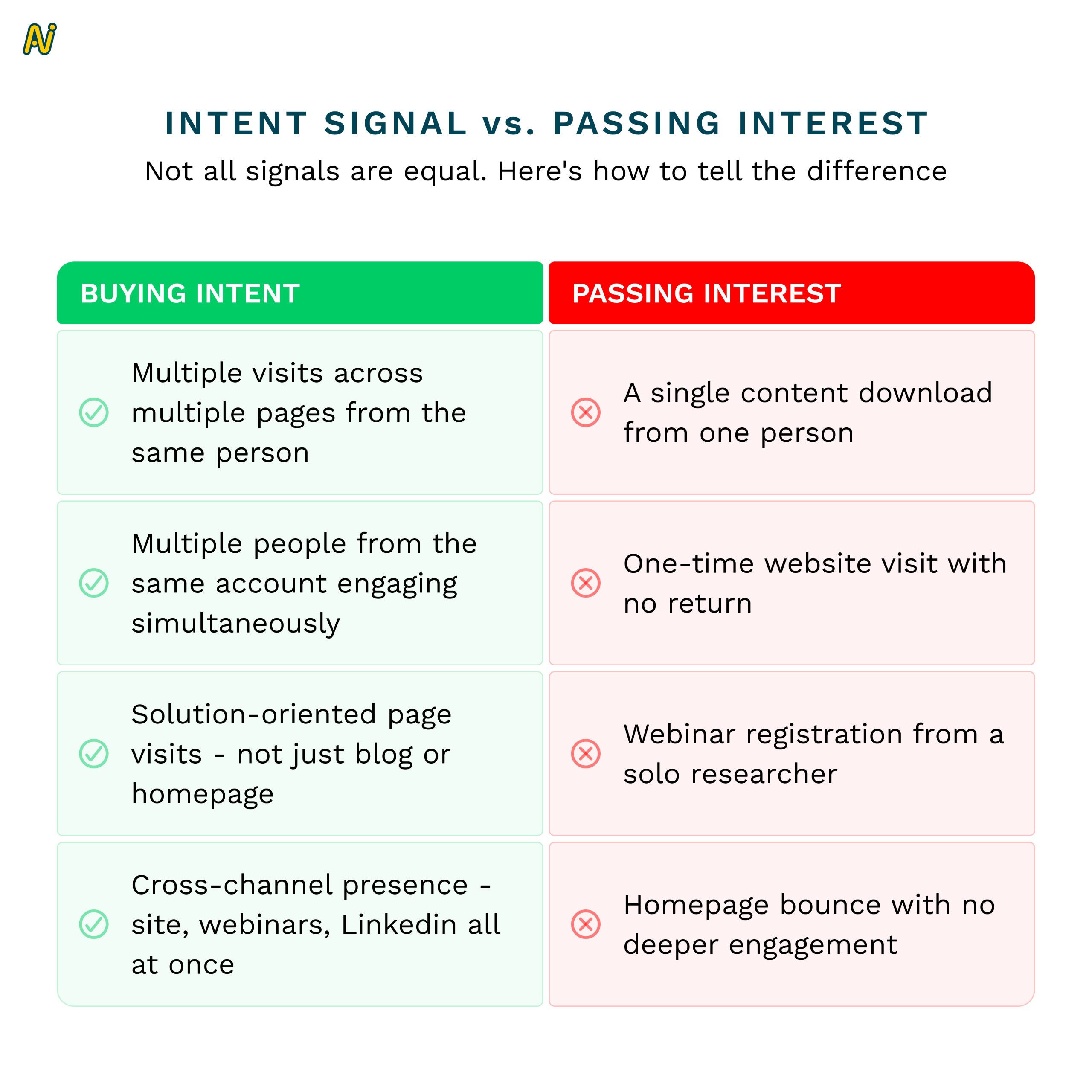
But not all signals are equal. The signals that suggest genuine buying intent rather than passing interest:
- An individual visiting multiple times across multiple pages, not just bouncing after one visit
- Multiple people from the same account engaging across multiple channels simultaneously (website, webinars, LinkedIn)
- Solution-oriented page visits, not just homepage or blog traffic
- Longer session depth and time on site from the same accounts
What does not necessarily signal intent: a single person downloading a piece of content, a one-time website visit, a webinar registration from someone doing general research.
The increasingly important caveat: AI search is changing this entirely. Jenna shared that at her last company, people were showing up in conversations ready to enter a buying journey having consumed zero tracked content. They’d done all their research through AI tools. You have no signal, no touchpoint history, no idea they existed. They appear and they’re ready to talk.
This makes brand investment more important, not less – and measuring it harder.
How to Defend Brand Investment When You Can't Track It
This is where Jenna gets tactical in a way most marketing conversations don’t.
The instinct when asked to justify brand investment is to explain how brand works – the long game, the awareness play, the trust-building. Jenna tried this. It doesn’t work.
I used to go in very naive and say let me explain to you the role of brand. And I'd go in with a very impassioned conversation about what brand did. And you know, who cares.
Jenna Chambers
Former VP of Marketing, DemandScience
What does work: A/B testing brand against no-brand within your own pipeline. Take a segment of ICP accounts. Run brand and demand to half of them. Run demand only to the other half. Let the numbers speak. Show conversion rates, show sales cycle length, show win rates. In a world where marketing is being measured on pipeline attribution, use the same quantitative rigour to prove the thing that’s supposedly unquantifiable.
The second tactic: add a free-form “how did you hear about us?” field to every landing page, and make sure your SDRs and AEs ask the question on every qualifying call. Set up a tracker in your call recording software. Over time, you build a picture of what influenced people before they ever appeared in your system. It’s not perfect measurement, but it’s directional – and directional is often enough to protect the budget.
The broader point: marketing has accepted the narrative that everything must tie to pipeline attribution. It doesn’t have to. Marketers need to push back internally and explain how these things work – not accept the redefinition of the role. If you just accept it, you’ve already lost the argument.
Business-Level Signals Matter as Much as Behavioural Ones
Knowing that someone visited your website is useful. Knowing that their company just announced a new market expansion, reported a major shift in strategic priorities on an earnings call, or is about to come off a competitor contract is more useful.
AI is now amazing for doing this work for you. You can feed in annual reports, investor calls, earnings calls. That deep research used to take when I was on the agency side - I charged a fortune for it because nobody had the time to do it themselves.
Jenna Chambers
Former VP of Marketing, DemandScience
The categories of business-level signal Jenna identifies as highest value:
Earnings calls and investor reports – executives telegraph their priorities in public. Those priorities roll into strategies, strategies roll into projects, projects roll into buying decisions. If you know what the CEO said matters most this year, you know what the company will spend money on.
Tech stack intelligence – providers like HG Insights and Go to Market Fabric tell you what technology an account is currently running, when contracts are likely to expire, and whether they’ve recently signed with a competitor. A hundred people visiting your website means nothing if they just signed a two-year deal with your competitor. On the flip side, knowing a competitor contract is coming up for renewal is more valuable than any intent signal.
Trigger events – office openings, leadership changes, M&A activity, hiring surges in specific functions. These are change events, and change creates buying decisions. The Aberdeen example Jenna shares is memorable: her team found out a target account was opening a new office in their city, so instead of sending an email they sent a welcome pack with restaurant recommendations and hotel suggestions. Not immediate ROI. On the RFP shortlist immediately.
The common thread: this research used to take weeks of agency time and cost a significant amount of money. AI has made it table stakes. The competitive advantage is no longer being able to do the research – it’s operationalising it into campaigns and outreach faster than your competitors.
The Account Priority Matrix: A Cross-Functional Framework That Actually Works
One of the most immediately actionable ideas in the episode. Jenna describes building a matrix at her previous company that brought sales, marketing, CS, and partnerships into alignment around a shared definition of account tiers – and pre-agreed commitments for what each tier would receive.
The structure:
- Define the criteria for low, medium, and high priority accounts – a combination of ICP fit and behavioural/business signals
- For each tier, get explicit commitments from each function: what does sales commit to do with a high-priority account? What does marketing commit to? What does CS commit to? What does a low-priority account get from each?
- Automate based on those commitments, not based on individual judgment
When sales and marketing sit down, you're having a really different conversation at that point. Because you're then talking about, well, this account is actually bottom tier, and we've already pre-decided what happens at bottom tier.
Jenna Chambers
Former VP of Marketing, DemandScience
The result: a common language across the whole go-to-market team. No more arguments about whether an account deserves attention – the criteria are agreed. No more CS offering up executive resources to low-tier customers. No more sales deciding Monday morning what to do with their pipeline based on instinct.
This is also, Jenna argues, exactly how AI should be used in go-to-market. You can’t automate what Bob thinks on a Monday morning. You can automate a process that’s been genuinely thought through by the people who know the craft.
AI can maybe suggest next best actions, but you still want that person who knows their craft, who knows what moves somebody forward, to do that. So if you then use AI to automate what you agree to do, I think that's a very good use of AI. That's not AI taking anyone's job, that's AI enhancing what the humans have put together.
Jenna Chambers
Former VP of Marketing, DemandScience
Re-engaging Closed-Lost: The "Wake the Dead" Campaign
Most companies have a rich mine of information about their closed-lost opportunities – and almost no systematic programme for re-engaging them. Jenna ran what she called a “wake the dead” campaign at her previous company: a rolling re-engagement motion for opportunities that closed to no decision, triggered once a defined time window had passed.
The data problem that usually blocks this: CRM notes from a seller who had zero incentive to fill them in properly. They’re motivated to move on to live deals, not spend time documenting the forensics of a loss.
The solution: call recording software, combined with a RevOps leader who was genuinely passionate about pulling intelligence out of it. At Jenna’s previous company, this person was pulling insights from every call, pushing them as Slack notifications to the relevant people, and updating CRM records automatically. The result for marketing: a set of data points rich enough to cluster accounts by what was actually concerning them – not just company size or industry – and campaign against those clusters specifically.
I knew what was concerning them and that was how I clustered them and that was what I would campaign against. And then sales knew what rabbit holes not to fall down next time as well.
Jenna Chambers
Former VP of Marketing, DemandScience
AI now makes this dramatically more accessible. The signal is already in the call recordings. The question is whether someone has set up the infrastructure to extract it, structure it, and route it to the people who need it.
Applying the Same Signals to Existing Customers
The signals that identify buying intent in new logo accounts work almost identically for expansion and upsell – but most go-to-market teams treat customers like completely different animals the moment a contract is signed.
Jenna’s framework for identifying expansion signals in existing accounts:
- Call recording triggers for language that implies an unmet need – a product they don’t have, a challenge they’re raising that your other solutions address
- Usage and seat capacity approaching limits – a signal that natural expansion is coming
- People from new geographies or new business units starting to engage with your content or webinars
- Visits to solution area pages that are adjacent to what they’ve bought
The critical enabler: CS teams need to be commercially incentivised for expansion. If they’re measured purely on retention, they have every reason to resist upsell conversations – it introduces risk to the relationship they’re being held accountable for. Bring them into the commercial journey and align their incentives with growth, not just survival.
What AI Will Actually Change About Go-to-Market
Jenna’s take on AI is less about what tools to buy and more about what it enables strategically. The mundane work – CRM updates, research, data hygiene, routing – is going to be automated. That’s table stakes. The more interesting implication is what that frees up.
As a salesperson, how much time are you spending in CRM updating fields when you could be on the phone with prospects? AI can take that job all day long. That's never going to take a human's job to do the actual selling, but it frees them up to speak to more customers.
Jenna Chambers
Former VP of Marketing, DemandScience
For marketing specifically: AI returning time to strategic thinking means more time for brand, more time for creativity, more time for the cross-functional alignment that tends to get sacrificed to execution pressure. And critically, it forces that alignment – because you can only automate a process that has actually been designed. You cannot automate improvisation.
The LLM visibility question – how do you show up in AI-generated answers? – gets a practical answer from Jenna: clear, consistent, plain-English positioning. Keyword stuffing won’t work. What will work is a website that coherently communicates what you do, who it’s for, and what you’re not. And consistency in how everyone talks about you externally, so that when AI crawls and synthesises, it’s working from a coherent picture rather than a contradictory one.
If you're confused on your website and you've tried to be a bit of everything to everybody, who knows how AI is going to present you. You could have people who were ready to reach out, have gone to an LLM, read something incorrect, and disqualified you - and you don't know about any of it.
Jenna Chambers
Former VP of Marketing, DemandScience
The Bottom Line
Jenna Chambers’ perspective is shaped by having sat on both sides of the commercial equation – selling and marketing – which makes her unusually clear-eyed about where the friction between those functions comes from and how to resolve it. Her frameworks are not theoretical. They’re built from the experience of a merger rebuild, an agency career, a sales leadership role, and a marketing leadership role that required all of it simultaneously.
The through-line across everything she shares: go-to-market excellence is about alignment – between functions, between signals and actions, between what you automate and what you preserve for human judgment. The tools are better than they’ve ever been. The opportunity is to use them to do more of what humans are actually good at.
Know a GTM leader, CRO, or AI transformation practitioner with a sharp point of view?
We’re looking for practitioners with genuine experience, not polished keynote stories.
Jenna Chambers is the former VP of Marketing at DemandScience. Connect with her on LinkedIn.
This post is based on her conversation with Randy Likas on The Revenue Lounge, Nektar’s podcast on the buyer journey in B2B Sales.
Never miss an episode! Subscribe to The Revenue Buzz newsletter to get weekly episode updates.
If you liked what you read, please share it with your peeps.
In this blog
Get the Revenue Lounge Brief
3 takeaways from every new episode, straight to your inbox.
Episode Transcript
[00:00:00] Randy Likas: B2B buyers don’t move through a funnel the way our dashboard suggests that they do. A website visit, a content download, webinar registration can tell you that an account is paying attention, but not necessarily that it’s ready to buy. Meanwhile, multiple people across the same account may be researching different aspects of a problem, forming a buying group long before anyone raises their hand.
So if attention isn’t intent, what should go-to-market teams actually be looking for? Hello, everyone. Welcome to another episode of the “Revenue Lounge.” I’m your host, Randy Lycis, and in this episode, we’ll explore how organizations can move beyond isolated lead activity to understanding account-level buying momentum.
And joining me today is Jenna Chambers, former VP of marketing at Demand Science. Jenna’s experience spans across senior roles in
Read Full Transcript
marketing, sales, client services, and partnerships, which gives her a really unique angle of go-to-market strategy. She’s helped map process , improvements across buyer journey and diagnose sticking points across the revenue bow tie.
Jenna, thank you so much for joining us today.
[00:01:06] Jenna Chambers: No, thank you for having me. It’s great to be here.
[00:01:09] Randy Likas: So Jenna, I usually like to start these episodes, , by just having you, introduce yourself. Walk us through maybe a little about your background,, career journey, and what you’re passionate about.
[00:01:19] Jenna Chambers: Yeah. So like you mentioned, , my career has e- spanned basically all across go-to-market, which for a while I think I thought was maybe like a shortcoming, and I was a bit like, oh, you know, I haven’t gone all up through the ranks of like either marketing or sales or partnerships. , But now I think in this like modern world of, B2B go-to-market, it has actually completely worked in my favor accidentally.
I’ll take credit for it now, but it wasn’t planned, , that I’ve had experience across all of those roles. So, , I actually started life in comms, just straightforward comms, for a not-for-profit, that moved into like a wider marketing role. , From there, , I did some graphic design, and I thought for a while I fancied myself a graphic designer.
It turns out I wasn’t very good, , and I needed a proper job again. So I went to an-another in-house marketing role. And that was a great grounding. , I don’t think I’ve ever worked in a role since where I’ve just had so much of like a bit of everything. It was just anything marketing, so PPC, web, events, PR, printed materials, and then towards the end, we started to do, , a program called Key Account Pursuits that I now know as ABM, but at the time we thought we were so clever.
Like we thought we’d made up something that like wasn’t real. , And so an agency came in to help us, , do, , quite a big rebrand at that point, and I got bitten by the agency bug. And so I moved over to agencies, , for a few years at that point, and worked my way up in client services. And then it was while I was there that I ended up moving over into MarTech partnerships, working with agencies who needed solutions for their clients.
It was kind of a natural transition at that point. That role then expanded to leading the sales team, both direct and partner, , sales. , And then, like you say, we, , went through a merger and, post-merger, , they were missing a marketing leader. And so I ended up taking on , the marketing leadership role.
, They kinda needed a bit of everything, right? The whole- there had been a, a merger, so we needed a rebrand, kind of site overhaul. , We needed to set up an entire demand gen engine, start customer marketing. It was like, “Go,” everything, which is great ’cause it was almost full circle back to that first job again with a bit of everything.
So, , yeah, that’s like , a potted history.
[00:03:16] Randy Likas: Yeah. So just, , you know, lessons learned from going through a merger like that. What were some of the surprises that, , happened? And if you were to do things over again, what might you benefit from having the hindsight of 20/20?
[00:03:29] Jenna Chambers: The lesson is just, expect the unexpected. Like- Yeah … , the whole point is that it wasn’t like, oh, there’s this plan that some people know in a corner and they’re not telling you. You need to figure it out. , I was part of the leadership team. We were creating the plan and building the plane as it was going, and I think just being comfortable being uncomfortable, which is a phrase that gets-
used all the time, but the whole point is it’s not comfortable. And so getting used to that feeling. Yeah. , And in hindsight, I would’ve prioritized better. I was very aware, like, all of this needs to be done, and so it all needs to be done now, and maybe having more of the confidence to push back and say, “Well, actually, that’s not quite as urgent as it maybe seems.”
Yeah … I took it all on and decided everything was high urgency. So, , I kind of burnt myself out a little bit, but, we had a lot of fun, and it was a great team, and everybody was getting after the same thing. And internally- Yeah … there was a lot of alignment, .. yeah, it had that kind of like startup-y feel, which was fun.
[00:04:16] Randy Likas: Yeah. It g- definitely is fun when you’re in that mode again and shake things up, but , I’ve been through a few of them, , myself, and I can 100%, , relate, where everything feels like it’s on fire, everything feels like it’s a priority. But sometimes the benefit of taking a step back and say- Yeah
“Okay, what do we really need to do?” So appreciate you sharing that. , So why don’t you just talk a little bit about , this really hot topic in the market right now that everyone seems to be debating, which is, , the funnel of MQL to SQL, to opportunity. And, it always assumes that a fairly linear buying journey is taking place.
We all know that’s never the case. , And we all know that, both the quality and, quantity, right, the ability to generate MQLs is getting a lot harder, yet the return of that is much different in a motion where maybe multiple people , are involved in a deal and the MQL is just maybe one person who’s been assigned to do the research, right?
So would love to get your perspective , on just the whole model. , Where does it go wrong, , and how do you think B2B, , buyers actually buy today?
[00:05:14] Jenna Chambers: Well, I think like the key thing is that it just forgets that buyers are people and people are human, and humans have emotions. And I don’t know about you, but I don’t go through my life with like a well-defined process.
I’m not gonna wait to talk to you until I’ve done step two, and then like we’re just people at work at the end of the day. Yeah. And so I think there’s just kind of like applying that, like the methodology and the process is from our perspective internally. Yes. Like as the sellers, this is how we want people to operate.
But as the buyer, meh, gazillion things are happening on any given day and priorities change, and you didn’t know that Fred down the corridor has had a conversation with a competitor and they’re already further on, and all of this stuff happens. , But to your point about the model, I think that, the key thing that the model doesn’t allow for is the transition from the individuals to the buyer group.
Yeah. Because like an MQL is a person, an SQL is a person, and then as soon as it’s an opportunity, there’s a buyer group involved. And so all of a sudden, boop, buyer group’s there, and up until that point, you haven’t really been, engaged with them maybe. You’ve probably been a bit blind to them. So in terms of, , like the best way to tackle that, I think if we’re talking inbound, , at this point, I think you need to do the hygiene check.
Is this MQL from a good fit ICP account? Slight tangent, if we’re being very honest, we will sell. Everybody sells to non-ICP at certain
[00:06:31] Randy Likas: points- Mm-hmm. Agreed …
[00:06:33] Jenna Chambers: because cash flow. Yeah. Yeah. And , there’s this kind of, “Oh, well,” the models are set up in a certain way and the go-to-market motion set up in a certain way, but at the end of the day, if you are behind on your revenue, you are gonna sell to a non-ICP account, and a certain percentage of that is fine.
I think where it goes wrong is that that is completely forgotten in the future forecasts and the modeling, and you don’t account for the churn. And so then all of a sudden you get this surprise churn number because you forgot how many non-ICP you sold to last year, and all of a sudden you’ve got this massive deficit and you’re left going, “Huh, how has that not happened?”
And poor CS are being beaten up for- Yeah … losing customers that should maybe never have been customers anyway. So I think maybe being a bit more open about that, internally and making allowances for that would be the, the smart, logical thing to do.
[00:07:17] Randy Likas: Yeah.
[00:07:19] Jenna Chambers: If we go back to, okay, if they are ICP, then I think looking at who is already engaged, from within that account already.
So, do you have other people within your key personas who are already engaging with you? , And I think at that point, sales using that time between MQL to SQL to do all the discovery that they do about the opportunity, make sure they’re spending a lot of that time also understanding the wider buyer group.
That tends to wait until they’re about to bring more people into the deal, and they suddenly go, “Oh, who else is involved?” And they’ve done some desk research, but you’ve got somebody there. Yeah. You’re having those qualifying conversations. So the quicker you can understand that buyer group, like the less of a leap it is from one person to the group.
And then ideally at that point, I think, you know, It’s 2026, nobody should be doing this anyway, but it’s not a case of marketing saying, “Well, here, we’ve handed you the MQL. It made it to SQL. Great. It’s off our plate now.” Marketing then has a role to do, and it’s a different role in expanding the buyer group.
So that can be as simple as spinning up ads to the account so that more people become brand aware. It can be as sophisticated as bespoke landing pages for the account, , sending relevant content. And once you start to move in that motion where your go-to-market team are working on trying to make that one person into buyer group into an opportunity, then maybe the model’s not quite as flawed as the way that we treat it today.
[00:08:35] Randy Likas: Yeah. Yeah. You’re spot on, and I also just wanna take a step back, and I wanna say thank you for being brave enough to say we’re all gonna sell to non-sa- ICP. Let’s not kid ourselves. Yeah. Nobody ever says that. , And I think , it’s absolutely true. But I think the key thing you said is, let’s remember, that this is not ICP, and we don’t fall back into this because, of , the churn aspect and the churn risk as well.
So I wanna acknowledge and just say thank you ’cause I don’t think we hear that very often., I also wanna i-i-in sort of in that same vein, open up and ask you , with similar transparency. If we think about the difference between, , an account That’s starting to pay attention to your company and an account that’s starting to show signs of entering a buying cycle because they are two different things, right?
Just because somebody, one person, , goes to your website , and downloads a piece of content or, , visits a couple of pages does not mean that they’re ready for a call from the SDR or a meeting, right? It could just be somebody that they know started at the company and they’re just curious what they’re all about, right?
, Yet I think in most times we don’t change our playbooks and we say, “Gotta follow up with all those people that visit the website,” or, “Gotta follow up with, – downloads a piece of content.” So I’m just curious, from your perspective, what is that difference between somebody visiting the website or somebody downloading a piece of content, , who’s maybe just, looking at the company, or somebody who’s really starting to enter into a buying cycle?
[00:09:52] Jenna Chambers: Yeah. Well I would say first of all, if you have somebody who’s engaging with you who’s not ready to buy, well done. Like that’s great. That’s great for brand awareness. , It’s probably a sign that your content’s meaningful., I’ve never gone to a company’s website or started to engage with their content just for fun.
Like there’s something valuable in that for me. And just because they’re not ready to enter a buying cycle right now doesn’t mean that, things might not change in their company, but it also doesn’t mean that they might not move somewhere else. Like you’ve now got an individual who is interested in you as a company and especially in this market, like people are changing jobs, , left, right and center.
Yeah. I think we’re so obsessed with, “We do this thing, what does it get us?” Like what is the immediate ROI on every single activity to the point that we have actually stopped, worrying about brand as much. Everything’s focused so much more over on the performance marketing side. Yeah. If you’re doing that brand work properly, then when the SDRs do reach out, they’re reaching out into a warm account and not a, “Who’s this?”
Or even- Mm-hmm … if they’re warm and they know your name, they actually also know what to expect from you. So you can have– you can leapfrog that talking about yourself on that first outreach call to talking about what you can do for them because you do- Yeah. That bit of work’s already been done. Yeah. Ideally, it also means that those coming inbound have a much better idea of who you are, and therefore they’re reaching out because they think that you can actually help solve something.
So that’s , a bit of a side tangent, but I think, we’re so quick to poo-poo like signals and accounts that are not quite ready to buy as if that’s been unsuccessful in some way, where actually that’s good marketing. It’s like building that wider machine. But to your actual question, I think we all know, right, that the buyers do the bulk of their research in places where we can’t measure and track it.
We don’t see those signals. They’re in Slack communities. They’re at events, at stands. They’re talking to their peers and kind of all of this stuff. So what we tend to see and be able to track tends to be the tail end of a much longer process- Yeah not the beginning. , Again, that’s why brand’s so important, so that you have that influence without you actually being in the room.
But signs that you can look out for that would imply maybe it’s not just passing interest and there’s , a real, buyer need there are things like- Individuals visiting, , multiple times and multiple pages, really engaging when they’re on your site, not just coming once and bouncing. Yep. Multiple people from an account engaging with you on various channels.
If you’ve got people coming to your site and people coming to your webinars, and they’re engaging with your LinkedIn posts, there’s,, a lot of a higher, signal there. , Solution-oriented pages, so, , making sure that your pages are tagged in a way that a site visit’s not just a site visit.
You’ve got, those tracked. But, , like I say, if they’ve consumed a lot of information and subconsciously they’ve made a lot of decisions before they engaged directly with you, especially now in the age of AI search where, , are they gonna… We, you know, we had a huge amount of people who were coming to us at my last place, , we didn’t have anything tracked about them at all, and suddenly they were like, “Hey, we’re ready to enter a buying journey.”
And we’re like, “Where did you come from?” They’re like, “AI.” Like, we haven’t been engaging with any of your content or any of your things. So I think just staying, adaptable,, to that as well is gonna be really important because I think,, we can all try to put together the theories about how to, , appear in LLMs, but that by its very nature is gonna change regularly.
And so I think just making sure that, , we’re back to basics and we’re doing that broad marketing mix and that we’re influencing people where we can’t see them and we can’t track them, so that when we do see them, hopefully they’ve already had a positive experience or impression of us before they ever got there.
[00:13:10] Randy Likas: Yeah. So we talk about LLMs and, and how do we get, , captured and, cited in the LLMs and there’s a lot of debate going on in the market in terms of how to do that. , I read something recently where I thought was interesting. It said it’s SEO , in different clothes, right?
I don’t know if I agree with that completely. But, , would love to get your perspective. What’s the best way to have the LLM start picking up your content?
[00:13:29] Jenna Chambers: I think, there’s always gonna be a way to gamify a system.
There’s always gonna be somebody who’s like, “I have become an expert in the last 24 hours-” “… on this new thing that just got released,” and you’re like, “, good for you.” , But I think, again, about that kind of topic of going back to basics, I think what the AI search is gonna mean is that your content is just gonna have to be relevant.
It’s gonna have to be meaningful. It’s not gonna be SEO as in like get, keyword stuffing and do all your backlinks and all of that sort of stuff. But – do you speak sense on your website, and does your website very clearly and very coherently tell those crawlers what you do and who it’s for?
And then are other people talking about you in the same way? So it’s that consistency piece. And so that doesn’t necessarily mean, like, get a guest blog on, , a partner’s website, but it does mean that when somebody is publishing about you, that they’re talking about you in the same way. So that kind of brand policing and making sure that everybody is dead clear on your messaging and your positioning, who you are and who you aren’t as well.
Yeah. , There’s one thing, can you show up on LLMs and can you show up on AI search? But are you showing up in the right way? ‘Cause if you’re confused on your website and you’ve tried to be a bit of everything to everybody, who knows how AI is gonna present you, ’cause you never see it. So you can’t influence it.
Right. You have no idea. You could have people who are, like, ready to reach out to you, have gone to an LLM, have read something incorrect, but have read something and then disqualified you, and you don’t know about any of it. Right. So you’ve just gonna have to be much, much clearer, I think, in who you are, who you’re not, who you’re for, , and just kind of speaking a bit more plain English, I think is gonna help.
[00:15:02] Randy Likas: Yeah. Yeah. , Great suggestions in terms of, maybe how to show up and how to get picked up. I have a question for you on the measurement side. Mm-hmm. How do you measure something that you might not see or you might not know about, right, , in that world? And is it a good faith, , sort of investment that we just know it’s, we’ve gotta do this or not?
– How do you measure something like that when you can’t see it or you don’t necessarily know about it? So, , somebody spoke for a long time on LinkedIn about you need to add like a how did you hear about us section to your landing pages and just make it- Yeah
[00:15:31] Jenna Chambers: free form. Yeah. And the number of people who will gladly tell you that, or you have your SDR or your AE on that qualifying call ask the question. So, , we had Gong,, at my last place, and we had a Gong tracker set up for the question: How did you hear about us? , And , in that way, sure, we heard about it like at the last point because they were already in touch with us, but we did start to get an idea of where people were and the sorts of things that led them to us.
But about not being able to measure in general, I think marketing has always been a bit of an art and a bit of a science, and I think in this world of measure everything, get ROI in everything, , move towards performance marketing, marketers are solely, , tasked on pipeline.
I think we’ve forgotten about the art side and creativity- Yeah … and- Yeah … trusting that marketers are professionals who know what they’re doing, and they do need to do some things that don’t necessarily lead directly to ROI, but they do impact downstream and . I think there’s maybe a bit of a job that marketers need to do about internal education and internal communication to make that point clear, , instead of just accepting, “Well, my role’s been changed now.”
Well, has it? , Or have you just not pushed back enough? Yeah. And have you not explained internally, , how these things work? Because if only you could publish a blog post and the pipeline comes in. If only. But that’s not the world we work in. Yeah. Otherwise, it would be a sheer numbers game.
[00:16:48] Randy Likas: Yeah. Yeah.
So, I think if we bubble that even farther, and it’s, this big debate that’s in the market is, brand versus demand and how much we are able to invest in brand as opposed to invest in, demand programs. And I think what you’re hinting at is exactly that argument, which is, you know, both are important.
One actually helps the other one, ru-rubs the other one’s back , a little bit, but- it’s a little bit harder to measure. , What’s been some of the things that you’ve done, , as far as being able to defend, you know, hey, we’ve gotta invest in brand, and the reason why we invest in brand is because it helps l-l-rise the, the tide of all the boats.
, Maybe some advice for some marketers who are , in a similar situation. H-how would you go,, talk about that with your executives?
[00:17:28] Jenna Chambers: So we were talking earlier about learning lessons. , And I would say the lesson I learned from myself, my younger self, was I used to go in, , I was very naive and I was like: “Let me explain to you the role of brand.”
And I’d go through a very impassioned conversation about what brand did, and, you know, who cares? Like, why? So now what I do is A/B test. I make it really clear. I’m like, here’s a, a, either like an ICP or, , like a section of customers or whatever it happens to be, and I’m gonna reserve X amount of them where I’m gonna do no brand work, and the rest of them I’m gonna do brand and demand and let the numbers speak for themselves.
I think in a world where marketing has come down to, I’ve spent more time in a spreadsheet than I have in InDesign for years, which is not really why I went into marketing, but we are where we are. And so in a world where marketers are being so heavily tracked on numbers, then actually rely on data and just show and say: “Listen, I’m working on the hypothesis that this is gonna work.”
“But I can explain it to you all day, and you can tell me why I’m wrong all day, but we’re just gonna need to put it to the test and put some dollars behind it.” Yeah. Okay. , Let’s change gears a little bit, and let’s talk about something that you mentioned,, as part of our prep that I really wanna, – unpack a little bit.
[00:18:39] Randy Likas: , And that is that, understanding what’s happening, , inside a business, , is just as important as understanding how the buying group is behaving, right? So, what external or maybe business-level signals should, go-to-market teams be paying attention to inside of the business? And I’d just love to unpack that idea a little bit more with you.
[00:18:57] Jenna Chambers: Yeah. So I think, there are different, components when it comes to understanding like an account or a prospect. We spoke about are they a good fit? Are they ICP? Are we engaging with the right folks in the buyer group? Do we understand their drivers? And then what’s happening in the wider business context, and that really helps us understand the drivers of the buyer group.
So, like in terms of what those signals are, like AI is now amazing for doing this work for you. Right. You can feed in annual reports, investor calls, earnings calls. , That deep research used to take forever. And when I was agency side, I charged a fortune for it because nobody had the time to do it themselves.
So we would- Yeah … go off. We would literally take two weeks and deep dive onto an account and figure out where they were opening up their next headquarters or, whatever was important to the client. , And it was really, really valuable. , We had some senior salespeople tell us that we’d saved them about a year’s worth of work in doing the research, where now I couldn’t really charge for it because you can just do it yourself with AI.
You can feed all of that in and say like, “Hey, now that you understand me with all of this information, what’s going on that I need to be aware about, in that account?” , The other, , piece of information I think is really important is that there are data providers out there. So I don’t know if you’ve heard of like HG Insights and Go-To-Market Fabric- Mm-hmm.
Yep … but they are providers that will tell you about a tech stack within an account. . So have they just signed up with your competitor? To the point earlier about the buying signals, it is irrelevant if 50 people come to your website and spend an hour each if they’ve just signed a two-year deal with your competitor, ’cause, , they’re obviously not buying.
On the flip side, are they about to come to the end of a contract and is now the time to go after them more wholeheartedly? , Or are you like a tech company where your entire solution sits , on top of ServiceNow, and therefore it’s important for you to be able to pick out ServiceNow, , accounts to go after?
So those are the sorts of like wider what’s going on in the company that , you could find out from your champion, and you could find out from an individual, but you’re just gonna bombard them with questions. They’re gonna get really annoyed with you. So that’s the kind of research that now is a lot easier to do than maybe even 10 years it was.
[00:20:58] Randy Likas: Yeah,- 100%. And I think as a salesperson, , my entire career, you’ve always tried to look for and identify, what is the change event that’s going , on inside of the organization. And it’s unbelievable in terms of like earning calls and analyst, , days and things like that, what executives will share.
And all of those things are, top priorities or objectives. And guess what? All those things roll down into strategies, and all strategies rolls into projects and objectives. And I think that – those are all signals in and of themselves in terms of how you can market.
Not just sell, but how you can market. So I think you’re right. It used to take me forever to do that type of research. Yeah. , And it’s just so much easier today to do that. And we just have to change way we, which we, use that information and operationalize that through our campaigns and through our follow-ups and things like that.
[00:21:38] Jenna Chambers: Well, and especially if you’re taking a more account-centric like ABM approach, then 100%, it’s not just for the salesperson, it’s for marketing. And back to that creative piece I was speaking about earlier, , my first in-house marketing job way back when, too many years ago to mention, , so we did like operational excellence software for the oil industry.
We had an oil company that was on our ABM list, and we found out that they were coming to Aberdeen, where we were headquartered. And so instead of just sending an email, , we got them a welcome pack and we sent it to their new office because we knew ahead of time. So we sent them restaurant recommendations.
We told them which hotels to have their staff stay in. We did all the stuff that was just, that’s not immediate ROI, but it gave them such a nice experience of us that like as soon as RFPs were coming out, we were on the list.
[00:22:19] Randy Likas: Yeah. Yeah. Sometimes you just have to be remembered, right?
[00:22:21] Jenna Chambers: Yes.
[00:22:22] Randy Likas: Yeah.
Yeah, yeah. Absolutely. Okay. So, , we started to talk about this a little bit with like this , in this world now with AI and how things are changing. I wanna ask you a question about AI maybe that’s a little bit, , not like how is AI changing the world, but, , I want you to think about it from the perspective of, what do we do differently in an AI-powered revenue organization?
Skills, behaviors, , ways of working that’s g- actually gonna matter more. , And maybe what should we stop spending our time on? –
[00:22:53] Jenna Chambers: Well, everybody’s trying to figure this out, right? Everybody’s getting knotted up about, AI and automation and how it’s gonna change things. My take on this is, and I think I’ve mentioned this a few times now, but back to basics, is I think it’s gonna let marketing specifically and hopefully sales too, , go back to basics in that like a lot of the doing is gonna be automated.
So an awful lot of the stuff that’s taking up the time, like as a salesperson, how much time are you spending in CRM updating fields when you could be on the call, on the phone with prospects? It’s ridiculous. That sort of thing, AI, you’d take that job all day long. That’s never gonna take a human’s job to do the actual selling, but it frees them up to speak to more customers.
From a marketing perspective, I think it’s gonna allow us time to be more strategic, and to focus more on brand, even just from a thinking perspective- Yeah … if not budget perspective. It means that, time-intensive piece is gonna be, , taken away, which I think is , a good thing.
And then you really need to think through your strategy and how you’re gonna go to market in order to automate it. So it’s gonna force us all to sit down, hopefully across sales, marketing, customer success partnerships and say, “Right, how do we want to do this?” Because we’re gonna have to automate an actual process.
We can’t automate what Bob thinks on a Monday morning.
[00:24:03] Randy Likas: Yeah. ‘
[00:24:04] Jenna Chambers: Cause that doesn’t work. And so I think that’s gonna force like a lot of strategic thinking, which is gonna be great. Yeah. Yeah. , I think it’s also gonna free sales and marketing up to speak more together, as opposed to it being this kind of, dynamic it can be at the moment.
The ability to sit together and look at either leads or ABM accounts and dashboards and decide together, right, okay, what’s the next campaign? Which account needs outreach and what are we gonna say to them? What content do customers need that they haven’t seen from us for a while? And then with all of the signals that we mentioned above, , I think the great thing is that only humans can decide what to do with it.
Like sales and marketing professionals are professionals for a reason. They have experience. Yeah. Like a machine can maybe suggest next best actions, but you still want that person who knows their craft- Yeah … who knows what, like moves somebody forward to do that. , And so what we did at my last place, b- in order to do that kind of strategic thinking and get the machine to automate it, was to create almost like a matrix.
So what is the criteria for a low priority account, like a medium priority account, and a high priority account? And then sales, marketing, CS, partnerships, what are we all committing to if an account hits each of those Thresholds. Because you can’t spend as much time on a low priority account. You want to automate more of that, , sales process or outreach, versus a high priority account.
That’s a combination of ICP fit and then all of the signals that we’ve just been speaking about just now, what pushes somebody higher up into one of those,, high fit accounts. And then when sales and marketing sit down, you’re having a really different conversation at that point because you’re then talking about, well, this account is actually bottom tier and we’ve already pre-decided what happens bottom tier versus they’re only mid-tier.
It’s also useful, I think, to assign, , those commitments, , like I said, in terms of what they’re gonna get. So from a customer success perspective, no, you can’t offer up the VP of product to low-tier customers. Back to that, ’cause we sold to some not great tier customers at the start. You can’t give them all the bells and whistles.
That then becomes a full go-to-market framework that reaches all the way through from first touch and what marketing do, all the way through a live opportunity, all the way through a customer and try and upsell. Um, and it means that everybody knows what we’re talking about at that point, and there’s like a common language that we can all speak.
[00:26:08] Randy Likas: Yeah. And then if you then use AI to automate that and what you agreed to do around it, I think that’s a very good use of AI. That’s not AI taking anyone’s job. That’s AI enhancing what the humans have put together. Yeah. 100% agree with the premise and idea that like what it’s helping us do is to actually become better thinkers, to be able to think more strategically , and, , because when you had to do a lot of execution, it certainly just, you, there’s only so much ba-ba-bandwidth.
So, , I don’t think it’s replacing humans. I think it’s helping us actually be better, , strate-strategic thought providers. , I also think that there’s, an opportunity, and this is gonna be a little bit maybe , of a new topic or new question for you be- it’s timely.
I read something this morning about it, which is, think about your deals that have been closed lost to no decision. , And that’s like a very high percentage of deals where we’ve made the investments in marketing and these leads and they’ve worked and for whatever reason, they’ve didn’t close because of no decision.
When you look at why that was a no decision traditionally, and you look inside a CRM, you typically get one or two sentences from the rep that puts it in there because the last thing that they wanna do is spend a lot of time, , re-really talking about a deal that they just lost.
However, there’s so much signal inside of that opportunity- Yeah … across every meeting, email, e- everything else, that AI can now, synthesize and represent so that , true marketers who are truly doing account-based could use that to help retarget and re-engage and so on and so forth.
So, I think that’s a just a tremendous opportunity, that, , opens up for us to re-retarget. Would just love your perspective on that.
[00:27:51] Jenna Chambers: So I, in my past, we have had like a rolling, what we would call wake the dead campaign, which is exactly that, kind of like something closed to close to no decision, probably not within three months.
You’re not gonna go bombard them straight away, but the minute like that times out into its time to re-engage them again, then understanding, , what’s going on in that account is vital. And if you are lucky enough to have call recording software as well- Yeah … it’s next level at that point. Like the goldmine of information that you can get from there and being able to set up kind of triggers and notifications is just fantastic.
Because you’re right, if you rely on CRM notes from a seller who is motivated in absolutely no way, shape, or form to go fill that out because they are not getting commission on that account, and so we want them to go and move on to something else. We want them to go work on a live deal and not spend the time doing the admin.
So if you have got call recording software and then somebody who’s a bit of a whiz in terms of pulling all of that out, and making that information, , I was very lucky. , The VP of RevOps that I worked with at my last place was an absolute AI geek and wizard. , And , he was just so impassioned by this that our CRM records were the most detailed, beautiful things because he was just constantly pulling things out of the call recording, , pushing them as Slack notifications to the relevant people, and then also updating CRM.
That from a marketer’s perspective, it was great because , there was more sets of data points that I could slice and dice to campaign by. Yeah. Like- Yeah … it didn’t matter what size the company was because I knew what was concerning them, and that was how I clustered them, and that was what I would campaign against.
And then sales knew what rabbit holes, , not to fall down next time as well.
[00:29:27] Randy Likas: Yeah. , Okay, I have one more question for you on the, regular nature of podcast before we transition into something that’s a little bit more fun and lighthearted, which is our lightning round
I wanted to ask you a little bit about the difference in, buying signals, between, an account that’s, a new logo, brand new, ha- haven’t worked with them today, to companies that, , or signals, , that exist in, your existing customers, right? So upsell, cross-sell, and, how do you think about, using signals, if you will, whether they be third party or first party, to identify when an account is ready for an upsell or ready for an expansion or ready for something, completely white space?
[00:30:07] Jenna Chambers: , So I think a lot of what we’ve spoken about applies both to existing customers and net new. , We just seem to treat them like they’re completely different animals the minute they become a customer. They’re still- … presenting challenges that we can- Yeah … potentially help solve. But when they- Yeah
become a customer, like it’s now different. , And obviously you’ve got the great advantage that you’re actually talking to them. And especially- Yeah … like not to harp back on about Gong and call recording again, but if you do have that in place, and then you get your triggers set up properly, , you can be listening almost like on the sales team behalf into conversations with customer success or, with sales or whoever they’re speaking with, , that would imply there’s a need for either, , like a product that they don’t have yet or, , maybe a new, colleague has joined them.
, If you don’t have call recording software… Oh, and actually if you do have the call recording software and you are listening to what the customers are saying, bonus for marketing because that should be your content, , calendar that comes out- Yeah … because your customers care about it, your future customers care about it, and that’s what you should write about and speak about.
, There are other signals though like, , depending on your pricing model, like are they reaching kind of usage seat capacity, and it’s kind of time to automate some of that, , outreach? , You can still use things that we spoke about, like are different people maybe from different geographies coming to your website and starting to engage with your, , webinars?
Are they visiting solution areas that are not the solution that they’ve bought from you? So a lot of , the play still works. You just have to point it at the existing customers. – Yeah … and I think as well, like it’s really important at that point that you make sure that your customer success team is commercially incentivized as well, ’cause otherwise it’s in their interest to back off.
Like, don’t sell anything to my customers because they’re so focused on the retention. Yeah … so bring them into that journey with you.
[00:31:44] Randy Likas: Yeah. Wonderful advice. , Okay, let’s go move into the lightning round. , I just wanna be conscious of time , and wanna make sure we can ask you a few of these. So,, first thing, the intent of these questions is just roll off the first thing comes to your mind.
It needs to be funny. , If you had to pick one, brand or demand?
[00:32:01] Jenna Chambers: Brand.
[00:32:02] Randy Likas: Why?
[00:32:03] Jenna Chambers: Because I love it, and it’s creative, and it’s fun, and it makes my heart sing a bit.
[00:32:08] Randy Likas: Okay. , One marketing metric that you think gets way too much attention. ,
[00:32:12] Jenna Chambers: Ugh, last touch attribution.
[00:32:14] Randy Likas: One marketing metric that doesn’t get enough attention.
[00:32:18] Jenna Chambers: Boy, it doesn’t get enough attention I think it is, um… I don’t know. I don’t know. Gosh, everything gets attention. , Everything is wildly analyzed. I actually don’t know if I have an answer for that for you.
[00:32:32] Randy Likas: I’ll ask it a different way. What is the one metric, that, uh, , gets, the least investment or is under-invested in?
[00:32:39] Jenna Chambers: Okay., I think the website. I think that we get very focused on how many people are coming to the website, and then immediately we leap to how many of those became leads. Sorry. But when you go to the CFO and you’re like, “I wanna invest in the website,” it’s like, “Ah, it’s a website. Like, let it be. There must be free tools and things.”
So.
[00:32:56] Randy Likas: Yeah. , One piece of marketing conventional wisdom that you completely disagree with
[00:33:04] Jenna Chambers: That you go from MQL to SQL to lead? Yeah.
[00:33:09] Randy Likas: One company that, comes to mind where, you know, you hear, , really good modern B2B marketing or have put out really good content. ,
[00:33:19] Jenna Chambers: Cognism in the UK to… I’m not even entirely sure that I know too much of their own direct marketing, but they used to have, .. was, was she head of marketing and then became CMO?
And her content was so great that in my head I always knew about Cognism. She wrote a book and everything. She’s fab. Yeah. , Favorite part of, being head of marketing?
Getting to, actually see ideas come to life. We’re one of the few departments that actually, gets a proper launch date.
, It’s really fun to, , launch a new product and see a new brand go to life. And if I can have a second one, , it’s the need to work, like, across departments. So it’s the ability to,, see things from a salesperson’s perspective, understand where the CFO is coming from, and not just have to, sit in your lane.
[00:34:03] Randy Likas: Yeah. , There’s always gonna be a flip side to that question, which is, what’s the least favorite part of leading marketing?
[00:34:12] Jenna Chambers: You don’t get as much kudos when things are just going well, if it’s just going to plan. If you’re way over shooting plan, great. If you’re under plan, heaven help you. , But if things are just to plan, which is also success, it’s just a given.
[00:34:26] Randy Likas: Yeah. , What’s the one thing that you like to do, , outside of your job to unwind or decompress?
[00:34:33] Jenna Chambers: I’m very lucky that I live… I don’t know if you’ve heard of the Cotswolds, but it’s a very- beautiful area of the UK, , near Oxford, and I live on the edge of it. And so I spent my weekends- Wow … basically, like, walking in the countryside and eating, Sunday roasts in pubs. Like, basically being, like, the most British person I can possibly be.
Just hanging out with friends and family. Yeah. That’s wonderful. Last question. After this episode, if someone wants to get in touch with you, , best way to do that? ,
Probably LinkedIn, I would say.
[00:34:59] Randy Likas: Okay. Wonderful. Jenna, I really appreciate you taking the time. I, think what we talked about was,, a little bit of a different perspective in terms of, , what we’ve spoke with others before.
You’ve certainly brought some new wisdom and new insights. So thank you very much for sharing, the past 40 minutes with us. I really appreciate your time , and look forward to connecting with you again.
[00:35:15] Jenna Chambers: Absolutely. Thanks so much. Bye.
[00:35:16] Randy Likas: Bye-bye. Take care. That’s another episode of the Revenue Lounge, everyone.
Thanks so much for joining. Talk later.