

Fix Your CRM Data Quality to Drive More Revenue
- Product
- 11 min
- Updated: August 17, 2026
Your CRM has more data in it than ever. Organizations run an average of hundreds of thousands of records through their CRM, and that number only grows: marketing collects data through campaigns, sales through client interactions, support through calls. The volume keeps climbing every quarter.
Volume was never the problem. It’s the quality of that data that actually moves the revenue needle, and by that measure, most organizations are in real trouble. Fewer than half of organizations report that even 50% of their CRM data is accurate, and confidence in that data to actually drive go-to-market decisions runs lower still.
Without trustworthy CRM data, go-to-market motions fail to deliver. Customer churn, lower employee morale, weak ROI on the rest of your tech stack, and misalignment between customer-facing teams all trace back to the same root cause: revenue leaking out through data nobody can fully trust.
Get our latest insights into your inbox

Inefficiencies Plaguing Your CRM Data Quality
Even after decades of existence, CRMs still haven’t evolved from a system of record into a system of genuinely actionable insight. Most of that failure has less to do with how a CRM functions and more to do with the data it’s actually operating on.
1. Missing Data
CRMs put the burden of data entry on reps manually uploading it, and most of it simply never makes it into the system. That leaves out critical revenue data, and every gap is a missed opportunity hiding in plain sight.
2. Data Decay
CRM data decays fast. Current research converges around 22.5% annual decay for typical B2B contact data, with some sources citing figures as high as 70% depending on industry and record type, tech and healthcare contacts tend to decay faster than finance, for instance. Using data that’s no longer accurate sends sales and marketing down the wrong path entirely, targeting the wrong people at the wrong time with a message built on outdated context.
3. Data Silos
Most CRM data sits in silos. Sales keeps its own data; marketing runs its own stack. That lack of coordination means both teams optimize for their own goals rather than a shared one, and without unifying data from every source into a single source of truth, campaigns can’t deliver the targeted, personalized value buyers now expect.
4. Poor Quality Data
Incorrect or outdated data sits in a CRM even as the real world keeps changing underneath it: people leave roles, companies grow past a segment, mergers happen, a buyer moves to a competitor. Knowing about these changes is critical for a successful campaign, and stagnant CRM data simply never captures them.
How Poor CRM Data Quality Affects Revenue
Be careful what you feed your CRM, or you get a textbook case of garbage in, garbage out. You can’t expect meaningful insight from a system built on an unreliable source.
Data is what gives you visibility into where to improve, which leading indicators to focus on, and where the revenue funnel is about to break before it actually does. If the underlying data is compromised, none of that visibility is real. 44% of organizations estimate they lose more than 10% of annual revenue to poor data quality, and that leakage shows up across the business in several distinct ways:
1. High Employee Turnover
CRM users, your own employees, are hitting a saturation point. A majority say they’d consider leaving if their organization doesn’t invest in a real CRM data quality plan. In a market where talent is genuinely scarce, that turnover means real time and money lost to hiring, onboarding, and re-engaging replacements.
2. Poor Sales Forecasting
Forecast quality has a direct line to revenue. A poor forecast is what happens when bad data feeds a system that’s supposed to predict what closes each quarter, and the result is resources wasted chasing outcomes that were never realistic to begin with.
3. Poor ROI From the Tech Stack
Every tool in the stack, CRM included, only delivers ROI when it has good data to work with. Without it, those tools stay expensive shelfware, eating budget without delivering value anyone can point to.
4. Poor Targeting
Pulling every contact and running one uniform campaign is long past its expiration date. Today’s buyers expect hyper-personalized messaging, which requires marketing teams to have real, high-quality data on their contacts, not just a name and an email address. CRM data tells you who to target; it rarely tells you why. Bad data compounds that gap, sending the wrong message to the wrong customer for a problem they may not even have, which puts brand reputation at real risk.
How to Address the CRM Data Quality Issue
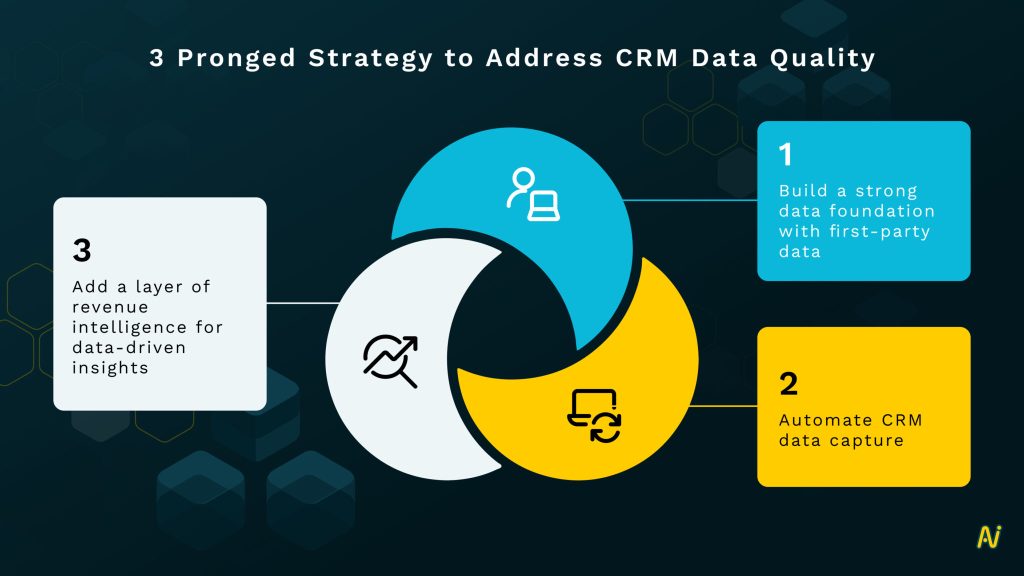
A strong data foundation is the first step. Once you have one, the next step is a system that continually enriches, maintains, and updates that data going forward. If a contact leaves their organization, your system should catch that automatically. If a new stakeholder joins the buying committee you’re pitching, that contact should get captured without anyone manually uploading it.
Raw data is still useless on its own. Layer revenue intelligence on top of high-quality CRM data, and you get the data-driven insight that actually generates more revenue.
1. Build a Strong Data Foundation
Third-party data quality and compliance are both increasingly questionable, and third-party data is on its way out as privacy law gets stricter. First-party data, the information a user shares directly with you, with consent, an ebook download, a webinar registration, avoids the problem at its source. It’s unique to you, privacy-compliant, accurate, low-cost, and genuinely marketable. Organizations report up to a 66% increase in revenue from clean, enriched first-party data, with campaign response rates improving by roughly 20% and close rates by 15% within six months of real enrichment.
2. Automate CRM Data Capture
Forcing reps to manually upload contacts has never worked and never will. Manual upload fills the CRM with inaccurate, incomplete data, and costs sales productivity and morale on top of it. Reps resent time spent on manual entry when they could be selling. Sales reps currently spend somewhere between 5.5 and 27% of their working week dealing with inaccurate or missing data, time that automated capture gives back directly. Automated capture also keeps data correct and non-duplicated by design, and reps stop treating the CRM as a burden and start using it as a core part of how they actually sell.
3. Leverage Actionable Insights From CRM Data
Raw data alone is still useless. Once you trust the quality of what’s in your CRM, layer revenue intelligence on top of it to turn that data into insight that actually informs decisions, actions, and conversations that close deals.
A rep who knows a new CEO just joined the account they’re pitching has real leverage over one who doesn’t, they can message the new stakeholder appropriately and know to stop looping in the old CEO, who’s no longer part of the buying committee at all. That’s one example among many of how first-party CRM data becomes genuinely actionable intelligence.
Why This Matters Even More With AI Agents in the Mix
Everything above has always mattered for revenue. It matters more now because of what this same data increasingly feeds. Duplicate and decayed records don’t just mislead a person reading a report anymore, current research has found data quality issues, duplicates specifically, break AI prediction accuracy at close to a 90% failure rate in some analyses. A growing share of CRM data now feeds AI agents acting on it directly, prioritizing an account, flagging risk, updating a forecast, and a gap that used to just produce a slightly-off report can now produce a confidently wrong automated decision, at a speed nobody catches in time.
Nektar’s Data Foundation automatically captures first-party contact and activity data directly from email, calendar, and meetings, with zero rep effort required, closing exactly the gaps manual entry leaves behind. Daisy AI then turns that clean, unified data into the specific insight covered above: buying-group visibility, deal risk flags, and engagement scoring, grounded in real captured activity rather than whatever made it into the CRM manually.
Frequently Asked Questions
Q. How fast does CRM data actually decay?
Estimates vary by source and industry, but current research converges around 22.5% annual decay for typical B2B contact data, with some sources citing rates as high as 70% for faster-moving industries like tech. The consistent takeaway across sources: without active maintenance, a meaningful share of your CRM becomes unreliable within a single year.
Q. How much revenue does poor CRM data quality actually cost?
44% of organizations estimate losing more than 10% of annual revenue to poor data quality, and Gartner's widely cited estimate puts the average cost at $12.9 million per organization annually. The exact number varies by company size, but the direction is consistent: this is a real, measurable revenue problem, not just an operational annoyance.
Q. Why is first-party data more valuable than third-party data for CRM quality?
First-party data comes directly from a user with their consent, which makes it more accurate, more compliant with tightening privacy law, and genuinely unique to your relationship with that customer. Third-party data quality and compliance are both harder to verify, and access to it is narrowing as regulation gets stricter.
Q. Does automating CRM data capture actually improve data quality, or just speed up entry?
Both, and the quality improvement is the more important half. Automated capture eliminates the duplication and inconsistency that manual entry introduces by nature, which is a different (and larger) problem than simply entering data faster.
Commit to a Sustainable Revenue Model With High-Quality CRM Data
Economic uncertainty and unpredictability keep pushing businesses toward processes built to withstand shocks rather than just react to them. Addressing the root causes of revenue leakage, starting with your own CRM data, is the first real step toward a revenue model that can actually take that kind of pressure.
Get a free CRM scan to see how much data your own CRM is currently missing, before you build anything else on top of it.
Enjoyed our content? Follow Nektar on LinkedIn