

How to Drive Sales and Marketing Alignment With Unified Data
- Sales, Marketing
- 13 min
- Updated: August 14, 2026
Sales and marketing alignment is a huge, ongoing problem. Roughly 9 in 10 sales and marketing professionals say their teams are misaligned, worrying in a business environment that only moves faster every year.
Because sales and marketing performance gets measured differently, both teams end up using different approaches and systems, producing disjointed content, maintaining a passive relationship, and setting disconnected goals. All of it leads to real revenue leakage.
Get our latest insights into your inbox

What Is Sales and Marketing Alignment?
Sales and marketing alignment is the ongoing set of processes both teams use to collaborate seamlessly across the full range of revenue-generating activity, not a single initiative with a defined end date. It matters more in a digital, distributed business environment, where teams are scattered across geographies and increasingly remote. Alignment isn’t an outcome you reach once, it’s a continuing joint effort, and a large majority of sellers and marketers feel poor alignment actively hurts both the business and the customer experience.
Misalignment most commonly shows up when marketing hands off leads without complete or current contact information, when both teams set disconnected revenue goals based on their own separate strategies, or when communication between the two is simply muddled. Cross-functional collaboration smooths these bumps out, and the first real step toward it is putting unified data at the center of the process.
A Peek Into Unified Data
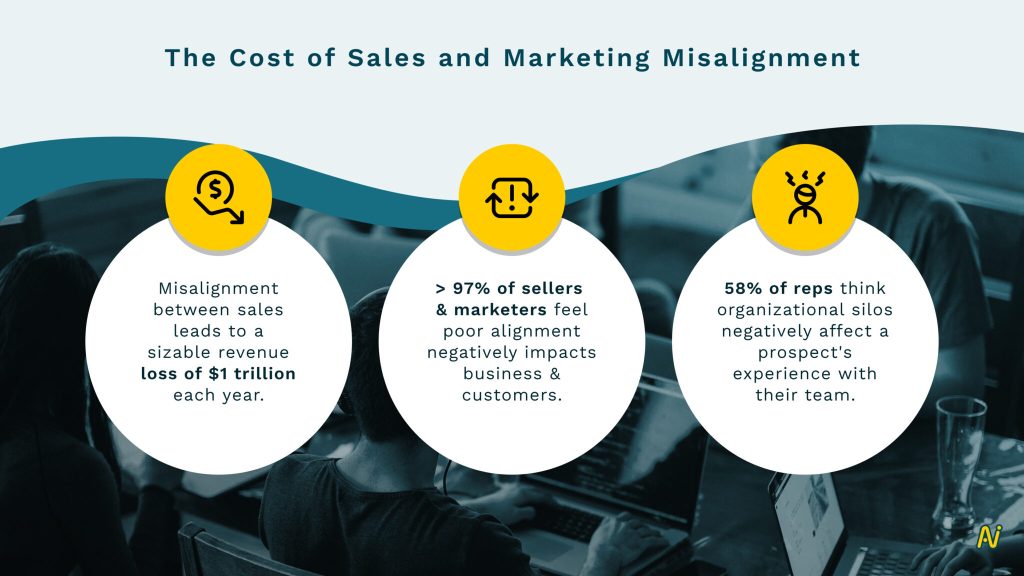
Data volume keeps growing every year, and it’s growing faster than most estimates from even a few years ago suggested. The real challenge has never been generating data, it’s creating value from it. Nearly half of employees find it genuinely difficult to share information across teams because of poorly integrated systems, and the result is the same dirty data pattern showing up everywhere: incomplete, inaccurate, non-compliant, outdated, inconsistent. This doesn’t just hurt rep performance, it hurts the customer experience directly, a majority of reps believe organizational silos negatively affect how a prospect experiences their team.
Unified data solves this by combining data from disparate sources and disconnected systems into a single, central view, capturing data across the sales and marketing tech stack so everyone works from the same picture. It also drives better customer engagement, reduced churn, and higher ARR.
Forrester’s research highlights how much buyer engagement now happens before a deal closes: buyers commonly contact sellers five or more times before closing, expect instant answers to complex questions to shorten the cycle, and a large share do substantial independent research before ever talking to sales. That journey leaves behind data breadcrumbs with real insight in them, if a team is actually set up to see it.
Making the most of that engagement means sales and marketing need continuous data exchange, not a periodic handoff. New prospect information keeps arriving, and it needs to be accumulated, managed, and kept current so both teams have it at their fingertips. That’s the specific problem unified data solves, and automation, paired with AI for contextual insight, is what makes it work at real scale.
Marketing data sales can use: lead and organizational data, lead scoring and qualification results, customer behavior and intent analysis.
Sales data marketing can use: connecting campaign objectives and performance directly to revenue, nurturing leads with genuinely relevant content, and building lookalike models of sales-ready leads for new prospecting.
The Need for Sales and Marketing Alignment
Misalignment between sales and marketing is estimated to cost businesses more than $1 trillion annually, a figure tracing back to Harvard Business Review and IDC research that’s still actively cited in current studies on this exact topic.
Sales and marketing have conventionally operated as separate worlds, with different objectives, revenue goals, and processes, creating friction that keeps both from operating at their best. In today’s dynamic environment, where events like economic instability can shift the landscape quickly, a disconnected sales-marketing relationship simply isn’t viable for sustained growth anymore.
The buying process itself keeps getting more complex, too. Businesses need to build trust and real relationships, and the buyer today is a buying group, key stakeholders across multiple departments, not one person. Gartner’s research puts the current average at 6 to 10 stakeholders per deal, with enterprise deals frequently reaching 17 or more, and a large majority of B2B deals now involve at least three buying-group members. That buying group wants to engage with multiple people on the seller’s side too, evaluating the company, its process, and its offering as a whole, not just one rep’s individual pitch.
As the buying process evolves, so does the customer journey. Traditionally, that journey ended at deal closure. In the modern, bow-tie-shaped funnel, it continues well past close, into onboarding, driving real impact, and sustaining growth, and for subscription businesses specifically, post-sale service and retention matter as much as the initial close, sometimes more. Most SaaS businesses rank customer retention as a genuinely high priority, and for good reason: happy customers are highly likely to purchase again, and companies with strong post-sale support see meaningfully higher repeat-customer rates.
At the same time, buyers increasingly want less direct involvement from a rep during the process itself. A majority prefer a rep-free purchase experience where possible, and while selling has become more remote than ever, virtual sales execution still tends to fall short of the win rates teams actually expect. Sales and marketing alignment is a real part of solving that gap, but it has to be more than an exchange of information between the two teams, it has to be a genuine exchange of ideas.
Best Practices for Sales and Marketing Alignment With Unified Data
Organizations with genuinely well-aligned sales and marketing functions see measurably higher customer retention and higher sales win rates, and strong cross-functional collaboration has been linked to significant increases in key customer spend.
Here’s how to actually get there.
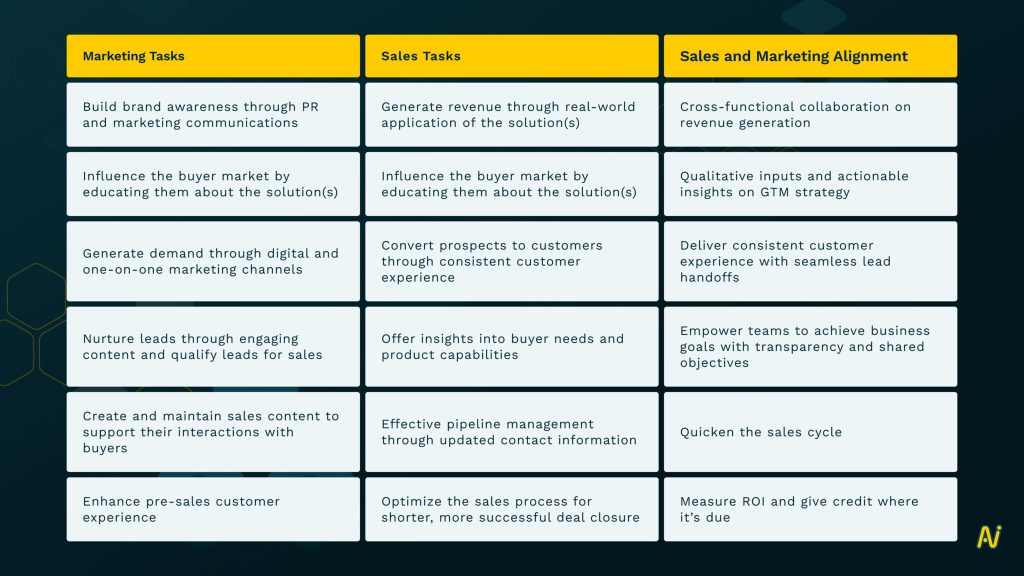
1. Define Shared Goals and Strategies
Start by establishing common ground through shared Objectives and Key Results, revenue targets both teams are actually accountable to together, not separately. Improving alignment takes more than setting shared goals, though; leaders need to identify the specific processes that cause friction, lead handoffs and mismatched MQL/SQL definitions being common culprits.
Training sales and marketing together, so each understands the other’s process, responsibilities, and constraints, smooths the nurturing and handoff process considerably. While you’re defining goals, it’s also worth setting up unified processes for lead scoring, lead generation, and customer support.
2. Treat the Customer Journey as an Integrated Process
This requires a real Ideal Customer Profile (ICP) and a shared definition of what actually counts as a lead for both teams. The buying environment has shifted meaningfully here too: organizations used to define ICP around an individual; today it needs to reflect the buying group and its key stakeholders instead.
The journey itself isn’t linear anymore either. When defining MQL and SQL, the shared objective should be converting and retaining prospects, and both teams need real flexibility to get there. Some practitioners argue it may be time to drop separate MQL/SQL definitions entirely, since the distinction itself can reinforce exactly the siloed process alignment is trying to fix, working toward one shared ICP instead tends to keep both teams’ activity more fluid and better aligned.
3. Consider the Buying Group
The buyer used to be treated as an individual. Today, B2B buying decisions typically involve 6 to 10 stakeholders, and sales and marketing alignment needs to be built around that group, not a single point of contact.
Once ICP and target market are defined, marketing identifies active buying groups and engages both the group as a whole and its key stakeholders individually, with content tailored to each. A buying group with an IT stakeholder and a finance stakeholder, for instance, needs technical detail for one and ROI-focused conversation for the other, while the group as a whole needs to see how the solution addresses every represented pain point together. Sales and marketing then jointly qualify and prioritize the buying groups showing the strongest intent, and sales takes over from there, validating needs, accelerating pipeline movement, and pushing the deal to close.
4. Refer to a Single Source of Truth
This is where unified data actually pulls everything together. A unified CRM gives both teams a far more comprehensive, accurate picture of the customer journey, and better-informed decisions follow directly from that.
Sales gets visibility into a prospect’s actual pipeline progress, how a lead found the product, what content they engaged with, and every selling opportunity within an account tied to complete stakeholder information. Marketing gets deeper insight into buyer needs, sharpening content relevance and continuously refining ICP and segmentation. Unified data also makes real revenue attribution possible, tracking and measuring every touchpoint a lead passes through, so a team can actually determine which specific touchpoint, an ad, a demo, a sales meeting, a webinar, deserves credit for the close.
5. Coordinate Account-Based Marketing Campaigns
Alignment improves content creation across the customer journey, keeping every channel’s messaging consistent with what’s actually happening in live sales-buyer conversations. Marketing can incorporate real input from sales conversations directly into messaging, and audit existing content to refresh or replace whatever’s fallen out of step.
When both teams know the same talking points, marketing can also help sales leaders and reps build genuine expertise on public channels, creating content templates reps can post themselves to capture prospect attention organically.
6. Combine Workflows and Communication
Alignment works both externally and internally. Externally, a marketing-first approach tends to work best, prospects may not know your brand yet, and consistent campaigns and branding build the market presence that makes a buyer more receptive to converting later.
Internally, keeping both teams genuinely involved matters just as much: marketing shadowing sales calls, attending sales briefs, and holding regular brainstorming sessions builds a real, shared understanding of the buyer that neither team gets fully on its own. Leaders should actively protect that cross-functional communication rather than let it erode under day-to-day pressure.
7. Measure Performance With Common KPIs
Sales KPIs (win rate, deal closure rate, renewals, new prospects) and marketing KPIs (brand awareness, campaign success, lead quality and quantity) traditionally live in separate worlds. A better approach: one shared KPI, revenue generation through pipeline management and an optimized joint process, which is only trackable at all once a single source of truth actually exists.
Beyond that shared KPI, you can also connect individual stakeholders to their buying group, monitor relevant opportunities within that group, and track their progress through both pipeline and revenue cycle together.
8. Invest in Tools That Boost Alignment
A unified revenue data capture platform like Nektar’s Data Foundation consistently helps teams create value and close more deals. Even when sales and marketing run on different systems, Nektar combines data across channels into one 360-degree view, capturing every interaction with the buying group, social, email, or call, for faster, better-informed deal closure. Buying Group Intelligence makes this specifically actionable, automatically mapping the buying group across whichever tools each team happens to use. Alignment gets considerably easier with intent data, enriched contact data, and conversation insight all flowing into the same place, and automation is what makes the whole thing faster and simpler to sustain.
Alignment = Value = Driving Sales
Sales and marketing alignment genuinely drives value, improving both lead quality and conversion odds. A large majority of best-in-class organizations give both sales and marketing aligned access to the same CRM, and that alignment shows up directly in outcomes: marketing can educate customers better, nurturing the ones actually most ready to buy, while sales maintains consistent communication that targets real buyer needs with more precision.
Better-fit customers churn less. More engaged buyers drive better pipeline management, and better pipeline management drives better ROI.
Frequently Asked Questions
Q. How much does sales and marketing misalignment actually cost businesses?
More than $1 trillion annually across the industry, according to research from Harvard Business Review and IDC that’s still widely cited today, roughly 10% of a typical company’s annual revenue when the specific cost is modeled out.
Q. What’s the difference between the 80% of deals have 3+ buyers stat and the 6-10 stakeholders stat?
They measure different things. The first is the share of B2B deals involving a plural buying group at all; the second is the actual average size of that group once it exists, 6 to 10 stakeholders typically, 17 or more on enterprise deals. Both point to the same underlying reality: single-threaded selling to one buyer is increasingly the exception, not the norm.
Q. Should we get rid of separate MQL and SQL definitions?
Some practitioners argue yes, since maintaining separate definitions can reinforce exactly the silo alignment is trying to break down. A shared ICP that both teams work toward together tends to keep activity more fluid, though this is a real strategic choice worth making deliberately rather than defaulting to either option.
Q. What’s the fastest way to start improving sales and marketing alignment?
Establish one shared source of truth for pipeline and revenue data first. Most other alignment tactics (shared KPIs, coordinated ABM, joint content) depend on both teams actually seeing the same data, without that foundation, alignment initiatives tend to stay aspirational.
Make Alignment More Than a One-Off Activity
Don’t let sales and marketing alignment be a project you revisit once a year. Talk to our team to find out how unified data can drive consistent alignment, and consistent sales success, going forward.
Enjoyed our content? Follow Nektar on LinkedIn