Beyond AI Adoption: Rebuilding the Organization for AI
A conversation with Silvana Bacigalupo, Head of Internal AI Transformation at Asana.
TL;DR
Short on time? We've distilled this conversation into a one-page summary. Get it in your inbox.
Executive Summary
Most organizations are celebrating AI adoption. Usage is up. Tools have been rolled out. People are experimenting. But that does not always mean the business is actually changing.
Silvana Bacigalupo, Head of Internal AI Transformation at Asana, has spent over 20 years leading organizations through structural change, from early internet to mobile, from radio to streaming, from on-premise to SaaS. Her training is in organizational development: the study of how organizations, as connected systems, actually change. That background makes her perspective on AI transformation unusually grounded and unusually honest.
In this episode of The Revenue Lounge, she draws a sharp line between adoption and transformation, explains why systems thinking is the leadership skill most organizations are missing, lays out the exact sequence for AI readiness (it starts with people, not data), describes what workflow redesign actually looks like versus automation layered on top of old processes, and names the human skills that will matter most as AI takes over execution.
Silvana Bacigalupo arrived at AI transformation through an unusual path. Her career has been on the go-to-market side spanning revenue, technology, and operations. But her academic training is in organizational development: the discipline of understanding how organizations, as interconnected systems, navigate change.
That combination is exactly what this moment requires. AI transformation is not a technology deployment. It is a technology and people revolution simultaneously. And most organizations are only planning for one of those two things.
Adoption Is Not Transformation, and the Difference Is Everything
The trap is hard to resist. Usage metrics go up. The rollout of Claude or Copilot gets celebrated in an all-hands. AI adoption is climbing. And none of it necessarily means the business is getting better.
To be clear: adoption is not bad. Silvana is explicit about this. You need people engaging with the tools. You need behavior to start changing. You need adoption to happen before transformation can follow. The problem is not adoption. It is treating adoption as the destination rather than the first step on a longer journey.

Silvana Bacigalupo
Head of Internal AI transformation, Asana
Adoption by itself isn't bad. You need it as you're moving down the road of making a change. The trap is measuring just adoption. Just because you have the wheels on the bus doesn't mean you're going in the right direction.
Adoption is a means to an end. The end is business outcomes: shipping products faster, growing revenue with the same number of people, retaining top talent, improving customer satisfaction. These are the measures that matter, and they are several steps removed from adoption metrics.
The shift Silvana describes is from measuring behavior to measuring what behavior produces. Efficiency gain used to be a competitive advantage. Now it is table stakes. The playing field has leveled. Every organization is getting more efficient. The question is what you do with that efficiency.
Silvana Bacigalupo
Head of Internal AI transformation, Asana
Examples of strategic competitive advantage that using AI will give your business: Are you able to ship products faster? Is your cost going down so you're more competitive on price? Are your sellers better equipped? Are you retaining and developing your top talent? Those are the gold metrics.
Some examples of what to measure instead of just adoption:
- Product or feature velocity: are you shipping faster?
- Revenue efficiency: are you growing revenue with the same or fewer people?
- Talent retention: are people more engaged and motivated by their work?
- Customer outcomes: are CSAT and support quality improving?
Strategy Before Experimentation, But Experimentation Matters Too
There is a right order to this. Strategy leads execution. But strategy without champions who are excited to experiment is just a document.
I have always been a fan of strategy leading execution. Experimentation without direction is like having the wheels on, but you're not sure if the bus is moving."
Silvana Bacigalupo
Head of Internal AI transformation, Asana
The frame Silvana uses: start with the strategic objectives. What does the business need to be true this year? She shares examples like ship 50% of the roadmap faster, grow revenue with the same headcount, or maybe to get customer feedback and iterate on product in half the time.
Once you have your objectives, work backwards to figure out what would enable those things? That is where AI transformation enters, not as a standalone initiative, but as the mechanism for achieving strategic objectives that already matter.
This framing also solves the change management problem. When people understand why they are being asked to change their behavior and when they can see the connection between the ask and the direction the organization is going, transformation becomes a pull, not a push.
Read the complete transcript for more insights on moving beyond AI adoption to driving real organizational transformation.
The AI Council: Two Layers, Not One
One of the most structurally specific insights in the episode is how Asana evolved its AI council as the transformation matured. The lesson: the composition and purpose of the council has to evolve as the work does.
1. The early stage champions layer
When the AI council first formed at Asana, the composition was enthusiastic early adopters. These were people who owned processes and were willing to experiment with them. Their job was to build literacy, foster curiosity, and bring learnings back to their teams.
2. The later stage strategic layer
As AI started crossing departmental lines, workflows started connecting across functions and goals became more complex, a second, more senior layer was added. This layer holds strategic conversations across functions: where is each team going, how does AI connect to those goals, and what data infrastructure is needed to support those larger motions?
The champions layer is golden. Those are your critical change agents. The people who are willing to come alongside peers and help them, troubleshoot with them, stick with the change. But when goals became bigger and more connected across functions, we needed to have strategic conversations that the grassroots layer couldn't have.
Silvana Bacigalupo
Head of Internal AI transformation, Asana
The trigger for adding the strategic layer: when the transformation needed to move beyond single-workflow changes into connecting multiple workflows across teams to accomplish something in harmony. That required data infrastructure conversations, cross-functional alignment, and a longer horizon than champions could hold.
Systems Thinking: Building the Non-Negotiable Leadership Skill
A CEO understands how research impacts product, which in turn impacts marketing, sales, and finance. That systems-level thinking is expected at the top. Silvana’s argument is that AI transformation now requires it to come much further down the organization.
AI tooling is starting to span outside of one department. Our workflows are no longer siloed enough for leaders to just focus on their corner. We need more of our leaders underneath to have the ability to see upstream and downstream from the change they're bringing to their teams.
Silvana Bacigalupo
Head of Internal AI transformation, Asana
The specific ask: leaders need to be able to follow a change to its conclusion. If anyone in the organization can now design, build, and ship something using AI, what does that mean for the composition of teams? What skills do you no longer need as a specialization? What skills become more critical? What roles look different in three years?
This is not comfortable thinking. But the leaders who can do it and who can hold the whole organism in mind while making decisions about one part of it, are the ones who will navigate transformation without creating new problems downstream.
The AI Readiness Sequence: People First, Then Security, Then Everything Else
Most organizations think about AI readiness as a data and technology problem. Silvana’s sequence is deliberately different.
I think about this a little backwards from people who are just focused on the technology deployment. The first thing we have to focus on is the people. The mindset that we as leaders help people have toward the change.
Silvana Bacigalupo
Head of Internal AI transformation, Asana
Step 1: People and mindset
Before anything else, leaders need to create a vision and align hearts and minds toward it. If people receive the change you are pushing with an open posture, transformation becomes possible. If they receive it with resistance, you are pushing uphill on everything. This is not a communications exercise. It is relationship-building, trust-building, and narrative work.
Step 2: Security
The two things that impact the velocity of transformation the most are the rate at which humans can change behavior, and how quickly you can clear security.
You need to do it at scale, and in order to do it at scale safely, you need your castle to be secure.
Silvana Bacigalupo
Head of Internal AI transformation, Asana
Security sitting in the AI council is not optional. It is what allows the rest of the organization to move fast within a safe perimeter.
Step 3 (in parallel): Champions, data, and forward-deployed engineers.
- Champions network: the peer-level allies who carry hearts and minds campaigns more effectively than leadership can
- Data: standard, clean, trustworthy, coherent — and this takes longer than anyone expects
- Forward-deployed engineers (FDEs): technical partners deployed into business teams who give non-technical functions the leverage to accelerate transformation without waiting for IT
Organizations underestimate how much leverage having a team of forward-deployed engineers can create. Business teams need that help to really accelerate.
Silvana Bacigalupo
Head of Internal AI transformation, Asana
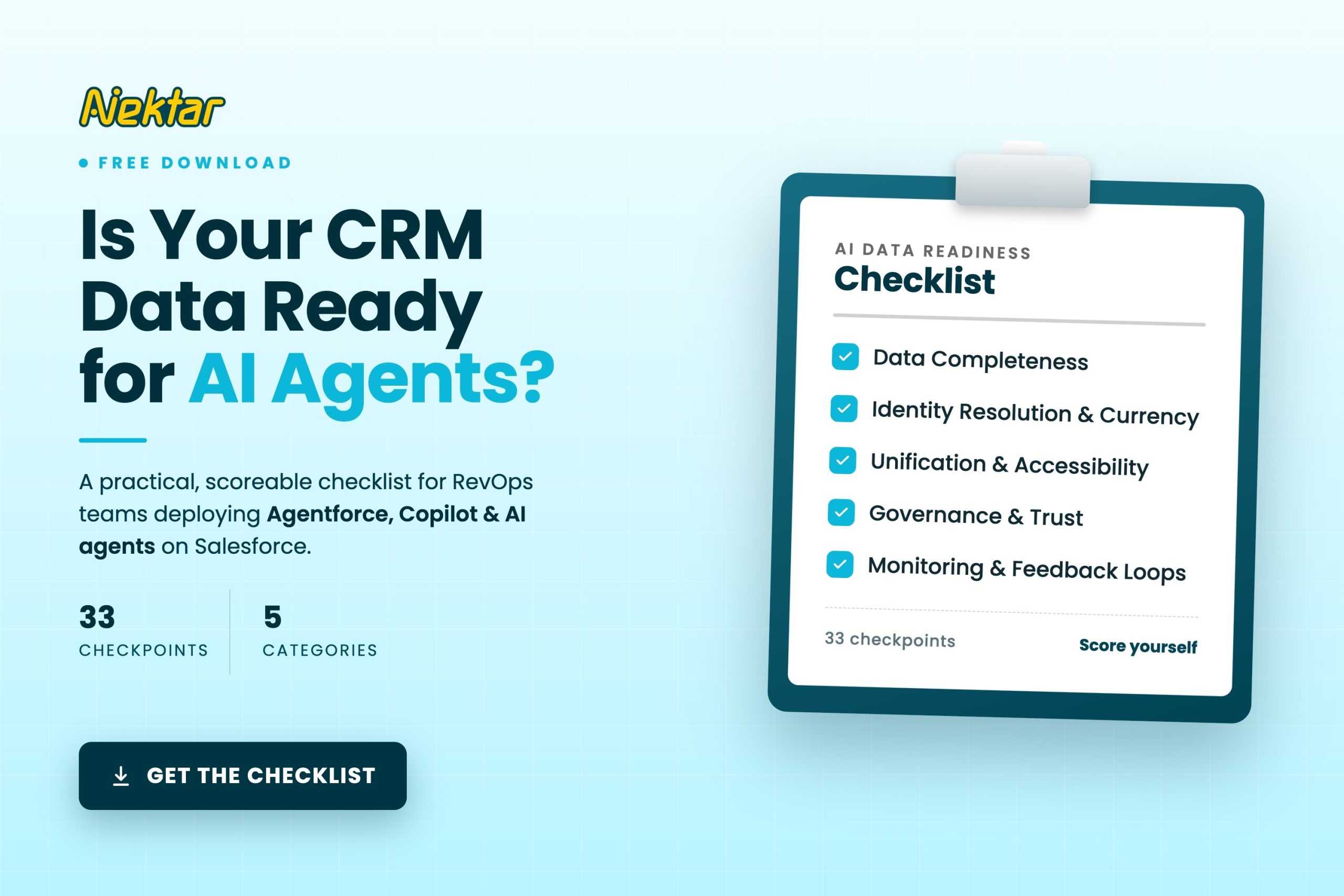
Get our AI Readiness Checklist
33 checkpoints across 5 categories to give you a clear picture of what’s in place and what isn’t.
Automation vs. Redesign: The Test That Reveals Which You Have Done
This is the most practically useful diagnostic in the episode. Silvana offers a simple test for whether you have automated a workflow or actually redesigned it.
The test: remove the AI and see if the process still exists.
If the answer is yes, you have inserted AI into a step of an existing workflow. The process is fundamentally the same. The human is still doing most of the same things, just faster. That is augmentation, not transformation.
If your answer is no, you have redesigned the work. The process without AI would not make sense, because the process was built around what AI makes possible.
The support ticket example makes this concrete:
Automation layered on an old process: A human still reviews the queue. A human still sorts tickets. AI helps draft the response or look up the answer in a knowledge base. The human still completes the workflow manually. Remove the AI and the process still exists, just slower.
Redesigned process: The AI assesses, routes, and answers automatically. No ticket needs to be created for a large category of issues. The human role shifts to monitoring quality, handling exceptions, and managing the edge cases the AI cannot resolve. Remove the AI and the process does not exist, because the process was built around what the AI enables.
Redesigning the workflow is starting from wiping the whole process off the board and asking why each step is there. Do you actually need it? What do the steps become if AI can redo this whole process? What steps would still actually need humans?
Silvana Bacigalupo
Head of Internal AI transformation, Asana
The questions to ask at the start of any redesign:
- Why does each step in this process exist?
- Do we actually need it?
- Assuming AI could redo this entire process, what steps would still need a human?
- What becomes possible that wasn’t possible before?
The Human Skills That Matter More Now
If AI is handling execution, what remains for humans? Silvana’s answer is specific and not what most people expect.
1. Judgment and discernment
Someone has to know whether the AI output is good. That requires having done the craft for long enough to recognize quality.
It's the work elders, the people who have done this thing for a long time who can tell what is high quality and what isn't.
Silvana Bacigalupo
Head of Internal AI transformation, Asana
2. Coaching and mentoring
Managers are moving away from overseeing task completion and toward guiding their people to make the judgment calls. That requires a fundamentally different management skill that many managers have never had to develop.
We need managers to guide their folks to be the ones who make the judgment calls. That measuring and coaching skill is something to develop.
Silvana Bacigalupo
Head of Internal AI transformation, Asana
3. Storytelling
The ability to paint a vision, make it real for people, and sustain belief in a direction through change. Not a spin but a narrative with integrity.
We need folks to be able to tell a story about the vision of what is possible and continue to inspire and engage the hearts and minds of the people we are asking to change behavior.
Silvana Bacigalupo
Head of Internal AI transformation, Asana
4. Systems thinking.
Already discussed above, but worth restating as a skill to actively build. The ability to see how a change in one part of the organization flows through to other parts.
What Most Organizations Are Getting Wrong Right Now
Silvana describes a pattern she keeps encountering: leaders mandating AI usage without connecting it to anything meaningful.
We're going to measure how much you use it. Just make sure you're using it. And I just think that's so unproductive and disconnected."
Silvana Bacigalupo
Head of Internal AI transformation, Asana
Usage mandates without vision create activity without direction. People comply without engaging. The adoption numbers look fine. The business does not change.
Try to connect the ask or the momentum with a vision that can inspire and motivate so that people will look for ways to achieve that vision. Otherwise there will be no results.
Silvana Bacigalupo
Head of Internal AI transformation, Asana
On overestimating AI and the speed of outcomes, leaders bring in a new model and expect the business to move faster immediately.
We are still limited by our human capacity to change behavior at scale. We're still human. And this change takes time.
Silvana Bacigalupo
Head of Internal AI transformation, Asana
On underestimating AI and the role of the manager, the middle layer of any organization is the connective tissue of transformation. These are the people who bring their teams along, have one-on-one conversations about fear, build the trust that makes behavior change possible. Most transformation plans underinvest in this layer.
Without investing in those managers and their ability to bring people along, transformation will not be as successful.
Silvana Bacigalupo
Head of Internal AI transformation, Asana
The Takeaway
Silvana’s perspective on AI transformation is shaped by a deep understanding of how organizations, as human systems, actually change. Her frameworks are not about the technology. They are about the people, the structure, the sequence, and the leadership behaviors that determine whether transformation happens or stalls.
Her most enduring insight: AI transformation is both a technology change and a people change simultaneously. Organizations that plan for only one of those two things will get only half the result. The ones that hold both together, that connect strategic direction to human behavior change, that build champions networks alongside data infrastructure, that redesign work rather than automate old work, those are the organizations that will be ahead.
This is going to touch everything. The scope and scale of this transformation is something we've never seen it in our generation.
Silvana Bacigalupo
Head of Internal AI transformation, Asana
Know a transformation leader, CHRO, or enterprise AI practitioner with a real point of view?
We’re looking for practitioners with genuine experience.
Silvana Bacigalupo is the Head of Internal AI Transformation at Asana. Connect with her on LinkedIn.
This post is based on her conversation with Randy Likas on The Revenue Lounge, Nektar’s podcast on the future of go-to-market.
Never miss an episode! Subscribe to The Revenue Buzz newsletter to get weekly episode updates.
If you liked what you read, please share it with your peeps.
In this blog
Get the Revenue Lounge Brief
3 takeaways from every new episode, straight to your inbox.
Episode Transcript
[00:00:00] Randy Likas: AI adoption is no longer the hard part organizations are wrestling with. The harder question is what happens when AI starts changing the work that actually gets done. Most organizations are still looking, at AI as a technology layer, but real transformation requires something much bigger: rethinking workflows, roles, decision-making, skills, and the systems that hold an organization together.
[00:00:24] Randy Likas: Hello, everyone. Welcome to another episode of the Revenue Lounge. I’m your host, Randy Likas, and in today’s episode, we’ll explore what it really takes to move from simply adopting AI to work, in redesigning how work is done in an AI era. So joining me today is Silvana Bacigalupo.
Read Full Transcript
Silvana is Head of Internal AI Transformation at Asana. She sits at the intersection of technology, execution, and people, and has led organizations through IPOs, built the operational backbone that helps companies scale, and partnered with C-suite executives to navigate disruption from early internet era to the reinvention of entire industries.
[00:01:00] Randy Likas: Silvana, thank you so much for joining me today.
[00:01:02] Silvana B: Thanks for having me, Randy. I’m excited to be here, and I’m excited about this conversation.
[00:01:07] Randy Likas: Yeah, I am as well. So usually what I like to do is start, these episodes off, talking a little bit about your career background and your career journey and your current role.
[00:01:15] Randy Likas: You’ve spent your entire career helping companies scale and navigate some pretty significant periods of change. Yeah. I’m curious, what brought you to AI transformation, and what are you responsible for, at Asana today?
[00:01:25] Silvana B: Sure. Yeah. So, I have been in the tech space for over 20 years, mostly on the go-to-market side, focused on, revenue, technology, operations.
[00:01:38] Silvana B: And I started in ad tech. And when I started, we were early in the internet. So, the pattern of leading through innovation and disruption has held throughout my career, right? So I have led through, our transition from web to mobile, for example, or when we moved, from radio to streaming or..
[00:01:58] Silvana B: And when SaaS, started coming up as a big thing for us, and now AI transformation is kind of, it seems like on brand, and right along the path. But AI transformation the scale is unprecedented from what we’ve ever seen.
[00:02:14] Randy Likas: Yeah.
[00:02:14] Silvana B: So that’s my background as far as work.
[00:02:16] Silvana B: But my training is in organizational development, not a lot of people have heard about organizational development. But organizational development at a really high level, is about the work that goes into how organizations change. Yeah. So it’s the way that you think about, the organization as a connected system and how an organization manages itself or how you manage an organization through, whatever the change or transformation, is happening.
[00:02:45] Silvana B: What I love about this work right now and what I find, it almost feels like a culmination of sorts is, this current role leading AI transformation is exactly that intersection. So it, blends together not just the technology and the change that we’re all going through with technology, but it’s really a technology and people change.
[00:03:08] Silvana B: So it blends together the technology and the intentional systems change or the intentional organizational change. It’s very holistic. And so those two sides of my background come together, really well and kind of equally, when we’re doing this AI transformation work.
[00:03:26] Randy Likas: Yeah, I wanna ask you a little bit later about that change because, change is hard for everyone, and especially in a role like yours. You’re trying to not only change individual departments or functions, but collaborate change really across the entire organization. So we’ll unpack that a little bit more.
[00:03:40] Randy Likas: What I would love to do is just, talk about a trend that we’ve been seeing, which is that, companies are celebrating AI adoption because they’re seeing that, usage, is up, or they’ve rolled out Copilot, or they’re, enabling the organization with Claude or, a bunch of other tools.
[00:03:54] Randy Likas: But, you can have a lot of AI usage without really changing the business. Yeah. So how do you distinguish AI adoption from actual AI transformation? And what would you measure that, – instead?
[00:04:05] Silvana B: Yeah. So, I think about adoption as kind of the first step on the journey. So adoption by itself isn’t bad.
[00:04:12] Silvana B: Like, you need it, right? As you’re moving through the road or down the road of making a change, you need people to be engaging with the tools. You need people to be using it. You need behavior to start changing. In order for that to happen, you have to have adoption. So a- adoption is the first measure, and I think that it’s probably the one that’s maybe the first one that’s really easy to get excited about because it’s concrete. We can measure it. I think the trap of just measuring adoption is that it’s exactly that, to your point. Just because you, have adoption or just because you have the wheels on the bus doesn’t mean you’re going in the right direction on the bus, or that the bus- Right
[00:04:54] Silvana B: isn’t spinning its wheels, right? Improvement. Right, yeah. So you wanna make sure that you’re actually, going in the direction that you wanna go. And so the real measure, it really is the business outcomes that come out of the improvement of the business capabilities that come from the integration of AI, the adoption and the usage of AI.
[00:05:16] Silvana B: So the real, the meaningful thing to measure is a few steps removed, and down the road after behavior change or systemic behavior change or behavior change at scale, from adoption. So, leaders have to do this work of thinking holistically and working backwards from what is it that they want
[00:05:39] Silvana B: Because-, the playing field is leveled, right? It’s hard to find anyone now who’s not using AI for some part- Right… of their production. And so the efficiency gain is table stakes. That’s not the thing anymore. So- Yeah when you’re thinking about the strategy for the business, you have to think about what is the strategic competitive advantage that using AI is going to give your business.
[00:06:04] Silvana B: So you wanna be thinking about, are you able now to ship products faster, or is your cost going down so it makes you more competitive on your price point? Or for our revenue folks out there are sellers better equipped, better enabled with not just, state-of-the-art enablement tooling, but, go-to-market infrastructure so that in turn we can drive revenue growth.
[00:06:30] Silvana B: And something that people don’t think about much the folks who are leading the technology adoption is, another, measure would be how are you retaining and developing your top talent? Because if people are engaged and they’re motivated by their work, they’re gonna wanna stay.
[00:06:47] Silvana B:, And those things are different now in an environment where our work is fundamentally different using AI. that is the gold of what you wanna measure is how much is your business improving, how much are you getting better as a business, having better outcomes as a result of the way that your business capabilities are stronger because of the adoption.
[00:07:08] Randy Likas: And where does that start? Does that start from if you look at your key objectives and strategies of a business, and then working from there to define what outcomes that we wanna drive? Is it a little bit of experimentation first?
[00:07:20] Randy Likas: Can you walk us through, where the best place to start is when you think about the, starting with the outcome and how we wanna measure that outcome? How do you approach that?
[00:07:28] Silvana B: Yeah. I have always been a fan of the strategy leads the execution. So I think it is..
[00:07:38] Silvana B: First of all, it’s really easy for experimentation to happen when, you have enthusiastic champions in the business, and you need experimentation to happen because you want to champion those champions, right? But experimentation without direction, again, it’s like having the wheels on, but you’re not sure, right, if your bus- Yeah
[00:08:00] Silvana B: is moving. So I, continue to be convinced that having some kind of strategic vision and direction, like let’s point everyone north, right? Mm-hmm. And so having the ability to say, our, strategic objectives this year or this quarter include, shipping, like 50% of our roadmap faster than we’ve ever done.
[00:08:25] Silvana B: Or getting feedback from our customers faster than we’ve ever done so that we can iterate on our product faster than we’ve ever done. Because if we can get to market faster, then, all the things that follow, as part of your strategic objectives. And then you need to connect the transformation to that.
[00:08:43] Silvana B: So what will enable us to ship faster? What will enable us to grow our revenue with the same number of people in the organization? What will enable those things? And that’s where the recipe for how you’ll get there, how you’ll achieve the strategic objectives. Yeah. That recipe should contain AI transformation as a part of it.
[00:09:03] Silvana B: That also helps when you’re asking people to carve time out of their already full plates to learn a new thing, figure out a new way, change their behavior, right? It gives people, a reason to move in the same direction.
[00:09:22] Randy Likas: And so in doing that, I think the way that you all have structured it internally, if I have read correctly, is you’ve got like an AI council, right?
[00:09:29] Randy Likas: And I think you might chair that council. Yeah. And it’s a cross-functional group of folks. And, that’s a trend that we’re starting to see more and more, but I think you guys have done it really from the get-go. When you think about that, putting together that council, like what’s the mission of the council and what’s the cadence in which you all meet?
[00:09:42] Randy Likas: And I’m sure it’s all based on the objectives and outcomes that we just discussed, right? Yeah. But I’d love for the audience to understand what that looks like today, and what the charter is and how do you manage that?
[00:09:51] Silvana B: Yeah.
[00:09:52] Silvana B: So, I would say that with any cross-functional body that comes together, just like often teams that come together or, organizational design that comes together, it needs to serve the objective or needs to serve whatever it is that you’re trying to accomplish.
[00:10:06] Silvana B: And so the nature of that body sometimes will change and will grow and develop over time. So the nature of the AI council when it first started at Asana, was, hey, we just wanna bring together some champions who are keen to experiment and who wanna understand what’s happening, and who want to bring back to their teams some learnings and foster literacy and get their teams to be more fluent and curious about using the tool.
[00:10:37] Silvana B: So early on, the, composition of the champions was those enthusiastic kind of doers, explorers who were willing to, and also who probably own some kind of process, right? Who were willing to take their process and play with it a little bit to see what would AI do for that process. Now we’re much far..
[00:10:59] Silvana B: and I think acceleration of that has just increased in this year, right? How much we’ve accelerated, from compared to the year before. Like what kinds of things we’re doing now with AI, as we’re toward the end of the year versus where we were at the end of last year and the things we were doing with AI, and the difference, from the beginning to the end of the year.
[00:11:20] Silvana B: And so now we are at a point where the work that we are changing.. So let me take a step back. When, you’re rolling out transformation, there’s a path where you’ve got, people are piloting and then, maybe, with easy workflows, and then the workflows are starting to get maybe a little bit more complex and some teams are, adopting maybe more than others.
[00:11:45] Silvana B: And then you move a little bit towards more operationalization of the transformation, and then scaling of the transformation, right? What’s permeated.
[00:11:54] Randy Likas: Yeah.
[00:11:54] Silvana B: I think that now we at Asana are at that point, I think, between operationalization and scaling-.. in some teams. And maybe there’s one or two teams that are still, a little bit before operationalization, and that makes sense for– because the different parts of the business are gonna move differently or have different needs to integrate, AI.
[00:12:15] Silvana B: And so now that we are more toward operationalization and scaling, The composition of the council has changed, and we now have two layers. One for every function. We have the strategic layer-
[00:12:29] Randy Likas: Mm-hmm…
[00:12:29] Silvana B: and the champions layer. I think that champions layer is golden. Those are your critical change agents in your organization whenever you’re trying to push out change behavior at scale.
[00:12:40] Silvana B: You need those champions, who are willing to come alongside people and help them or troubleshoot with them or they’re the ones who are willing to try and stick with the change. And then the folks who speak to the strategy are the ones who can look across and down the horizon a little bit further-
[00:12:59] Silvana B: for their function and can say, “Okay, this is where, we need to go because, we know the strategic direction that we wanna go toward, and we believe that we understand, the role that integrating AI will play in that, in our achieving of that strategic direction.” And so there’s kind of two levels of conversation.
[00:13:21] Silvana B: Those be– within a function, the strategic level layer and the champions layer stay connected, right? So they’re coherent. They’re making sense together. But then, across the organization, we are having strategic conversations about where we’re all going together.
[00:13:38] Silvana B: That’s, how I think a critical way that the structure is different now than it was when the body first began.
[00:13:46] Randy Likas: At what point did you layer in more of that strategic layer as opposed maybe to the champion layer, initially?
[00:13:50] Randy Likas:. You probably don’t know defined time set, but is it based, on momentum? Or, at what point did you feel it was right to break it out into two layers?
[00:13:58] Silvana B: Yeah. I think it was a little bit momentum. It was a little bit driven by our business objectives, right?
[00:14:03] Silvana B: So we have, some meaningful business objectives around the how we would need it to improve some specific business capabilities so that they would help us achieve certain outcomes. And we were, in those two places in the business, we needed to do it at a bigger scale, we were moving beyond just a workflow transformation- Yeah
[00:14:28] Silvana B: and we were moving more toward like a whole process, like a combination of workflows-
[00:14:35] Randy Likas: Yeah…
[00:14:35] Silvana B: together. Yeah. Or a specific motion that we needed, you know, one team to connect to another team so that we could accomplish something in harmony. So it’s when, those goals became, real for us this year that we needed to have, more strategic conversations, for example, about data.
[00:14:57] Silvana B: And I think maybe we’ll talk about this a little bit later, but the importance of creating a solid data layer or like data infrastructure-. to support these larger processes became more critical. And so that’s when we decided, okay, it actually makes sense.
[00:15:17] Silvana B: We can’t have that level of conversation with this body of people who are- operating on the ground. Yeah. Or more grassroots. We need to have it collectively, at a higher level because our goals were, now more connected and bigger.
[00:15:34] Randy Likas: Yeah.
[00:15:34] Randy Likas: Yeah, that, makes a lot of sense. If I’m interpreting it correctly, it’s almost driven by the amount of change that actually needs to take place internally, right? So you could. start small, you could test some things in isolation, but as you need to ke-connect it to the larger ecosystem, does require more change, and it does require more alignment, probably cross-functions.
[00:15:51] Randy Likas: So Yeah… makes a lot of sense.
[00:15:52] Silvana B: Absolutely, yeah.
[00:15:54] Randy Likas: I’d love to unpack something that I think you’ve written about before, which is, the, systems thinking as increasingly important skill, leadership skill. Yeah. And, why specifically AI transformation requires us to think more in systems as opposed to individual workflows.
[00:16:10] Randy Likas: As an example, let’s say I’m a CEO and, every department comes to me, and I’ve got 10 different use cases, that I want, right? Marketing has theirs, sales has theirs, finance has theirs. why isn’t that enough? And where does systems thinking come into play?
[00:16:23] Silvana B: Yeah. So systems thinking is, the ability to see the entire organism as a whole and understanding how parts work together and connect to each other, and that’s how I think about the role of our leaders or our CEOs who are looking at the whole body, the whole organism of the organization, of the company, and they understand how, research impacts product, impacts marketing, impacts sales, impacts finance, impacts legal.
[00:16:54] Silvana B:, Our CEOs understand, the way that all the parts work together. And we need that ability to come down.. We need more of our leaders underneath to have that ability because our workflows are now no longer siloed. They’re not distinct enough now. We have the ability to be more intelligent, to use the technology to, help us be more intelligent, connecting both data and process across.
[00:17:29] Silvana B:, I don’t think, our AI tooling, not just ours, but AI in general, is not great at all the way across the organization. But it’s spanning, it’s starting to go out outside of one department, and so, there’s that. That’s the technology piece. But going back to the first, question we talked about, organizational development, this transformation is not just transformation of technology.
[00:17:56] Silvana B: It’s also a workforce transformation. So, this is one where it’s going to require technology and people. Because if the work itself is changing, the jobs are changing, the teams are changing, what we need from managers are changing, and therefore what the organization w- looks like and needs to hire for and needs people to do and the skills that they need to have, that needs to look different as well.
[00:18:21] Silvana B: So that’s what I mean by systems thinking. We need to have our leaders see, upstream and downstream-. from what the change that they’re bringing to their teams, and we need them to imagine, I know, this is hard for some folks to imagine something that doesn’t exist already, but follow, a change to its conclusion as far as you can see, right?
[00:18:45] Silvana B: So if you know that, anyone in the organization can now design – build and ship- Something, then maybe you no longer need a team of designers or, maybe you need a different kind of combination of skills. And I know that sounds really scary, in some pockets because there’s nothing that’s gonna be untouched really.
[00:19:05] Silvana B: I believe that no role is gonna be untouched. But our leaders need to be able to think about the whole thing at once, which is quite hard to do. That’s not a muscle that a lot of us, have needed to develop.
[00:19:17] Randy Likas: Yeah.
[00:19:18] Silvana B: But they go together, the technology and the people.
[00:19:21] Randy Likas: One hundred percent, and I would like to unpack a little bit about what you just mentioned a little bit more because I think what we’re seeing, is, people are thinking they may be AI-ready, right? They’ve got the tools. They’ve got access to the models. People are experimenting.
[00:19:34] Randy Likas: But when you look under that hood a little bit, what tells you whether or not the organization is actually ready? You mentioned, the data. What specifically about the data do we have to make sure, is ready, or governance, or context? Yeah. Can we unpack that a little bit more?
[00:19:46] Randy Likas: Yeah. What do you see m-might be missing when people think they’re ready, but really what the hard part is that they might be missing?
[00:19:51] Silvana B: Yeah. So I think about this maybe a little bit differently than other technology, like, people who are just focused on the technology deployment.
[00:20:02] Silvana B: I think that maybe a little bit backwards or the order is different because I believe that the first thing we have to focus on is, the people, the mindset that we as leaders help people have toward the change. We as leaders need to be able to, create a vision and inspire our teams to see the same vision that we see so that folks can take on a posture that receives the change you’re trying to push in the organization because– I use the word push because sometimes it is a push.
[00:20:36] Silvana B: But sometimes, if you can inspire enough, if you can align folks’ minds and hearts toward this direction that you’re all going, it’s not as much a push. That’s not easy to do, and it requires a lot of EQ. But, I think without having those hearts and minds aligned and believing in the direction with you, it is going to be a push.
[00:21:00] Silvana B: Two things. First, people and security. And now having worked on this for a little bit, I say security because, the things that are going to impact the velocity of transformation, I think are two. One is the rate at which humans can change behavior, and two is how quickly can you get through your security clearance.
[00:21:25] Silvana B: Because at the end of the day, to be able to make change that’s meaningful enough to, create the outcomes that you want, you need to do it at scale, and in order to do it at scale safely, you have to be sure that your castle is secure. Yeah. And so I think, having an upfront kind of investment in the enablement and the resourcing, and the tooling for the security team so that they can, in some ways lead the charge, ensure that, our position is secure so that we can run, is, I think will be a, a differentiator for how quickly people can go.
[00:22:06] Silvana B: So those are the two things that I think not a lot of people start with. And then multiple things that I think everyone’s familiar with that can happen in parallel, right? Is there a champion network? Because a lot of the, hearts and minds campaign will happen, the allies that come with you on that campaign are the peers of the people who are maybe on the fence.
[00:22:31] Silvana B: So, is there a champion network group, and are you championing the champions? Are you supporting them as they are championing? Data, we talked about that. I think that, the power of AI is how much you can trust its output. And you can’t trust output when the AI is leaning on data that is poor quality and, not trustworthy.
[00:22:56] Silvana B: And I think a lot of companies underestimate how long this piece takes. So getting your data to be standard, clean, trustworthy, coherent. So if you’re bringing data together from one system, with another system, can they talk to each other? So, getting the data ready to do that can be a really large body of work.
[00:23:18] Silvana B: That’s the third parallel thing is, is the data ready, to be connected in that way to really become that data infrastructure layer? And then I would say, is the organization prepared to invest in the deployment of forward deployed engineers? Because, a lot of, transformation is clearly happening in technical teams, but it’s also happening in business teams.
[00:23:43] Silvana B: And I see AI as this democratized access to amazing technology, including in our business-facing teams, but our business teams are not technical folks, and they need the help- to really accelerate how much they are transforming. And, I think that sometimes folks miss, how much leverage having an FDE, team or, group of people that they can deploy to spot, partner within the organization, how much leverage they can create for the transformation.
[00:24:18] Silvana B: So I think, an organization that has all those things in place, I think is, ready to roll.
[00:24:24] Randy Likas: Yeah. Not an easy task, for sure. No. y- you brought something up which I think is really insightful, which is not getting too far ahead of ourselves without knowing, what security hurdles we are facing, legal compliance, so on and so forth.
[00:24:36] Randy Likas: I’m just curious, just to go back to the AI council, when do you start thinking about bringing those teams, into the process? First, yeah. Yeah.
[00:24:45] Silvana B: Yeah. And I think that’s a lesson that sometimes we have to learn the hard way.
[00:24:49] Randy Likas: Yeah…
[00:24:50] Silvana B: because the average employee is not thinking about security when they’re thinking about, “Can I change my process?”
[00:24:58] Silvana B: They’re thinking like, “Can this take- less steps? Can it be faster? Can it be smarter?” They’re not thinking, “Is the way that I’m gonna do this gonna create any risk to the organization?”, And so I think one of the benefits of having an AI council is having someone from security sit in that council.
[00:25:18] Silvana B: Yeah. And if you’re using the council as the change agent body that is embedded in different teams, then there’s education that’s happening, for those change agents. There is, an embedded, coordination or advisory that happens from security teams when they’re hearing kind of what people are getting ready to do or what changes are gonna be deployed.
[00:25:43] Silvana B:, You absolutely need them at the table, in that council.
[00:25:46] Randy Likas: Yeah.
[00:25:47] Silvana B: And before thinking about bringing anything in, even if it’s a smaller process change, I think when to bring security in is first.
[00:25:55] Randy Likas: Yeah. Yeah, for sure. Is that like a gating part of the process?
[00:25:58] Randy Likas: I think maybe if you bring them in at the very beginning, it’s not necessarily gating ’cause, they’re part of the whole collaboration process, right?
[00:26:05] Silvana B: Yeah. I wouldn’t use the word gating necessarily. I think that, people can experiment with different..
[00:26:13] Silvana B: I, I hesitate to say go experiment with small things because, you can get into shadow IT really fast, so if an organization, doesn’t have the ability to, deploy their security team to be that first clearance before folks are deploying something larger, then, at least have them be first or gating when you’re bringing in a technol- one technology you want everyone to use.
[00:26:41] Silvana B: Right? So you’re bringing in Gemini, and you want everyone to use Gemini, or you’re bringing in Claude or my Copilot or whatever.
[00:26:48] Randy Likas: Yeah.
[00:26:48] Silvana B: Lock that down. Make sure that’s safe. Give folks a safe playground and say, “Okay, there’s so much you can do within this playground, and anything that you do in here will be, is fine.
[00:27:01] Silvana B: You don’t have to check with us.” Mm-hmm. ” But at least do it there.”
[00:27:04] Randy Likas: I think one thing that’s happening maybe, more and more now as maybe even a year ago is a year ago people were thinking about, an existing process that they thought, they could put AI on top of. And what you and I are talking about is maybe that’s not necessarily the right starting point.
[00:27:18] Randy Likas: What does it look like when you stop automating, pieces of an old workflow and actually redesign the work around, what AI actually opens up, the possibilities that opens up? Maybe you can share a couple of examples of a workflow that looks fundamentally different after that redesign.
[00:27:34] Silvana B: Sure. Yeah, so, when you’re looking at a workflow and you’re thinking about just inserting AI into a step of the workflow, it’s, you can test whether you redesigned it or not by taking out the AI and seeing if the process still exists, right? So, augmentation of a workflow or, just inserting AI into a workflow can look like, let’s say you have your support ticket process.
[00:28:05] Silvana B: And you have the process that still requires a human to, review the queue one by one and maybe sort, and then maybe use AI for the, drafting of a response or maybe for looking up the response in a knowledge base. But then you still use the human to get the response and then continue the manual, the human workflow.
[00:28:29] Randy Likas: Yeah.
[00:28:30] Silvana B: That is one way to, to just- Paste, AI, into the workflow. Redesigning the workflow is starting from wiping the whole process off the board and, asking more about why the process has those steps. Why does every step that you take in the process, why is it there?
[00:28:53] Randy Likas: Yeah.
[00:28:53] Silvana B: Do you actually need it?
[00:28:56] Silvana B: And whether AI can change even just the processes that go in, into those steps. Like what else is possible or what, assuming that AI could redo this whole process, what steps would we still actually need humans to take? Or would there be any? Or what do the steps become-
[00:29:17] Randy Likas: Yep…
[00:29:18] Silvana B: when, we can get AI to rethink about this process
[00:29:22] Silvana B: completely and make it something that didn’t exist before. To use the same example, it could be that, the support process instead of, doing one part of the process, you can create a solution that does the assessing and automatic routing and automatic answering, or there’s the automation of the entire thing-
[00:29:44] Silvana B: without even having to have a ticket created.
[00:29:48] Randy Likas: Yeah. Yeah.
[00:29:50] Silvana B: That’s an easy to understand difference between the two.
[00:29:53] Randy Likas: So just to piggyback off that for a moment. If AI is helping us take what I would classify as maybe more of the executional layer off of our plates, on the human capital side, what becomes more valuable, on the human side?
[00:30:04] Randy Likas: What are some of the skills that people should be developing now that maybe mattered less five years ago, but, given where we are, with AI, and, that tactical stuff being, automated, what should we be developing?
[00:30:15] Silvana B: Yeah. So I think this is where it gets more complicated, because the skills that I think we are going to need more of are skills that are, that you don’t just learn, in a classroom.
[00:30:30] Silvana B: So, if AI is h- helping us with execution a lot more, then- the part of the work that humans are still doing is to ensure that the output of the AI is correct.
[00:30:44] Randy Likas: Mm-hmm.
[00:30:44] Silvana B: Right? So that’s one thing. So you need your humans to be the ones who can exercise judgment and discernment, and know the craft enough to know what is good and what is bad and what is slop, or what part of this output actually makes sense and what absolutely doesn’t.
[00:31:02] Silvana B: Yes. And, You need your work elders to know that, right? The elders. It’s the people who have done this thing for a long time and can know and are able to tell this is high quality and this isn’t. And so that in order for the non-work elders to develop that same, judgment, intuition, discernment, the..
[00:31:25] Silvana B: We now need our elders to mentor and coach. So we all need to develop our judgment and discernment and decision-making skills, and then we need more of our managers who are in that, decision-making layers coming, again, further down in the organization. We now need those managers to have the ability to be mentors and be coaches to their team, and not every m- manager has ever, has had to do that.
[00:31:54] Silvana B: So we’re moving away from managers overseeing the task completion-.
[00:32:00] Randy Likas: or
[00:32:01] Silvana B: the quality, of an output, and now we’re guiding, we’re needing our managers to guide their folks to be the ones who make the judgment calls. So that mentoring and coaching skill, is something to develop for our managers.
[00:32:18] Silvana B: I think that other skills are our ability to story tell. So, going back to some of the answers above, we need folks to be able to tell a story about the vision of what is possible, and it continue to inspire and engage the hearts and minds of the people you’re asking to change behavior.
[00:32:39] Silvana B: Yeah. So how do we story tell? How do we create a narrative that is in integrity, right? And is real. Yeah. But that ability, I think, is really important. And then systems thinking we already talked about. But, a lot of those are, harder to develop, for our managers and for our leaders and for our average worker.
[00:32:59] Randy Likas: Yeah. So we have to mentor, Do we have to coach how to be maybe a little bit more analytical? That’s gonna help build the skills up. But, making a conscious decision of that because aI is replacing a lot of work, but that doesn’t mean that, the role of what the people are doing just elevates into more of an analytical, critical skill as opposed to, “Hey, this is taking away, the work that I typically would do,” right?
[00:33:21] Silvana B: Yeah.
[00:33:22] Randy Likas: Yeah. Something that we had talked about, earlier, which is as, the, transformation, becomes broader than maybe just a departmental application, or workflow, and it starts looking at, cross-functional bound, areas, How do you think the boundaries between functions start changing as well?
[00:33:39] Randy Likas: And do you think that maybe we’ll be moving to, an area where organizations are designed around the outcomes and the workflows maybe than traditional sort of functional departments? Would love to get your perspective on that.
[00:33:50] Silvana B: Yeah. So yes is, the short answer. I think that as, we shift away from the requirements to have specialized knowledge or to be really good at a craft, at a specific, knowledge worker craft-, the less you need people who know exactly how to do that craft, right?
[00:34:13] Silvana B: But We need the people who know what that good craft looks like. And so the roles become a little fuzzier. and it also, – creates the ability for one person, one human who has seen an entire end-to-end, what good looks like for a work product, be able to play that role, that analytical, critical role across a work product creation.
[00:34:41] Silvana B: So, then you can imagine what do we need? What skills do we need in a team now? What do teams look like now? Or what will teams look like? So I think that they will shift, from being fixed and functional to being more cross-function- more horizontal, meaning cross-functional, and less fixed.
[00:35:06] Silvana B: Meaning I think that we will become more fluid in what a team means, and maybe more temporary. Mm-hmm. Maybe it’s a team per assignment or a team, given for a specific deliverable. And I think w- there’s some amazing AI technologies within the people space or the talent management space, for example-, yeah
[00:35:31] Silvana B: that is creating, is giving us the ability to see the organization through a skills and talent lens that would allow us to bring flexible teams together. That we would n- we would never be able to do that before in a systematic way. I think that’s one way that teams are gonna change.
[00:35:49] Silvana B: And then, I think, we’ve already talked about skills, but, what you hire for, and what you train for, and how you retain talent, and how you do succession planning, I think all of it is gonna shift, too. As a result of the fact that you’re gonna need different skills and your teams are g- gonna look different.
[00:36:08] Randy Likas: Yeah. I am conscious of time here, and I wanna, ask you just a couple more questions, before we get to the lightning round, which is a little bit more fun, lighthearted, sorta off the cuff answers. So we started at the very top of the episode talking about how the change, is really hard, right?
[00:36:22] Randy Likas: And, I would love to get your perspective on, some of the resistance that maybe you might face. Maybe it’s fear that AI is gonna take my job or, am I really gonna be able to trust the output or the loss of control. Would love to get your perspective in terms of, how do you manage that friction that you might face and, with, everything being hindsight, you know, twenty/twenty, what might you do differently, from lessons learned and sorta try to, address some of that friction you might see?
[00:36:48] Silvana B: Yeah. So I think, this touches a little bit on trust. And, as a leader, if you.. Taking your team, taking your employees from one place to the other successfully requires that they, have some trust in you to follow you, to go toward the vision that you’re painting. And trust is a psychological thing.
[00:37:15] Silvana B: It has to be built one pebble in a jar at a time. Uh, so it’s hard work. Our leaders are needing to be more human than they’ve ever been be- needed to be before, in developing these abilities that are uniquely human, and I think will always be uniquely human, is this ability to build trust with another human.
[00:37:37] Silvana B: And so the manager layer is a critical connector here, in helping folks move through any resistance, or move into different behavior. Resistance is often, just the face of fear, to your point.
[00:37:53] Randy Likas: Yeah.
[00:37:54] Silvana B: And I think managers are the best positioned to get really curious about that fear, what is behind that fear.
[00:38:01] Silvana B: And oftentimes today, it’s some variation of, “AI will take my job.” Yeah. And I think this is where, the reality is that all of our jobs will change, and I think leaders need to be able to look their employees in the face and say, “All of our jobs will change, including mine.” And I think excellent leaders, excellent managers care about partnering with their teams to develop their skills so that they can use their skills in their current job and in the future.
[00:38:38] Silvana B: And so if we can move the conversation necessarily, from jobs, which we can’t guarantee that will exist tomorrow for many reasons- if we can talk about skills and move the conversation to how do we, without knowing the future and without being able to control every outcome about our jobs, how can we focus on the skills that we know we will need for the, for what the job will look like tomorrow, or that we just know we’re going to need tomorrow- Yeah
[00:39:10] Silvana B: even if it’s not for this job? And how do we practice those skills here, and how can I help you, my employee, continue to build those skills to use them here, ideally, but if not here, then in the next thing that you do, which may not be the job you’re doing now because it might be a different job that you get to do- Yeah
[00:39:30] Silvana B: that doesn’t exist right now. And that’s really, it changes the conversation from jobs. Yeah. But it requires a huge amount of trust between the manager and the employee. And I think that, again, goes to, one pebble at a time, and also touches on coaching and mentoring and relationship building between managers and employees, that I think are gonna become more and more critical as we, take organizations through the change.
[00:39:57] Randy Likas: Yeah. I wanna wrap up with a question, I’m gonna ask you to take out your crystal ball and think about, if we were to have this conversation three years from now, what’s the one thing about how organizations operate today that you think will seem obviously outdated in a couple of years?
[00:40:17] Silvana B: I think performance reviews might be really different. How do we measure judgment?
[00:40:25] Randy Likas: Yeah.
[00:40:25] Silvana B: How do we measure, the ability to build trust? Coaching and mentoring. if the role now be- roles now become more of that, of being the gaugers of quality and, the people having..
[00:40:40] Silvana B: the roles become now the ability to stitch together, functions or work across the lines. How do people do that really well? So I think those are things that today they are competencies, though I think that they’re not the stronger part of a performance evaluation.
[00:40:58] Silvana B: Yeah. I think those might take, more room in the way that we do. Our people development cycles. I think people are gonna invest more in team building things. Things that help us, really treasure and build out things like our abilities like creativity and communicate, like human to human communication and, building connections so that you can have trust.
[00:41:28] Silvana B: We’re gonna continue to work with other humans, you know, you need that. Yeah. I think people are gonna become more aware of the human component of what it means to work together.
[00:41:38] Randy Likas: so we’ve covered a lot of ground, right? We’ve covered a l, everything from, process and strategy and outcomes and data, and everything.
[00:41:45] Randy Likas: Is there anything that we’ve missed? Is there any question that you think I should have asked so far that maybe you think, is important that you wanna share with the audience?
[00:41:56] Silvana B: I think there’s nothing that you haven’t covered as a question. But there’s one thing that I am always surprised by when I talk to some peers around how some companies are approaching transformation or the mandate for transformation. And, it’s around, like, We’re gonna be measuring how much you use it, and use it for any reason, and just make sure you’re using it.
[00:42:18] Silvana B: And I just think that’s so unproductive and disconnected from all the things that we’ve talked about today. Yeah. And so I would say, if there are leaders who, d- don’t know how to guide their organizations through the change, I would say try to connect the ask or the momentum with a vision that can inspire and motivate so that then people will also look for ways to go achieve that vision and, achieve that mission.
[00:42:53] Silvana B: Yeah. And it’ll make it make sense. And people will be keen, to do the thing. Otherwise, I think there’s gonna be no results.
[00:43:01] Randy Likas: Yeah. That’s a great add in, I appreciate you adding that. We’ve had such a rich discussion, I just wanna ask you couple of quick lightning round questions. What’s the one thing that you think, people are overestimating about, AI right now?
[00:43:15] Silvana B:, How quickly we can actually see outcomes. Tell me more about what you mean by that. Outcome changes.
[00:43:24] Randy Likas: Yeah.
[00:43:24] Silvana B: And. i’ll say this again, I think we’re still limited by our human capacity to change behavior at scale and to absorb the ability of the technology at scale- Yeah
[00:43:37] Silvana B: like across the organization. We’re still limited by that, and I think sometimes, leaders think like, “Okay, I brought Claude in. Why aren’t we faster?” And it’s like, well, it’s because we’re still human and, this change, it. takes time. Yeah. So I think we overestimate how quickly we can have, outcomes materialize in an organization.
[00:44:00] Randy Likas: What about the flip side? What do you think, people are underestimating the most about this?
[00:44:06] Silvana B: The role of the manager.
[00:44:09] Randy Likas: Tell me more about that.
[00:44:11] Silvana B: I think not a lot of folks are thinking, going to back to the top of the conversation, thinking about this as a, technology and people- Yeah.- Revolution, evolution.
[00:44:21] Silvana B: And the role of the manager is critical in hel- in – moving the transformation along. We need those managers to bring their teams along and bring their teams through the mindset shift and through the behavior change. I think without investing in those managers and their ability to bring the people along, things are gonna slow down and transformation won’t be as successful.
[00:44:49] Randy Likas: Yeah. I think we’ve got time for one final question, which is because the things are changing so rapidly and because you’re at the bleeding edge of this right now, where do you turn for inspiration and ideas? Is it peers?
[00:44:58] Randy Likas: Is it other sources? Would love to understand that a little bit more.
[00:45:04] Silvana B: I talk to peers all the time. I think one of the really cool things about doing this work is that there are no experts. We’re all learning this at the same time, which is really cool.
[00:45:16] Silvana B: We’re all co-creating at the same time. And, so I get to spend a lot of time with people that are doing the same work in another company, and exchanging ideas, getting the pulse of what’s happening. This transformation It’s like a kaleidoscope. It’s got many different aspects to it that you can geek out on any one of them in any one of these, events, conferences, dinners, whatever.
[00:45:39] Silvana B: And I think going, spreading my scope as wide as possible, to hear all of the different perspectives and all the different co- aspects of the conversation that people are having, is really inspiring to me. And it helps me to continue to practice systems thinking. Being able to see kind of the whole picture, and not just, my one little side of it.
[00:46:04] Randy Likas: Yeah. last question. Do you think there’s anything different about AI transformation as any other previous transformation that sort of took place before? Or, is it just, transformation is transformation and we’ve gone through it several different times?
[00:46:18] Randy Likas: Or is there something, unique about AI transformation that you think is different?
[00:46:23] Silvana B: I would say probably when you say before, I mean, I think like the Industrial Revolution. I would put this kind of in the similar scale, as far as like worlds changing.
[00:46:34] Randy Likas: Yeah.
[00:46:35] Silvana B: Before this, I think that we could look at the transformations that have happened, especially in the tech space, and, they can be, boxed off, right? You can tell that it was in this industry or it was in tech, or it was.. So yes, the internet, sure.
[00:46:50] Silvana B: But I think there is no job, in, n- nothing that will be untouched, except for – maybe like the physical wor- like people who are masseuses and, people who are, I don’t know, working as electricians. But maybe even that, I think the tools that they use, I think this is going to touch everything.
[00:47:12] Randy Likas: Yeah. –
[00:47:12] Silvana B: the scope and scale of this transformation is, we’ve never seen it, I think, in our generations.
[00:47:19] Randy Likas: Yeah. There’s so much to ahead and like I said, if we had this conversation, a couple years from now, I think we’ll have learned so much that we just didn’t, weren’t even aware of or didn’t,
[00:47:26] Randy Likas: even think to ask today. So- Yeah… I just wanna say thank you very much for your time and your insight and sharing with the audience. Yeah. If anyone listens and they wanna reach out to you and get in touch, what’s the best way?
[00:47:36] Silvana B: LinkedIn. Look me up on LinkedIn. I’m, happy to chat and connect with folks.
[00:47:40] Randy Likas: Wonderful. Well, thank you again. And that is another episode of the Revenue Lounge. Thank you everybody for listening. Take care.
[00:47:45] Silvana B: Thanks for having me. Bye.
[00:47:47] Randy Likas: Bye.