10 Best Deal Tracking Software for 2026
- RevOps, Sales
- 10 min
- Updated: July 27, 2026
A sales team juggling multiple deals at once, meetings, follow-ups, and deadlines, can feel like it’s carrying more than any spreadsheet or memory can reliably hold. Deal tracking software exists to take that weight off, giving a team one place to see exactly where every deal actually stands instead of piecing it together from memory and a dozen open tabs.
Get our latest insights into your inbox

What Is Deal Tracking Software?
Deal tracking software helps sales professionals manage their pipeline by keeping every deal’s status in one central place, from initial contact through to close. If you’ve got dozens of deals in flight, some small, some enterprise-scale, deal tracking software shows you at a glance which ones are in negotiation, which need a follow-up call, and which are genuinely on track to close, rather than requiring a rep or manager to reconstruct that picture from memory.
10 Best Deal Tracking Software for 2026
- Nektar
- EngageBay
- Kapture CX
- Salesmate CRM
- Pipedrive
- Insightly
- Nutshell
- Salesflare
- BIGContacts
- Freshsales Suite
Overview of the 10 Best Deal Tracking Software for 2026
1. Nektar
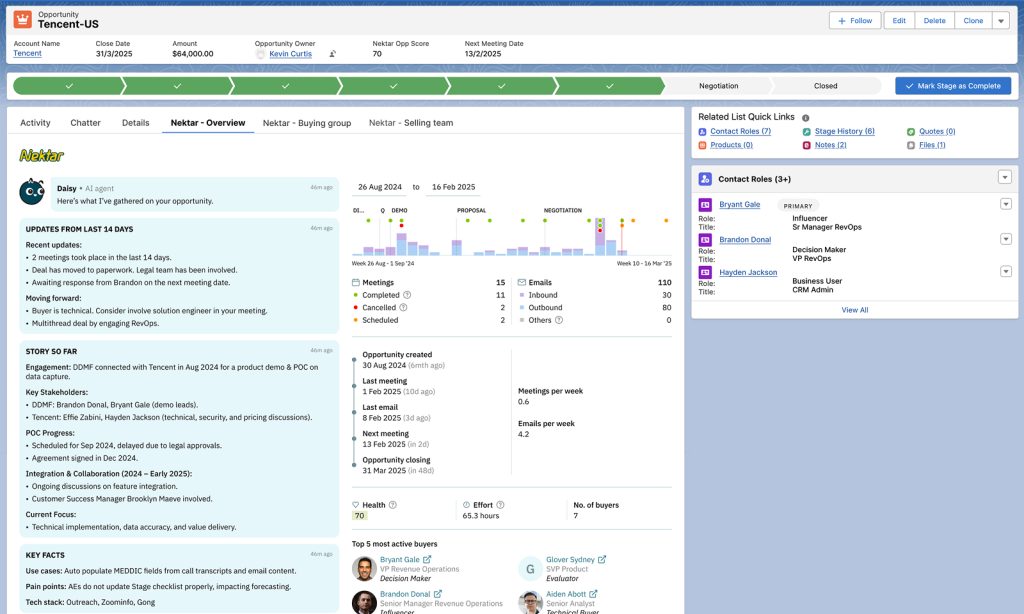
Nektar makes sure the underlying activity data, every email, meeting, call, and calendar event, is actually captured and structured against the right deal before anything tries to track or score it.
Data Foundation does this automatically, with zero rep effort required, writing directly into Salesforce, HubSpot, or Dynamics. Time Travel retroactively corrects historical records as new context arrives, closing gaps a point-in-time capture tool can’t touch.
Daisy AI then surfaces the specific signals that matter for deal tracking: buyer engagement scoring, deal risk flags, buying-group coverage, and time-in-stage analysis, directly on the Opportunity tab rather than a separate dashboard nobody opens.
Key features:
- Buyer-seller activity captured automatically as the leading indicator of real deal progression, not a rep’s memory
- Time-in-stage measurement to identify precisely where deals are stalling, not just that they are
- Deal risk flags and engagement scoring that surface high-priority opportunities before they go cold
- Time Travel™ retroactive correction, backfilling up to 12 months of historical activity as new context arrives
- Buying-group intelligence that auto-detects stakeholders from real email and meeting activity, rather than requiring a rep to log them
- Vendor-neutral integration, sits alongside Gong, Outreach, Salesloft, and other tools already in your stack rather than replacing them
Best for: Salesforce-first, Salesforce, HubSpot, or Dynamics teams that need the underlying deal data trustworthy enough for both reps and any AI layer built on top of it.
Pricing: Custom, based on team size and scope. A free CRM scan shows how much of your own pipeline activity is currently missing before you commit to anything.
2. EngageBay
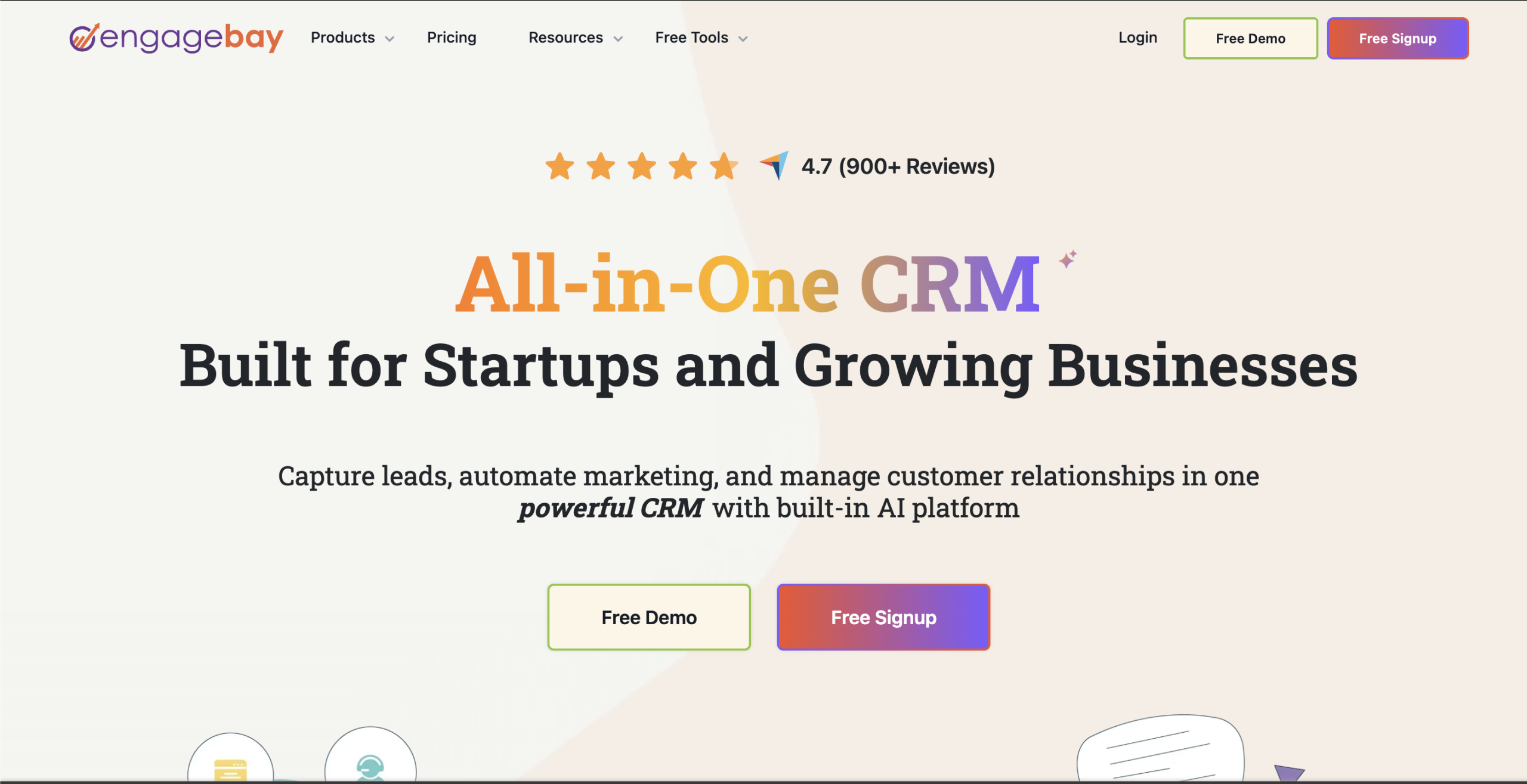
EngageBay is an all-in-one CRM and marketing automation platform aimed squarely at startups and small-to-midsize teams that want sales, marketing, and support tools bundled together rather than bought as separate point solutions. It’s trusted by over 150,000 companies, largely on the strength of its price-to-feature ratio relative to HubSpot or Salesforce, and it’s added AI features (email and campaign generation, deal scoring, smart insights) on top of its original bundle over the past couple of years.
Key features:
- Unified sales lead information across marketing, sales, and support in one platform
- AI-powered deal scoring to prioritize which leads are actually worth a rep’s time
- Centralized client data with contact tagging, filtering, and custom fields
- Built-in email marketing, landing pages, live chat, and helpdesk/ticketing
- Estimated revenue generation forecasting tied to pipeline stage
- Over 30 native integrations, including Zapier, Mailchimp, Twilio, and Stripe
Best for: Startups and small businesses wanting sales, marketing, and support consolidated into one affordable platform rather than stitched together from several point tools.
Pricing: Free plan available for up to 15 users and 250 contacts. Paid tiers start around $15/user/month (Basic), scaling to roughly $65/user/month (Growth) and $120/user/month (Pro), with meaningful discounts on annual or biennial billing. Confirm current tiers directly, since EngageBay has adjusted contact limits and feature gating more than once in the past year.
3. Kapture CX
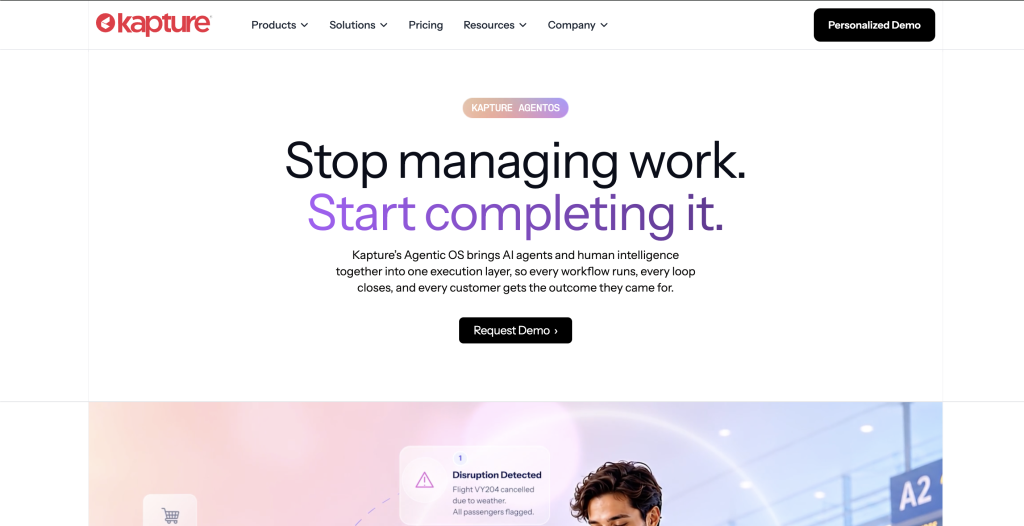
Kapture CX (also marketed as Kapture CRM) bundles sales, marketing, operations, and customer service into one platform, with a particular strength in omnichannel support and enterprise-grade customization via 500+ APIs. It’s built for organizations that want centralized control over pre-sale activity and post-sale support from the same system, and it ships with industry-specific configurations for verticals like retail, hospitality, real estate, and healthcare rather than a one-size-fits-all template.
Key features:
- Custom organizational hierarchies with sales performance data broken out by rep, team, or region
- Omnichannel support spanning email, chat, social, and direct campaigns from one dashboard
- Integrated sales monitoring with real-time KPI tracking (calls answered, response times, ticket resolution)
- 500+ pre-built integrations, including SAP, Oracle, Shopify, Dynamics 365, and Salesforce
- AI-powered live chat and self-service portal for both sales and support use cases
- Over 500 configurable reports for pipeline, agent, and campaign performance
Best for: Mid-market to enterprise teams, especially in retail, hospitality, or field-sales-heavy industries, wanting sales and post-sale support unified in one heavily customizable platform.
Pricing: Three tiers, Essential, Professional, and Enterprise, all custom-quoted based on team size and configuration. No published flat-rate pricing; request a demo for a specific quote.
4. Salesmate CRM
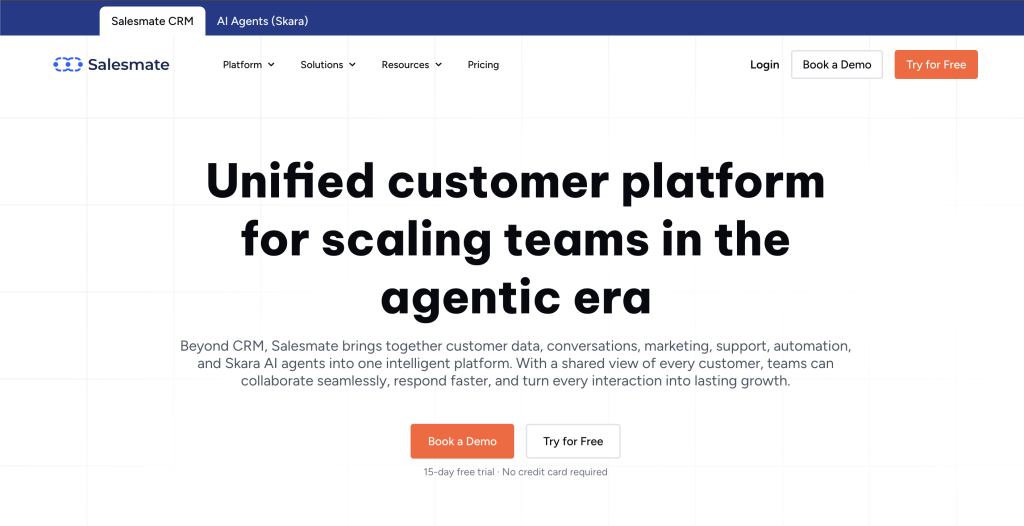
Salesmate CRM pairs a built-in sales activity tracker with automation for repetitive tasks, follow-up emails, CRM field updates, so managers can monitor rep activity in real time without reps losing time to manual admin. It’s frequently cited by reviewers as delivering enterprise-level features at a noticeably lower price point than HubSpot, Salesforce, or Zoho, which is its clearest differentiator in a crowded category.
Key features:
- Automated sales activities and multi-step playbooks triggered by deal stage or behavior
- Sales timeline view for tracking every touchpoint on a deal in chronological order
- Smart calendar view synced across team members for scheduling and follow-up visibility
- Built-in calling, texting, and email from directly within the CRM record
- Workflow automation for lead routing, task assignment, and stage progression
- Native integrations with Meta Lead Ads, Google Workspace, and Microsoft 365
Best for: Budget-conscious small and mid-sized sales teams wanting activity automation and calling/texting built in, without paying enterprise-tier pricing for it.
Pricing: Three tiers, starting around $23/user/month and scaling to roughly $63/user/month for the top tier, with a free trial available. Confirm current tiers directly before budgeting.
5. Pipedrive
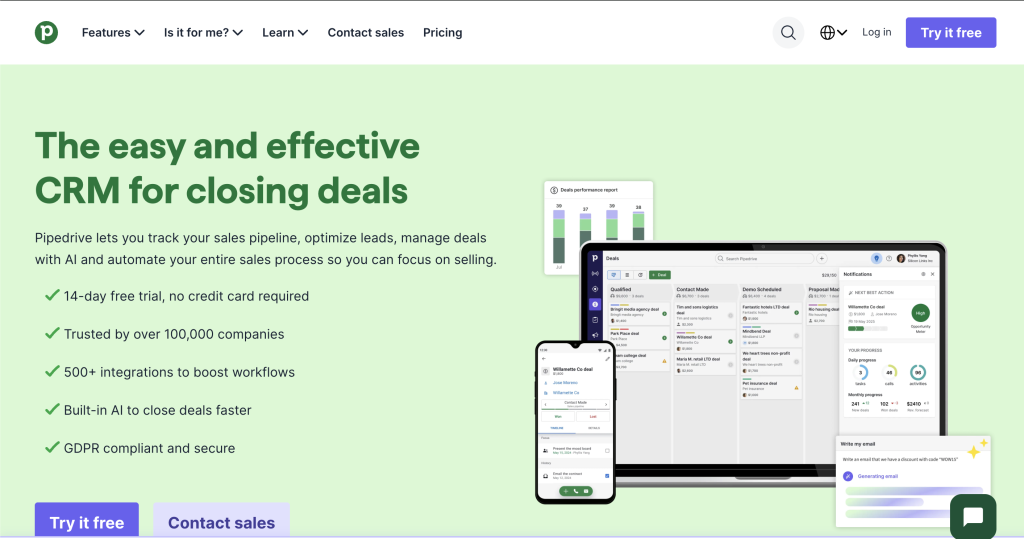
Pipedrive went through a brand refresh in July 2025 and has been steadily layering agentic AI features on top of its long-standing visual pipeline since late 2025: an AI Sales Assistant that scores deal-win probability, “Deal Rotting” alerts that flag stalled opportunities before a rep notices, an AI email writer, agentic call and meeting auto-summaries, and a natural-language reporting assistant (Insights AI). It remains one of the most widely adopted CRMs for small and mid-sized sales teams specifically because it was built by salespeople first, which shows in how little ramp time it typically takes.
Key features:
- Visual, drag-and-drop sales pipeline with fully customizable stages
- AI Sales Assistant with deal-win probability scoring and Deal Rotting alerts for stalled deals
- Agentic AI call and meeting summaries generated automatically after each interaction
- LeadBooster suite (chatbot, web forms, prospecting) included on higher tiers at no extra cost
- 500+ marketplace integrations, including ZoomInfo, DocuSign, PandaDoc, and HubSpot
- Customizable automation covering up to 150 workflow rules on top-tier plans
Best for: Small to mid-sized sales teams wanting a fast-to-adopt visual pipeline with genuinely useful AI layered on top, rather than AI bolted on as an afterthought.
Pricing: Multiple tiers; the Premium plan runs around $49/user/month and includes the AI Sales Assistant, revenue forecasting, and LeadBooster. Lower entry tiers exist without the AI features. Confirm current tiers directly, since pricing and feature gating shifted with the 2025 rebrand.
6. Insightly
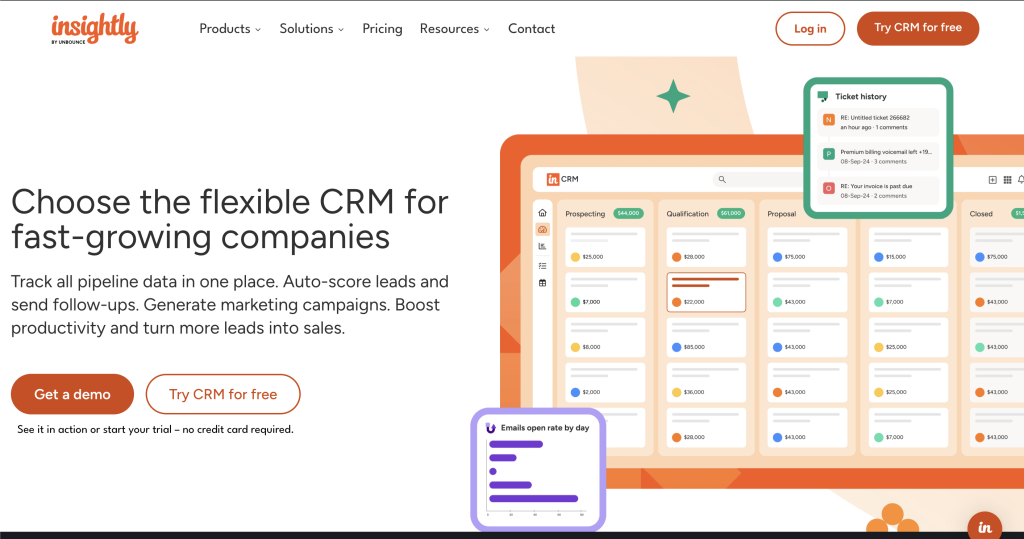
Insightly bridges CRM and project management, useful specifically for teams that need visibility past the close date into delivery and onboarding, not just up to it. It launched an AI Copilot in late 2025 supporting natural-language queries against CRM data (“show me all open opportunities over $10K closing this quarter”) and AI-assisted email drafting, though it’s worth knowing upfront that Copilot’s output quality depends entirely on how clean the underlying CRM data is, teams with messy data get noticeably less reliable suggestions.
Key features:
- Customizable dashboards for tracking deals by stage, salesperson, or product
- Native Gmail and Outlook integration with email tracking (opens, clicks) on Professional and above
- AI Copilot (launched late 2025) for natural-language reporting and email drafting
- Built-in project management for teams that need to track delivery after the deal closes
- Bidirectional calendar sync with Google Calendar and Outlook
- AppConnect integration tool, though advanced workflows often require a paid upgrade to it
Best for: Service businesses, agencies, and B2B teams that need CRM and post-sale project delivery tracked in the same system rather than handed off to a separate tool.
Pricing: Three paid tiers billed annually only (no monthly option): Plus around $29/user/month, Professional around $49/user/month, and Enterprise around $99/user/month. A limited free tier has been offered at various points; confirm current availability directly, since Insightly’s plan structure has changed more than once in the past two years. Budget separately for AppConnect if you need advanced integrations, it’s priced apart from the core CRM tiers.
7. Nutshell
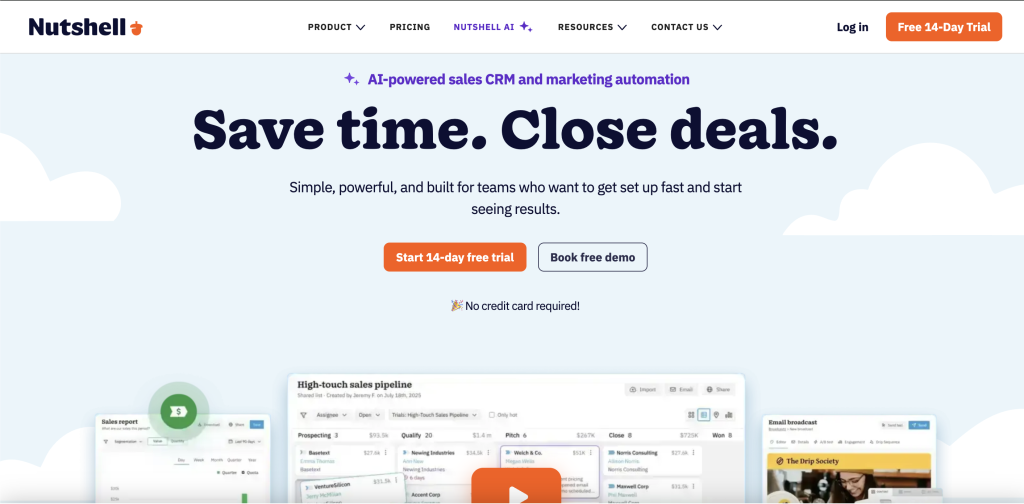
Nutshell is built around real-time sales performance visibility rather than heavy configuration, aimed at teams that want to see trends and adjust strategy quickly without a lengthy admin setup. It pairs CRM functionality with built-in email marketing, positioning itself as a lighter-weight alternative for teams that don’t want to buy a separate marketing platform just to run basic campaigns.
Key features:
- Sales forecasting based on pipeline stage and historical close rates
- Lead volume monitoring to catch pipeline generation problems early, before they show up in a closed-deal shortfall
- Lost-deal analysis that surfaces patterns in why deals are actually being lost
- Built-in email marketing and sequences without needing a separate tool
- Board, list, and chart views of the pipeline depending on how a rep or manager prefers to work
- Native mobile app with offline access for field sales teams
Best for: Small to mid-sized teams wanting straightforward pipeline visibility and basic email marketing bundled together, without the setup overhead of a larger platform.
Pricing: Multiple tiers available; confirm current pricing directly, as Nutshell’s plan structure and per-seat rates have shifted across its product lineup in the past year.
8. Salesflare
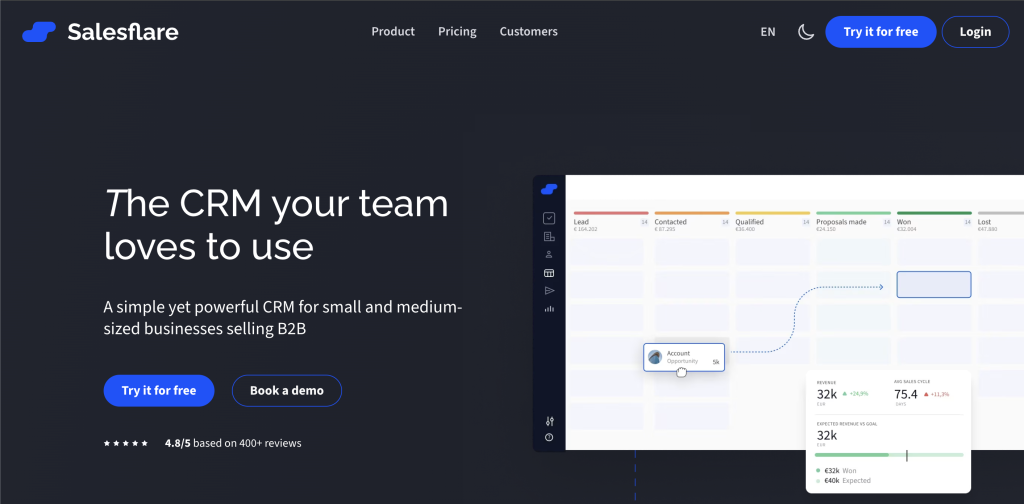
Salesflare is built specifically to eliminate manual data entry: it automatically enriches contact and company records, tracks email opens and link clicks, and surfaces which deals actually need attention through what it calls a “hotness” algorithm, a relationship-intelligence layer that flags deals going cold based on real engagement patterns rather than a rep’s gut feel. It’s a genuinely different focus from Pipedrive’s more activity-and-automation-heavy AI, Salesflare’s AI leans specifically toward removing data entry rather than accelerating rep-facing tasks.
Key features:
- Automatic contact and company enrichment pulled from email signatures, LinkedIn, and public data
- Email, website, and link tracking that logs engagement without any manual input
- “Hotness” algorithm that scores deals by real engagement recency, not just stage
- AI-drafted follow-up suggestions and an account-history chat assistant
- Deal scoring based on actual buyer behavior across tracked touchpoints
- Integrations with Salesforce, Pipedrive, HubSpot, Google Workspace, and Zoho for teams migrating from a heavier CRM
Best for: Small teams, especially agencies and consultancies, that want to minimize manual CRM upkeep and are willing to trade some enterprise-grade customization for that.
Pricing: Three tiers, roughly $29 to $99/user/month depending on billing cadence and features, with a free trial of up to 30 days and no permanent free plan.
9. BIGContacts
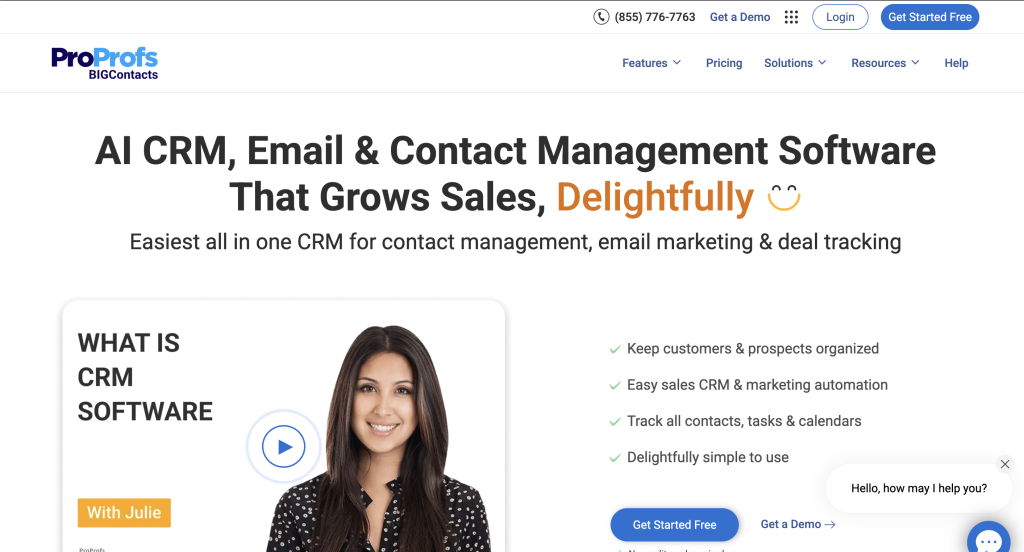
BIGContacts is built specifically for very small teams and solo operators, positioning itself around affordability and simplicity rather than depth of feature. It offers one of the more generous forever-free tiers in this category, full contact management and email features included, which makes it a common starting point for teams of one to five before they outgrow it and move to something with more automation.
Key features:
- Visual sales pipeline with custom stages defined per business, not a fixed template
- Unified sales data across contacts, deals, and email in one dashboard
- Smart reports and predictions on pipeline health and rep activity
- Native integrations with Mailchimp, QuickBooks, Google Calendar, and Microsoft Outlook
- Email marketing and campaign tracking bundled into the core product
Best for: Very small teams and solo operators (one to five people) wanting a free or low-cost starting point for contact and deal management before scaling into a more feature-dense CRM.
Pricing: Forever-free plan available for small teams; paid tiers scale up from there for larger contact volumes and advanced reporting. Confirm current tiers directly.
10. Freshsales Suite
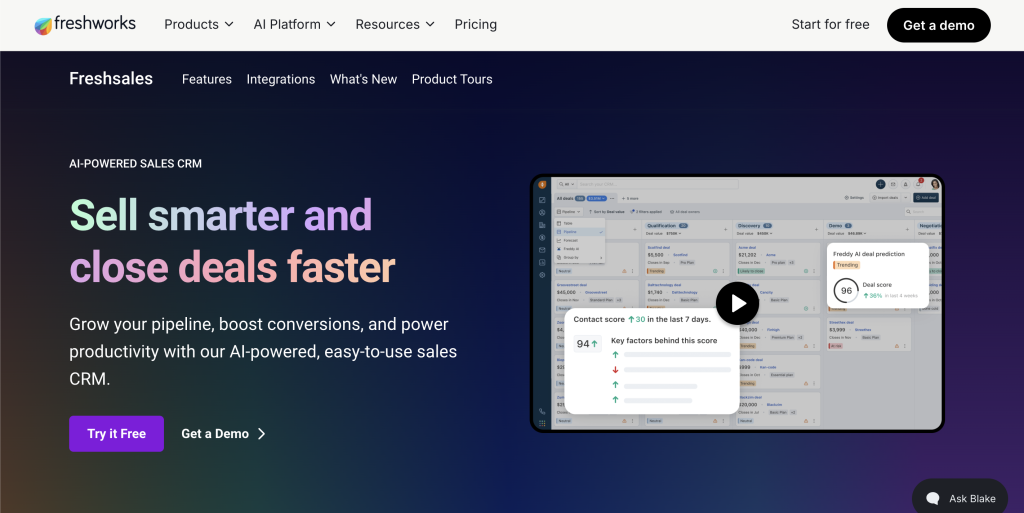
Freshsales Suite (Freshworks’ rebrand of its former standalone Freshsales product) gives a chronological timeline view of customer engagement alongside deal pipeline visibility, with AI-based lead scoring and built-in phone and email baked into the core product rather than sold as an add-on. It’s frequently compared against Insightly and HubSpot in the mid-market bracket, and reviewers generally rate its automation and lead scoring highly while flagging its mobile app and reporting depth as weaker points relative to larger competitors.
Key features:
- Activity timeline showing every customer interaction in chronological order
- AI-based lead scoring to prioritize which contacts are actually worth a rep’s time
- Built-in phone and email, no separate dialer or email tool required
- Customizable deal pipelines and stages matched to your own sales process
- Performance activity sales reports across reps, teams, and campaigns
- Native integration across the broader Freshworks suite (support, marketing) for teams already in that ecosystem
Best for: Teams wanting phone, email, and AI-based lead scoring bundled natively, particularly those already using other Freshworks products.
Pricing: Multiple tiers with a free trial available; confirm current pricing directly with Freshworks, since packaging shifted as part of the Freshsales-to-Freshsales-Suite rebrand.
Deal Tracking Software Compared
What Does a Deal Tracking Process Look Like?
Lead management. Assigning leads to the right rep and setting up follow-up tasks so nothing sits unowned.
Sales pipeline. Tracking each lead’s progress through defined stages (prospect, qualified lead, proposal sent, negotiation, closed won) with a visual tool rather than a spreadsheet.
Sales forecasting. Projecting future revenue as leads move through the pipeline, so resource planning is based on a real trajectory, not a guess.
Sales reporting. Generating regular reports on deal size, win rate, and average cycle length to catch drift before it becomes a quarter-end surprise.
Common Deal Tracking Challenges
Lengthy sales cycles. Long B2B cycles make it easy for a deal to quietly stall without proper tracking and follow-up.
Multiple decision-makers. Buying committees with several stakeholders, each with different priorities, make the sales process harder to navigate without clear visibility into who’s actually engaged.
Limited visibility. Without a clear view of the full pipeline, it’s easy to miss important details, especially at volume or across multiple reps.
Changing requirements. B2B deals evolve, and keeping track of shifting specifications over a long cycle is a real, ongoing challenge, not a one-time setup task.
What Incorrect Deal Tracking Actually Costs
Missed opportunities. Deals that aren’t tracked properly get overlooked, and overlooked deals don’t close.
Inaccurate forecasting. Planning and resource allocation both depend on forecast accuracy, which depends entirely on the underlying deal data being right.
Poor customer experience. Details that slip through the cracks show up to the buyer as a rep who isn’t paying attention, which damages trust and future opportunity.
Inefficient sales processes. Without clear pipeline visibility, bottlenecks stay invisible until they’ve already cost real time and revenue.
Why Deal Tracking Accuracy Matters More With AI in the Mix
Everything above has always been true. What’s new is what deal tracking data increasingly feeds. A growing share of CRM data, including the exact Stage, Amount, and activity fields deal tracking software depends on, is now read and acted on directly by AI agents rather than just displayed for a person to review. A deal marked at the wrong stage, or missing recent activity, used to just produce a slightly-off forecast a manager could catch in a pipeline review. Feed the same gap into an agent acting on it directly, and the error becomes an automated action taken on bad information, before anyone reviews it.
That’s why the accuracy of the underlying activity data matters more now than when this list was first published, not less. Deal tracking software can only track what actually makes it into the CRM, which is exactly the layer Nektar’s Data Foundation is built to close.
Frequently Asked Questions
Q. What is the best deal tracking software?
It depends on your CRM, team size, and sales motion. Nektar is built specifically to make the underlying deal data other tools depend on more complete and accurate; Pipedrive and Freshsales Suite are strong general-purpose options; Kapture CX and Salesmate CRM suit teams wanting built-in activity automation.
Q. What’s the difference between a CRM and deal tracking software?
Most modern CRMs include deal tracking as a core feature rather than a separate category. The distinction that still matters is between passive tracking (a dashboard showing deal status) and tools that actively capture activity and surface risk signals, since the latter depends on data accuracy in a way the former doesn’t.
Q. How does AI change what deal tracking software needs to do?
As more CRM data feeds AI agents that act on it directly, deal tracking accuracy has shifted from a forecasting nicety to a precondition for using AI safely. A wrong stage or missing activity record used to just mislead a manager; it can now trigger an incorrect automated action.
Track Deals With Data You Can Actually Trust
The right deal tracking software only works as well as the data underneath it. Get a free CRM scan to see how much of your own pipeline activity is currently missing, or explore Nektar’s Data Foundation to see how automated capture keeps deal data accurate without adding work for reps.
Enjoyed our content? Follow Nektar on LinkedIn