10 Sales Productivity Tools for the AI Era
- Sales
- 9 min
- October 26, 2026
Executive Summary
Sales productivity tools used to mean faster data entry and better dashboards. In 2027 they mean AI agents that research accounts, draft outreach, qualify leads, and flag deal risk on their own.
Gartner expects AI agents to outnumber sellers 10 to 1 by 2028, yet predicts fewer than 40% of sellers will say those agents improved their productivity. The gap comes down to context: agents are only as useful as the customer data underneath them. This guide covers 10 tools worth evaluating this year, grouped by the job they do, and explains how to build a stack where the agents actually help.
The average seller still spends only 40% of their time selling, according to Salesforce’s State of Sales 2026. GenZ reps fare worse at 35%, losing about two hours a week to manual data entry. Sales teams named AI and agents their top growth tactic for 2026, and sellers expect fully deployed agents to cut prospect research time by 34% and email drafting by 36%.
That promise has a catch. Analysts warn that agents are no shortcut to productivity and recommend sales leaders build a centralized context layer connecting enterprise data, systems, and seller judgment. Most teams skip that step.
Data quality is another area of concern. 76% of organizations say less than half of their CRM data is accurate and complete. Agents built on that data produce confident, wrong answers at scale.
Get our latest insights into your inbox

What is Sales Productivity?
Sales productivity measures how much revenue a sales team generates relative to the time, headcount, and cost it takes. It has two parts: efficiency (how well time and resources are used) and effectiveness (how well that effort converts into pipeline and closed revenue).
In 2027, the definition stretches to include work done by AI agents. A team’s output now depends on how well reps and agents divide the work: agents take research, data entry, first-touch outreach, and follow-up, while reps spend their time on discovery, negotiation, and relationships.
What are Sales Productivity Tools?
Sales productivity tools are software that helps sellers spend more time selling and less time on administrative work. The category now spans five layers:
- Data foundation: captures customer interactions and keeps the CRM complete, so every other tool and agent has accurate context.
- CRM-native agents: AI agents built into Salesforce, Dynamics 365, or HubSpot that qualify leads, research accounts, and coach reps.
- Revenue intelligence and orchestration: conversation intelligence, forecasting, and sales engagement, increasingly sold as one platform.
- Prospecting and enrichment: external company and contact data plus AI research agents.
- Enablement: content, training, and coaching delivered in the flow of work.
How to Choose Sales Productivity Tools in 2027
- Start with the data foundation. Every agent in your stack reads from the CRM. If emails, meetings, and buying group contacts never reach Salesforce, each tool you add inherits the same blind spots.
- Check how a tool works with agents you already run. Most vendors on this list now offer a Model Context Protocol (MCP) server or native connectors to Agentforce, Copilot, or Claude. A tool that only works inside its own interface adds another tab to a rep’s day.
- Weigh adoption costs. Tools that require reps to log, tag, or update anything manually tend to decay. Favor tools that work in the background or inside surfaces reps already use, like Salesforce, Slack, and their inbox.
- Account for consolidation. Clari merged with Salesloft, Seismic merged with Highspot, and Salesforce has been acquiring AI companies across the Agentforce stack. Ask vendors for a 12-month roadmap and how merged products will integrate.
The 10 best Sales Productivity Tools for 2027
Data foundation
1. Nektar
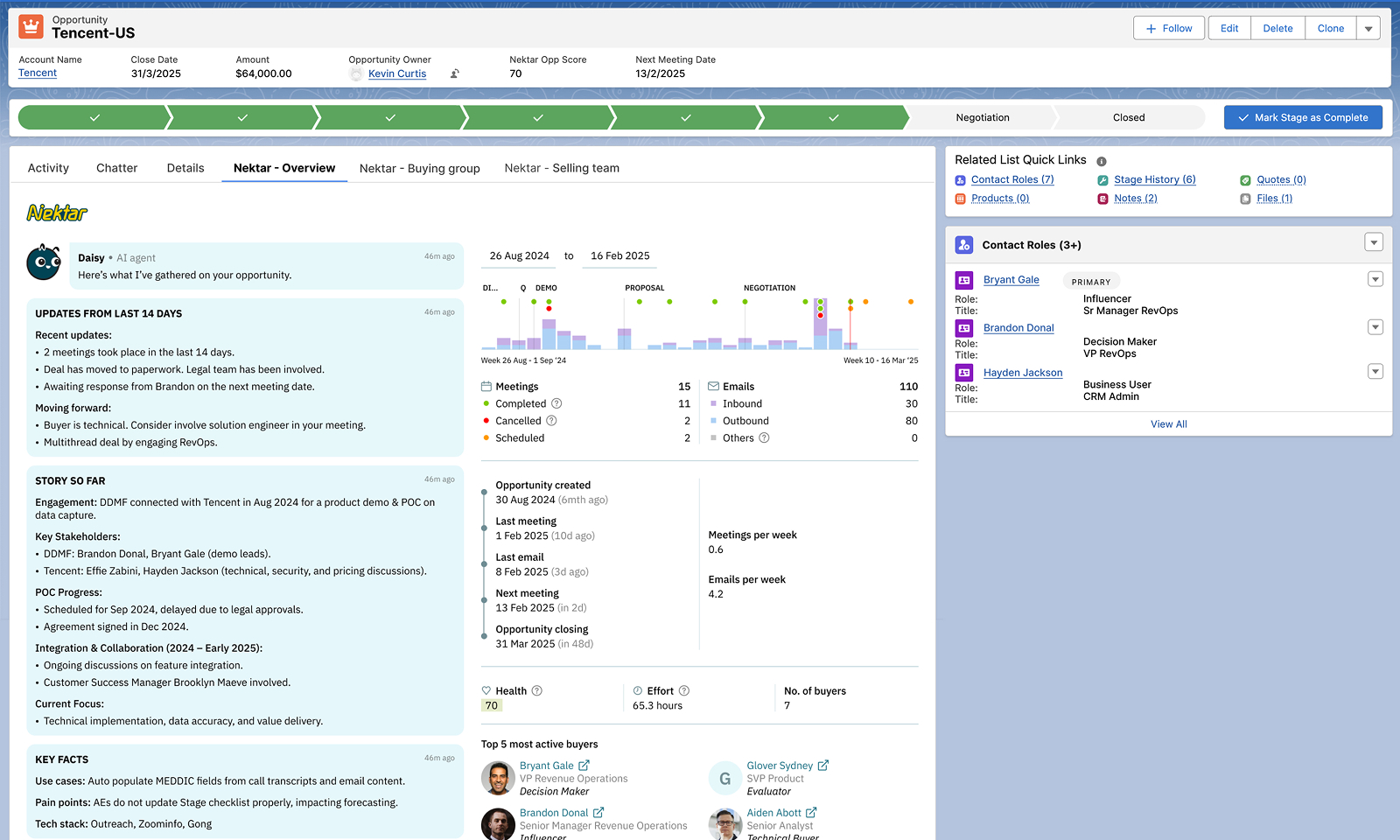
Best for: Salesforce teams that want complete, AI-ready CRM data without asking reps to log anything.
Nektar is the data layer underneath the rest of your stack. It automatically captures every customer interaction across email, calendar, meetings, call transcripts, and Slack, structures that data with machine learning, and writes it natively into Salesforce. Activities land on the right contact, account, and opportunity. Buying group members who never made it into the CRM are discovered and added. Time Travel™ backfills historical activity on day one, and the data keeps correcting itself as relationships change.
The productivity gain comes from two directions:
- Reps stop doing data entry, because capture requires zero behavior change.
- Every agent and tool on this list gets a complete picture of each deal to work from.
Mimecast used Nektar’s engagement data to power an internal Expansion AI tool that drove $2M in expansion revenue and $80M+ in pipeline in its first 80 days. Read the full story here.
Where it fits: Nektar complements agents and revenue platforms. Agentforce, Gong, and forecasting tools all produce better output when the CRM reflects what actually happened with buyers.
CRM-native AI agents
2. Salesforce Agentforce for Sales
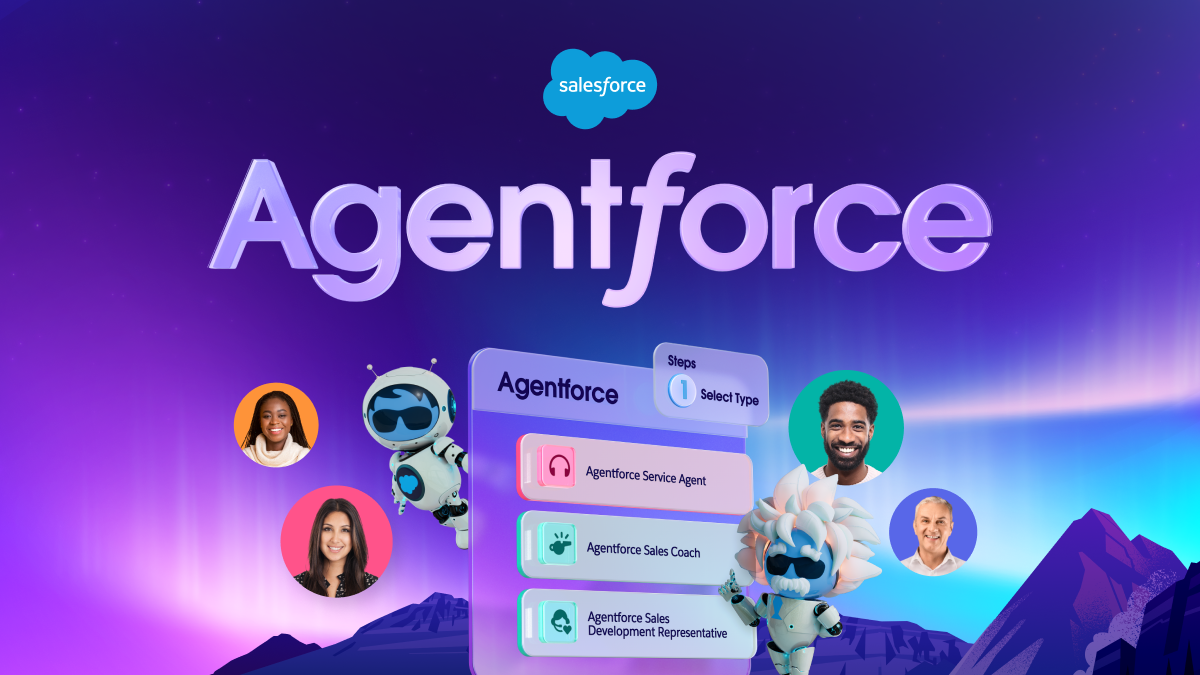
Best for: Sales Cloud customers who want AI agents working directly on Salesforce records.
Agentforce replaced the Einstein branding as Salesforce’s AI layer. For sales teams, its two headline agents are an SDR agent that engages inbound leads, answers questions, and books meetings, and a Sales Coach agent that role-plays pitches and negotiations with reps (Salesforce). In April 2026 Salesforce launched Headless 360, making the platform’s capabilities available to agents through APIs, MCP tools, and CLI commands.
Watch for: Agentforce acts on what is in Salesforce. Sparse activity history and missing contact roles limit what the SDR and coaching agents can do.
3. Microsoft Dynamics 365 Sales agents
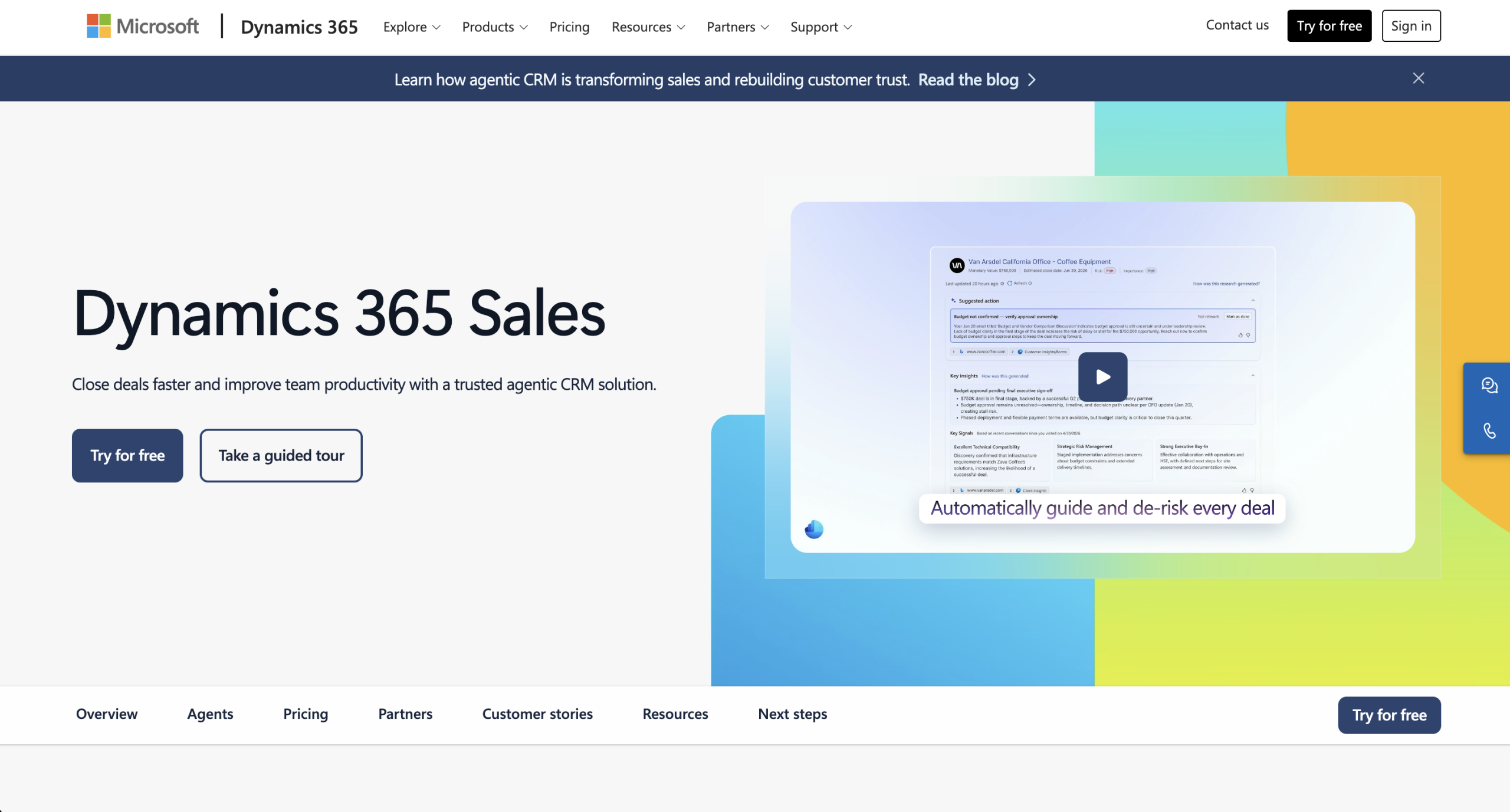
Best for: Dynamics 365 and Microsoft 365 shops.
Microsoft made its Sales Qualification Agent generally available in October 2025, built on Copilot Studio to research leads, assess fit, and send personalized outreach (Microsoft). Sales Research and Sales Close agents extend the same approach to sales leaders and deal execution (Constellation Research).
Watch for: Qualification quality depends on how complete lead and account records are inside Dynamics.
4. HubSpot Sales Hub with Breeze agents
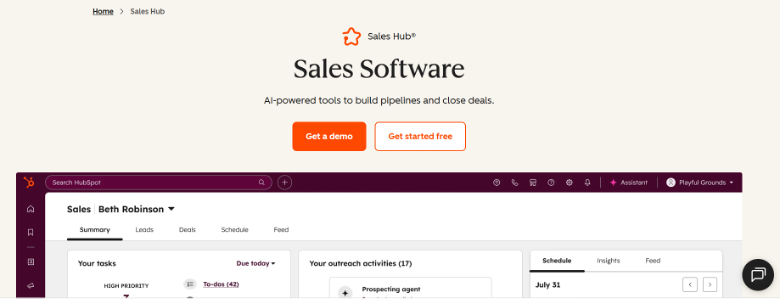
Best for: Mid-market teams running marketing, sales, and service on HubSpot.
HubSpot’s Breeze agents include a Prospecting Agent that identifies target contacts, monitors buying signals, and drafts outreach for reps to approve. Because Breeze shares one data model across HubSpot’s hubs, sales agents can draw on marketing and service history (eesel guide).
Watch for: Agent access depends on Professional or Enterprise tiers, and output is limited to the data HubSpot holds.
Revenue intelligence and orchestration
5. Gong
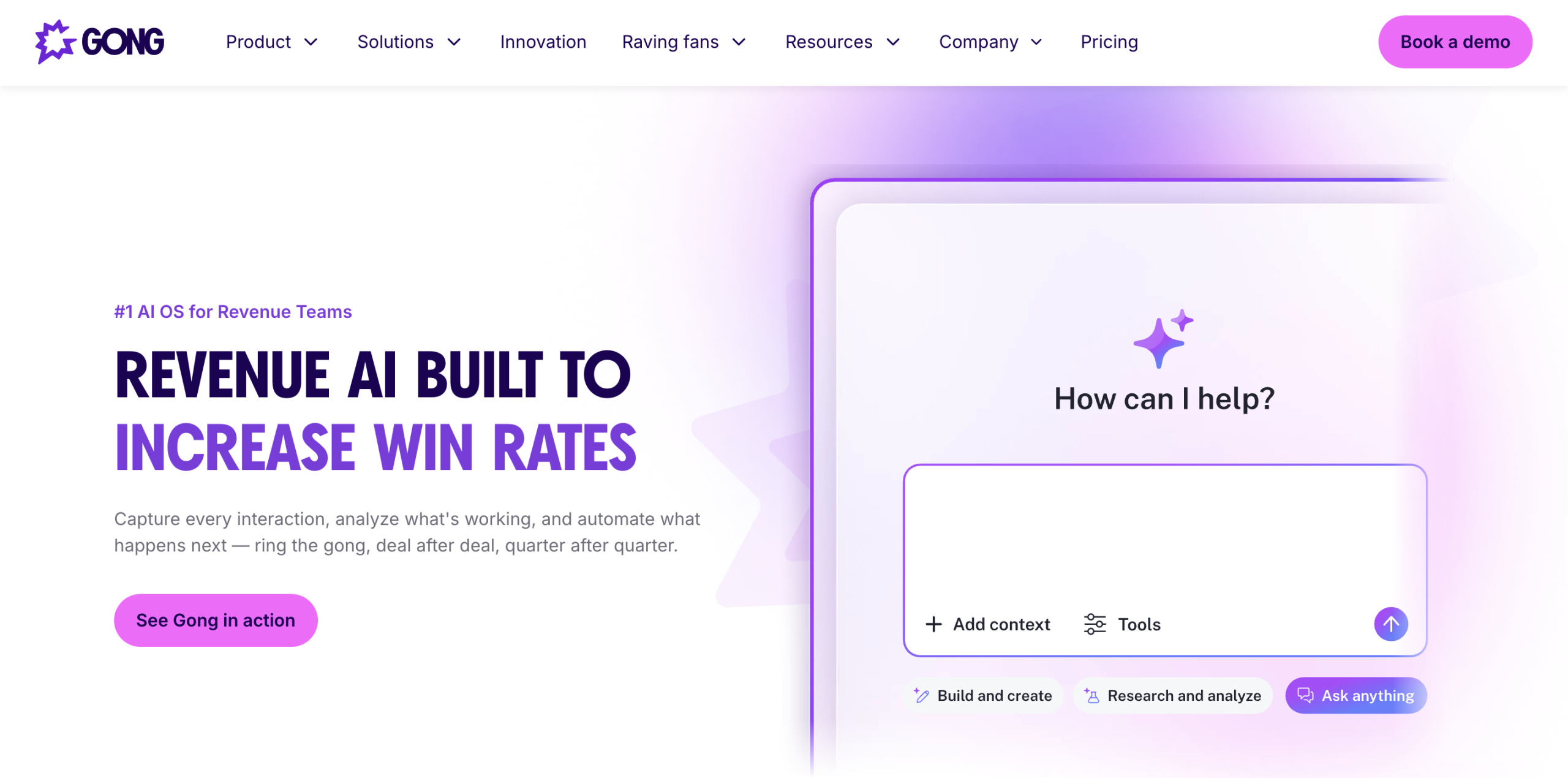
Best for: Enterprise teams that want conversation intelligence, forecasting, and governed agents in one platform.
Gong now positions itself as a Revenue AI Operating System. Its June 2026 Mission Big Dipper release introduced an agentic execution layer that governs and orchestrates AI agents across the revenue cycle, plus Custom Agents that RevOps leaders can build without engineering support (Gong). Gong also supports MCP, so external assistants such as Microsoft 365 Copilot can query its data.
Watch for: Gong’s agents run on Gong’s own Revenue Graph. If other agents, such as Agentforce, also need that context, check how the data flows back into Salesforce.
6. Salesloft (including Clari Forecast)
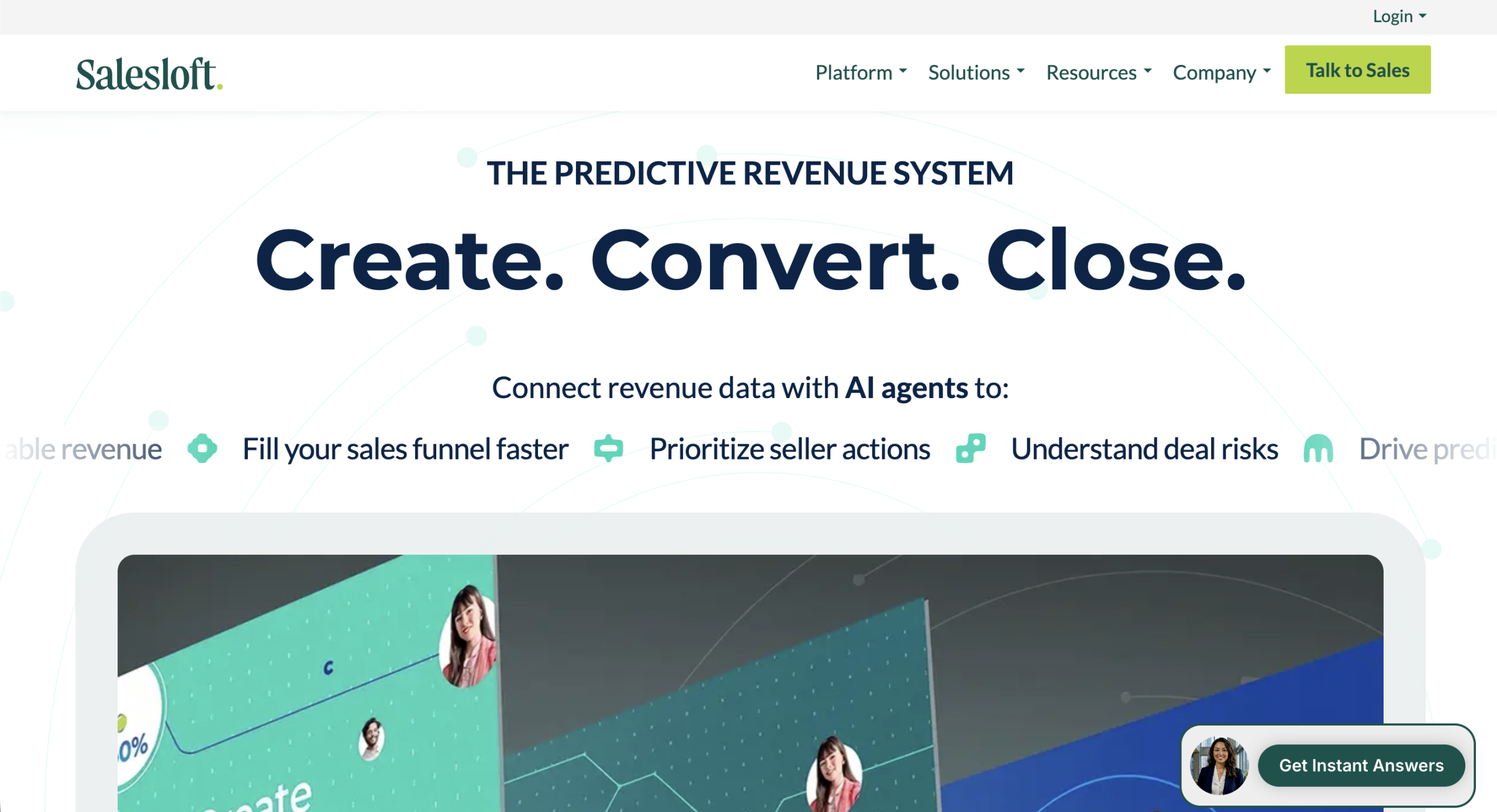
Best for: Teams that want sales engagement and forecasting from one vendor.
Clari and Salesloft completed their merger in December 2025, and in September 2026 the company moved to a single Salesloft brand. Clari Forecast keeps the Clari name, while revenue intelligence, deal management, and conversation intelligence continue under Salesloft (Salesloft). The combined platform now runs cadences, conversation intelligence, deal inspection, and enterprise forecasting.
Watch for: Integration of merged products is ongoing, so ask for the roadmap that covers the modules you buy.
7. Outreach
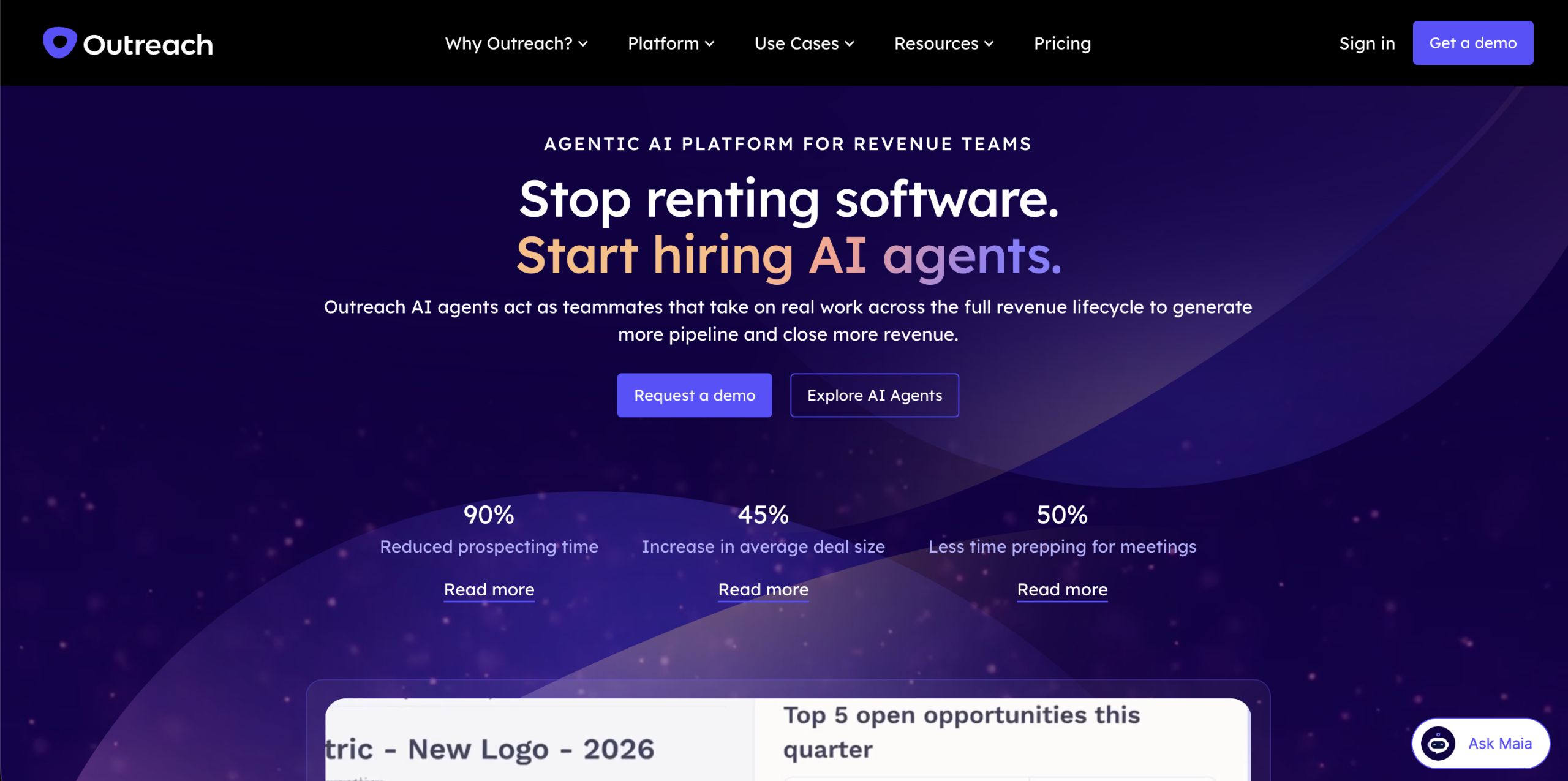
Best for: Teams that want sequencing and execution run by configurable AI agents.
Outreach rebranded to Outreach.ai with its Spring 2026 release, which introduced Omni, a conversational agent for revenue execution, and Agent Studio for building custom agents (Business Wire). Its February 2026 release added an MCP server so Outreach insights and next best actions reach external AI systems such as Claude (Outreach).
Watch for: Engagement agents personalize from CRM and activity history. Gaps there show up as generic outreach.
Prospecting and enrichment
8. Clay
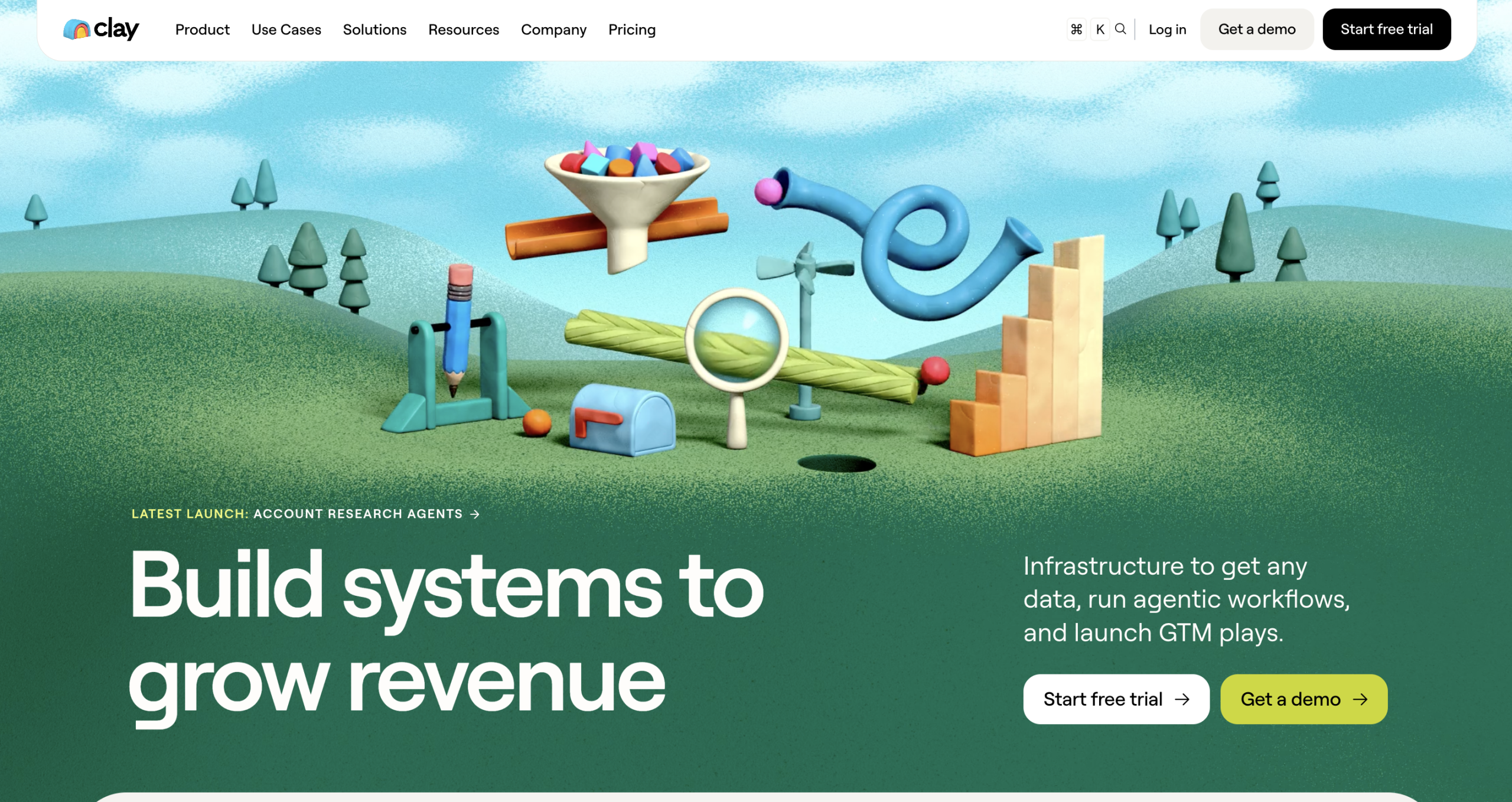
Best for: GTM engineers and RevOps teams building custom research and outbound workflows.
Clay combines data from many providers with Claygent, its AI research agent, so teams can research accounts, enrich records, and run personalized campaigns. Clay raised a $115M Series D at a $7.1B valuation in September 2026 and reports more than 17,000 customers (Daily Research News).
Watch for: Clay is powerful but technical. Most teams need someone who owns the workflows.
9. ZoomInfo
Best for: Teams that need verified external company and contact data inside their AI tools.
In June 2026 ZoomInfo made GTM.AI generally available, a headless context layer that exposes its company and contact graph to agents in Agentforce, HubSpot Breeze, Microsoft Copilot, Claude, ChatGPT, Outreach, and Gong through API and MCP (destinationCRM).
Where it fits: ZoomInfo supplies external data about companies and people. It does not record your own team’s interactions with buyers, which is the first-party layer Nektar covers. Many teams need both.
Enablement
10. Seismic (Highspot by Seismic)
Best for: Large teams that need governed content, training, and AI coaching.
Seismic completed its merger with Highspot in August 2026, creating a company serving 2,500 customers and 3.5 million users across sales, marketing, and enablement (Highspot by Seismic). Recent launches include AI role-play deal simulation, a Deal Agent in Slack and Salesforce, and AI coaching tools. The announcement cites a Gartner prediction that, by 2029, sales organizations with AI-driven enablement will see 40% faster sales stage velocity than those using traditional methods.
Watch for: Deal-level coaching is only as specific as the deal data the platform can see.
Build the Stack From the Data Up
Every tool on this list promises to give reps time back, and most will, if the agents inside them see the full picture of each account. That is the part most stacks miss. Salesforce is your system of record. Nektar makes sure that record reflects what actually happened with your buyers, so every agent and tool you add works from the truth.
Frequently Asked Questions
Q. What are the best sales productivity tools in 2026?
The strongest options depend on your CRM and motion. Salesforce teams typically pair Agentforce with a data foundation like Nektar and a revenue platform such as Gong, Salesloft, or Outreach. Microsoft shops look at Dynamics 365 Sales agents, and HubSpot customers at Breeze.
Q. How do AI agents improve sales productivity?
Agents take on research, lead qualification, outreach drafting, and follow-up. Salesforce's 2026 research found sellers expect agents to cut prospect research time by 34% and email drafting by 36% once fully implemented.
Q. Why do AI sales tools underperform?
Most run on incomplete CRM data. Gartner predicts fewer than 40% of sellers will say AI agents improved their productivity, and recommends building a centralized context layer so agents produce relevant, company-specific output.
Q. What is the difference between a sales productivity tool and a CRM?
The CRM stores customer records. Productivity tools act on those records: capturing activity, automating outreach, analyzing calls, and guiding reps. Their value depends on how complete the CRM is.
Enjoyed our content? Follow Nektar on LinkedIn