
Growing Beyond $1M ARR: Mistakes to Avoid in the Valley of Death
- RevOps
- 12 min
- Updated: August 03, 2026
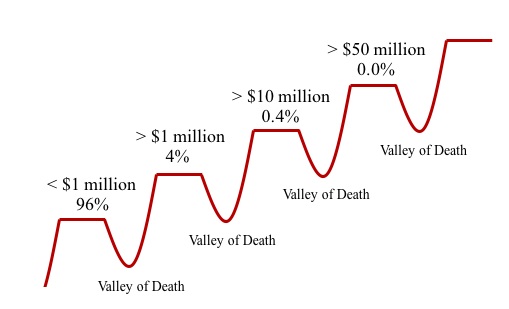
If you’re a SaaS business that’s crossed the $1M ARR mark, congratulations. You belong to a group of less than 1% of businesses that manage to reach that number. A bigger challenge lies ahead: the valley of death.
Only 4% of SaaS companies reach $1 million in revenue, and only 0.4% make it to $10 million. Scaling to $10 million ARR and beyond is where a lot of promising startups quietly dissolve, and the odds only get longer as the revenue number climbs.
Get our latest insights into your inbox

What Is the Valley of Death?
The valley of death is the period in a startup’s life between receiving its initial capital and reliably generating revenue at scale, the stretch where the risk of failure is highest and the margin for error is thinnest. The longer a company spends in it, the higher the odds it never comes out the other side. Surviving it is a real milestone, one that signals a meaningfully better chance of reaching maturity.
Carving the Journey From $0 to $50 Million
According to Abhijeet Vijayvergiya, CEO at Nektar.ai, every startup goes through similar challenges, but the specific challenge changes at every stage. What breaks a company at $0-1M is different from what breaks it at $10-25M, which is different again from $25-50M. Each stage needs a genuinely different approach, not more effort applied to the same playbook.
1. Getting to $1 Million: Find Your Product-Market Fit
In the 0-1 journey, focus on the core mission a startup was actually formed around is what matters most. This is the stage where founders validate their product’s value proposition, answering two questions directly: is there a real market for this, and does the product actually fit that market? Trying to do a bunch of different things and seeing what sticks is a recipe for disaster here. $0-1M is about calibrated steps toward validation, not breadth.


Abhijeet Vijayvergiya
CEO & Co-founder, Nektar.ai
It's very easy to get distracted. I think a lot of startups die because they lose focus and they get distracted from their core mission. This does not mean that you can't pivot. You definitely should pivot when you evolve as a company, you achieve product market fit or you see traction. But at the same time, you should not be doing too many things. That's a very common mistake I have seen that a lot of start-ups make. Figure out what you're solving for. Every start-up starts with a vision. You have a problem that you feel is unsolved and something that you can uniquely solve in a way nobody is solving it today. And you can do it X times better in case it's already sold by somebody.
Trying to force growth is what makes several startups fail to go beyond this stage. An initial team’s job is to help a founder see clearly whether product-market fit is actually there, not to force a scaling motion ahead of it. In the 0-1M journey, staying focused, iterating fast, and evolving to solve the problem the company was actually built for, with real commercial value attached, is the whole job.
2. $1M to $10M: Double Down on What Has Worked
This is where the valley of death begins in earnest. A startup here has a million dollars in revenue and a validated core value proposition, with a very real, very difficult climb to $10 million ahead of it. Abhijeet’s guidance for this stage is specific: if you’ve achieved product-market fit, you’re in a strong position to scale, but not by opening new markets, launching new products, or chasing new customer segments in a rush to hit the next number. What matters is looking hard at the problem you’ve actually solved and how you solved it, then templating that into a real playbook.
Do more of what has worked for you. Just doing this makes the $1-$10m journey quite easy. In my past experience, we figured out how the founders sold to the first 5, 10, 20 and 50 people. We could really onboard sales teams in a way that they started delivering their first deal within the first 6 months of joining in a new market.
Abhijeet Vijayvergiya
Customer retention matters just as much as new logo growth at this stage. Abhijeet draws on his experience at Capillary Technologies here:
We did a great job at retaining our customers. We still have the lowest churn rate in the industry. We've always focused on delivering that delight to our users and customers so that they become our evangelists.
Abhijeet Vijayvergiya
Surviving the valley of death requires founders to keep returning to why the company and product exist in the first place, and to convert the tribal knowledge floating in their own heads into a working, teachable playbook.
The first and foremost thing that you should do once you hit a product market fit & you're looking to scale and ramp up is to articulate that knowledge that is in your head into a playbook and templatize it. That gives you a solid foundation and a scalable model.
Abhijeet Vijayvergiya
3. The Journey From $10M to $50M
After $10M, most startups start hitting real ceilings in their existing markets. Innovation becomes the difference between plateauing and continuing to climb.
You need to continuously innovate, whether it's creating new products, going for price upgrades, or adding more value to what you're currently offering.
Abhijeet Vijayvergiya
Strategy and product both come into sharper focus between $10M and $50M, and one of the most important habits Abhijeet points to is a relentless, ongoing accounting of sales capacity against the addressable market.
We would always go into that exercise of what's our addressable market, how many logos are out there, have we spoken to all of them? And if not, how soon can we speak to them? Because they all have similar problems, they need us, we need to be out there in those meeting rooms where they are thinking about solving those problems.
Abhijeet Vijayvergiya
Investing in sales enablement becomes crucial here too, so a growing bench of new reps can operate closer to the level the founding team once did on its own. Abhijeet also points to this stage as the right moment to hire VPs across functions, with a sharp caveat about hiring well rather than hiring fast.
What I have also seen people do wrong is not doing endgame in the core markets where they are seeing success. They will open in more and more markets, and that will mean you're spreading thin. At the same time you are leaving money on the table in the existing markets which you are really good at. It's very important to go for market share between $10m-$50m. Which are your core markets? If you're doing quite well then go for market share. And when you're opening new markets, you're opening them strategically and as soon as you hit a million dollars in a new market, you double down and get to 10m after that.
Abhijeet Vijayvergiya
How to Cross Over the Valley of Death
There are a few common, well-documented reasons startups get crushed by the valley of death instead of crossing it. Here are three of the most common.
1. Trying to do too many things
Every growth stage has its own requirements, and what worked before $1M won’t work when the target is $10M and beyond. Crossing $1M is exciting, and that excitement can push founders and teams to wear too many hats at once, especially once a base team is in place generating its own ideas about where to grow next.
Scaling past this point requires real focus on the specific north star a business has set for itself, not an ever-expanding list of promising directions. Establishing processes is what keeps a company on track here: a sales leader’s job becomes asking, directly, what creates the most impact for the least effort, then building a real playbook around that answer rather than the next idea that comes up in a brainstorm.
Without that process, founders end up doing too much, or focused on work with no long-term impact, and spreading thin at this stage is a common route to unnecessary churn and misdirected effort. The businesses that make it through build a scalable, repeatable playbook engine and look honestly at their own real strengths and weaknesses, rather than every opportunity that looks appealing at the moment.
2. Failing to evolve the sales process
The early “honeymoon” period from $1-5M ARR tends to run smoothly: a small, efficient, founder-coached sales team, personal-network-driven inbound, everything working at a comfortably small scale. Past roughly $5M in ARR, that stops working, and companies have to genuinely change approach as they move upstream.
The processes that worked before $1M don’t hold up here. Early use cases start showing their limits, or the product starts hitting real edge cases it wasn’t built for. Founders need to run something close to the same 0-1 product-market-fit exercise again, this time for a scaled sales motion rather than the product itself. That means real investment in a scalable, extendable sales process, and the right tech stack plays a genuinely crucial role here, since a stack built for a five-person founder-led team doesn’t hold up once the team, the deal complexity, and the buying committees all triple in size.
On the GTM side, training becomes essential, since sales cycles change meaningfully moving from SMB to enterprise, and a lot of nuance enters the picture that a founder-led motion never had to account for. Navigating the buying organization and getting real visibility into the buying committee, not just the one or two contacts a rep happens to log, is what separates companies that build a genuinely hyper-optimized, repeatable sales and marketing engine from ones still running on founder instinct long after that instinct stopped scaling.
3. Hiring without intent
A large share of SaaS companies stall out around $15M ARR because they don’t treat customer happiness as a core, tracked metric. Building something customers genuinely love requires an implementation plan that scales the product itself, and a team capable of sustaining product development, support, and implementation all at once, none of which survives a bad hiring decision unscathed.
The average cost of a bad hire runs up to 30% of that employee’s first-year earnings, a genuinely large number for a startup still absorbing its own operating costs.
One mistake that startups make is that they hire professionals from the biggest brands who are probably operating at a $100m or billion dollar scale. That is very different from how a $10m or $5m company will operate. There is a lot to learn from professionals from bigger enterprises who are operating at a bigger scale. But I think at the stage around the $10m mark, you can't use the things they are using. You need to still hustle, you need to still roll up your sleeves. Your sales head needs to train your sales reps as well as go in the field to close some of the larger deals. Be a coach and figure out predictable growth at the same time.
Abhijeet Vijayvergiya
Poor hires cost more than the salary alone, lost productivity, and the real expense of recruiting and training a replacement. Nearly three-quarters of companies that made a bad hire report an average of $14,900 in wasted cost per hire. Scaling too fast without real attention to hiring needs creates bottlenecks that are expensive to unwind later, and the intent behind a hire, not just the timing, is what tends to separate a genuine accelerator from an expensive detour. Hiring a VP of Sales at the right moment, for the right reasons, is one of the clearest examples: done well, it builds a predictable engine; rushed, it can set a company back further than not hiring at all.
The Thread Running Through All of It
Every stage above shares the same underlying tension: what worked when a founder personally knew every customer, every deal, and every rep stops working the moment the company outgrows the founder’s own attention span. The fix at $1-10M is turning tribal knowledge into a playbook. The fix at $10-50M is turning personal visibility into the buying committee into a system that doesn’t depend on the founder being in the room. Both are, at their core, a data and process problem before they’re a headcount problem.
That’s the exact gap Nektar exists to close for companies navigating this journey today. Buying Group Intelligence automatically surfaces who’s actually engaged in a deal, not just the one or two contacts a rep remembers to log, giving a scaling sales team the same visibility a founder used to carry personally. Nektar’s Data Foundation captures the activity that would otherwise live only in a founder’s memory or a rep’s inbox, so the playbook Abhijeet describes building has real, current data behind it rather than a document nobody updates.
Get a free CRM scan to see how much visibility your own team has into what’s actually happening across your buying committees, or read the RevOps Starter Guide for a practical framework to build the playbook this piece keeps returning to.
Have something to add? Let us know in the comments, or reach out directly at marketing@nektar.ai.
Enjoyed our content? Follow Nektar on LinkedIn