
Revenue Operations vs Sales Operations: 6 Key Differences in 2026
- Sales
- 12 min
- Updated: July 30, 2026
Two departments, both aimed at growing the company’s revenue, both eliminating silos, both supporting business strategy. And yet they’re not the same function, which is exactly why most companies still struggle to tell RevOps and SalesOps apart.
The rise of new revenue-related roles over the past several years has made this confusion worse, not better. This guide differentiates the two by definition, use case, function, and fit, and includes perspective from Lorena Morales, Director of Global Digital Marketing Revenue Operations at JLL, who addressed the distinction directly in a conversation with us.
Get our latest insights into your inbox

What is Revenue Operations (RevOps)?
RevOps exists to maximize a company’s revenue potential by integrating marketing, sales, and post-sales functions into one coordinated system, rather than three departments each optimizing their own metrics in isolation.
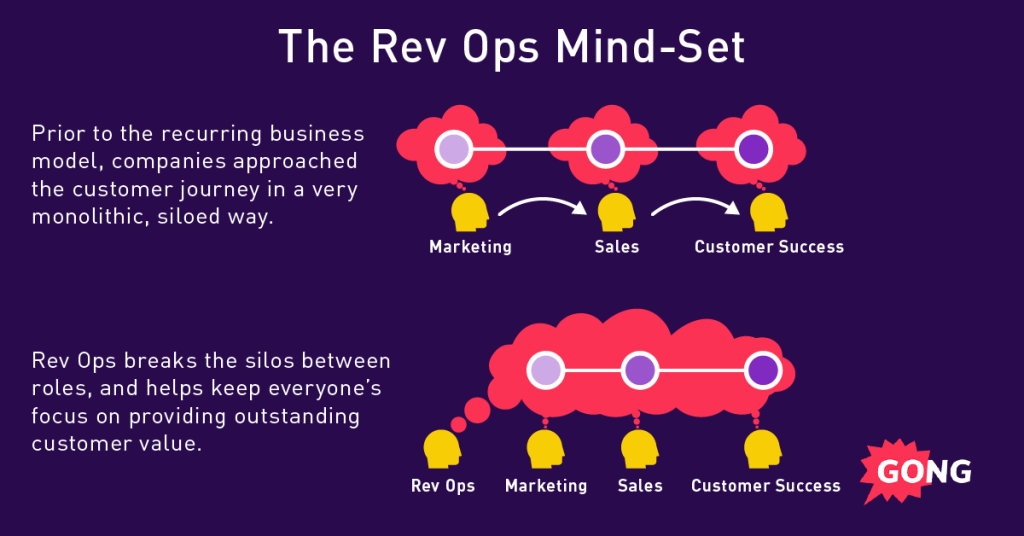
A RevOps function breaks down the silos between marketing, sales, customer success, customer support, and finance, using cross-department visibility to achieve three shared objectives: surfacing new revenue opportunities, improving lead conversion, and closing revenue leakage.
What Is the Role of Revenue Operations?
RevOps increases transparency and communication across every business function touching the customer, from lead generation through customer support. The team is responsible for managing and analyzing data across the entire customer lifecycle, identifying potential customers already in the pipeline, and protecting revenue that’s already been won.
RevOps also drives enablement, employee onboarding, training, and the processes that make those things consistent, aiming to increase visibility and communication in ways that ultimately show up as revenue growth.
What is Sales Operations (SalesOps)?
SalesOps supports the sales team specifically, providing strategic direction and reducing friction so reps can focus on selling. It’s sometimes called sales support or business operations, and it uses software, engagement techniques, and strategic planning to drive growth within the sales function.
SalesOps promotes best practices for reps and gives cross-departmental visibility into sales data. Its role has broadened over time to include more of the analytical insight sales teams need to sustain growth, not just administrative support.
What Is the Role of Sales Operations?
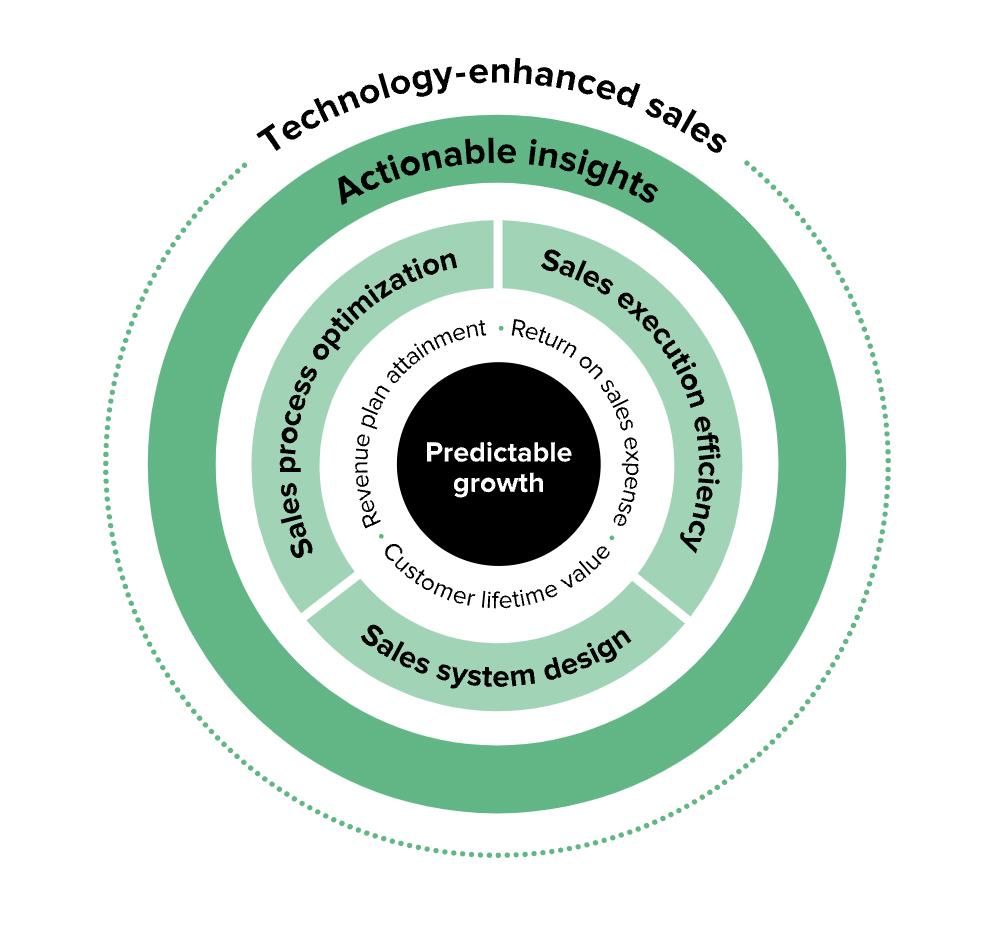
SalesOps has two core functions: making sure the sales department has enough resources to stay productive, and enabling accurate data collection to support revenue forecasting.
The specific structure and daily duties vary by industry and company size, but territory planning and sales forecasting are close to universal across SalesOps teams. Most also manage sales commission data and implement incentive compensation programs, and monitor the current pipeline directly.
RevOps and SalesOps operate as distinct functions, but they work together, and each benefits the other’s effectiveness alongside the company’s overall revenue. What actually separates them?
Revenue Operations vs. Sales Operations
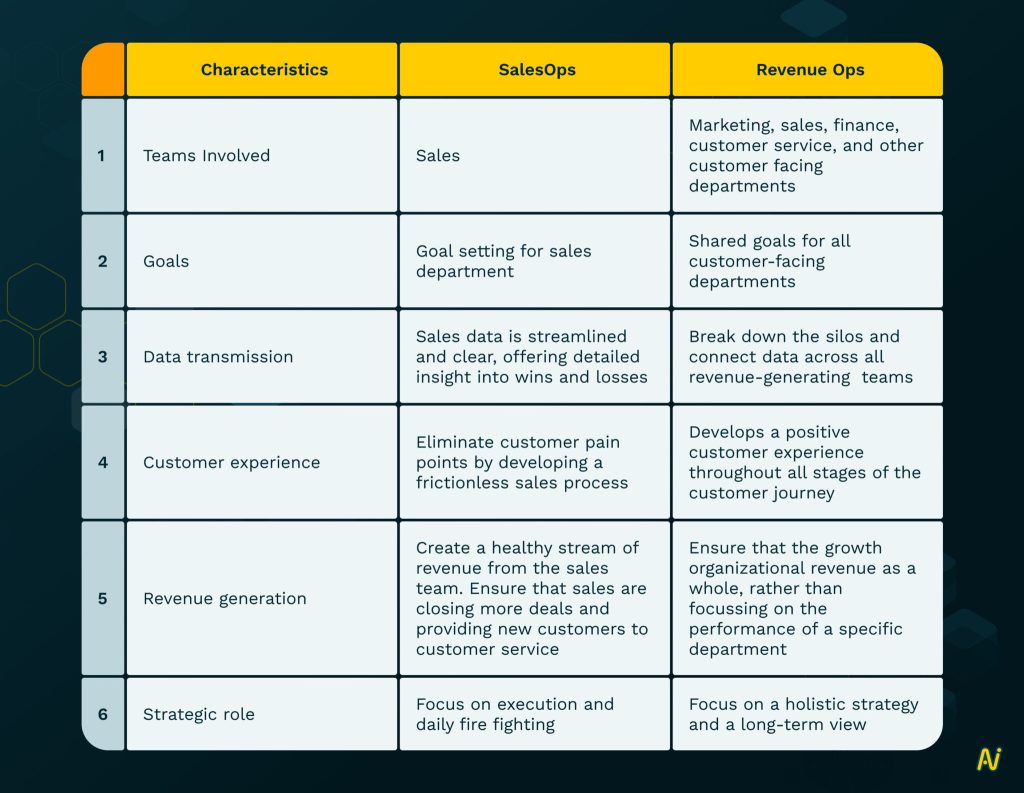
The core distinction: SalesOps focuses solely on the sales function, while RevOps aligns multiple departments toward shared business growth. Sales operations is best understood as a subset of revenue operations, not a competing function.
SalesOps is more executional, handling day-to-day administrative work, data management, tech stack upkeep, form processing, training, so the sales team can focus on approaching leads and closing deals. RevOps takes the more holistic view, acting as a bridge between departments and increasing revenue opportunity by improving communication and shared goals across all of them.
RevOps focuses on the entire customer journey, improving the experience at every touchpoint, prospecting, sales, onboarding, customer success, and renewal, which is what builds the long-term relationships that drive customer loyalty and, eventually, more revenue.
The RevOps Function of an Organization
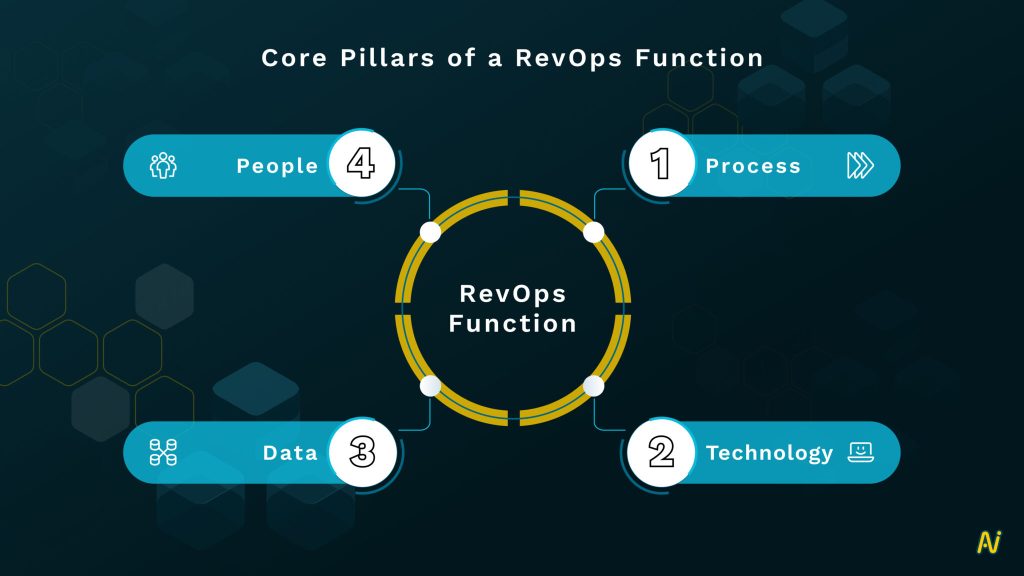
- Process. RevOps builds the well-structured, consistent processes that carry a customer from lead generation to cash collection, since inconsistent process is where revenue quietly leaks out of a funnel.
- Technology. RevOps selects the tools that make those processes actually run efficiently, and increasingly, makes sure those tools are integrated with each other rather than operating as disconnected point solutions.
- Data. Accurate data in systems like the CRM is the foundation everything else in RevOps depends on. The insights derived from it directly drive the strategic decisions that grow the business, and this pillar carries meaningfully more weight now than it did even a couple of years ago (more on that below).
- People. The team responsible for managing systems, process, and data, sized according to the organization’s scale and maturity.
Team Structure: RevOps vs. SalesOps
SalesOps teams are typically structured simply, aligned with the sales team itself, organized by region, product, or channel depending on the company’s go-to-market approach. Some SalesOps teams organize by function instead, with different members owning pipeline management, forecasting, and similar specific responsibilities.
RevOps team structure is usually more complex, since it has to integrate with sales, customer success, marketing, and finance simultaneously. Most RevOps teams organize around functional areas, though some structure around customer segment instead, with team members responsible for driving revenue growth from a specific type of customer.
Both functions ultimately aim to improve the bottom line. SalesOps focuses specifically on sales department performance; RevOps focuses on aligning every revenue-facing department across the company.
Revenue Operations vs Sales Operations: Which Is the Best Fit for You?
When You Need SalesOps
SalesOps exists to remove the friction that’s tedious for a sales department specifically, updating lead data, building new pipeline processes, streamlining software, so the team can stay focused on revenue generation rather than administrative overhead.
Strengthen your sales operations when:
- Your sales team spends more time on process than on actual selling
- You need better visibility and communication between sales and other departments
- Reps are reacting to inbound activity rather than proactively pursuing new prospects
- Your strategy is solid, but execution is the actual bottleneck
When You Need RevOps
RevOps starts from the premise that revenue generation keeps changing, and connects sales, marketing, and service data so every customer-facing department is working from the same picture. A strong RevOps function proactively drives revenue and gets ahead of problems, rather than reacting to one crisis after another.
Strengthen your revenue operations when:
- You need a genuine 360-degree view of the customer journey, before, during, and after the sale
- You want real cross-functional visibility, communication, and accountability
- You need every customer-facing team aligned around one shared outcome
- You’re trying to remove silos and identify roadblocks that are quietly slowing the whole organization down
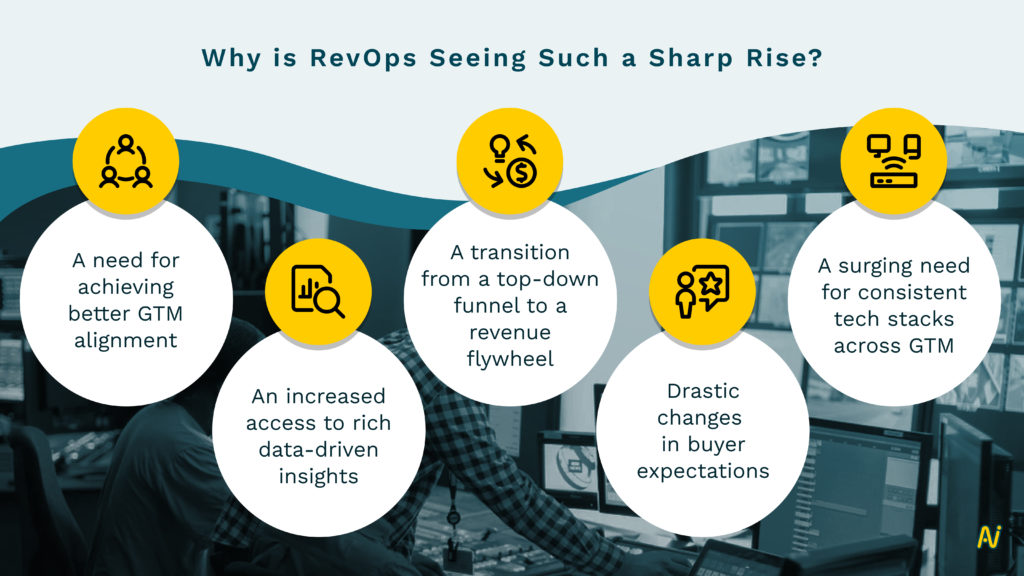
Most modern businesses are zooming out to focus more on RevOps specifically. Building the right RevOps team starts with understanding the stakeholders actually involved in it.
Key Stakeholders in Revenue Operations
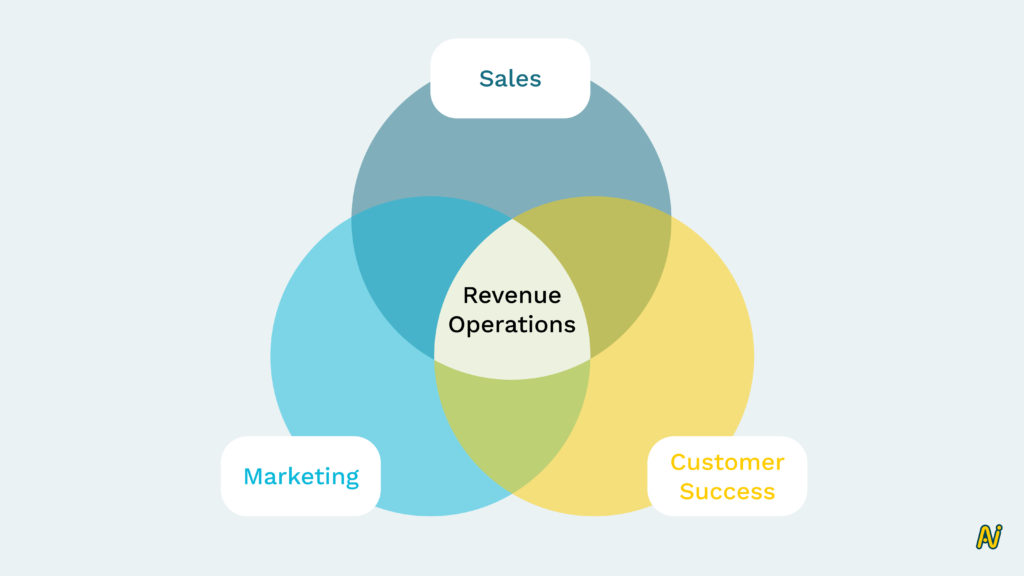
RevOps aligns every customer-facing role. Here’s how it improves outcomes across each one:
1. Sales
RevOps maintains clear visibility across the before, during, and after of the sales process, checking for bottlenecks and making sure process cracks don’t quietly stall a rep’s work. It also brings a blueprint and set of best practices that make the whole team more productive. Some SaaS organizations have reported meaningful gains in sales productivity and lead acceptance after implementing a real RevOps function, though the exact percentage varies enough by organization that it’s worth measuring your own baseline rather than assuming a specific industry-wide number applies.
2. Marketing
RevOps gives marketing access to data from sales and customer success, letting the team build more customer-centric campaigns rather than working from assumptions. Beyond improving lead generation and engagement, this shared data also informs go-to-market strategy and product positioning at a level marketing alone usually can’t see.
3. Customer Success
RevOps helps customer success by surfacing gaps in the sales funnel before they become churn. Aligning revenue functions together improves customer communication and service quality throughout the buyer’s journey, and sharing knowledge, expertise, and data across teams tends to compound: each function gets sharper, and so does the organization overall.
With shared data across every department, businesses can rethink strategy and iterate faster at any point in the revenue-generation process, giving the organization more certainty in its own sales and revenue projections rather than relying on gut feel.
Why the Data Pillar Matters More Than It Did a Few Years Ago
The four RevOps pillars above (process, technology, data, people) haven’t changed. What has changed is the stakes riding on the Data pillar specifically. For most of RevOps’ history, inaccurate CRM data was a coordination problem: a manager working from an incomplete pipeline view made a slightly worse decision, and a person further up the chain usually caught the obvious error before it compounded.
Increasingly, that same data feeds AI agents that act on it directly, updating fields, flagging risk, triggering workflows, without a person reviewing the change first. A wrong stage or a missing stakeholder used to produce a misleading report. Now it can produce a wrong automated decision at a speed nobody catches in time. Whether your organization structures around SalesOps, RevOps, or both, this is the pillar worth getting right before layering AI on top of it.
Frequently Asked Questions
Q. Is sales operations part of revenue operations?
Yes. SalesOps is best understood as a subset of RevOps, focused specifically on the sales function, while RevOps coordinates sales alongside marketing, customer success, and finance around one shared revenue goal.
Q. Do I need both RevOps and SalesOps?
Many organizations run both, with SalesOps handling day-to-day sales execution and RevOps coordinating across departments at a higher level. Smaller or early-stage companies often start with SalesOps and add a dedicated RevOps function as they scale and cross-departmental coordination becomes a real bottleneck.
Q. What’s the biggest difference in team structure between RevOps and SalesOps?
SalesOps teams are typically structured simply, organized around the sales function itself (by region, product, or channel). RevOps teams are usually more complex, since they need to integrate with sales, marketing, customer success, and finance simultaneously, and are often organized by functional area or customer segment instead.
Q. Why does data quality matter more for RevOps now than it used to?
Because a growing share of RevOps data now feeds AI agents that act on it directly, rather than a person reviewing it first. Incomplete or inaccurate data used to just produce a misleading report; now it can produce a wrong automated decision with nobody catching it before it’s acted on.
Nektar: Better RevOps and SalesOps With Trustworthy CRM Data
Whether your organization is scaling SalesOps, building out RevOps, or running both, the data underneath either function has to actually be complete. Nektar’s Data Foundation automatically captures every email, meeting, call, and calendar event across sales, marketing, and customer success, and writes it natively into Salesforce, HubSpot, or Dynamics, with zero rep effort required. Daisy AI then turns that unified data into the specific signals both functions actually need: buying-group visibility for sales, pipeline health for RevOps leadership, and churn risk for customer success, all from the same underlying record.
Key features:
- Zero-rep-effort activity capture across email, calendar, meetings, and calls
- Time Travel retroactive correction of historical CRM records as new context arrives
- Daisy AI signal library spanning buyer visibility, deal risk, and rep performance
- Vendor-neutral, sitting alongside your existing sales and marketing stack rather than replacing it
Best for: Organizations building or scaling either function who need the CRM data underneath both to be reliable enough for people and AI agents to act on.
Get a free CRM scan to see how complete your own revenue data actually is.
Enjoyed our content? Follow Nektar on LinkedIn