

10 B2B Sales Closing Techniques for 2026
- Sales
- 11 min
- Updated: July 21, 2026
“How hard can you push a client to close a deal?”
It’s still the wrong question, and it’s gotten more wrong since we first wrote this guide. Gartner’s 2026 buyer research found that 67% of B2B buyers prefer a rep-free experience, and buyers now weigh an average of seven different information sources that includes AI tools. All this happens before a rep is meaningfully involved at all.
A tactic designed to manufacture agreement doesn’t land well on a buyer who’s already done most of the homework and has little patience for anything that feels like a script.
That doesn’t mean closing techniques stopped mattering. It means what “closing well” looks like has changed. 69% of buyers still turn to sales reps specifically to validate AI-generated insights. The seller’s role has shifted from primary source of information to source of validation and confidence at the specific moments a buyer actually needs it. Buyers who combine self-directed research with the right rep interaction at the right moment are 1.8 times more likely to complete a high-quality deal than buyers who go fully independent.


Marty Overman
EVP of Americas Sales, Darktrace
You don’t necessarily need a salesperson anymore. You need a sense maker who can help buyers make sense of all the data and information available to them.
This guide keeps the techniques that hold up under that shift and replaces the ones that don’t.
Get our latest insights into your inbox

Why Old-School Closing Tactics Backfire
Buying committees have gotten bigger and more skeptical. Gartner puts the average B2B deal at 6 to 10 stakeholders, with enterprise deals reaching 17 or more. The average B2B win rates have fallen to roughly 20%, with sales cycles running 38% longer than in 2021. There are more people in the room, more independent research happening before you’re in it, and less tolerance for anything that feels like pressure rather than partnership.
The techniques below are built around that reality: buyers who are already informed, skeptical of scripts, and looking for a rep who reduces their risk rather than one who’s trying to manufacture urgency.
The 10 B2B Sales Closing Techniques
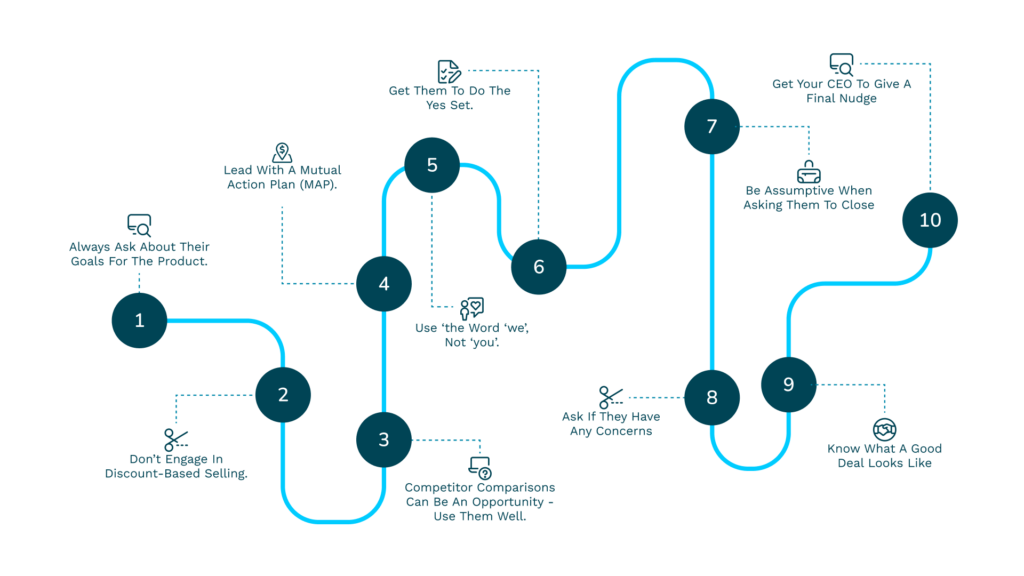
1. Lead with their goals, not your script
For senior buyers, the decision is close to binary: your product either meets a specific goal or it doesn’t. Consultative selling i.e. diagnosing the real problem before proposing anything remains the technique most aligned with what buyers actually want; multiple 2026 studies cite a strong majority of B2B buyers wanting sales reps to act primarily as advisors rather than pitchers.
To do this well:
- Look past the sales script and ICP data. Ask what the actual person in front of you is trying to accomplish this year.
- Use the language they use to describe the problem, not your own terminology.
- Ask specifically, and early: “What does success on this initiative actually look like for you?”
2. Don't lead with a discount
Asking about goals is also how you qualify a deal. A buyer with a clear, time-bound initiative and no objective evaluation criteria yet is a very different conversation than one already comparing vendors on price. If a buyer pushes for a discount before you’ve established value, start from a position of value, not concession. And never offer a discount before it’s asked for.
Buyers in 2026 are broadly more cautious with spend than in prior years. A rep who leads with price signals that price is the only thing worth discussing.
3. Use competitor comparisons as an opening, not a threat
Buyers increasingly already know a competitor’s weaknesses before they talk to you. Independent research (reviews, analyst coverage, peer communities) surfaces vendor gaps that used to only come out in a sales conversation. Assume that, rather than trying to extract it.
Ask directly: “On a scale of 1 to 10, how well is [current tool] actually working for you?” Listen for where the gap is, then ask what would need to be true for it to be a 10. Use their own words to describe the gap, and confirm understanding before moving on. The goal is accuracy, not a gotcha.
4. Lead with a mutual action plan, sized to the real buying committee
A mutual action plan maps out who needs to do what to close the deal, with dates attached. This matters more now than it did a few years ago, since the buying committee it needs to account for has grown. A MAP built for a single buyer doesn’t hold up against a committee that size.
Cover three things explicitly: the realistic timeframe to close, what it costs both sides (due diligence, procurement, compliance), and who’s actually involved on each side. Send a written summary after the conversation and ask them to confirm it. That alone tells you a lot about how seriously the deal is being treated internally.
5. Use "we," not "you," when the stakes are shared
A small technique, but a real one: replacing “you” with “we” when describing a shared goal (“we’re both trying to hit this timeline”) does more to build genuine partnership than most rapport scripts. It only works if it’s true. Use it when you’re actually aligned on an outcome, not as a rhetorical trick layered on top of a pitch.
6. Run a premortem before you ask for the close
Before pushing a deal to the next stage, assume it’s six months from now and it falls apart. Work backward from there. Why did it fail? Did the champion lose internal support? Did budget get reallocated in Q3? Did a new stakeholder join and froze the decision?
This technique, borrowed from research psychology and increasingly cited in latest sales research, surfaces risks of a straightforward “any concerns?” question often misses, because it forces specificity instead of a polite “no, we’re good.”
7. Make the close easy, but only once the signals say it's earned
An assumptive close (“Would you prefer to start on the Starter or Enterprise plan?”) still works, but it only works when the buying signals actually support it. Real engagement across the buying committee, a completed MAP, and a validated economic buyer. Used before that’s true, it reads as exactly the kind of scripted pressure buyers now actively screen for.
The difference between an assumptive close that lands and one that backfires is almost entirely about timing, and timing is a data problem more than an instinct problem. Which is where the technique breaks down for teams working off gut feel instead of real engagement data.
8. Ask directly what's still unresolved
By this point in a well-run process, both sides should be clear on what’s expected. There are usually still loose ends. Summarize the plan and ask directly what’s still unresolved in person or on a call, not over email, since tone and hesitation matter here more than the words themselves.
9. Know what a good deal looks like. And say so when it isn't one
Enjoyed our content? Follow Nektar on LinkedIn
Sometimes a prospect isn’t ready to buy, no matter how much time has gone into the deal. Acknowledging that plainly. “Based on what you’ve told me, I don’t think this is the right fit right now,” is one of the few techniques that reliably builds enough trust that a prospect argues the other side of the case themselves. It only works if it’s genuine. Used as a manufactured trick rather than an honest read of the deal, buyers who’ve already done extensive independent research tend to see through it quickly.
10. Bring in executive alignment on both sides
A customer may have second thoughts late in a deal, sometimes for reasons they don’t say out loud such as doubt that a rep has the authority to handle a specific ask, or a need for reassurance from someone more senior. An exec-to-exec conversation can resolve that in a way no amount of rep-level reassurance can.
This works best when it’s backed by actual visibility into who else is engaged on the buyer’s side like which executive has been in a call, or who’s gone quiet, rather than a generic “let’s get our CEOs talking” ask.
Closing technique is now a Data Problem, not just a skill
Every technique above works better with the same underlying input: knowing, accurately, what’s actually happening in the deal. Who’s engaged, who’s gone quiet, whether the buying committee is actually multithreaded, and whether the signals genuinely support asking for the close right now. That’s the gap between a rep working off memory and a rep working off real data, and it’s widened as buying committees have grown and buyer patience for guesswork has shrunk.
Nektar’s Revenue Telemetry automatically captures every email, meeting, call, and calendar event across a deal and structures it in Salesforce without any rep effort required. Daisy AI turns that into the specific signals several techniques above depend on: buying-committee coverage, engagement scoring, and deal-risk flags that tell a rep whether now is actually the right moment to ask for the close, instead of a guess dressed up as instinct.
Close With Real Signals, Not Guesswork
The techniques in this guide work best when they’re grounded in what’s actually happening in a deal, not what a rep assumes is happening. See how complete your own pipeline data actually is with a free CRM scan, or read 7 Elements of a Successful Deal Review for how to turn that data into a sharper read on every deal in your pipeline.