
7 Salesforce Data Enrichment Tools for 2026
- Salesforce
- 10 min
- Updated: July 30, 2026
What Is Data Enrichment?
Your ideal customer isn’t just a name and an address. They’re a full person with specific buying habits, a role, and a digital footprint that either fits your ICP or doesn’t. Raw Salesforce data often shows only a distorted or partial picture of that person and the buying committee around them, more like a dusty attic full of half-remembered details than a usable profile.
Your CRM is the backbone of business decisions, and skewed numbers make for skewed strategy. Data enrichment is what fills in the gap.
Data enrichment adds complete information to your existing leads and contacts: phone number, address, company size, industry, location, and more. A lead named “Adam Doe from Acme Ltd” isn’t useful until enrichment fills in what Acme actually does and who Adam actually is beyond an email address, at which point a rep can tailor a pitch to an actual person instead of a name in a form field.
Data enrichment happens in three ways:
- Direct: the lead provides complete information themselves, through a form or survey.
- Internal: you combine scattered information about the same lead across your own disconnected systems into one record.
- External: a third-party enrichment service appends information from outside sources you don’t otherwise have access to.
Enrichment itself relies on two underlying processes: data cleansing (removing obsolete, duplicated, or partial data so the dataset is accurate to begin with) and data appending (pulling data from multiple sources together into one unified profile).
Get our latest insights into your inbox

Why You Need a Salesforce Data Enrichment Tool
77% of organizations report struggling with data quality issues, and reps are already dealing with a growing buying committee to keep track of. Data enrichment makes both problems more manageable by giving reps as much accurate context about a lead as possible, rather than a name and a guess.
With the right enrichment in place, sales teams can:
- Work from better-quality data. Enrichment adds context and removes redundancy, which builds a more effective, less manually-maintained pipeline.
- Craft messages that actually land. Enrichment can surface real detail about a prospect’s interests and context, letting a rep tailor outreach that actually resonates instead of a generic template.
- Target the right people. A complete picture of a prospect’s company reveals who the real stakeholders are, letting reps invest effort in the buying committee that actually matters rather than guessing.
- Forecast with more confidence. Understanding a buying committee’s actual behavior, backed by real data instead of assumption, supports a more accurate read on which deals will really close.
Enrichment also strengthens internal data over time: connecting the dots across enriched records surfaces patterns that help spot churn risk before it becomes a lost renewal.
Our Top 7 Picks for Salesforce Data Enrichment
1. Nektar
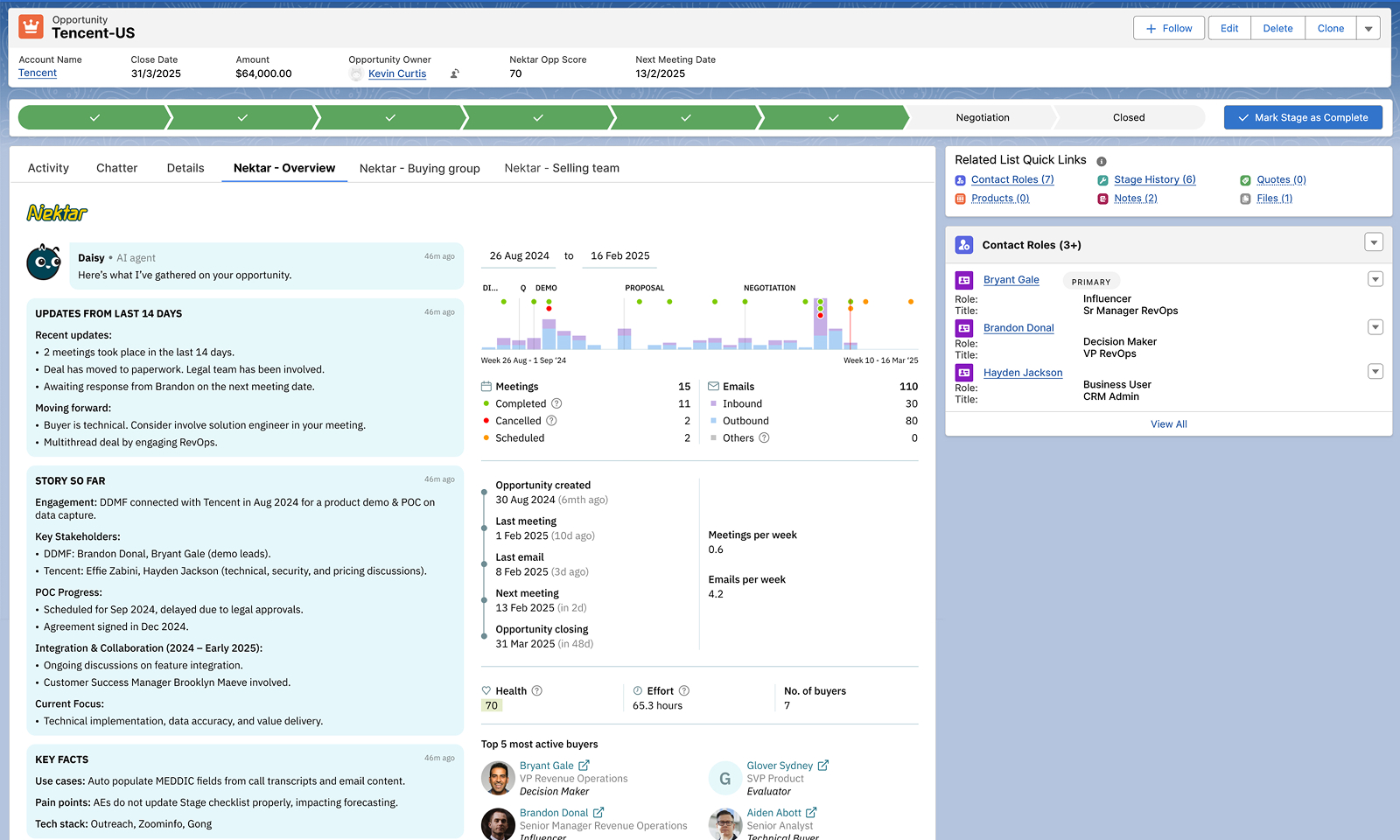
Nektar approaches enrichment differently than the other six tools on this list. Rather than appending third-party data purchased from an outside provider, it automatically captures first-party contact and activity data directly from email, calendar, and meetings, the actual record of what’s happening in your own relationship with an account, and structures it in Salesforce with zero rep effort required. That distinction matters: third-party enrichment tells you about a company in general; Nektar tells you what’s actually happening between your team and that specific account right now.
Key features:
- Automated contact and opportunity management. Contacts get added, edited, and linked to the correct opportunity automatically, so it’s clear who’s actually likely to make the decision, not just who happened to get manually entered.
- Time Travel retroactive correction. Historical records get corrected as new context arrives, rather than staying static from the moment they were first created, closing gaps a one-time enrichment pass can’t touch.
- Depth and breadth of activity data. Every email and meeting exchange between buyers and sellers across the customer journey gets captured, giving granular, contact-level engagement visibility across leads, opportunities, and accounts.
- Data automation via Daisy AI. Teams can define logic that produces quantitative output directly in Salesforce: engagement scores, auto-filled fields like Competitor or MEDDPICC criteria, or an automatic stage update (marking an opportunity closed-lost after three months of no engagement, for instance), meaningfully reducing manual CRM upkeep.
- Vendor-neutral integration, sitting alongside third-party enrichment tools like the ones below rather than replacing them.
Best for: Salesforce-first teams whose real gap is first-party activity data, what’s actually happening with an account, not just firmographic detail about the company itself.
2. ZoomInfo
ZoomInfo is the largest and most established firmographic database in this category, providing 360-degree intelligence on individuals and companies, firmographic data including company name, size, industry, and location, natively optimized for Salesforce and appending existing or new records automatically as they enter the CRM. Its scale is the core differentiator: for most B2B categories, ZoomInfo’s database coverage is deep enough that a rep rarely comes up empty on a target account.
Key features:
- Massive, continuously refreshed database covering millions of companies and contacts
- Deep data insights across both firmographics (size, industry, revenue) and technographics (what tech stack a company runs)
- Direct-dial and verified contact information for hard-to-reach decision-makers
- Native Salesforce integration with automatic record appending
- Intent data signaling when a company is actively researching a relevant category
Best for: Teams needing the broadest possible firmographic and technographic coverage, especially for finding and verifying contact information for senior decision-makers.
3. Clay
Clay has become one of the fastest-growing enrichment platforms in the category, built around waterfall enrichment: automatically querying dozens of underlying data providers in sequence until a field is actually filled, rather than relying on any single provider’s coverage gaps. Instead of buying one vendor’s fixed dataset, teams build their own enrichment logic, chaining together whichever combination of data sources and AI-driven research steps actually gets the field filled for their specific ICP.
Key features:
- Waterfall enrichment across dozens of underlying data sources for meaningfully higher match rates than any single provider
- Highly customizable, no-code workflow builder for designing your own enrichment logic
- Built-in AI agents that can research and qualify leads automatically as part of the enrichment workflow
- Integrates with existing sales and marketing tools and CRMs, including Salesforce
- Pay-per-enrichment credit model, so cost scales with actual usage rather than a flat database license
Best for: Teams wanting maximum enrichment coverage and willing to build custom workflows, rather than accepting one vendor’s fixed dataset and match rate.
4. Crunchbase
Aimed specifically at startups and the broader tech industry, Crunchbase provides a directory of company activity, funding history, organizational structure, and investment rounds, with additional insight into industry trends. Its differentiator relative to the firmographic databases above is depth on company-stage and funding signals specifically, useful for reps selling into venture-backed companies where a recent funding round is often the actual buying trigger.
Key features:
- Extensive company profiles including full funding history, recent news, and key personnel changes
- Free tier providing basic company information at no cost
- Paid plans unlocking deeper insight, advanced search filters, and API access
- Funding and investment-round alerts useful for timing outreach around a buying trigger
- Integrates with CRMs and marketing automation tools for streamlined enrichment workflows
Best for: Teams selling to startups and venture-backed companies, where funding stage and recent investment activity are meaningful buying signals.
5. LeadGenius
LeadGenius handles bulk data enrichment at scale, using customizable, targeted web crawlers to gather niche-specific data that broader databases often miss, standard demographics alongside less common fields like previous employer, career trajectory, or location history. It positions itself less as a self-serve database and more as a managed enrichment service, combining automated crawling with human-in-the-loop verification for harder-to-find data points.
Key features:
- Tailored, custom data collection built around a specific business niche rather than a generic dataset
- A/B-test-ready email outreach sequences for discovering and engaging new stakeholders
- Human-verified data quality layered on top of automated web crawling
- Advanced, precise lead prospecting at real volume for account-based programs
Best for: Teams with a specific, niche ICP that generic firmographic databases don’t cover well, and who are willing to trade self-serve speed for more precise, custom-gathered data.
6. Cognism
Cognism refreshes stale data (job changes, relocations, role changes) while maintaining technographic detail, with a Chrome extension that lets reps tap into its GDPR- and CCPA-compliant database while browsing LinkedIn or a company website. Its Intent Signals feature flags when a target account is showing real, measurable signs of being ready to purchase, letting reps prioritize outreach based on timing rather than a static account list.
Key features:
- Combines data enrichment with automation and multi-channel engagement in one platform
- Automated email outreach sequencing for lead nurturing
- Personalized social outreach recommendations for more targeted, less generic communication
- Strong compliance posture (GDPR, CCPA) built into the core database rather than bolted on
- Diamond Data verification for direct-dial phone numbers, reducing wasted call time
Best for: European and UK-based teams specifically, where compliance-first data sourcing is a genuine requirement rather than a nice-to-have, alongside intent-based prioritization.
7. ZoomInfo Operations (formerly RingLead)
RingLead doesn’t exist as an independent brand anymore. ZoomInfo acquired it in September 2021 and fully absorbed it into ZoomInfo Operations; the ringlead.com domain now redirects directly to ZoomInfo’s own product page. The underlying capability, deduplication, normalization, and lead-to-account matching, is unchanged in substance, just sold as a module within ZoomInfo’s broader platform rather than a standalone company. It’s a genuinely different product from ZoomInfo’s core contact database (#2 on this list), focused specifically on data quality and routing rather than firmographic lookup, and worth evaluating separately even though both now share a parent company.
Key features:
- Purpose-built for segmentation and automation of B2B contact data at scale
- Deduplication and lead-to-account matching to fix mismanaged or fragmented accounts
- Imports and reconciles data from LinkedIn to fill gaps in existing records automatically
- Call scripting and voicemail-dropping tools for phone-heavy outbound motions
- Configuration and rule-based matching logic inherited directly from the original RingLead product
Best for: Teams already standardized on ZoomInfo’s broader platform who want data quality and lead routing bundled with the same vendor relationship, rather than a separate point solution.
Best Practices for Data Enrichment
Define your data goals clearly. Before choosing a tool, identify exactly what’s missing, demographic detail, firmographic data, or more precise technographics. Knowing what “good enough” looks like, and why it matters for your specific business, should guide the tool choice, not the other way around.
Clean before you enrich. Enriching on top of duplicated or inaccurate data just produces confidently wrong output at scale. Search out duplicates and erroneous entries and eliminate them before layering enrichment on top.
Build a real data governance plan. Enrichment brings in large amounts of new information, which makes access controls and clear ownership genuinely important. Review enriched data regularly to keep it accurate and relevant rather than letting it silently decay.
Automate rather than manage manually. Tools that combine enrichment with automation (lead scoring, data augmentation) free up time that would otherwise go into manual upkeep, letting reps focus on actually winning deals.
Enrichment Matters More Now That AI Agents Are Acting on It
Enriched data used to mainly serve a rep deciding how to approach a lead. Increasingly, that same enriched data feeds AI agents, lead-scoring models, outreach sequencers, qualification bots, that act on it directly. An enrichment gap that used to just leave a rep guessing at a title now risks an agent making a wrong call at scale: prioritizing the wrong account, personalizing a message based on outdated firmographic data, or scoring a lead incorrectly because the underlying record was never actually enriched in the first place. Getting enrichment right, and keeping first-party activity data flowing in continuously rather than relying on a one-time third-party append, matters more now than when this list was first published.
Frequently Asked Questions
Q. What’s the difference between data enrichment and data cleansing?
Data cleansing removes inaccurate, duplicate, or outdated information from a dataset. Data enrichment adds new, missing information to records that are already reasonably accurate. Most enrichment strategies do both: clean first, then enrich, since enriching dirty data just produces confidently wrong results at scale.
Q. Should I enrich with third-party data or capture first-party data instead?
Ideally both, for different reasons. Third-party enrichment (firmographic and technographic detail) tells you about a company and its market position. First-party activity capture (emails, meetings, calls) tells you what’s actually happening in your specific relationship with that account, and it’s the data most CRMs are missing the most of.
Enrich Your CRM With Data You Actually Own
Third-party enrichment tells you about a company. First-party activity data tells you what’s actually happening in your relationship with it, and most CRMs are missing far more of the second kind than the first.
Get a free CRM scan to see how much of your own buyer-seller activity is currently going uncaptured, or explore Nektar’s Data Foundation to see how first-party capture and third-party enrichment work best together.
Enjoyed our content? Follow Nektar on LinkedIn