
Top Relationship Intelligence Tools for 2026
- RevOps
- 12 min
- Updated: July 14, 2026
Gartner puts the average B2B buying group at 6 to 10 stakeholders, most of whom a rep will never speak to directly. Forrester’s research on self-serve buying shows a growing share of that group would rather research on their own than sit through a sales conversation.
These new realities mean that reps get less face time with more people who all have a vote. CRMs were supposed to solve this. In practice, they’ve solved storage, not visibility.
Salesforce only sees what a rep manually logs, and reps log a fraction of what actually happens in a deal. Most estimates put manually-captured activity at 20-30% of the real picture. The other 70-80% (the champion who went quiet, the executive who joined one call and never came back, the procurement contact nobody added to the opportunity) stays invisible until it costs you the deal.
Relationship intelligence closes that gap. It automatically captures every meeting, email, and call tied to an account, structures it, and turns it into a map of who’s actually involved and how engaged they are, instead of asking reps to remember to write it down.
Get our latest insights into your inbox
The AI Shift: Why Relationship Intelligence Is No Longer Optional
For most of CRM history, bad data was a hygiene problem. A rep mis-logged a meeting, a manager caught it in a pipeline review, someone fixed it. Humans sat between bad data and bad decisions.
That buffer is disappearing. Salesforce and every major CRM vendor spent 2025 and early 2026 shipping AI agents that read CRM data and act on it directly. Tasks like updating opportunity stages, drafting follow-ups, reprioritizing pipeline,or flagging churn risk, without a person checking the work first. Gartner projects that 40% of enterprise applications will include task-specific AI agents by the end of 2026, up from under 5% just a year earlier.
That’s a real shift in what “clean data” is for. When a human interprets a messy CRM, they apply judgment and usually catch the obvious errors. When an agent acts on that same CRM autonomously, it doesn’t pause to sanity-check. It executes. A wrong contact role, a missing stakeholder, an activity logged against the wrong opportunity: these used to produce a bad report. Now they can produce a wrong decision, at machine speed, with nobody in the loop to catch it.
The industry’s own numbers show how far the data foundation lags the AI ambition. 76% of organizations report that less than half their CRM data is accurate and complete, and 45% say their CRM data isn’t prepared for AI use at all. This is happening despite 92% of leaders calling data strategy critical to AI success. That’s the gap relationship intelligence tools now have to close: not just “give reps better visibility,” but “make the CRM trustworthy enough for an agent to act on unsupervised.”
It also changed what these tools need to do. Three years ago, “relationship intelligence” mostly meant a dashboard: here’s who’s engaged, here’s who’s gone quiet. In 2026, the category is splitting between tools that still stop at surfacing insight and tools that structure data well enough to feed the agents now running on top of it like Agentforce, Copilot, a custom LLM pipeline, whatever your stack runs. The tools built only for human dashboards are starting to look thin next to the ones built to be a trustworthy data layer underneath autonomous execution.
What Is a Relationship Intelligence Tool?

A relationship intelligence tool automatically captures interaction data like emails, calendar invites, meetings, and calls across every stakeholder tied to an account. It then structures it into a usable picture: who’s involved, how engaged they are, and where the relationship is trending. It replaces the manual, incomplete version of this that lives in a rep’s memory (or doesn’t) with a system that captures it whether or not anyone remembers to log it.
The best platforms do three things reasonably well:
- Capture passively. No rep has to open a new tab or fill in a field for the data to exist.
- Structure it against the CRM. Raw activity is useless until it’s mapped to the right contact, opportunity, and role.
- Surface it as a decision, not just data. A list of emails isn’t insightful. “Your economic buyer hasn’t been on a call in 34 days” is.
In 2026, add a fourth: hold up as a source an AI agent can act on. If the data underneath your relationship map is wrong, every downstream agent, be it CRM-native or third-party inherits that error.
Why a relationship intelligence tool matters
1. It shows you the whole buying committee, not the one or two contacts a rep happened to add
Most opportunities in Salesforce list one or two contacts. The real buying group is usually 6 to 10. That gap is where deals quietly stall. A champion changes roles, a new VP joins a call and never gets a follow-up, and nobody notices until the deal is already cold. Relationship intelligence tools auto-detect new stakeholders from actual email and calendar activity and map them to the opportunity, so multithreading stops depending on a rep’s memory.
2. It tells you which relationships are actually strong, not which ones look strong on paper
Meeting count isn’t engagement. A relationship intelligence platform weighs recency, frequency, and who’s actually responding, so you can tell the difference between a champion who’s still driving the deal and one who’s gone quiet.
3. It recovers deals you already wrote off
Not every lead converts, and pipeline math means most won’t. But “lost” and “dead” aren’t the same thing. Relationship intelligence tools retain historical engagement data even for closed-lost opportunities, so when a prospect’s priorities shift six months later, you can see who was engaged and pick the relationship back up instead of starting cold.
4. It’s the data layer your AI initiatives are quietly depending on
This is the part that’s new. If your team is investing in Agentforce, Copilot, or any AI system that touches CRM data, that system’s output is only as reliable as the data underneath it. Relationship intelligence is what makes that data complete enough to trust.
Top 10 Relationship Intelligence Tools for 2026
This year’s list is tightened to platforms that actually do relationship intelligence: automated capture, stakeholder mapping, and engagement scoring, ranked by where each one is strongest.
1. Nektar
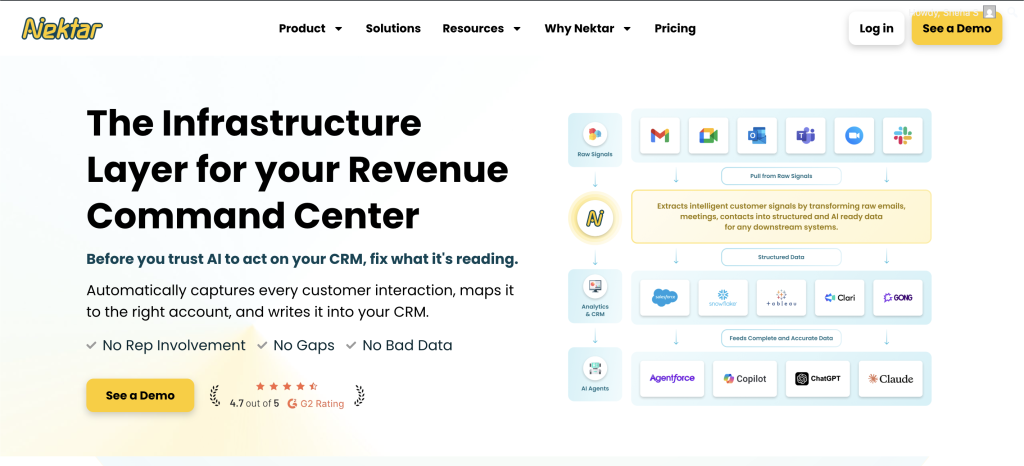
Nektar makes Salesforce safe for AI execution. As more of your GTM stack, be it Agentforce, Clari, your own AI agents, starts acting on CRM data autonomously, the CRM has to be complete and correct, continuously, or every agent built on top of it inherits the error.
Nektar is the GTM telemetry platform that automatically captures every customer interaction and delivers clean data to your CRM, data warehouse, and AI applications, all with zero manual entry or adoption friction.
Nektar flows this valuable data directly into core business systems like Salesforce, Snowflake, Claude and your entire stack, ensuring customer insights are accessible across all GTM teams & downstream AI initiatives.
Nektar does this in two layers.
Data Foundation is the capture layer. It automatically pulls in every email, meeting, call, and calendar event across your team regardless of what tool a rep actually uses. It then writes it natively into Salesforce with a proprietary matching engine built to avoid the false positives and duplicate contacts that plague simpler capture tools.
Daisy AI is the intelligence layer sitting on that foundation. It reads the captured activity and transcripts and surfaces a library of 39 revenue signals across eight categories: buyer visibility, deal velocity, deal predictability, marketing impact, exec engagement, rep performance, churn risk, and presales ROI.
Because Nektar is vendor-neutral, it sits alongside Gong, Outreach, or Salesloft rather than replacing them. Its job is making sure the CRM data those tools (and any AI agent) depend on is actually complete.
In production: Mimecast used Nektar’s telemetry to identify $80M in pipeline and $2M in incremental expansion revenue within 80 days.
Best for: Salesforce-first revenue teams running a multi-threaded enterprise motion who need the underlying CRM data trustworthy enough for both human reps and AI agents to act on it.
2. Affinity
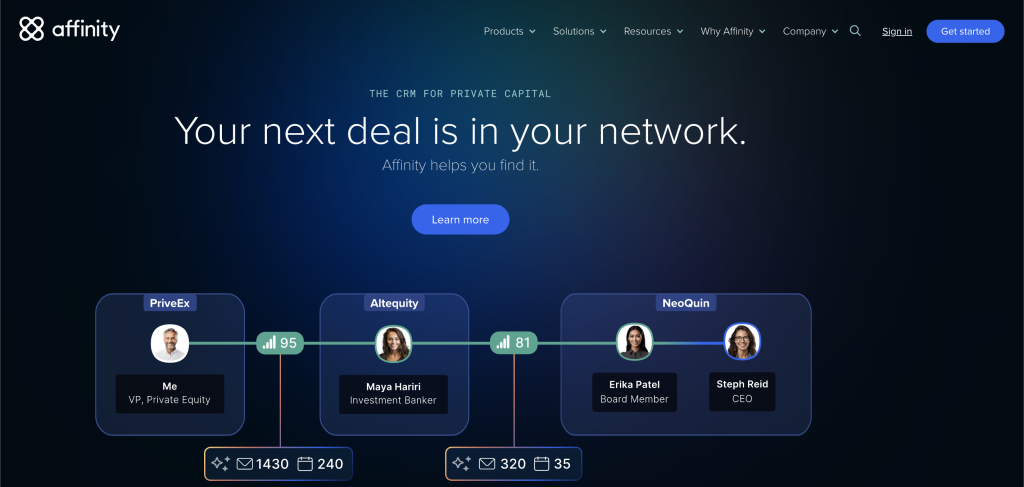
Affinity is the category standard for venture capital, private equity, and other relationship-driven investment firms. It’s a full CRM built around automatic relationship capture: email and calendar data feed a network graph that surfaces warm introduction paths across a firm’s collective contacts. Its AI features (auto-generated meeting notes, relationship scoring) have matured steadily, but its core value is still finding who at your firm already knows someone at a target company.
Best for: Deal-flow-driven firms where “who knows who” is the whole advantage, not built for a traditional pipeline-management sales motion.
3. Introhive
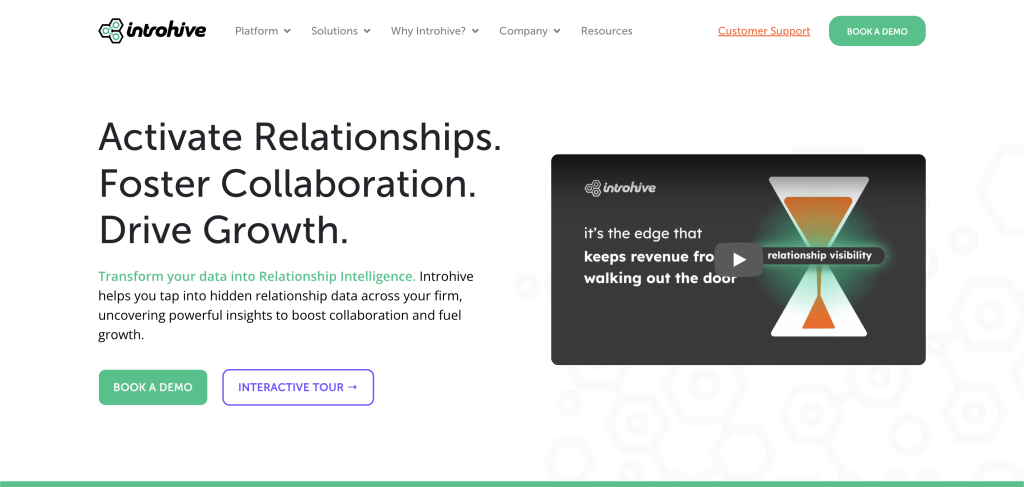
Introhive is the enterprise incumbent in relationship intelligence for professional services like law, accounting, and consulting firms running cross-practice referral models. It layers on top of an existing CRM (typically Salesforce or Dynamics) rather than replacing it, automatically capturing email and meeting data and scoring relationship strength. In 2026 it added an MCP Server so firms can query relationship data directly through Copilot and other AI assistants: a signal that even the professional-services corner of this category is being rebuilt around agent access, not just dashboards.
Best for: Large partner-driven firms with a referral motion and a CRM hygiene problem; expensive and slow to implement relative to newer entrants.
4. Revenue Grid
Revenue Grid is a Salesforce-native activity capture and guided-selling platform that layers relationship health scoring on top of automatic email and calendar sync. It’s built to shift Salesforce from a system reps check into one that tells reps what to do next, with relationship intelligence as one piece of a broader revenue-operations suite.
Best for: Teams that want activity capture and relationship signals bundled with guided-selling and forecasting features in one Salesforce-native product.
5. LinkedIn Sales Navigator
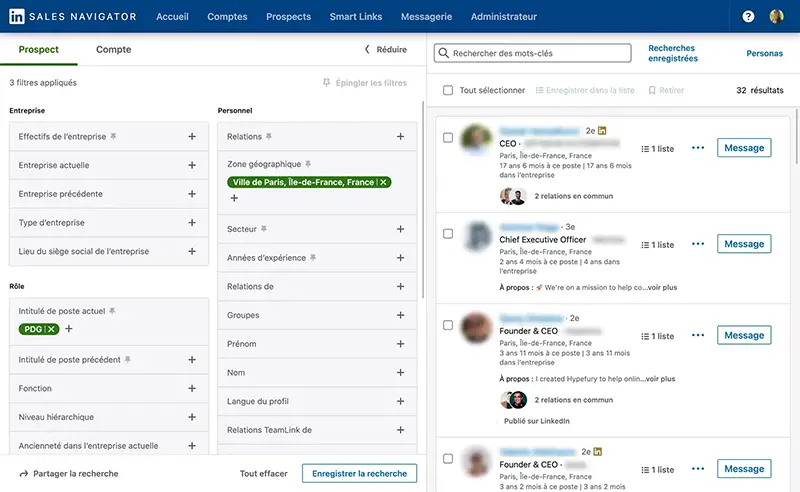
LinkedIn Sales Navigator maps social and professional relationships at a scale no CRM-native tool can: mutual connections, job changes, and org charts sourced from LinkedIn’s own graph. It’s the best source for external relationship signals; it has no visibility into your team’s actual email and meeting activity, which is why most enterprise teams pair it with a CRM-native tool rather than use it alone.
Best for: Prospecting and warm-path discovery outside your own CRM data — a complement to relationship intelligence, not a replacement.
6. Bigtincan
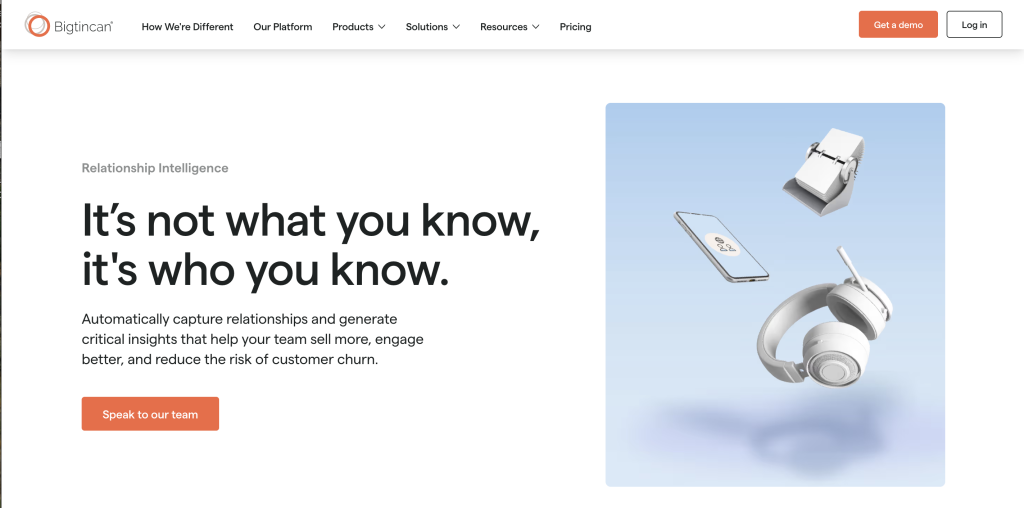
TrustSphere’s organizational-network-analysis technology of scoring relationship strength across a company’s inbound and outbound email based on frequency, volume, and recency, is now sold as Relationship Intelligence by Bigtincan. It’s less about individual deal coverage and more about understanding communication patterns across a whole org, bundled as part of Bigtincan’s broader sales enablement platform rather than sold as a standalone product.
Best for: Large enterprises that want organization-wide network analysis rather than deal-by-deal stakeholder mapping.
7. Vasco
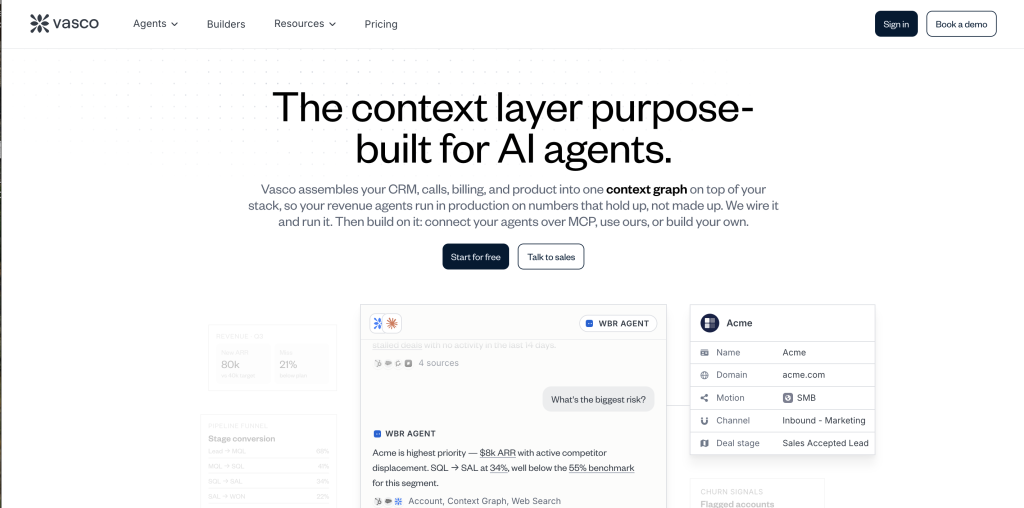
Vasco is a newer entrant building a semantic layer in the form of a “Context Graph” on top of existing CRM, billing, and call data, designed to make AI queries against your revenue data accurate rather than approximate. It doesn’t capture new data itself; it structures what’s already in your stack so tools like Claude or Gemini can query it reliably.
Best for: Teams that already have reasonably complete CRM data and want a queryable semantic layer on top of it. Works best paired with a capture tool if the underlying CRM data has gaps.
8. Day AI
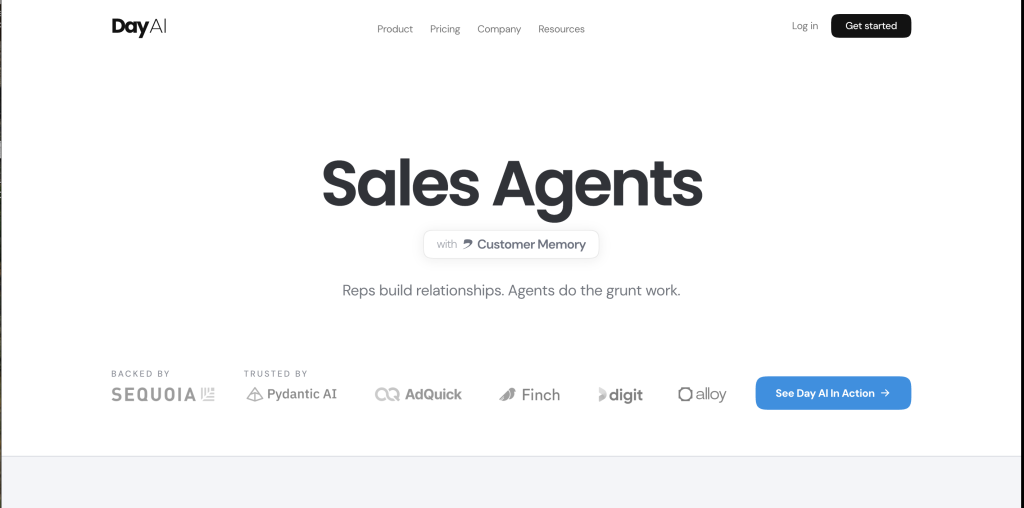
Day AI positions itself as a memory layer for GTM teams. It ingests email, calls, Slack, and Gong transcripts into a unified context store that AI agents can draw on. It’s the closest architectural overlap to Nektar’s thesis, built with a lighter-weight, startup-first approach rather than enterprise-scale data governance.
Best for: Smaller, fast-moving GTM teams that want an AI memory layer without an enterprise-grade rollout.
Relationship Intelligence Tools Compared
Frequently Asked Questions
Q.What is the difference between relationship intelligence and a CRM?
A CRM stores contact and deal data that a rep enters manually. Relationship intelligence automatically captures interaction data like emails, meetings, and calls, and structures it against the CRM without requiring rep input, closing the gap between what actually happened in a deal and what got logged.
Q. Do relationship intelligence tools work with Gong, Outreach, or Salesloft?
Yes, in most cases. Tools like Nektar are built to be vendor-neutral and sit alongside conversation intelligence and sales engagement platforms rather than replace them. Nektar specifically captures email and calendar activity that call-focused tools like Gong don’t see.
Q. Why does relationship intelligence matter for AI agents, not just sales reps?
Because AI agents that act on CRM data (updating stages, flagging risk, drafting outreach) inherit whatever errors exist in that data, with no human checking the work before it executes. Relationship intelligence tools are what make CRM data complete and accurate enough for that automation to be trustworthy.
Q. How long does it take to implement a relationship intelligence tool?
It varies widely by vendor. Enterprise professional-services platforms like Introhive typically take 6-16 weeks. CRM-native capture platforms like Nektar are built to go live in under two weeks with no rep-facing rollout required.
Q. Is Nektar a CRM replacement?
No. Nektar writes structured data directly into your existing CRM rather than replacing it. Your team keeps its existing system of record while the underlying data becomes complete and self-healing.
The Bottom Line
Relationship intelligence started as a way to give reps visibility they didn’t have. In 2026, it’s also infrastructure: the layer that determines whether the AI agents now running on your CRM are working from a complete picture or a partial one. Nektar is built for that second job: automatic capture, self-healing accuracy, and an intelligence layer your reps and your AI stack can both act on.
Enjoyed our content? Follow Nektar on LinkedIn