Nektar vs. Clari vs. Gong vs. Backstory (People.ai) vs. EAC
- Product
- 15 min
- Updated: July 29, 2026
Automated data capture stopped being a nice-to-have for revenue teams years ago. In 2026, it’s become something closer to infrastructure: the layer that determines whether an AI agent acting on your CRM is working from a complete picture or a partial one. This comparison covers five platforms that all promise some version of automated capture, AI-driven insight, and cleaner CRM data, Nektar, Clari, Gong, Backstory (formerly People.ai), and Salesforce’s own Einstein Activity Capture, and where each one actually delivers versus where the marketing outruns the product.
Two of these five have changed meaningfully since this comparison was last written, and getting that history right matters if you’re evaluating them today: People.ai rebranded to Backstory in April 2026, and Clari merged with Salesloft in December 2025. Both are covered accurately below, not under their old, standalone identities.
Get our latest insights into your inbox
Nektar
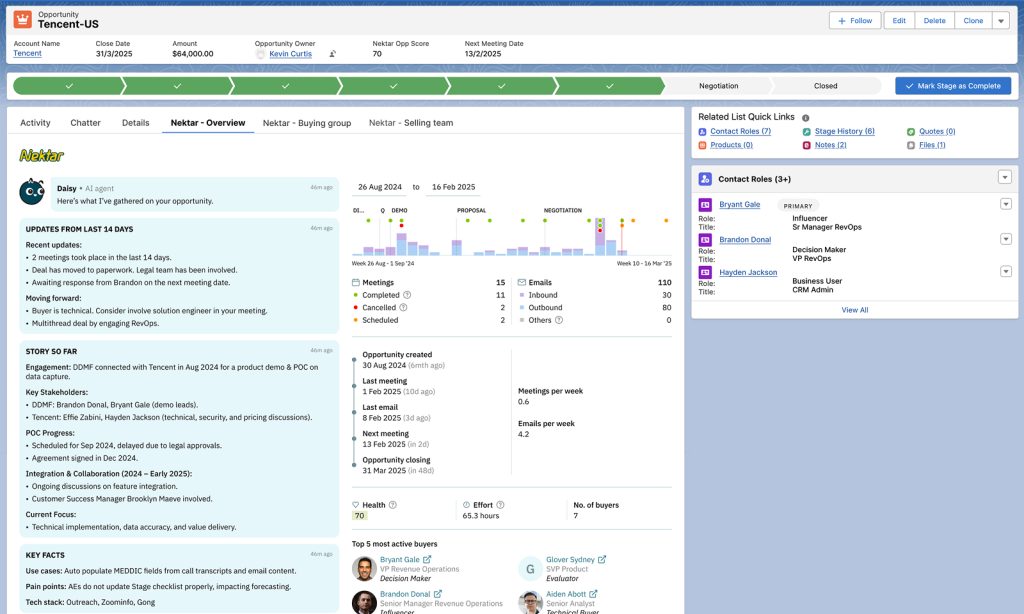
Nektar was founded in 2020 with a vision to help GTM teams close revenue leaks with a purpose-built AI data foundation that unifies accurate, clean, timely revenue data automatically, at scale. That thesis has sharpened since: Nektar’s current positioning is making Salesforce data trustworthy enough for both reps and AI agents to act on directly, not just clean enough for a human to read.
Claim to Fame
Nektar’s Data Foundation automatically syncs contacts, emails, and calendar meetings from sales communication into Salesforce, for ongoing activity and historical GTM activity alike, with zero rep effort required.
Time Travel goes further, retroactively correcting historical records as new context arrives, something none of the other four platforms in this comparison do. Daisy AI sits on top, surfacing 39 signals across deal risk, buyer engagement, and rep performance directly on the Salesforce Opportunity tab. It supports every customer-facing team, business development, sales, customer success, and account management, which is why revenue operations leaders specifically choose Nektar for a genuine 360-degree view of the customer, not just a sales-only slice of it.
Pros:
- Captures historical and ongoing contacts and GTM activity to deliver genuinely complete CRM data, not a partial sync
- Automatically presents the buying committee in every deal by enriching contacts with job titles and buyer roles (influencer, decision maker, economic buyer)
- Automatically links captured contacts to relevant open opportunities as Opportunity Contact Roles, not just Account-level records
- Classifies activity by sales or CS process automatically, surfacing exactly how sellers and CSMs are actually spending their time
- Captures calendar events including recurring events and any updates made to them (participant or schedule changes)
- Always-on reporting delivered directly to Slack, email, or MS Teams, the power of a dashboard without requiring anyone to open one
- Time Travel™ continuously maintains CRM data, updating and correcting records as new context arrives rather than leaving them static
- Works for every customer-facing team, not sales alone, including partnership, channel, and alliance teams
- Vendor-neutral by design, sits alongside Gong, Clari, or Salesloft rather than replacing them
Cons:
- Best suited for companies with 10+ sellers; smaller teams may not need the full depth of the platform
- As a more specialized data-foundation layer rather than an all-in-one suite, teams wanting conversation intelligence or forecasting UI natively often pair Nektar with a complementary tool rather than expecting Nektar to do everything
Clari (Now Clari + Salesloft)
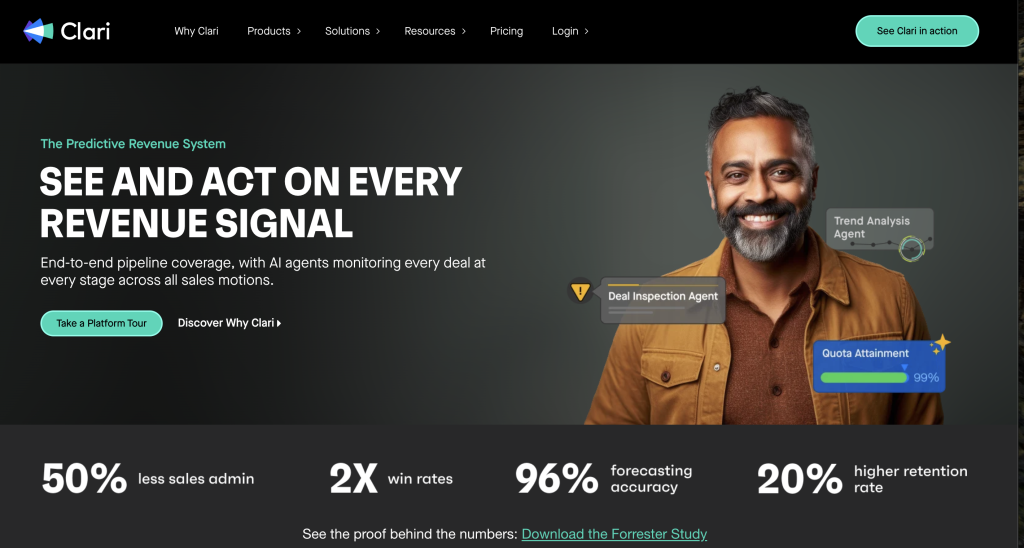
Founded in 2012, Clari built its reputation on AI-driven forecasting and predictive analytics for sales teams. In December 2025, Clari merged with Salesloft, forming a combined revenue-orchestration company under CEO Steve Cox, adding Salesloft’s sales-engagement layer (and Clari’s earlier Groove acquisition) to Clari’s forecasting core. If you’re evaluating “Clari” today, you’re really evaluating this combined platform, not the standalone forecasting tool it used to be.
Claim to Fame
Clari is still best known and most appreciated for its forecasting capabilities specifically, funnel views, pipeline inspection, and forecast rollups that sales leadership teams lean on heavily. Post-merger, it’s positioning itself as a full revenue-orchestration platform spanning forecasting, engagement, and conversation intelligence in one place, which is a meaningfully bigger promise than the pre-merger product made.
Pros:
- Clean visuals and UI, widely regarded as one of the more polished interfaces in this category
- Customizable dashboards and a genuinely useful “funnel view” of the pipeline
- Strong visibility into current and projected pipeline for forecast rollups
- The Salesloft merger adds sales engagement and cadence automation natively, reducing the need for a separate tool for that function
- Conversation intelligence (via the earlier Chorus.ai and Wingman lineage) now bundled in, easier to consolidate vendors if you want one platform for forecasting, engagement, and calls
Cons:
- Several contacts still aren’t reliably captured in Salesforce; contact-level completeness has been a longstanding weak point independent of the merger
- Syncing activity into Salesforce Opportunities isn’t always accurate
- Salesforce sync issues persist as a recurring theme in user feedback
- User adoption remains a real risk, and requires ongoing enablement investment to sustain
- The merger itself introduces real integration risk in the near term; analysts including Forrester have flagged genuine product overlap between the combined pieces that’s still being worked through as of mid-2026, worth a direct conversation with the vendor about current integration maturity before committing
Comparing Nektar & Clari?
Gong
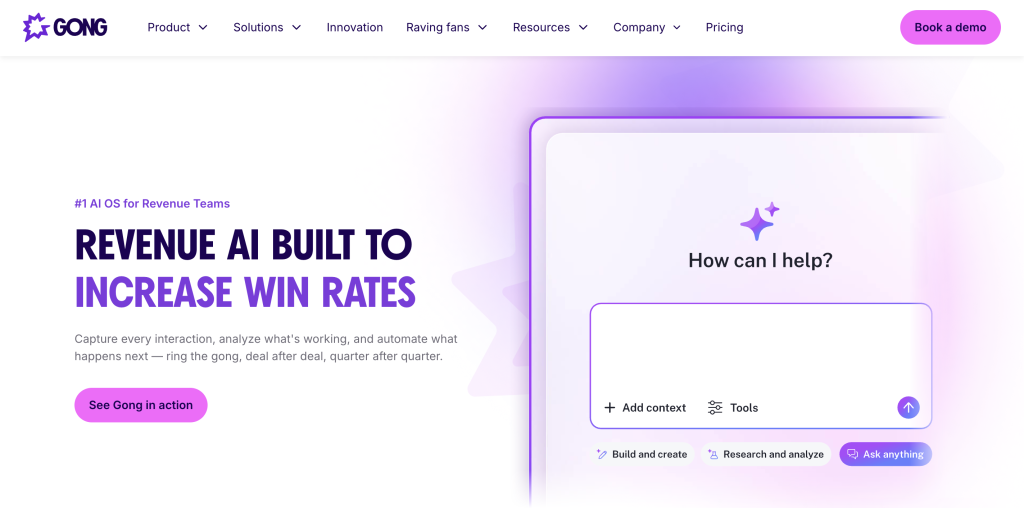
Founded in 2015, Gong built the conversation-intelligence category, using AI to analyze customer calls and meetings and surface coaching and deal-risk insight from what was actually said. It remains a large, well-resourced, independent company (no merger or rebrand to report here) and has continued investing in AI-native forecasting and coaching since this comparison was last written.
Claim to Fame
Gong is still best known for helping sales leaders coach reps and ramp new hires faster through conversation intelligence, accuracy and depth of insight from actual call and meeting content remain genuinely best-in-class. What started as a sales-team tool has expanded into real usage among customer success and SDR/BDR teams as well, given its focus on conversation-based engagement broadly.
Pros:
- Ramps new sellers faster and coaches existing reps more specifically, grounded in what actually happened on a call
- Useful across every customer-facing team given its conversation-intelligence focus, not sales alone
- Keyword and topic alerts when specific language comes up in sales calls
- Extensive integrations and genuinely deep insight into conversation-based engagement
- Continued AI investment in forecasting and coaching features since 2025
Cons:
- Conversation intelligence remains the primary widely-used feature, which raises real “value for money” questions if a team isn’t fully using the broader platform
- Data captured in Salesforce is removed when Gong is uninstalled, a real lock-in and continuity risk worth planning around
- Data enrichment requires building custom Salesforce Flows; it isn’t handled natively by Gong itself
- Operationalizing Gong’s data inside Salesforce is genuinely difficult, given an isolated, sometimes confusing data model
- Full-platform adoption requires substantial training investment, it isn’t a light lift
Comparing Nektar & Gong?
Backstory (Formerly People.ai)
People.ai was founded in 2016 to automate sales and marketing activity capture and analysis. In April 2026, People.ai rebranded to Backstory, repositioning itself as a “Revenue Answers Platform” with a conversational AI layer on top of its existing activity-capture technology. Same underlying company and core capability, meaningfully different pitch.
Claim to Fame
The original People.ai product built its reputation on account planning and playbook enablement, popular with sales teams and, notably, with marketing teams running ABM programs, since its contact capture was historically stronger than some other heavyweights in this category. Since the Backstory rebrand, the pitch has shifted toward natural-language querying: asking a conversational interface about deal or account health rather than navigating a dashboard.
Pros:
- Monitors playbook adoption and compliance across a sales team
- Captures contacts, emails, and meetings across linear sales communication
- Historically solid insight into buying-committee members relative to some competitors
- Easy-to-use interface for sellers updating CRM records
- The new conversational layer (post-rebrand) offers a genuinely different, more accessible interface for asking deal-health questions in plain language
Cons:
- Data capture remains less extensive and less accurate than category leaders, a limitation the rebrand’s conversational layer doesn’t fix, since it’s only as good as the underlying captured data
- Engagement insights are less granular than competitors offering deeper signal libraries
- Limited flexibility; customization typically requires vendor support rather than self-service configuration
- Data privacy posture has historically been a point of concern given its operating model
- Interface (outside the new conversational layer) still requires continuous training and enablement
- Support responsiveness has been a recurring complaint
- The rebrand itself is recent enough that positioning and roadmap may still be settling; worth a direct conversation with the vendor about what’s genuinely new versus repackaged
Comparing Nektar & Backstory (People.ai)?
Einstein Activity Capture (EAC)
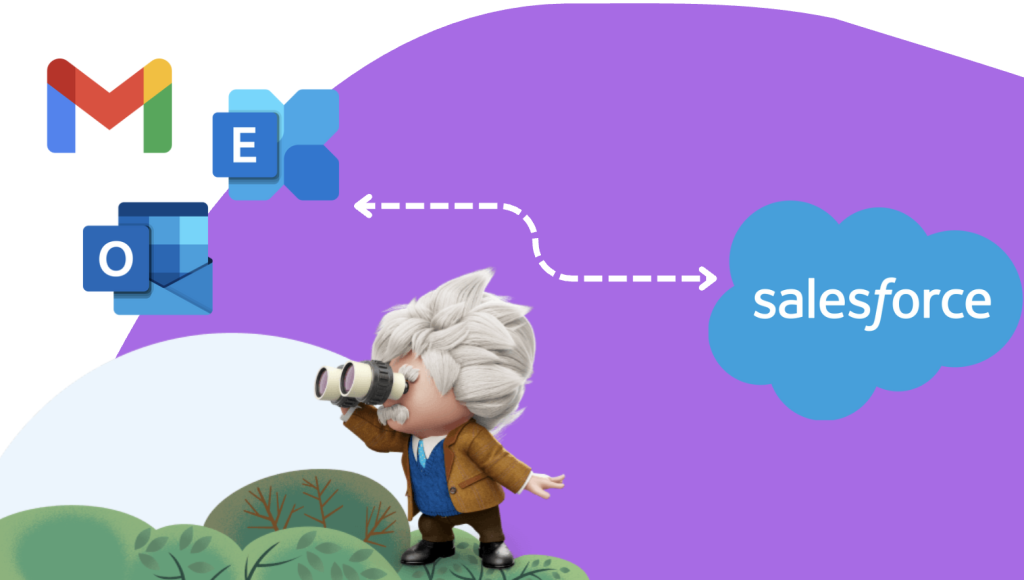
Einstein Activity Capture is a native Salesforce feature, not a standalone company, introduced to automatically capture and log customer interactions, emails, and calendar events as part of Salesforce’s broader Einstein AI suite. It remains unchanged in its core architecture and limitations as of 2026.
Claim to Fame
EAC is a more complete solution than plain Salesforce Inbox, since it captures calendar events alongside emails, and it became popular largely on price: as a Salesforce add-on, it’s historically been more affordable than third-party alternatives. Given its native proximity to Sales Cloud, it remains most popular specifically among sales teams rather than the broader customer-facing org.
Pros:
- Native access to the Activities Dashboard and Activity Metrics inside Salesforce
- Send emails directly from within Salesforce
- Inbound and outbound emails auto-captured and displayed directly in the activity timeline
Cons:
- Captured data is stored on AWS infrastructure, not natively inside Salesforce itself
- A maximum of 6 months of captured activity history is retained
- Activity data isn’t reportable through standard Salesforce reports, a real limitation for anyone wanting to build custom analytics on top of it
- Limited customization options for what gets captured and how
- Captured data isn’t fully owned by you in the way natively-stored Salesforce data is
- Captured data is lost entirely if you switch away from EAC, a genuine migration risk worth planning for
Comparing Nektar & EAC?
How Agentic AI Changes What Actually Matters Here
Every platform in this comparison markets itself around “AI-driven insight.” What’s changed since this page was first written is what that AI is now doing with the data underneath it. Salesforce’s own April 2026 Headless 360 initiative made every core Salesforce capability available as an API or MCP tool specifically so agents, Agentforce or otherwise, can read, write, and execute workflows without a human reviewing every change first.
That shifts the evaluation criteria for all five tools in this comparison. A platform that captures data into its own separate system and syncs it back to Salesforce imperfectly (the recurring “Salesforce sync issues” theme across Clari, Gong, and Backstory above) isn’t just producing a slightly-off dashboard anymore. It’s producing the exact input an AI agent might act on directly, with no person catching the gap before it becomes an automated action. This is precisely why Nektar’s approach, writing data natively into Salesforce as the system of record, with continuous self-healing correction via Time Travel™, matters more in 2026 than it did when “clean data” was mainly a reporting-quality concern.
Full Comparison Table
|
|
Nektar
|
Clari + Salesloft
|
Gong
|
Backstory (People.ai)
|
Einstein Activity Capture
|
|---|---|---|---|---|---|
|
Core Focus
|
Data foundation + AI signals
|
Forecasting + engagement
|
Conversation intelligence
|
Activity capture + conversational AI
|
Native Salesforce activity capture
|
|
Contact-level capture
|
Yes, enriched with buyer roles
|
Weak, contacts often missed
|
Not a core focus
|
Historically stronger, still limited
|
Emails and events only, no contact enrichment
|
|
Data stored natively in Salesforce
|
Yes
|
Partial, sync issues reported
|
No, removed if uninstalled
|
Partial
|
No, stored on AWS
|
|
Historical data correction
|
Yes (Time Travel™)
|
No
|
No
|
No
|
No, 6-month retention cap
|
|
Opportunity-level sync
|
Yes
|
Account-level primarily
|
Limited
|
Account-level primarily
|
Limited
|
|
Works across all customer-facing teams
|
Yes
|
Primarily sales
|
Sales, CS, SDR
|
Primarily sales, some marketing/ABM
|
Primarily sales
|
|
Data ownership if tool is removed
|
Fully retained (native Salesforce)
|
Partial
|
Lost
|
Partial
|
Lost
|
|
Recent structural change
|
None
|
Merged with Salesloft, Dec 2025
|
None
|
Rebranded from People.ai, Apr 2026
|
None
|
Things to Consider Before Investing
The sales tech landscape is vast and complicated, and almost every tool here overlaps meaningfully with another, sometimes without even being in the same nominal category.
1. Depth and Breadth of Data Capture
For any revenue operations and intelligence tool, data is the foundational element. These tools exist to provide meaningful visibility through relevant insights, and if the input data is poor, the insight built on top of it is poor too. Garbage in, garbage out, still applies, and applies more sharply once an AI agent is the one acting on the output.
A few specific dimensions worth checking directly with any vendor:
- What data actually gets captured? Just emails? Emails and calendar events? Contacts too? Most tools in this category only capture emails and meetings, not contacts, which matters because contacts missing from the CRM mean activity can’t be correctly attributed even when it is captured.
- Does the captured data get enriched? Capturing data is only step one. A genuinely useful tool enriches it, Nektar, for instance, automatically adds buyer roles based on job titles, giving direct visibility into buying-committee coverage rather than a flat contact list.
- Is the data continuously maintained, or captured once and left static? Stale, uncorrected data has limited value. Time Travel™ is Nektar’s answer to this specifically; none of the other four platforms in this comparison offer genuine retroactive correction.
- Does the data land in your CRM, or in the vendor’s own platform? Most tools in this category capture data into their own system and sync a subset back to Salesforce, a sync that, per the cons sections above, frequently has real issues. Nektar writes directly into Salesforce first, then powers its own analytics from that same clean, complete record.
- Does the sync reach the Opportunity level, or just the Account level? Most tools in this space sync only at the Account level. Opportunity-level sync, which Nektar provides, is what actually enables precise, deal-specific visibility rather than a general account overview.
2. Configurability
Revenue process is inherently unique to each business, yet most platforms in this category are walled gardens with a defined boundary you can only expand through a feature request or support ticket, neither of which resolves quickly. When evaluating, check specifically for flexibility to customize what gets captured, flexibility to configure the insights that matter to your specific process, and how much of that configuration is genuinely self-service versus dependent on vendor support.
3. Integrations
No tool in this category should be evaluated as a standalone island. Check both directions: pull integrations (what sources the tool captures from, Gmail, Google Calendar, Outlook, Slack, LinkedIn, Zoom, and similar), and push integrations (where captured data actually lands, Salesforce, Dynamics, Snowflake, Tableau, HubSpot, Marketo, Gainsight, and similar). A clear revenue operations roadmap makes this evaluation considerably easier, since it tells you which problem you’re actually hiring a tool to solve before you start comparing feature lists.
4. Intelligence Capabilities, Not Just Dashboards
Revenue leaders need actionable insight, not another dashboard they have to learn to navigate and interpret every time. Static dashboards and reports are snapshots; by the time an insight is surfaced, ingested, and acted on, the original trigger for needing it has often already passed. Worth asking directly: does a new insight require submitting a request to an admin, or can the person who needs it get there themselves?
5. User Adoption
If your GTM stack is already crowded, teams commonly buy 10 to 15 tools but only actively use 3 to 6 of them, and every additional tool past a certain threshold can have a negative return regardless of its individual merits. Deployment should be fast and low-code, onboarding shouldn’t require extensive admin training, and end users shouldn’t have to learn an entirely new interface if it can be avoided. Evaluate how easily a tool fits into existing workflows, since that’s what actually determines whether it gets used six months after the contract is signed.
Frequently Asked Questions
Q. Is People.ai still a company, or did it become something else?
People.ai rebranded to Backstory in April 2026, repositioning as a “Revenue Answers Platform” with a conversational AI interface layered on top of its existing activity-capture technology. Same underlying company and core technology, new name and pitch.
Q. Did Clari get acquired?
Not acquired, merged. Clari merged with Salesloft in December 2025 to form a combined revenue-orchestration company under CEO Steve Cox, adding Salesloft’s engagement platform (and Clari’s earlier Groove acquisition) to Clari’s forecasting core.
Q. What’s the difference between Nektar and Einstein Activity Capture?
EAC is a native Salesforce feature that captures emails and calendar events, but stores the data on AWS (not natively in Salesforce), caps history at 6 months, and loses all captured data if you switch away from it. Nektar captures a broader range of activity (including contacts, enriched with buyer roles), writes it natively into Salesforce as the system of record, and retroactively corrects historical data via Time Travel™, none of which EAC does.
Q. Do I need to choose just one of these tools?
Not necessarily. Most revenue teams end up combining two to four tools from categories like this, since each solves a somewhat different piece of the problem (Nektar for data completeness, Gong for conversation intelligence, Clari + Salesloft for forecasting and engagement). The question worth answering first is which specific gap you’re actually trying to close, not which single vendor claims to do everything.
So, Which of These Is Actually Right for You?
Every platform in this comparison has a real, legitimate use case. The honest differentiator, and the reason revenue teams increasingly evaluate Nektar first rather than last, is what happens underneath the dashboard: whether the data feeding these platforms is actually complete, accurate, and continuously maintained, or a partial sync with known gaps that everyone quietly works around.
If your evaluation criteria include contact-level buying-committee visibility, opportunity-level (not just account-level) sync accuracy, retroactive correction of historical records, and data that stays fully yours and fully in Salesforce even if you ever switch tools, Nektar is built specifically around those four requirements in a way none of the other four platforms in this comparison currently are. Clari + Salesloft, Gong, and Backstory each do one piece of the broader puzzle well; Nektar is the layer that makes sure whichever combination you choose is actually working from real, complete data rather than a confident guess.
Get a free CRM scan to see exactly how much of your own pipeline activity is currently going uncaptured, or explore the individual comparisons in more depth: Nektar vs. Clari, Nektar vs. Gong, Nektar vs. People.ai, and Nektar vs. EAC.
Enjoyed our content? Follow Nektar on LinkedIn