AI in RevOps: From Experimentation to Revenue Impact
Insights from Paul Ross, VP of Global Revenue Operations at Infoblox, on The Revenue Lounge podcast
TL;DR
Short on time? We've distilled this conversation into a one-page summary. Get it in your inbox.
Executive Summary
Almost every revenue organization is experimenting with AI. Far fewer can say which experiments deserve to scale, which should be bought instead of built, and which are simply not worth the effort.
Paul Ross, VP of Global Revenue Operations at Infoblox, has run sales operations and RevOps at companies including Dynatrace and UiPath, after 19 years at EMC. He has seen a lot of initiatives succeed and fail.
In this episode of The Revenue Lounge, Paul shares the practical tests his team uses. Which individual agents should become shared ones? Is the juice worth the squeeze? Does a given initiative make the boat go faster? When should you build and when should you buy? He also explains why AI is excellent at summarizing data and weak at knowing which data is right, where AI is moving the needle in channel and renewals, why he triangulates forecasts instead of trusting one model, and why he expects RevOps to become a center of excellence for AI.
Paul’s career, in his words, has been “a long, strange trip.” He holds degrees in electrical and nuclear engineering, went into the Navy, and then did engineering work, including at IBM on a project to revamp the air traffic control system. After a stretch in IT, he spent 19 years at EMC, now part of Dell Technologies, working across product marketing, sales, a software product group, and operations. Since leaving EMC he has run sales operations and RevOps at public companies, startups, and now Infoblox, which is held by private equity. That mix of hardware, software, and SaaS businesses gives him an unusually broad view of how revenue organizations work.
Everyone Wants an Agent, and That Is the Problem
Infoblox has an AI-first initiative: everyone in the company is expected to use AI every day. Paul has built one himself, an agent that starts at seven each morning, goes through his emails and texts, and preps him for the day’s meetings. He is quick to say he is not an expert, “but I try.”
What he has seen across the field organization is consistent. Every sales rep, sales engineer, and channel person wants to build an agent, and so does everyone in ops. Most of what gets built is one person solving an individual problem, mapped exactly to how that person works. Some are complex and robust, because someone knows the technical side and wants to get it done. Others are simple, like his daily prepper.
He started what he calls the AI Acceleration Office. He did not want to call it a governance council, because he did not want people to think his team was sitting on top of them telling them what they can and cannot do.
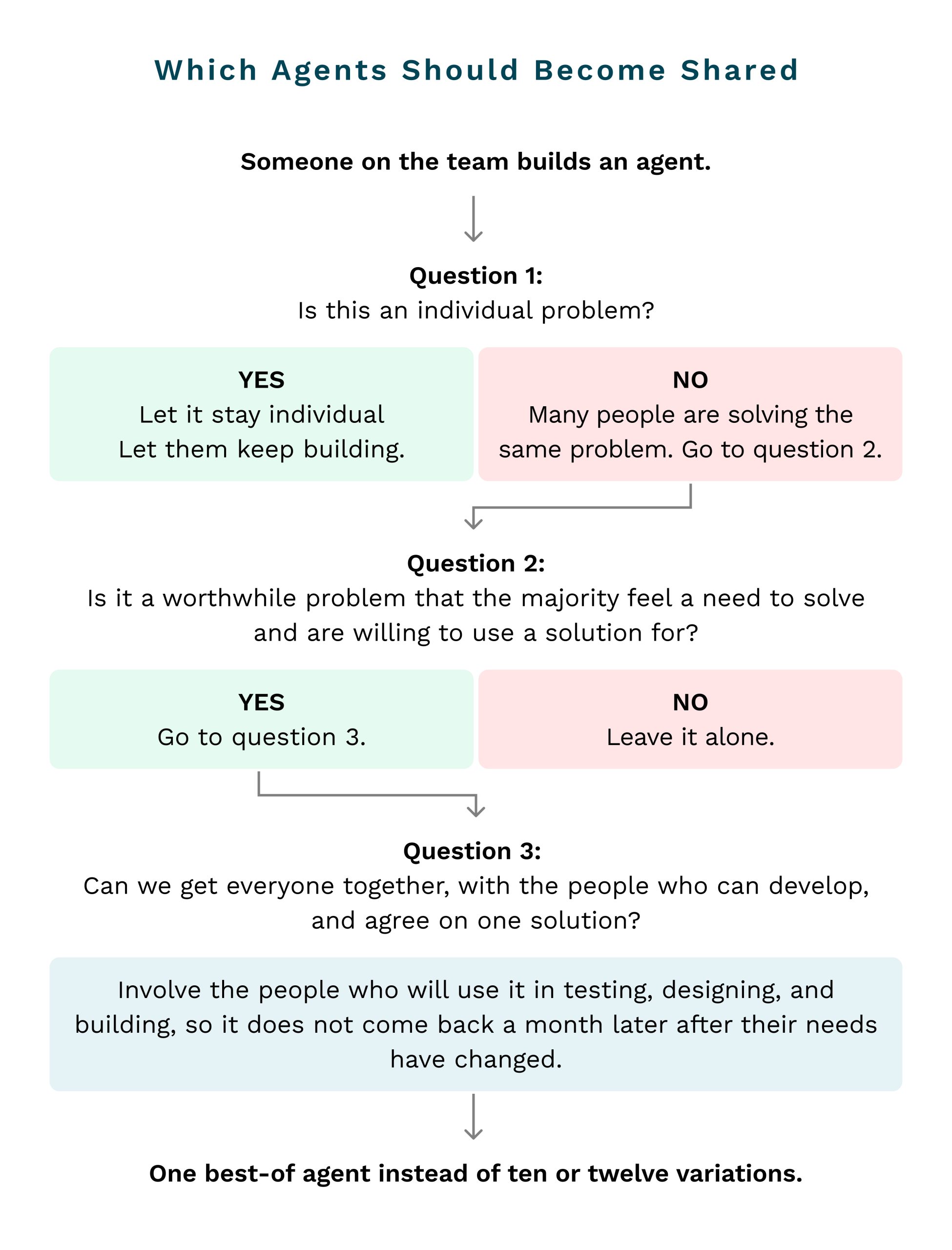
Individual solutions stay individual. The exception is when many people are solving the same problem, each in their own way. Account research before a call is the example Paul gives. Everyone wrote one, and they varied in quality and in how usable they were by anyone else.

We're looking at how do we not build six of the same agent that are just slightly different than each other.

Paul Ross
VP of Global Revenue Operations, Infoblox
What to do: Do not stop people from building. Do look for the problems that many of them are solving independently, because those are the candidates for a shared solution.
Two Tests for Which Agents to Centralize
Once the account research duplication showed up, Paul’s team identified ten or twelve versions, got everyone together with the people on his team who can do development, and built a best-of. That experience gave him two criteria for deciding what to centralize.
The first is that it has to be a worthwhile problem, one that the majority of people feel a need to solve and are willing to use a solution for. The second is that the people who will ultimately use it have to be involved in testing, designing, and building it.
That second point matters because of timing. If someone asks for a tool, disappears for a month, and returns with something built, the needs may have changed in the meantime. Involving users along the way means they feel the result meets what they need, and they use it. Paul heard a line at a recent Vista conference for CXOs that he plans to share with his team, and it sums up the filter.
It's no longer about whether you're using AI. It's really about whether you're getting value out of what you're doing with AI.
Paul Ross
VP of Global Revenue Operations, Infoblox
Read the complete transcript for more insights.
Is the Juice Worth the Squeeze?
Randy asked how Paul sizes a problem before deciding to build. His answer reframes the question: it is less about how big the problem is and more about whether the juice is worth the squeeze.
The biggest annual effort for his team is planning. They start early so quota sheets reach reps right after kickoff, because reps without quota sheets sit in what Paul calls a purgatory zone and do not produce as much. Planning today runs on spreadsheets, and the team believes it can do better with AI. But the capacity model is not where the value is.
Capacity planning is a spreadsheet model with inputs and outputs. Territory planning is where the pain is, because the rules change every year and the world is not one homogeneous market. Even after planning ends, people argue and juggle accounts for about three weeks before the territories are locked, with only a little movement allowed because changes can affect comp plans.
What Paul wants to automate is the impact analysis. If you make a trade, what does it do? Does it create an overbalanced or underbalanced territory? Does it push a quota too high, or set one too low for what someone is being paid? His team plans to build a set of agents, built by ops people for ops people, in the environment they already know.
He contrasts this with a smaller example. After Infoblox acquired a network observability company, the team built a forecasting and pipeline dashboard using Glean. It took a lot of work, because LLMs do not always follow the instructions in a prompt and may point at different data than you intended, so you have to keep iterating in development. Built in Tableau, they would have known exactly how it would behave, and probably finished in the same amount of time.
Was it worth it? I don't know. But it made everyone happy that we built it in AI.
Paul Ross
VP of Global Revenue Operations, Infoblox
His takeaway is to assess up front whether it is easier to just get it done and save your scarce AI expertise for the problems that need it.
You have a lot of people that'll do AI, but you have a few people who are really good at it. It's a new skill.
Paul Ross
VP of Global Revenue Operations, Infoblox
A Pilot is for Learning, and Pull Beats Push
Pilots are designed to succeed, with the best people, the cleanest use case, and lots of attention, so what makes a pilot work is the attention, not the AI. Scaling it dies when that focus disappears.
Paul respects that perspective and adds to it. In a pilot, people have agreed to participate. When it becomes a non-pilot, it is imposed on everyone else. But he thinks the most important thing about a pilot is that you learn something. A pilot his team is running has changed quickly, with a phase one, two, and three, and what they learned was that it should work differently and be less restrictive than they first set it up. In this case, the broader rollout is a tidal wave that will happen regardless.
The point of the pilot wasn't to try out yes or no. The point of the pilot was to learn so we're effective when we scale.
Paul Ross
VP of Global Revenue Operations, Infoblox
He then offers his metaphor for what separates things that last from things that need life support.
It's really hard to push a rope. It's really easy to pull one.
Paul Ross
VP of Global Revenue Operations, Infoblox
A good pilot, in his view, should feel like people are asking to get in: “Can I get in the pilot? I want to be in the pilot.” When there is real pull, the thing sustains itself. Where it breaks is if you have not built the infrastructure behind it to scale. And if you build your own tool, the work does not end at launch.
You don't get to build it and then it's done.
Paul Ross
VP of Global Revenue Operations, Infoblox
If you let it stall, people get frustrated that their evolving needs are not met, and they go build their own. Then you have fifty-three people doing fifty-three different things, with nothing globally consistent, nothing manageable, and a lot of wasted time.
What to do: Run pilots in phases, write down what you learn, and change the pilot quickly. Treat people asking to join as the strongest signal that you have found something worth scaling.
The Boat Test for Prioritization
With limited resources, how do you decide what comes first? Paul’s answer starts with something that is not about AI at all. He has worked at two high-performing companies, Dynatrace and Infoblox, and he learned the same lesson at each.
When you arrive, plenty of things look odd or wrong. Some of them are the reason the company performs so well, and some are legitimately broken. Telling them apart is not hard.
Spend your time on the stuff that's legitimately broken. Don't change things to the way that you think they should be because you're used to it, because that may be part of the reason we're so good.
Paul Ross
VP of Global Revenue Operations, Infoblox
Once you have the broken things, the next question is which matters most. Paul borrowed a test from a speaker at the company’s Sales Readiness Summit, whose book about rowing crews is built around one question: does it make the boat go faster? He applied it to a large company-wide initiative that had consumed millions of dollars of people’s time. If they had not done it, would the long-range plan go down? The answer was no, and he rested his case.
He used the same test on a tool request at Dynatrace. A sales leader who, in Paul’s words, “never met a tool he didn’t like” wanted licenses for a particular tool. After a year of having these tools, the one he wanted showed no change from before to after, and the one he had not asked for did show an impact. They chose the one that made the boat go faster.
You know what the ultimate metrics are. Do you make more money? Do you spend less money? Can you get something faster?
Paul Ross
VP of Global Revenue Operations, Infoblox
Build vs. Buy: Use What You Own, and Count the Cost of Maintenance
Every RevOps vendor now offers AI, and Paul notes that everyone is motivated to think, “I could just do that with AI.” His response is blunt.
I could build it easily. Yeah, maybe. Probably not.
Paul Ross
VP of Global Revenue Operations, Infoblox
His first rule is that if you already own a tool, use it and do not replicate it. Many tools ship with native AI, including Gong, SalesLoft, and Salesforce. Infoblox uses Gong for insights into actual sales calls, and Paul is looking at it for a particular buying scenario: some reps succeed and some do not, so what do the successful reps do that the others do not, and can everyone be trained on it?
Forecasting is where he describes combining tools. Gong has a forecasting tool, but it is less flexible than Clari, which Paul likes for the process of forecasting. What Gong does have is call insights. It can note that a deal has had three calls and none included a particular person, or that every time timing came up, the customer said November, so an October close is unlikely. That beats relying on rep notes, which may be thin, or may say only that the team is waiting on procurement. Paul is trying to get the best of both worlds, and his team says it can be done.
When does building make sense? When you do not have a tool that does what you want, and the use case is narrow enough that buying would mean paying for a lot of functionality you do not need. Account research for new-logo reps is his example, since there may be nothing on the market that fits. But building has a cost. The head of global SEs called Paul with a problem: many of his people built agents that others wanted, then did not know where to take them to finish. They got the agent to the twenty-yard line, but it was not scalable or globally deployable. Paul has since put resources in place to finish and maintain the ones worth keeping.
Randy suggested a common framing, that you buy the plumbing and build the upstream work. Paul does not think about it that way.
What's the way that makes the most sense? Quickest, fastest, cheapest way to get the solution.
Paul Ross
VP of Global Revenue Operations, Infoblox
If that is building it yourselves, build. If it is buying, buy. The question is whether you have a broad problem that many people are solving, in which case someone on the market is paying to maintain a solution, or a narrow problem specific to your business or a role in it. And on who owns AI, he is direct: “No one owns AI. It’s a tool. It’s not a thing you own.”
He compares it to Excel. When Excel arrived, people thought accountants would be put out of business, and instead Excel became a tool everyone used, for things no one had imagined. He thinks LLMs will follow the same path, and he points to a use he says few predicted: training and enablement. Teams now create a fake customer for a rep to practice a pitch on, and get a grade on what they did right and wrong.
Build or Buy? Here’s What 67 Teams Told us About Building it Themselves.
Data: AI Is Great at Summarizing and Weak at Knowing What Is Right
Randy raised the point that revenue data is fragmented across tools like Gong, Clari, and Outreach, and asked how data quality figures into making AI work. Paul calls it one of the most important things to deal with.
He starts with what LLMs do well. His team interviewed three or four potential consultants for a project, and each produced a proposal of about seventy pages. Paul fed them in and asked for a summary and a compare and contrast. The output was five to ten pages, and the rest of the team wanted it. LLMs are also great at finding data.
What it's not great at is knowing which data is right and which data's not.
Paul Ross
VP of Global Revenue Operations, Infoblox
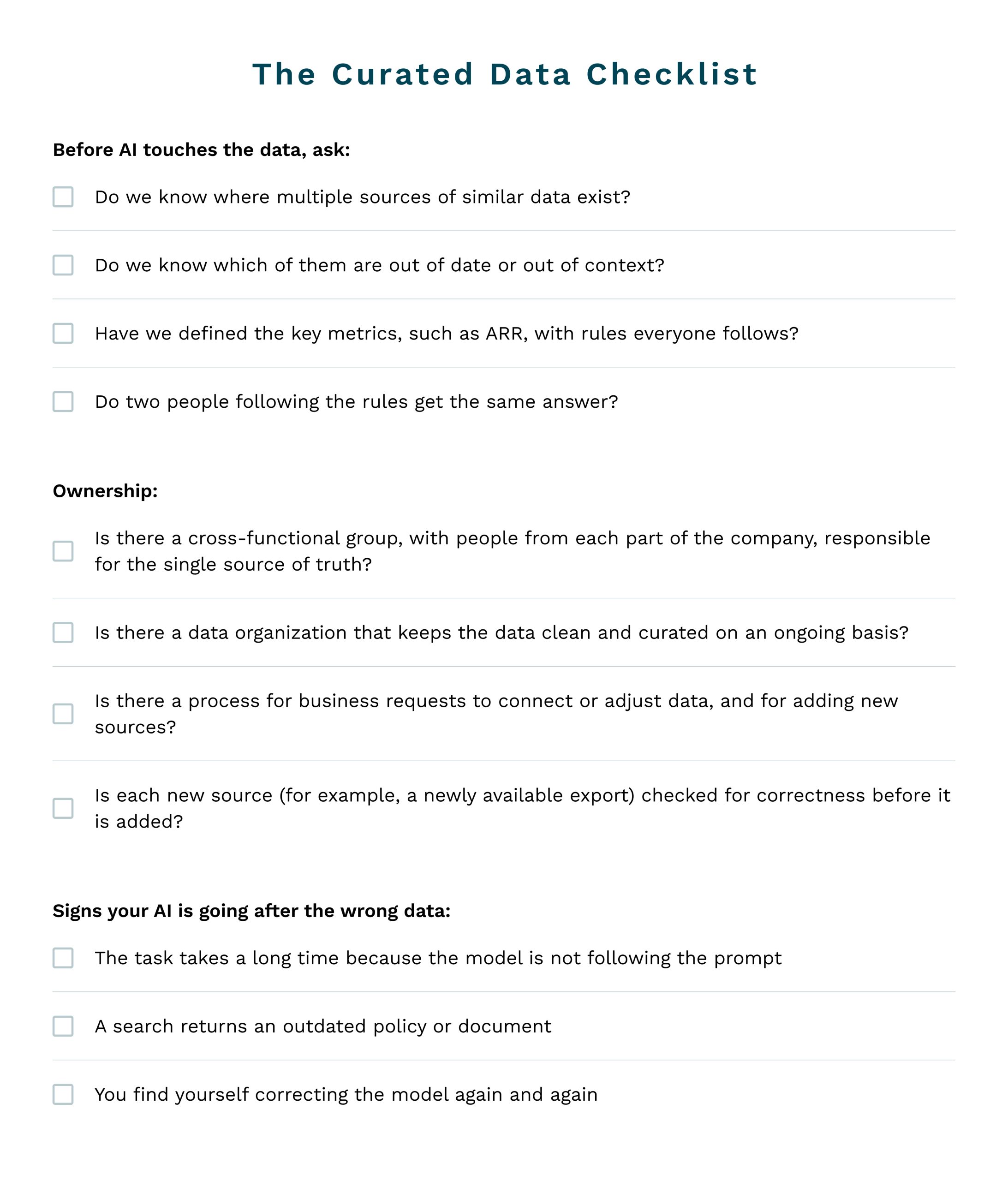
The problem is that organizations often hold multiple sources of similar data, and some of them are out of date or out of context. Paul has people using AI to search the company’s own content platform for a policy, and they find one that is three years old.
Infoblox is running a broad cross-functional project, with people from across the company, to clean up its data lake and create a curated single source of truth for data and data definitions. The example he gives is ARR. If you calculate it differently from someone else and you did not follow the rules, yours is not right. If everyone follows the rules, everyone gets the same answer. The project is in its final quarter of completeness, and Paul expects it to help tremendously.
It does not end there. An IT data organization is responsible for keeping the data clean and curated on an ongoing basis. The business will keep making requests to connect one thing to another or set it up a little differently, so the team will constantly re-engineer a little and take on new sources. Clari now allows its data to be exported, for example, and the team wants to bring that in, after making sure it is correct.
Where AI Moves the Needle: Channel and Renewals
When Randy asked where AI has the most impact beyond administrative work, Paul said he could only speak to his business. His examples are tied to executing the company’s strategy within its cost profile.
To increase accountability, Infoblox moved its channel teams and its renewals teams under the geo sales leaders. Historically, sales would say channel was not delivering, channel would say sales was not doing its part, and everyone pointed fingers. With the teams under them, geo leaders can see the P&L, decide how many channel people they need, and redeploy budget into sales reps. Paul acknowledges that if you do that too much, with no channel people left, you will struggle.
Then his Channel Ops team found something. Fifty to sixty percent of the opportunities closed through the channel involved uncovered partners: small partners that do one or two deals a year. That meant reps would be taking care of these partners, and reps are the people whose time the change was meant to save. So the team is building a number of agents to do the work channel managers used to do, so that the channel team can at least be Robin to the rep’s Batman, with much of that work offloaded.
By Paul’s estimate, roughly half of channel managers’ time was spent answering questions and facilitating things with partners, which he calls a little disappointing but an easy one to address. The first agent is partner-facing. A partner who only registers a deal once a year can ask where to find the registration form. A rep can ask who the incumbent partner is, or what to do if the customer no longer wants to work with them, or what qualifies and what incentives can be offered. Paul says calling it an AI partner manager would be an overstatement, but it supplements the people so the strategy can be executed.
Renewals follows the same logic. The goal is more renewals per rep. Some renewals are simple and some are very complicated, and the complicated ones take a lot of time and therefore a lot of reps. Infoblox is trying to co-term its contracts, which means someone has to find which contracts and assets are involved and put together a co-term proposal. Paul’s aim is to automate that upfront grunge work without spending hours figuring it out.
It lets us execute, take budget resources, and apply them to direct revenue-contributing things and not lose. We have a great renewal rate, so we don't want it to drop, but we'd like it to be as efficient as possible.
Paul Ross
VP of Global Revenue Operations, Infoblox
What to do: Look for the work in your own teams that is high-volume, repeatable, and answerable from existing rules, such as the same partner questions or the same contract reconciliation, and start there.
Forecasting: Triangulate, and Be Honest About the Ceiling
Randy asked whether predictive models can improve forecasting, not to replace experience and intuition but to complement it. Paul’s approach comes from his Navy background.
I'm a Navy guy. We triangulate when we navigate. You don't look at just one or two points, you look at three or four and make sure it all comes together in a tight circle and that's where you are.
Paul Ross
VP of Global Revenue Operations, Infoblox
Much of what he looks at is not AI. The Clari model, which he notes is not AI at all but a stochastic, percentage-based stage model, does a lot of the work. Beyond that, his team compares what leaders say with what reps say and looks at the gap. They look at the forecast categories reps use and ask whether the deals in a category can cover the forecast. The rule of thumb is that coverage should be yes plus ten percent, and if the answer is no, that is scary. They check whether reps are on track with linearity, and whether they have enough pipeline to finish the quarter based on historical data.
Where he sees AI adding real value is on the largest deals. He is not talking about the $20,000 deals but the ones at $200,000 or $500,000 and above, which, if they land or do not, make a big dent in the quarter. You cannot listen to all of the sales calls, and the VP of Sales is not on every call. Getting AI to sum up a deal’s whole history, including what the customers are actually saying and the historical triggers, makes a big difference. Paul describes it as looking at a ton of data you cannot just put in a database, and looking for context and assessment. He also notes you do not need to look at roughly eighty percent of deals by number, only the top twenty percent, which is manageable, even though those deals have historically run six to nine months at his company, with a lot of calls behind them.
He also explains why forecasting difficulty varies by business. At a previous company, there was no hockey stick. Deals were small, mostly one-time, and extended terms could be predicted analytically, so the forecast was mathematically very accurate. At enterprise SaaS companies like Infoblox and Dynatrace, there is a predictable baseline, but a large share of the quarter can sit in a few big deals, and one or two slipping or landing can throw off forecast accuracy substantially, which matters most when a company faces public-market scrutiny.
Randy asked how far off the industry is from nailing it. Paul does not pretend to know.
I think you can get better materially. I think no one can get to nailing it, meaning ninety-nine percent accurate. I don't think that's possible.
Paul Ross
VP of Global Revenue Operations, Infoblox
Someone gets sick, someone gets angry and will not sign, or someone nobody knew about gets involved and the board has to review the deal. Even with perfect information, a multi-million dollar deal can change at the last minute.
Where RevOps Is Heading: A Center of Excellence for AI
For his closing question, Randy asked where RevOps is headed over the next three years and what skills Paul looks for in future hires. Paul says he is only beginning to think about it. What he sees is AI capability being sprinkled throughout the organization, and he and his CRO believe the center of it should be in ops. It does not belong in sales or sales engineering, which have other jobs. It does not belong in channel or support. IT could own it, but IT lacks the context.
So Infoblox is hiring an AI engineer, has started the AI acceleration council with important people from all parts of the sales organization, and has allocated people to development. That last step came from experience: people start a project and do not finish it, or a worthwhile one needs someone to maintain it and keep it alive.
“I think RevOps is going to increasingly have a center of excellence for AI.”
Everyone on his team will build and use agents, but they will be about as expert as he is. He wants someone with an engineering mindset, who can answer the question of why something worked yesterday and is not working today.
Functions will still exist, such as training and business intelligence, but they will work differently. His BI lead now builds dashboards using AI, with perhaps a little Tableau behind the scenes that Paul never sees.
It's gonna be a tool, I believe, like Excel became a tool. But unlike Excel, we're gonna have to have people that are really good experts at it to help for the bigger projects that are probably the ones that are needle movers.
Paul Ross
VP of Global Revenue Operations, Infoblox
The Bottom Line
Paul Ross’s perspective is shaped by running operations at companies of very different shapes, and it shows. He is not interested in whether a team is using AI. He wants to know whether it is making the boat go faster. Every test he offers comes back to that question, whether he is sizing a build, choosing between tools, or deciding which initiative gets scarce resources.
His other consistent message is that scaling is mostly the unglamorous work. Look for pull, not push. Build a curated source of truth with definitions people follow. Maintain what you build, or watch people build fifty-three versions of it. And put a center of excellence in place, in ops, so that the experts who can finish and maintain the important projects are there when the rest of the organization has taken things to the twenty-yard line.
He is also honest about the limits. You can improve a forecast materially, but you will not reach ninety-nine percent, because the world still produces surprises that no model sees coming.
For a look at how a unified customer data foundation works in practice, see how Mimecast built one. Read the Mimecast case study – Nektar.ai →
Know a RevOps leader, CRO, or go-to-market practitioner with a real point of view?
We’re looking for practitioners with genuine experience.
Paul Ross is the Vice President of Global Revenue Operations at Infoblox. Connect with him on LinkedIn.
This post is based on his conversation with Randy Likas on The Revenue Lounge, Nektar’s podcast on the future of go-to-market.
Never miss an episode! Subscribe to The Revenue Buzz newsletter to get weekly episode updates.
If you liked what you read, please share it with your peeps.
In this blog
Get the Revenue Lounge Brief
3 takeaways from every new episode, straight to your inbox.
Episode Transcript
[00:00:00] Randy Likas: Almost every revenue organization is experimenting with AI, but turning promising pilots into measurable business outcomes remains a challenge. For RevOps leaders, the question is no longer just where AI can be applied, but how to make it work at scale across the revenue organization. Revenue leaders are navigating a new set of operational decisions, raising questions about how AI can help teams identify pipeline risks, understand deal progression, and make more informed revenue decisions.
[00:00:26] Randy Likas: Hello, everyone. Welcome to another episode of the Revenue Lounge Podcast. I am your host, Randy Likas, and in this episode, we’ll explore how revenue organizations are approaching AI in practice, what’s working, what isn’t, and how RevOps leaders can move beyond experimentation to build an AI-enabled revenue operation that delivers measurable business impact.
Read Full Transcript
[00:00:44] Randy Likas: Joining me today is Paul Ross. Paul is the Vice President of Global Revenue Operations at Infoblox. With executive experience in sales, marketing, product management, and engineering, Paul has a unique mix of skills that allows him to work cross-functionally and turn strategy into execution. Paul, thanks so much for joining us today.
[00:01:01] Paul Ross: Yeah, I’m loving it, Randy. Sounds like a great thing.
[00:01:04] Randy Likas: Great. Pa- Paul, I usually like to start these episodes off with maybe just having you give us a, a bit of an introduction about yourself, , your background, career journey, and, what your role at Infoblox is today.
[00:01:14] Paul Ross: Sure. , My career has been like, the lyric in the Grateful Dead song, what a long strange trip it’s been. I have a master’s degree, two of them, in electrical engineering and in nuclear engineering , which has absolutely nothing to do with what I do right now., I got out of college, , to go into the Navy, ’cause that’s who paid for it, so , they earned that.
[00:01:33] Paul Ross: I left, and did engineering, at a company called SAIC, that did contracting with, , the Navy and other military things. So it just made sense. I wanted to get out of- doing just defense work and something into more positive, I joined, , IBM after that, also doing engineering, but it was to revamp the entire, , air traffic control system, which I thought was a very worthy and positive project.
[00:01:58] Paul Ross: That ended eventually. I went then into IT. I worked at, , GE for a little while. I worked at a company up here in Massachusetts, EG&G. , And I realized that while IT… For me, there’s nothing wrong with all you IT folks out there, right? For me, I found that, . in IT, if you’re in the infrastructure part, like owning all the underpinnings and making sure stuff works, if you do your job perfectly, you’re invisible, and if something goes wrong, you’re the, a goat.
[00:02:27] Paul Ross: Right? And not the greatest of all time GOAT. Right? And I didn’t like that. , My friend had left and went to EMC. He enticed me to come. I stayed there for about 19 years. , EMC is now owned by Dell. . It’s part of Dell Technologies. – I did a lot of jobs. I was in marketing. I ran a product marketing group.
[00:02:46] Paul Ross: , I was in sales. , I ran a product group for part of our software, and then I started getting into operations, and I did that for a while. , Eventually I left, EMC and I’ve been running sales ops or rev ops, , since then, , at public companies like Intralinks and Dynatrace, , at startups like UiPath and Qumulo,, and where I am now at Infoblox, which is a private equity-held.
[00:03:11] Paul Ross: Some of the companies are systems companies selling hardware and software, and some of them are doing SaaS. So I think I got a pretty broad experience base. , I’ve seen a lot of things, which kinda helps. , I’ve implemented, and most importantly, I’ve made a ton of mistakes, and that’s where you- Yeah
[00:03:26] Paul Ross: tend to learn a lot of stuff.
[00:03:28] Randy Likas: Absolutely. Well, let’s jump into the topic at hand, Paul. What I’d love to unpack with you is, you can’t really go to any, website, , a LinkedIn profile. – Everybody’s talking about AI, and they talk about using AI, , in their go-to-market organization.
[00:03:42] Randy Likas: And, I think over the past 12 months, companies have been certainly experimenting. Some are still experimenting. Others are really doing true transformation, , in delivering, agentic workflows in their production environments. , But scaling that is often fairly difficult, right?
[00:03:56] Randy Likas: It’s difficult to take something from a pilot into something that’s, , in production. So I’m just curio- curious, maybe you can talk about what the AI journey has been for you all at Infoblox, what you’re seeing, and what separates AI initiatives that succeed from those that maybe never go beyond the pilot.
[00:04:10] Paul Ross: , That’s a lot to unpack, Randy. , Let’s try to, , start it and have a conversation about, and see where it goes. Listen, I- Every company in the Vista portfolio, meaning, one of our big owners- Yeah is doing AI projects. They’re either building it into their products, as we are, and they’re using AI to try to, , make themselves more efficient, make more money, save costs, whatever it is, right?
[00:04:33] Paul Ross: And we’re doing the same. , We have , a initiative, , that we’re AI first, , that everyone in the company is using AI every day. I’m not an expert, but I try. I’ve got an agent that preps me for the day. It starts at seven o’clock in the morning. It gives me all my thing.
[00:04:49] Paul Ross: It goes into all my emails and texts, preps me for all my meetings so that I know what’s going on and gets me going. That’s just one use. , A-and what we’ve found , is everyone’s trying to make agents, right? I was just talking with my, ops leader for EMEA, and, , she tells me, “Everyone on my team wants to build an agent and wants an agent.”
[00:05:10] Paul Ross: It’s great. , And it’s true of every sales rep, every SE, all the channel people, at least the ones that are following the initiatives that , we’re told to do, and everyone in ops. – Most things that people build are one person trying to solve an individual problem that’s their problem.
[00:05:29] Randy Likas: Yeah.
[00:05:29] Paul Ross: Right?
[00:05:30] Randy Likas: Yep.
[00:05:30] Paul Ross: And it’s usually built really unique. Like, it maps exactly how they would do it, and they could be really complex , and robust ’cause someone just knows techy stuff and wants to go get it done and… Or it could be something simple like my,, daily prepper, right?
[00:05:44] Randy Likas: Yeah. ,
[00:05:44] Paul Ross: But it’s that one individual problem. Now, some things are taken on as global initiatives, meaning like they’re centralized.
[00:05:53] Randy Likas: Yeah. ,
[00:05:54] Paul Ross: But sometimes it’s just as much work to get AI to do it as if you just did it, like say for example in Tableau you made a dashboard.
[00:06:03] Randy Likas: Yeah.
[00:06:04] Paul Ross: Right? , And so okay,- that may not be as successful, right?
[00:06:09] Paul Ross: , And I started something that we call the AI Acceleration Office, ‘Cause I didn’t wanna call it the Governance Council because I didn’t want people to think like, “Hey, we’re like, , sitting on top of you and watching what you do and telling you what you can or you can’t.”
[00:06:21] Paul Ross: I want everyone to do all kinds of stuff. But what we found is there’s a ton of these individual solutions, and we’re gonna let them keep being their individual solutions, right? Yep. But there’s also a number of ones where there’s many people trying to solve the same problem, and they’re all doing it uniquely.
[00:06:38] Paul Ross: I’ll give a great example.
[00:06:40] Randy Likas: Please.
[00:06:40] Paul Ross: People wanna use AI for account research before they do their call. So everyone wrote one, and they’re all of varying levels of goodness, let’s just say- Okay … and usability by other people. But what we learned is that’s a universal problem that people universally wanna solve.
[00:06:57] Paul Ross: Okay. So that’s one of the key elements, right? It’s gotta be a worthwhile problem that the majority of people feel that there’s a need for a solution, and they’re willing to use this solution. What we did was we identified that there’s, , 10 or 12 of these account research agents, and we got everyone together with the people that, on my team that can do some of the development, and we made a best of Right?
[00:07:21] Paul Ross: And so that had the second element in it, is you get an agreement on a solution, and the people who are ultimately gonna use it participate in either the testing, the designing, the, the building, whatever of it, so that it’s not like just, “Hey, I want something,” and then it goes off, and then a month later you get something coming back and your needs might have changed since then.
[00:07:45] Paul Ross: You might have thought about something else, right? So that’s the other key element, right? And those tend to work. I was just came back from a Vista conference, , literally last night, , for CXOs, and every single session had AI in the title. So there was a theme, right? , One of the quotes I wrote down that I really like, and I’m gonna tell my team about it, is, , it’s no longer about whether you’re using AI.
[00:08:15] Paul Ross: It’s really about whether you’re getting value out of what you’re doing with AI. And that’s the key thing. And to get that value, you have to have a problem that many people, the majority of people want to solve-
[00:08:30] Randy Likas: Mm.
[00:08:30] Paul Ross: Right?
[00:08:31] Randy Likas: Yep. ,
[00:08:31] Paul Ross: And that you get out all the people, the constituents involved in building that solution so that they feel that it meets what they need, and then they’ll use it.
[00:08:44] Randy Likas: Yeah.
[00:08:45] Paul Ross: Right? Yeah.
[00:08:46] Randy Likas: For sure. There’s so many great things that you impact there, and it just takes me back to, , old software development processes. We had this – waterfall requirement where we’d gather requirements, and we’d go to stage two, and takes eight, nine months to build, and then it gets delivered, and it’s like, “This doesn’t work for us any longer,” right?
[00:09:02] Randy Likas: Yeah. You can’t do that any longer. , . and because of the speed at which we can do things, with vibe coding and such, we can deliver things quicker and iterate on on them quicker. You also talked about understanding the problem and getting agreement on the problem.
[00:09:12] Randy Likas: I’d be curious to unpack with you, like, sizing the problem, right? So , is the juice worth the squeeze? And where does that play in sort of the assessment of what we decide that we ultimately wanna maybe build at, build out and scale?
[00:09:24] Paul Ross: That’s a really great question.
[00:09:27] Paul Ross: What I’m getting out of that, the right question is the juice worth the squeeze versus how big is it, right? Yeah. ‘Cause if it’s big and it’s worthy to do in AI, let’s do it, right? Yeah. I’ll give you an example of that. , The biggest thing that my team does every year is planning. It takes up the most amount of time. We start early so that we can end as early as possible and get quota sheets out to people immediately after kickoff, right? Amen. That’s the goal.
[00:09:55] Randy Likas: Yeah.
[00:09:56] Paul Ross: Right? Why? Because the longer reps don’t have their quota sheets, – they sit around in this purgatory zone and don’t produce as much.
[00:10:03] Paul Ross: That’s the goal, right? Yep. What do we do? We use spreadsheets like everyone else. We’ve tried looking at other stuff. We do iterations, like you just said, right? But we feel we could do better with AI. How? Well, the biggest load for us, the thing that takes up the most amount of time, is the territory planning part.
[00:10:23] Paul Ross: Capacity planning, it’s a spreadsheet, but it’s a stochastic spreadsheet. A really smart person, you come up with a model. You put inputs. You put outputs. You get what you want, right? , I don’t really need AI to do math. Yeah. Right? The juice isn’t worth the squeeze on that one. , Territories are tough because- You have guidelines that change every year, right? Hey, we’re gonna have hunters and farmers. Oh, no, the farmers will be hybrids. , Hunters are allowed to have one prospect , or all prospects and one customer just to keep them going, but then not. But except in the Middle East where they’re allowed to all be hybrids and y- right?
[00:10:58] Paul Ross: It’s just that way. Yeah. Because the world isn’t , a homogeneous, , environment of one country where everyone speaks the same language and has the same culture and businesses operate the same way. It’s just not that way.
[00:11:09] Randy Likas: Yeah.
[00:11:09] Paul Ross: Right? So you have to adapt to that, which means there’s a lot of different rules.
[00:11:14] Paul Ross: And then what happens is if you don’t involve people, you can’t just sit there and say, “Well, I’m gonna stack rank all my accounts based on , a potential that each account has, and of course I’ll assign the best ones first, and the next best, and the next best, and then I’m done. Oh, but that account looks like it’s a big account, but our competitor owns it, so that’s a waste of time account.
[00:11:36] Paul Ross: Oh, well, this account looks like it’s a small account, but really it’s a big account And this one has a relationship with that guy, and this one goes across country boundaries, and blah, blah, blah.” There’s just so much more detail involved- that you do your best, and then even when we’re done, for three weeks after people still argue and juggle their accounts, and then we lock it down.
[00:11:56] Randy Likas: Yeah.
[00:11:56] Paul Ross: Right? Not, it’s not a lot of juggling. It’s a little bit, right? Because we don’t wanna do it too much. It might change comp plans, but there’s a little bit of juggling. Territories are a pain. The more we can automate that, the more we can automate, “Hey, listen, if you wanna make this trade, – this is the impact of what you just did,” right?
[00:12:17] Paul Ross: You now made an over balanced and an under balanced territory. Or you just made it so that I’m gonna have to assign this guy a quota that’s way too high. . Or I’m gonna assign this person a fair quota that’s really way too low because they’re getting paid this much. Things like that where I can plug in stuff and make changes and deal with the impacts and be resilient to it quicker would be great.
[00:12:43] Paul Ross: So we’re gonna build a bunch of agents built by ops people, right? For ops people to do planning and the work that they know in the environment that they know that is a large complicated one.
[00:12:58] Randy Likas: Mm-hmm.
[00:12:58] Paul Ross: Right? But the juice we believe, we don’t know yet, right? But we believe the juice is worth the squeeze.
[00:13:02] Paul Ross: At least all my team believes it’s worth the squeeze.
[00:13:05] Randy Likas: Yeah.
[00:13:05] Paul Ross: Right? And that’s a big one. But it’s also true with small ones. You could make a easy agent that frankly, , I don’t know. We just bought a company called, , Kentik. Awesome company, does network observability. – We haven’t integrated them yet, so we wanna make our forecasting and pipeline and, , we created a dashboard using, , Glean, and it took a bunch of work ’cause I don’t know, LLMs don’t always listen to what you tell them to do in the prompt.
[00:13:32] Paul Ross: They may point at different data than you want them to point to, , things like that. And so you have to keep iterating and getting it to work in development. If we just built it in Tableau, . we’d know exactly how it would work, right? And we probably could have built it in the same amount of time.
[00:13:45] Paul Ross: So was it worth it? I- I don’t know, but it made everyone happy that we built it in AI, right? Yeah. You gotta kinda make the assessment. I’m a big fan of assessing upfront whether it’s easier to just get it done and spend your precious AI expert resources, ’cause you have a lot of people that’ll do AI, but you have a few people who are really good at it.
[00:14:07] Randy Likas: Yeah.
[00:14:07] Paul Ross: Right? ‘Cause it’s a new skill, right? Yeah. No one’s got 20 years of experience on LLMs. On the complicated ones where the juice is worth the squeeze.
[00:14:18] Randy Likas: Yeah.
[00:14:19] Paul Ross: Make sense?
[00:14:19] Randy Likas: Yeah, , absolutely it does. I wanna share a perspective with you to address the part of , my multi-part question around why things might not ever get out of pilot mode.
[00:14:28] Randy Likas: And, I was speaking with someone recently who had an interesting perspective, and they said, “Pilots are designed to succeed, right? We put our best people on them with the cleanest use case. There’s lots of attention. What made it work was the attention that we had on it, not the AI. So when we go to scale it, it dies because we’re not as focused on that.”
[00:14:47] Randy Likas: And they’re, from their perspective, the scaling p- piece, it essentially needs three things. It needs the data in the context that you could trust. , It’s gotta be something that’s kinda built once and reused, and it’s gotta have an owner that makes it out of pilot and still is accountable six months later.
[00:15:04] Randy Likas: So their framing was, ” we gotta do a lot of the boring foundational work upfront. And if we do that right, then we have a higher chance of the pilot succeeding in production.” What are your thoughts on that?
[00:15:16] Paul Ross: I totally respect that perspective ’cause it’s true. With pilots you have a lot of attention.
[00:15:21] Paul Ross: You have people who have agreed to be part of the pilot as opposed to everyone else when it becomes a non-pilot, it’s imposed upon them, right? I would add something to that though. I think one of the things that’s important to learn in a pilot is to learn something. So we have a pilot going that- it does have a lot of attention.
[00:15:42] Paul Ross: It does have a select group of people that are involved, but the most important part of the pilot is what have we learned? And we fundamentally changed the pilot, I mean, quickly.
[00:15:53] Randy Likas: Mm-hmm.
[00:15:53] Paul Ross: Right? And we were gonna have a phase one and a phase two and a phase three. I said, “Ah, this just… The pilot phase and then after.”
[00:16:00] Paul Ross: And, what we learned is it should work this way, and we shouldn’t be as restrictive as we were, and then blah, blah, blah. And so that when we get out… Because in this particular case, it’s a tidal wave, and it’s gonna happen regardless, right? The point of the pilot wasn’t to try out yes or no. The point of the pilot was to, , learn so we’re effective when we do scale, right?
[00:16:21] Randy Likas: Yep, yep.
[00:16:21] Paul Ross: That said, I think this goes back to one of the points I made. If you’re building an AI tool, , it’s really hard to push a rope. It’s really easy to pull one.
[00:16:30] Randy Likas: Yep, yep.
[00:16:31] Paul Ross: Right? Find the things where people are pulling. If you can push on a rope with enough people.
[00:16:38] Randy Likas: Mm-hmm.
[00:16:39] Paul Ross: , I don’t know. I’m really probably taking the metaphor too far, but, if it requires all of this to keep it alive, , it’s not self-sufficient. What a good pilot should feel like, in my opinion, is I wanna get out of the pilot. Can I get in the pilot?
[00:16:53] Paul Ross: I wanna be in the pilot. I want that, I want that, I want that, I want that. And then you’re holding them back, right? Yeah. There’s a lot of pull, and when you have a lot of pull, , it will wanna self-sustain. Then where it breaks is if you don’t build the infrastructure behind it to scale, but it’s not a matter of it st- it, it was alive because you kept giving it attention.
[00:17:15] Paul Ross: You’re keeping it alive because people want it, and they’re not being frustrated because their evolving demands aren’t being met. , So I know we were gonna talk at some point about, “Hey, do you buy a tool that has AI or do you build your own?” We’ll talk about that if we do, but-
[00:17:33] Randy Likas: Yeah
[00:17:33] Paul Ross: at the end of the day, if you build your own, you have to continue to build it.
[00:17:40] Randy Likas: Yeah.
[00:17:40] Paul Ross: You don’t get to build it and , then it’s done.
[00:17:42] Randy Likas: The whole maintenance.
[00:17:44] Paul Ross: Because as soon as that happens, especially with AI, people will get frustrated, and then they’ll just go build their own thing. And then again, you have 53 people doing 53 different things that doesn’t
[00:17:57] Paul Ross: To say it doesn’t scale isn’t the right word. It’s not globally consistent. You can’t manage it. It’s a lot of wasted time, and people are looking at different stuff.
[00:18:04] Randy Likas: Yeah.
[00:18:04] Paul Ross: Right?
[00:18:05] Randy Likas: Yeah. ,
[00:18:06] Paul Ross: Does that help?
[00:18:07] Randy Likas: It does, and I just wanna unpack one more thing with what you just said there, and then we’ll talk about , the build versus buy next.
[00:18:13] Randy Likas: What I’m hearing you say , is let’s not go fight the fights that aren’t worth fighting. We have to find the, the rope pull. I also think that, we gotta find the friction, right? Where’s the friction in the business ‘Cause it’s always gotta be able to tie back, to the outcomes.
[00:18:24] Randy Likas: Not just what we learn, but what it can actually do for us. I also think that there’s probably so many people, right, across the different functions that, , y- your stakeholders live, , who raise their hands, and They wanna do something. Maybe there’s friction across the business.
[00:18:36] Randy Likas: How do you prioritize? There’s only so many resources , to go, whether you buy it or you build it. What’s the process that you g- you all work internally to manage what takes priority versus what doesn’t?
[00:18:45] Paul Ross: Yeah, so, this isn’t an AI thing, but it’s a relevant story, right?
[00:18:49] Paul Ross: I’ve had the, pleasure of working at two Rule of 50 plus companies. Mm-hmm. Right?
[00:18:55] Randy Likas: Wow.
[00:18:55] Paul Ross: Which is a big deal. There are- Less than 10 Rule of 50 companies of any meaningful size in the world at any point in time, right? , Dynatrace is one, Infoblox is another. , In fact, we’re over Rule of 60 right now.
[00:19:11] Paul Ross: It’s crazy. But, I come in to Dynatrace having been at startups, and I fortunately quickly learned this one lesson. There’s a lot of things that look odd and wrong. Some of them are the reason it’s a Rule of 50 company. Some of them are legitimately broken. It is ridiculously easy to figure out which one’s which, ’cause you just look at where everyone’s complaining.
[00:19:40] Paul Ross: At Dynatrace, they ran a partner model that I’ve never seen before. We could have spent effort and changed it to the way everyone else does it, but maybe that’s what makes it work there. It wasn’t causing a problem. But we did have plenty of stuff that’s problem, right? Yeah. Same thing with Infoblo- And I gave, , my boss when he showed up a year and a half ago, , that advice.
[00:20:03] Paul Ross: I said, “Listen, spend your time on the stuff that’s legitimately broken. Don’t change things to the way that you think they should be because you’re used to it- Yeah … ’cause that may be part of the reason we’re so good, and you don’t know ’cause you’ve never worked at a Rule of 50 company before.”
[00:20:19] Randy Likas: Yeah.
[00:20:19] Paul Ross: Right?
[00:20:20] Paul Ross: And not this one, which has its own unique things. Okay. So now apply that. It’s not that hard to figure out what are the worthy ones, right? Now, at some point, is this one more important than that one? And, , I was having a conversation with one of my friends this morning about an initiative, and, we had at our kickoff, we call it SRS, Sales Readiness, , Summit.
[00:20:44] Paul Ross: But, we had a speaker and, he wrote a book called Does It Make the Boat Faster? And it’s about crew, rowing.
[00:20:51] Randy Likas: Yeah.
[00:20:51] Paul Ross: And I asked him, I said, “For this project, though,” , it’s a big initiative. The whole company’s behind it. We’ve spent millions and millions of dollars of people time and stuff on…
[00:21:01] Paul Ross: I said, , “Does it make the boat go faster?” And he knew what I was talking about and he goes, “Yeah, I think it does.” I go, “Okay, let me test it. Our long range plan, if we didn’t do it, would the long range plan go down?” “Well, no Oh, okay. Pl- I rest my case. Yeah. Right? Yeah. So , the ultimate test is does it make the boat go faster?
[00:21:29] Randy Likas: Yep.
[00:21:29] Paul Ross: And if you use that, I really like this guy’s thing. Maybe you wanna buy his book, I don’t know. , He did a good job , at our speaking. But it’s a very simple concept. We had this guy at Dynatrace, excellent, excellent sales leader. , Never met a tool he didn’t like.
[00:21:43] Paul Ross: I want this, I want licenses for that, blah, you need to give them to me, blah, blah. And I said, “Okay. You’ve had these tools for a year now. Let’s see if they made the boat go faster.” And the one he wanted, no impact from before and after. The one he didn’t want actually did have an impact, and I said, “We should do that one, not the one you want,” ’cause it makes the boat go faster, right?
[00:22:10] Paul Ross: That’s the test, and , it’s not that hard, right? You know what the ultimate metrics are. Do you make more money? Do you spend less money? Can you get something faster, right? That’s-
[00:22:21] Randy Likas: Yep
[00:22:24] Randy Likas: , I love that metaphor and I think it makes so much sense, and it’s so simple, right? If you think about it like that All right. , Let’s dive into , the build verse buy question because it’s something that we’re seeing, over and over and many companies are trying to make that distinction of do we build it?
[00:22:39] Randy Likas: Do we buy it? Every RevOps, vendor, out there, is offering some form of AI within their product. When you think about whether you should build , or buy, how do you think about that? What are the trade-offs and when does it make sense maybe to build something custom versus something off the shelf?
[00:22:55] Paul Ross: Yeah. And with AI, everyone is motivated to think that, “Well, , I could just do that with AI.” Right? ” I could build it easily.” Yeah, maybe. Probably not. Right? , If, if it’s an important thing, certainly if you have the tool already, use it. Don’t replicate doing it, right? , Many tools come with native AI capabilities.
[00:23:21] Paul Ross: Gong, , SalesLoft, , Salesforce, right? , We use Gong, right? It’s great for insights into actual sales calls. Well, that’s good. You can use that for a lot of things. , We are looking at it for a particular, buying scenario, when they’re selling one of our products. Some reps are successful, some reps are not as successful.
[00:23:42] Paul Ross: Let’s find out what the successful reps do versus what the unsuccessful reps don’t do, right? What’s the difference between the two? And train everyone on that, you know, obviously to do the thing that wins, right?
[00:23:56] Randy Likas: Yeah, yeah. ,
[00:23:56] Paul Ross: I got a whole initiative on that. Forecasting, right? Gong has a nice forecasting tool.
[00:24:02] Paul Ross: It’s not as flexible as Clari. I just talked to , the SalesLoft guy about this, right? I said, “You got a forecasting…” There’s a forecasting tool, Gong. SalesLoft has Clari. , They’ve been merged. Clari has a very, , robust and flexible forecasting tool that is good for the process of forecasting.
[00:24:18] Paul Ross: Gong doesn’t have that, but what they do have is all the call insights. So they can sit there and say, “Well, you know, for this particular deal, you’ve had three calls , and none of them have been with this person, and the one time anyone mentioned timing, they always mention November, and so, I don’t really think this is gonna come in October.”
[00:24:36] Paul Ross: Right?
[00:24:37] Randy Likas: Yeah. ‘
[00:24:37] Paul Ross: Cause otherwise you’d be relying on the rep’s notes and you get whatever they put down. I’m not saying people are lying, but they may not recall things or maybe a rep that doesn’t put much down or- Yeah … all they put in there is, , “We’re waiting on procurement,” you know? So having these insights can help you a lot i- in the tool.
[00:24:57] Paul Ross: Right? Now, in our case, I love Clari for how it does its job, and I like Gong for all these insights. I’m trying to see if I can get the best of both worlds and put them together, and my team tells me we can, so we’re working on that. If you don’t have a tool that does what you want, and it’s a narrow use case, meaning , if you were to buy it, you would probably buy a whole bunch of functionality that’s got nothing to do with what you want in order to get this narrow use case.
[00:25:23] Paul Ross: So in that scenario, it probably makes sense to build it.
[00:25:27] Randy Likas: Yeah.
[00:25:27] Paul Ross: Like think of the account research one, right? It might be account research for new logo reps, you know what I mean? Like, where am I gonna get that on the market, right? But like I said before, it comes with the cost of having to maintain it, right?
[00:25:42] Paul Ross: I got a call from, , our head of global SEs. He said, “Listen, Paul, here’s my challenge. I got a lot of my guys build an agent to go do something, and it’s an agent that a lot of people want, and then they don’t know where to go to finish it. So they’ll take it to the 20-yard line,” and then using an American football analogy, right?
[00:26:02] Paul Ross: And it’ll be good, but it won’t be scalable and globally deployable, and where do they take it? You need someone to maintain it and finish it off, right? So I actually built some resources to go, and do that, right?
[00:26:14] Randy Likas: Yeah.
[00:26:14] Paul Ross: And that’s okay, but it’s gonna cost you when you build a tool. Like we talked about earlier, you can’t just build it and forget it and think it’s gonna survive, right?
[00:26:22] Randy Likas: Yeah. Yeah, I’ve heard of people also describe it as, , what is considered to be infrastructure or plumbing, ‘Cause we don’t wanna build that. We don’t wanna own the plumbing. We wanna redeploy our resources to the things more upstream. Connecting the signals, , doing the orchestration, making sure that the outputs are actually insightful enough to drive the out…
[00:26:46] Randy Likas: the outcomes that we want. And so it’s more of that type of work, , and they’re making that distinction between buy versus build that way. And I think it also depends on what lens is looking at it, right? IT might wanna build it because that’s…
[00:26:59] Randy Likas: They’re engineers. They wanna build things where the RevOps teams don’t wanna build those things. So I also think sometimes that decision comes from, , who’s the one that owns this in the organization? Yeah. Does IT own AI? Does RevOps own AI in context of go-to-market?
[00:27:15] Randy Likas: How does it work today? W where does AI, live today, It’s like saying
[00:27:18] Paul Ross: who owns Excel,
[00:27:20] Randy Likas: right? Yeah. That’s great.
[00:27:21] Paul Ross: Like a long time ago, there was no Excel, and then we’ve got Excel, and everyone thought accountants would be put out of business, and they weren’t.
[00:27:29] Paul Ross: Yeah. Excel became a tool- that everyone used, and in fact, people use it for stuff that no one conceived of using Excel for, right? We have LLMs, and whole bunch of people will get put out of work. Well, maybe, , or work will shift I, I think in five years people will notice that it’s a tool, and people will use it for stuff that no one conceived of using it for.
[00:27:54] Paul Ross: I mean, who thought, , two or three years ago that one of the top things that people use LLMs for training, , is for enablement of people in doing role plays, right? And you get a realistic person. Sometimes they make weird movements and say weird stuff, but most of the time you can make a fake customer that someone can practice their pitch on, and it’ll give them , a grade.
[00:28:17] Paul Ross: Yeah. “Here’s what you did wrong, here’s what you did right.” No one thought about– That’s not when someone built ChatGPT, that’s not what they thought of. But someone came up with the idea and everyone loved it, right?
[00:28:26] Randy Likas: Yeah.
[00:28:27] Paul Ross: So I don’t think about it that way. I get that the thought process and the traditional thought process is, “Hey, we wanna buy stuff that’s, the plumbing things, and we wanna elevate our people to do higher level work.”
[00:28:38] Paul Ross: Right? People have been saying that for all kinds of stuff lots of times. I honestly think it’s more about What’s the way that makes the most sense? Quickest, fastest, cheapest way to get the solution. If the quickest, fastest, cheapest way to get the solution is for us to, , build it ourselves, AI or otherwise, let’s do it.
[00:29:00] Randy Likas: Yeah.
[00:29:01] Paul Ross: Right? If it’s to buy it, which it often is, if it’s not a narrow solution, and that’s why I coaxed my answer the way that I did, right? It’s about do you have a broad problem that a lot of people are solving, and so therefore there’s something on the market where y- they’re paying the expense of maintaining it-
[00:29:21] Randy Likas: Mm-hmm
[00:29:21] Paul Ross: right, and keeping it up to date. Or is it a narrow, specific to your business or specific to a role within your business kind of problem where you wanna build it? Who owns AI? No one owns AI. We use it, , IT uses it. We can get IT’s help to build some stuff. , We can not get IT’s help. I can contract people.
[00:29:39] Paul Ross: , It’s a tool. Yeah. , It’s not a thing you own.
[00:29:42] Randy Likas: Yeah. It reminds me of something that, , another conversation I had where they framed it as, eventually, – everybody’s gonna have AI, right? Everybody’s gonna use AI use it in some form or fashion.
[00:29:52] Randy Likas: And when you come to a point when everyone’s doing that, what is your moat? Your moat is your data, right? And how you use your data for competitive – advantage. And, , it’s an interesting perspective because, , if we think about it specifically in the context of revenue data, that’s often spread across so many different systems, right?
[00:30:11] Randy Likas: Gong, Clari, Outreach. , It’s fragmented. Everyone talks about, well, , Salesforce should be the single source of truth. Well, yes, it should. But, if Gong put everything inside of Salesforce, then why are people gonna live out of their platform?
[00:30:23] Randy Likas: So they’ll have a partial write back to Salesforce, maybe – certain things, but they wanna keep a lot of the secret sauce in their platform to help show adaption. , What I’m getting at is when you think about, , in order to make AI solutions in go-to-market work well, because it can reason over the data that it sees, what role does the data cleanliness and reducing the fragmentation of it, like , how are you thinking about that today , and how are you solving for that?
[00:30:52] Paul Ross: It’s one of the most important things that you have to deal with when , you’re leveraging AI to do anything, right? LLMs are awesome at collecting and analyzing , and summarizing data, right? Yeah. – We, interviewed three or four different, , potential consultants to do a project that we have, and they each produced 70-page, proposals and, I fed the proposals in and said, “Summarize and compare and contrast for me.”
[00:31:22] Paul Ross: I guess I was the only one that did it because everyone wanted my little output, which was nice. It was only like a 5 or 10-page thing, and then boom, we could see what people wrote, right? And then ask questions. , It’s great at that. What it’s also great at is finding data. It’ll scour and use whatever, but
[00:31:40] Paul Ross: What it’s not great at is knowing which data’s right and which data’s not. Yep.
[00:31:44] Randy Likas: Yeah. ,
[00:31:44] Paul Ross: Which data is more valid versus others. Like, medical studies, right? There’s medical studies where they had 10,000 participants and all kinds of stuff, and medical studies where they had five, right?
[00:31:56] Paul Ross: I’m gonna trust the 10,000 one versus the five more. The AI’s got no idea, right? Yeah. How many times today or yesterday did you have to correct, , ChatGPT or Gemini or whatever and it goes, “Yes, you’re right. I did say that.” “And thank you for pointing that out.” , All the stuff that it does, right?
[00:32:18] Paul Ross: Yeah. One of our better, AI people,, does… is in charge of the business intelligence team for me. – He does the, the dashboards and the reporting, and he uses AI all the time, often Claude, right? And there’s nothing wrong with Claude. But he will tell me, “Hey, this one’s taking a long time because either, A, it’s not listening to me in the prompt, or B, it’s going after the wrong data.”
[00:32:42] Paul Ross: Right?
[00:32:43] Randy Likas: Yeah.
[00:32:43] Paul Ross: So it is critical that we get stuff to go after the right data, right? And the context, the organizations, us included, right, often have multiple sources of similar data. , Some of them are out of date. Some of them are out of context-
[00:33:01] Randy Likas: Yeah …
[00:33:02] Paul Ross: that doesn’t matter to whatever’s going and finding it.
[00:33:05] Paul Ross: Right. , I have people using AI that search our own thing, right? Our high spot, and, “Tell me the policy for this,” and then they find one that’s like three years old and, it’s not the right one, right? This is important to us. We have a broad cross-functional project, right? A whole company.
[00:33:22] Paul Ross: Not like the entire company’s involved, but it’s cross-functional. We have people from each part of the company to clean up our data lake, right? And to have a curated single source of truth for our data and data definitions. So how do you put these data together to get things like ARR? Right?
[00:33:41] Paul Ross: So that you can’t calculate it… You could calculate it different than me, but if you didn’t follow the rules, yours isn’t right. If you follow the rules, we’ll all come up with the same answer.
[00:33:49] Randy Likas: Yeah.
[00:33:50] Paul Ross: Right? That project , is well underway. It’s in final quartile of completeness. And that’s gonna help tremendously, right?
[00:33:59] Paul Ross: And it’s important to do that. , You gotta collect the data that you’re gonna use and you gotta curate it, and you gotta have a group of people. In our case, there’s an IT data organization that’s responsible for continuously making it clean and curated. And there’ll be requests from the business that says, “Well, I need to be able to connect this thing with that thing, and can you set it up a little bit different?”
[00:34:18] Paul Ross: And they’re constantly gonna have to re-engineer the data a little bit, , or take new sources. So for example, Clari, , now allows its stuff to get exported out.
[00:34:27] Randy Likas: Yeah.
[00:34:28] Paul Ross: Right? And we wanna put that in there, but we gotta make sure it’s correct. Right. So that’s kinda how we’re kinda looking at it.
[00:34:36] Randy Likas: Yeah. So I just want to be conscious of time. We’re having a really rich discussion , and I wanna make sure I cover off , on a couple of other questions I have for you. I’d love to get your perspective, also on where you see the application of AI, , having the most impact. So beyond maybe automating administrative work, account research, and things like that, think about its applications in, , , making – a call more accurate or predicting slips earlier or, things are gonna move the business and would love to get your perspective on where you think we are today and where do you think the potential is?
[00:35:10] Paul Ross: I can only give examples in our business, so , let me give some ones I think are needle movers. , And a lot of it has to do with us being able to execute on our planned business strategy, , within the cost profile and nimbly as we need to, right? So, , one of the things that we did recently, , was in order to get greater accountability, we moved the channel teams underneath the geo sales leaders.
[00:35:39] Paul Ross: We did the same thing with the renewals teams. Why? Because historically, sales would say that channel sucks and channels would say that sales isn’t doing their stuff, and everyone always likes to point fingers. You could say the same game with BDRs and reps too, and in some organizations, they move them under sales, and this…
[00:35:55] Paul Ross: ours we don’t, right? But, , in channels and in renewals, we did do this, right? And in so doing, part of the plan was to be able to take, , budget from ch… the geo lead would now be able to look at their P&L, which they couldn’t own, and say, “Oh, well, I don’t want as many channel people as I had before ’cause, , I want them focused on this, and I can take that money and redeploy it into sales reps.”
[00:36:21] Paul Ross: Which, you would argue makes more money. Of course, if you do it too much and you have no channel people, you’re gonna struggle, right? So they did that. , It turns out from my team, channel ops, fifty to sixty percent of the opportunities, , that were closed through the channel, , were in now uncovered partners.
[00:36:42] Paul Ross: Smaller, lots and lots of small I-do-only-one-or-two-deal-a-year partners, but partners. Well, who’s gonna take care of these? The reps are gonna take care of these people. Really? ‘Cause that’s who we wanted to save the time from if we… Well, what are we doing? , We are building, it’s not one agent, it’s a number of agents that do the work that the channel partners did so that they can at least be Robin to the Batman , of the rep.
[00:37:10] Paul Ross: And offload that work substantially. Like for example, turns out, a little disappointing, but it turns out, let’s say 50% of their time was spent answering questions and facilitating stuff with partners. All right. Well, that’s an easy one, right? Yeah. So , we built that. Now w- that’s partner-facing, it’s not internal.
[00:37:28] Paul Ross: I mean, internal can use it, too, but the partner calls, “Hey, where can I find the form to register a deal or what’s the pro- ’cause I only do it once a year and I forgot.” Right? .. All that stuff Done. What about, um, who is the, incumbent partner in the deal , as I’m the rep now, what do I do , if the customer doesn’t wanna work with him anymore?
[00:37:49] Paul Ross: Or how do I handle this registration or that registration, or what qualifies and things, and what incentives can I give my partner, and how do I do this and that? All of that we’re trying to get automated in so that they’re basically acting as, to say that they’re an AI partner manager is an overstatement, but they’re supplementing it so that, we can execute on the strategy that we had.
[00:38:12] Paul Ross: Same thing with our renewals team. We had a lot of people doing renewals. We’re trying to get more renewals per rep, and some of them are really comp- some of the renewals are really simple. Some of them are really complicated. Well, the complicated ones take a lot of time, so you need more renewal reps to do it.
[00:38:30] Paul Ross: What if I could, automate it so that the upfront grunge work of finding, well, there’s this contract, this contract, this contract, this one ends, and this asset here, and all these other ones, and, put together some sort of co-term proposal, ’cause we’re trying to co-term all our contracts now, , with all of these combined things without you having to spend hours and hours and hours and hours to go figure it out, right?
[00:38:52] Paul Ross: So , that’s a needle mover ’cause it lets us execute- take budget resources and apply them to direct revenue contributing things and not lo- We have a great renewal rate, but so we don’t want it to drop, but we’d like it to be as efficient as possible.
[00:39:10] Randy Likas: Yeah.
[00:39:10] Paul Ross: Right?
[00:39:11] Randy Likas: Yeah.
[00:39:11] Paul Ross: So there’s, a couple of examples of how we’re trying to move the needle.
[00:39:16] Randy Likas: What about on the forecasting side? Do you see- , the ability to use predictive models on the forecasting, not necessarily to replace, I think, , I don’t wanna use the word gut, but intuition or experience is definitely going, always gonna be important.
[00:39:27] Randy Likas: But to complement that- I
[00:39:28] Paul Ross: think, I like to triangulate.
[00:39:30] Randy Likas: Yeah.
[00:39:30] Paul Ross: Right? Yeah. I’m a Navy guy. We triangulate when we navigate, right? You don’t look at just one or two points. You look at three or four and make sure it all comes together in a tight circle, and that’s where you are.
[00:39:39] Randy Likas: Yep. ,
[00:39:39] Paul Ross: So there’s things that we do that are not AI, right?
[00:39:43] Paul Ross: We use the Clari AI, but the Clari AI isn’t AI. It’s a stochastic, percentage-based stage model that it does it, so it’s great. We don’t have to do it, but- Yeah … we look at what the leaders say. We look at what the rep’s saying what the gap is. , We look at what, – Forecast categories they put it in and, how – can they cover their forecast with the deals that they put in a forecast category, yes or no?
[00:40:05] Paul Ross: Usually it’s supposed to be like yes, plus 10% is the thumb rule, right? If it’s no, then that’s scary., Are they on track with linearity, yes or no? , do they have enough pipeline to finish the quarter, again, based on historical data? All not AI, but that’s one judgment, right?
[00:40:21] Randy Likas: Yeah. Yeah.
[00:40:21] Paul Ross: All right. The thing, and , I alluded to it a little earlier, is, and this is where I really like Gong, right? If I could get an assessment on… F- forget all the $20,000 deals. I’m talking about the 200 and higher thousand dollar deals, the 500 and higher thousand dollar deals that if we get that or we don’t, is gonna make a big dent in the quarter, right?
[00:40:46] Paul Ross: We have one particularly large deal this quarter that we’re like, “Oh, I don’t know. Is it gonna close or not?” Well, it’s gonna close, but whether it closes in time or not in time, that’s gonna make a huge difference in our ability to forecast. We’ll look like we’re great or terrible, right? Getting those insights and, ’cause you can’t listen to all the sales calls- No.
[00:41:05] Randy Likas: Mm-mm. Right? But getting it to sum it up and getting that will make a huge difference because wh- when it comes to forecasting, there are certain businesses that are easy to forecast. When I worked at Intralinks, there, there was no hockey stick. People did business with us when they needed us, and they didn’t when they didn’t.
[00:41:25] Paul Ross: They were mostly small deals. They were one-time shots and you knew it was coming and it just worked out. For things that had extended terms, we could analytically predict are they gonna go over on their contract, and we knew by how much. Are they gonna extend because we know is it…
[00:41:41] Paul Ross: and we were extremely mathematically accurate on the forecast. , At Infoblox and Dynatrace, which are SaaS companies that are enterprise SaaS companies, we sell some large deals, right? Th- there is a baseline that’s predictable, but above the baseline, , even if it’s a third, 40% of, the quarter is in large deals, and one of them or two of them coming in or slipping out or happening or not happening or bluebirds or whatever, , can throw off your forecast accuracy by a lot, right?
[00:42:17] Paul Ross: And you don’t wanna do that when you’re a public company. We’re not public yet, but we might be, right? It , is not as good for you, right? Because they’ll, you get punished or rewarded and then maybe you get punished later. , So you wanna be able to predict it, but it’s large deals. It’s those large deals that you wanna add.
[00:42:34] Paul Ross: You don’t need the, the Seven, 800 of, 80% of your numerical deals you don’t even have to look at. It’s the top 20% numerically-
[00:42:45] Randy Likas: Yeah …
[00:42:45] Paul Ross: which is manageable. And even those have lots and lots of sales calls because they’ve historically gone on for six to nine months, at least in my company. Mm-hmm. Right? , Getting something to know what are the historical triggers, what are the customers actually saying?
[00:42:59] Paul Ross: ‘Cause our VP of sales for Americas isn’t on every single call. They might go on one or two calls toward the end- Yeah … and they can get their own assessment, but there’s a whole history of stuff. That’s where we can use AI ’cause… And it’s looking at a ton of data that y- you can’t just stick in a database, right?
[00:43:22] Paul Ross: Yeah. And looking for context and assessment, and that is how you can get some really good forecasting. And that’s what I’m hoping to be able to do that.
[00:43:31] Randy Likas: Yeah. How far off do you think we are from really nailing it?
[00:43:35] Paul Ross: I don’t know. , Because you could still have weird stuff that changes a multi-million dollar deal at the last minute in a quarter-
[00:43:44] Randy Likas: Yeah
[00:43:44] Paul Ross: with perfect information.
[00:43:46] Randy Likas: Yeah.
[00:43:47] Paul Ross: Someone gets sick, someone gets pissed off and won’t sign something, someone who you didn’t have no idea about gets involved and the board now has to review it. I think you can get better, I think you can get better materially. I think you can’t get, no one can get to nailing it.
[00:44:02] Paul Ross: Yeah. Meaning, like, 99% accurate. I don’t think that’s possible.
[00:44:05] Randy Likas: Yeah. Yeah. There’s always gonna be the unpredictable no matter what. , Like you said, , somebody gets sick, , somebody’s canned, right? There’s always things that are gonna happen that no way I could predict.
[00:44:14] Paul Ross: Right.
[00:44:15] Randy Likas: All right. I wanna wrap up, , and if we’ve got time, I’ll ask you one or two li- light your own questions. But I would love to get your perspective on where you think revenue operations as a function is going, , in maybe the next three years with , that energy, , that, AI has right now.
[00:44:28] Randy Likas: How do you see it changing how you think about the organization, how you staff, how you manage, projects? , And, is there any certain, , skill sets that you, , look for in maybe your future hires?
[00:44:40] Paul Ross: Yeah. That’s a really good question, and I’m not gonna pretend that I know the best answer for that one.
[00:44:44] Paul Ross: It’s something that I maybe only started to be thinking about. What we’re seeing is that, , AI capability is being sprinkled throughout our organization, and I mean sales organization. We call it WWFO is sales ’cause it’s sales, SE, partners, support, , enablement, rev ops stuff, right?
[00:45:05] Randy Likas: Yeah. ,
[00:45:05] Paul Ross: My boss and I, the CRO, believe that, the nexus of it should be in ops, right?
[00:45:11] Paul Ross: Because where else would you put it? You wouldn’t put the nexus in the sales or SEs organiz- ’cause that’s not what they’re supposed to be spending. You wouldn’t put it in the channel or support organization, right? , You could give it to IT, but the problem with giving it to IT is they lack the context.
[00:45:26] Randy Likas: Yeah. ,
[00:45:26] Paul Ross: We’re hiring, , an AI engineer. I’ve started this, AI, , acceleration council, right? And the council, by the way, has important people from all parts of the sales organization. It’s not just us sitting around talking to each other. , I’ve allocated people to do development because I’ve found that people will start a project and not finish it, or if it’s worthy, it needs someone to maintain it and keep it alive.
[00:45:50] Paul Ross: Yeah. , So I think rev ops is going to increasingly have a center of excellence for AI. , I’m finding the need to centralize that because you need some people with a specific expertise. – listen, everyone on my team will build and use AI agents, but they’re gonna be about as experts as I am, right?
[00:46:12] Paul Ross: I want someone who’s like, “Hey, how come this worked yesterday and it’s not working today?” “Oh, well, someone changed this Glean setup, and now I gotta go and reconfigure something,” , like engineer-ish.
[00:46:23] Randy Likas: Yeah.
[00:46:23] Paul Ross: Right? I will tell you this, , so, not knowing what to look for when I wanted to create , the job description for this AI engineer, I went to LinkedIn, and I looked up AI engineer, and then my plan was find a whole bunch of them, download them, stick it in Glean, and say, “Gi- give me a best of,” right?
[00:46:45] Paul Ross: Yeah. What I found was,, most of the AI engineers were people to build LLMs, right? Or to build AI into product that they’re selling, which is not- Yeah … what I’m looking for.
[00:46:56] Randy Likas: Right.
[00:46:57] Paul Ross: Right?
[00:46:57] Randy Likas: Yeah.,
[00:46:57] Paul Ross: But , if I said, “Go to market AI engineer”- Right.
[00:47:00] Randy Likas: Yeah …
[00:47:01] Paul Ross: then , I found that. And th- Yeah … and there’s a, a lot of them, right?
[00:47:04] Paul Ross: Yeah. So I’m not the only one looking for this kind of stuff.
[00:47:07] Randy Likas: Yeah.
[00:47:08] Paul Ross: Right? And they weren’t that far off from each other. And then , I took my JD that I created with, , Glean , and sent it to our internal AI experts that were like the, the IT guy who’s the best at it and the guy who, , is in charge of it in , the CEO’s office of excellence or whatever it is, and, , and they said, “Yeah, it’s pretty good.
[00:47:28] Paul Ross: I just made these two minor changes.” So it wasn’t far off, which means that a lot of people are looking for the same thing. Yeah. So I think that what I’ve described is probably what people , are headed to doing. , I think we’ll still have functions that do the things that they do, right? We’ll still have training teams, and we’ll still have business intelligence teams.
[00:47:46] Paul Ross: But they’re gonna do things differently, right? Like, my BI guy makes all his dashboards in Cloudera Glean now. There, there may be a little Tableau behind it that I don’t see, right? Yeah. And I don’t need to know about that, right? Yeah. But, , he’s building AI dashboards, right? Yeah., Everyone’s trying to build an agent or two to try to make their job easier, and we’re looking at how do we, , not build six of the same agent, Yeah
[00:48:13] Paul Ross: that are just slightly different than each other, right? So it’s gonna be a tool, I believe, like Excel became a tool. , But unlike Excel, we’re gonna have to have people that are, like, really good experts at it to help for the bigger projects that are probably the ones that are needle movers.
[00:48:29] Randy Likas: Yeah. That’s great insight.
[00:48:31] Randy Likas: And I think you’re right, nobody knows, but, , the war for talent, especially around this particular niche that we’re talking about, is gonna be greater than ever, and it’s gonna certainly change organizations. So listen, Paul, I know we are at time.
[00:48:42] Randy Likas: I just wanna say thank you very much, , for your time and your insights. Really insightful. If anyone wants, to get in touch with you after listening, , what’s the best way to reach you?
[00:48:51] Paul Ross: Why don’t you just, , connect with me on LinkedIn? Okay. , Paul Ross. I work at Infoblox. And, just message out. I respond to most people. And I’ve actually had people go and have little talks back and forth, and we’ve ended up connecting over the phone and things like that. I love meeting everyone, so that’d be great.
[00:49:08] Paul Ross: Well- Randy, , this was awesome. It was a great discussion. Thanks for inviting me.
[00:49:11] Randy Likas: Yeah. Thank you, Paul. Well, that’s it for another episode of the Revenue Lounge. , Thank you everybody for joining. We’ll see you next time.