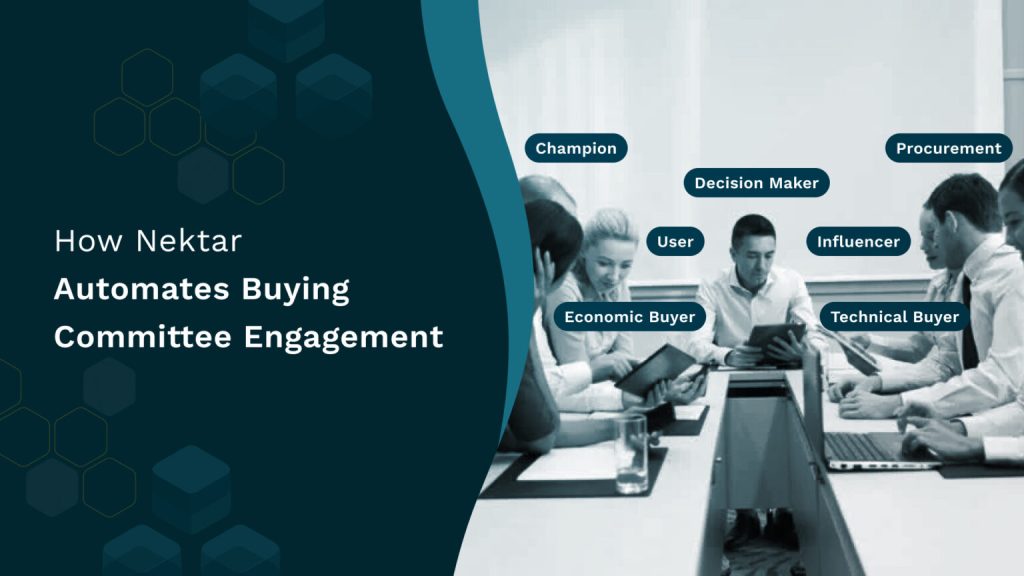
How Nektar Automates Buying Committee Engagement
- RevOps
- 11 min
- Updated: August 4, 2026
Salesforce’s data model has three objects relevant to a buying committee: Account, Contact, and Opportunity Contact Role. A Contact is a person. An OCR is a static label, “Decision Maker,” “Influencer”, attached to an Opportunity. That’s the entire model. It was built to store contacts. It was never built to map a buying group, and that distinction is architectural, not semantic.
The average enterprise deal involves 6 to 10 decision participants. The average CRM opportunity has one or two OCRs. A rep who wants to log a third has to remember to create it, assign a role, and keep it current by hand. In practice, almost nobody does this consistently, and the gap between what’s actually happening in a deal and what’s recorded in Salesforce quietly compounds.
Get our latest insights into your inbox

Why This Gap Exists, and Why It's Getting Worse
An OCR captures a label at a single point in time. It doesn’t track whether that person is engaging, disengaging, newly arrived, or gone. A contact tagged “Champion” who stopped responding three weeks ago looks identical in Salesforce to one who replied yesterday. The label exists. The signal behind it doesn’t.
Every system that reads CRM data inherits this blind spot: forecasting models, ABM platforms, customer success tools, attribution engines, and increasingly, AI agents. When a human reads an incomplete CRM record, they can sense-check it, ask a follow-up question, or lean on institutional memory. When an AI agent reads the same record, it takes it at face value. If Salesforce shows one contact on a deal, the agent plans around one contact.
Salesforce’s own April 2026 Headless 360 initiative made every core Salesforce capability available as an API, specifically so agents can read, write, and execute workflows without a human opening a browser first. That’s a real shift in what an incomplete buying group actually costs. It used to produce a slightly-off report a manager could catch. Now it can produce a wrong decision made by software, at a speed nobody catches in time.
What Breaks Across the Business When Buying Groups Go Unmapped
The gap above doesn’t create one problem. It creates a different failure in every function that touches CRM data.
In sales, a rep who inherits an account from a departing colleague gets three logged contacts on a key opportunity when the real buying group was nine. Months of relationship context, who the real blocker was, which VP had a back-channel, evaporate the moment the previous rep leaves. A closed-lost re-engagement trigger fires on the one contact still in the system, while the five or six other people who actually shaped that decision were never captured at all.
In sales leadership and forecasting, a CRO’s mandate to “multithread every deal above $200K” has no way to be measured, since there’s no data showing whether a labeled “Executive Sponsor” has attended a meeting in the last month or gone quiet. Forecast models score deals on the activity they can see, which typically represents a fraction of what’s actually happening in the account.
In marketing, a VIP re-engagement campaign gets built from CRM contacts that cover maybe one or two people per account, while the procurement lead and technical evaluator who actually shaped the original decision never make it onto the list. A prospect’s CFO can attend a webinar six weeks before close and never show up in an attribution report, because nobody added them as an OCR.
In customer success, a champion leaves for a new role three months before renewal, and the team discovers there’s no fallback relationship, because nobody ever recorded who else in the account cared about the outcome. QBR invites go to the two or three operational contacts CS already knows, while the executives who cared about strategic outcomes were never mapped in the first place.
In RevOps, a meaningful share of the team’s time goes to chasing and cleaning contact data that was incomplete by design from the start, since adding more contacts manually doesn’t solve a problem that’s actually about missing engagement context, not missing names.
How Nektar Automates Buying Group Engagement
Nektar’s approach starts from a different premise than “get reps to log more contacts.” The data already exists, it’s in the emails, the calendar invites, and the meeting attendee lists generated by normal sales activity every day. What’s missing is the layer that captures it, structures it, attributes it to the right opportunity, and writes it into Salesforce automatically. Four capabilities do this end to end:
1. Automated Opportunity Contact Role Creation
Nektar automatically identifies stakeholders from real email and meeting activity and creates the corresponding Opportunity Contact Role, with no rep input required. Every relevant person gets documented and correctly associated with the opportunity as the relationship develops, not just the one or two contacts a rep remembered to add manually.
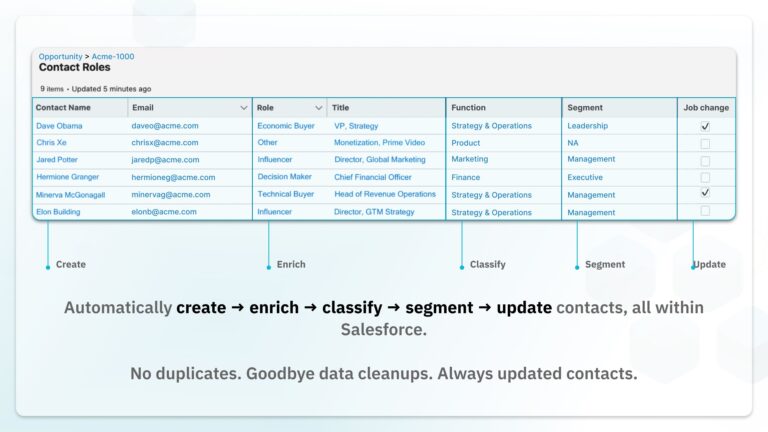
Why it matters: Eliminates the manual entry that made OCR data unreliable in the first place, keeps contact roles accurate and consistent rather than dependent on rep memory, and gives sales and RevOps leadership a real, current view of who’s actually involved in a deal.
2. Conditional OCR
Contact roles get created based on specific, predefined conditions your team actually cares about, not a one-size-fits-all rule. Different sales teams or business units can tailor exactly when and how a contact role gets assigned.
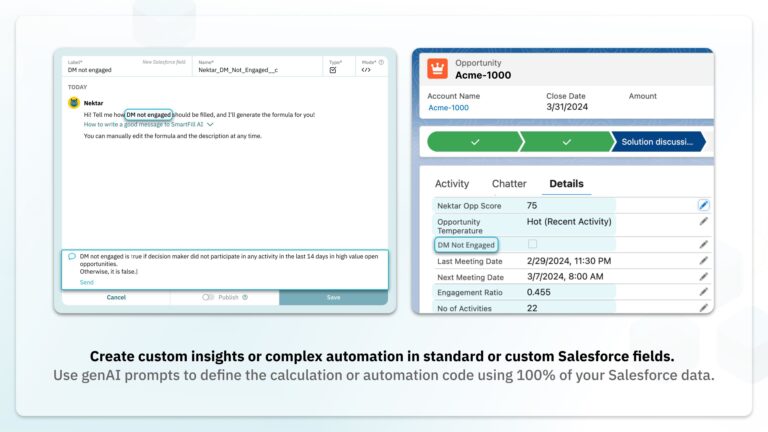
Why it matters: Adapts to your specific sales process rather than forcing a generic structure onto it, keeps contact-role creation focused on genuinely relevant people rather than every name that appears in an inbox, and scales to complex sales environments with large, varied buying committees.
3. Intelligent Meeting Tagging
Meetings get automatically tagged with relevant context, using AI to identify key details and associate them with the right contacts and opportunities, closing the gap between what happened in a meeting and what’s actually recorded about it.
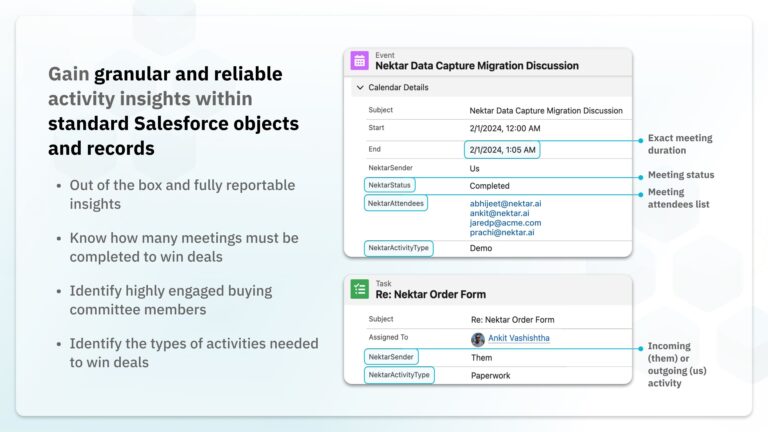
Why it matters: Surfaces real insight into what a meeting actually covered and how it went, keeps meeting data consistently captured and tagged rather than dependent on a rep writing it up afterward, and frees reps to focus on the conversation instead of the paperwork that follows it.
4. Contact Participation (Meeting Intelligence)
Nektar tracks and analyzes who actually attends and participates in meetings, not just who was invited, giving a real read on engagement levels across every stakeholder in the buying group.
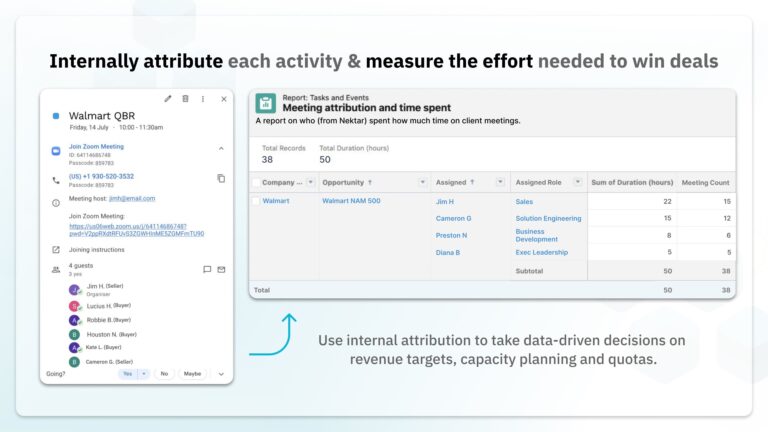
Why it matters: Identifies real influencers and decision-makers based on actual participation rather than title alone, helps tailor follow-up strategy to who’s genuinely engaged versus who’s gone quiet, and gives sales leadership a data-driven read on buying group dynamics instead of a rep’s best guess.
How GuideCX Got Visibility Into $1.7M of Inactive Pipeline
Every company wants to squeeze the most revenue possible out of its active pipeline, but inactivity and poor engagement quietly bury deals that never officially close as lost, they just stop moving. GuideCX transformed how it prioritized deals using process automation built on customized rules that considered the engagement data Nektar captured directly in their CRM. That gave GuideCX instant visibility into $1.7M worth of inactive deals that would otherwise have been written off entirely.

Nealesh Patel
CRO, Crunchbase
Nektar has made it so much easier to work with consistent data across teams. It's like they've brought order to the chaos, and we're seeing the results in our growth.
Start tracking your committee that actually buys.
What Full Buying Group Coverage Actually Changes
Teams that move from a handful of logged contacts to genuine, engagement-aware buying group visibility see the difference show up directly in deal outcomes. Data from conversations on The Revenue Lounge podcast with GTM leaders found fully mapped buying groups driving 2.4x larger deal sizes, 23% faster sales cycles, and 60% less pipeline fallout. Palo Alto Networks specifically saw a 15x pipeline impact after shifting from single-contact tracking to a genuine buying-group model. Marketing teams using Nektar’s contact data surface roughly 2x more influenced contacts and 3x more attribution than they could see before.
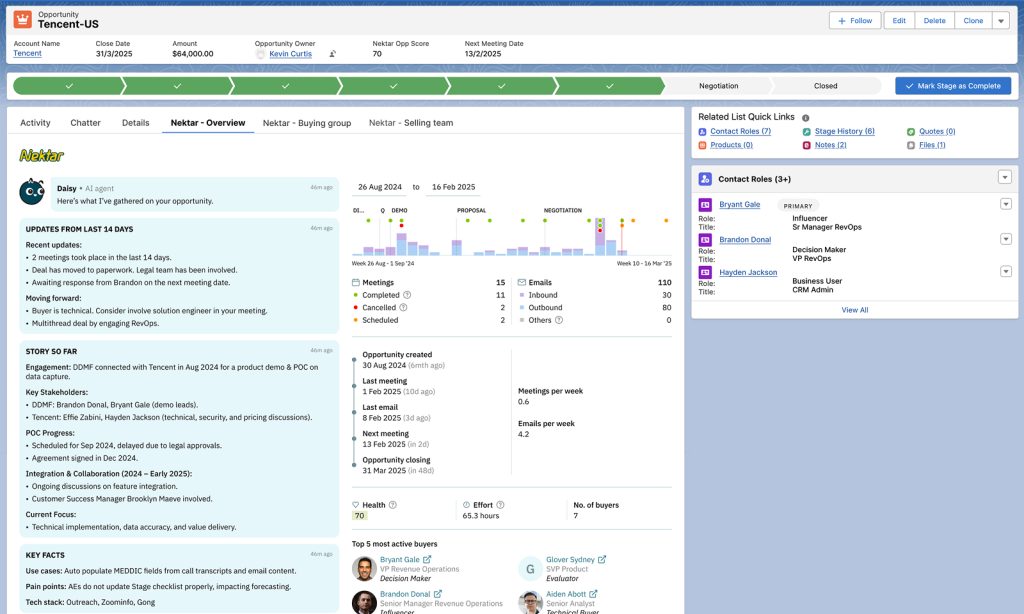
None of that comes from adding more fields to Salesforce. It comes from the underlying engagement data actually being there when someone, or something, goes looking for it.
A Few Questions Worth Addressing Directly
Q. Doesn’t a conversation intelligence tool already do this?
Conversation intelligence captures what was said on a call. It doesn’t automatically map the full buying group, assign persona roles, or attribute engagement to the correct opportunity across a multi-opportunity account. The two are different data layers that complement each other rather than overlap, transcript context tells you what happened; buying group intelligence tells you who was actually in the room, across every channel, not just recorded calls.
Q. We already mandate that reps log more contacts.
That tends to hold for a few weeks after a sales kickoff and then decay, because manual entry is structurally unreliable for something that needs to be comprehensive, continuous, and correctly attributed to the right deal. The reps with the most complex, highest-value buying committees are also the ones with the least spare time to document them by hand.
Q. We have plenty of contacts on our accounts already.
Contacts sitting on an Account record aren’t the same as an engagement-aware buying group mapped to a specific Opportunity. Fifty contacts on an account and one OCR on the opportunity tied to it is the norm, not the exception, and the gap isn’t about contact volume. It’s about structured, current engagement data tied to the deal that’s actually in motion.
Frequently Asked Questions
Q. What is an Opportunity Contact Role (OCR) in Salesforce?
An OCR is a standard Salesforce object linking a Contact to an Opportunity with a specified role (Decision Maker, Influencer, and similar). It’s a static label assigned manually by a rep, with no built-in connection to engagement data, so it tells you a role exists without telling you whether that person is still actively involved.
Q. How many stakeholders are typically involved in a B2B buying decision?
Gartner’s widely cited research puts the average enterprise deal at 6 to 10 decision participants. Most CRM opportunities show only one or two logged contact roles, a gap Nektar is built specifically to close.
Q. Does automating buying group tracking replace the need for a rep to build relationships?
No. It removes the manual documentation burden, tracking who’s involved, tagging meetings, updating contact roles, so reps can spend that time on the relationship itself rather than the record-keeping around it.
Q. Why does buying group visibility matter more now that AI agents are involved?
Because AI agents increasingly read and act on CRM data directly, without a person reviewing it first. An agent working from a CRM that shows one contact on a nine-person deal will plan and act accordingly, with no way to know the picture is incomplete unless the underlying data actually reflects reality.
Ready to Automate Buying Group Engagement in Your Own CRM?
A deal that looks single-threaded in Salesforce and a deal that actually is single-threaded are not the same thing, and right now, most CRMs can’t tell you which one you’re looking at.
Get a free CRM scan to see how much of your own buying committee is currently invisible to your CRM, or explore Buying Group Intelligence for the full picture of how Nektar closes that gap.
Enjoyed our content? Follow Nektar on LinkedIn