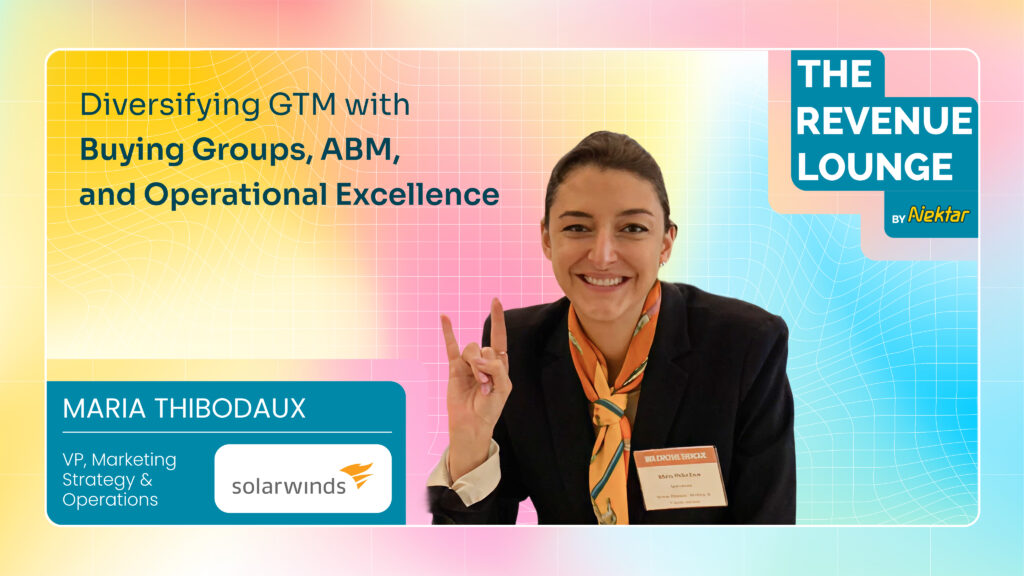
Diversifying GTM With Buying Groups, ABM & Operational Excellence A conversation with Maria Thibodaux, Vice President, Marketing Strategy & Operations at Solarwinds. Executive Summary SolarWinds’ VP of Marketing Strategy & Operations, Maria Thibodaux, outlines how the company is modernizing B2B marketing without discarding proven levers. The MQL remains useful, but only as one node in a diversified system that also includes ABX and buying-group engagement, events and channel routes to market, and brand building to earn a spot in the consideration set long before form fills. The operating model leans on governed processes, interoperable tech, and data storytelling to connect disparate signals into decisions sales can act on. AI is applied pragmatically—first to reduce manual load in lead management and routing, then to pilot agents that support expansion and renewals. Throughout, sales and marketing co-own platforms and outcomes, trading “handoffs” for shared accountability. Key points at a glance MQLs evolve, not vanish: Treat them as demand capture while ABX and buying-group motions drive depth and coverage. Portfolio GTM: Balance always-on digital with targeted ABX, buying-group plays, in-person events, and channel to reach specific accounts and regions. Brand + demand balance: Protect brand investment so you are in the top-three consideration set when buyers self-educate. Data storytelling over dashboards: Custom schemas and connected data (CRM, MAP, intent, events) mirror the real GTM motion and explain outcomes credibly. Pragmatic AI: Start with high-impact efficiency (lead management, routing, follow-ups), then test agents for expansion and renewals. Tight sales–marketing loop: Marketing runs key platforms used by sales and stays engaged post-launch to ensure adoption and results. Governance matters: Standardized codes, budgets, and processes make multi-touch measurement and experimentation possible at scale. Facebook Twitter Youtube Introduction Marketing leaders today are redefining how they measure success, allocate budgets, and engage buyers. For Maria Thibodaux, Vice President of Marketing Strategy and Operations at SolarWinds, the key isn’t in abandoning legacy metrics like MQLs — it’s about integrating them into a broader, more intelligent revenue ecosystem that reflects how modern buyers actually behave. In this in-depth conversation with The Revenue Lounge, Maria shares how SolarWinds is evolving its marketing operations, blending ABX and buying group strategies, optimizing its tech stack, and leveraging AI to create a seamless bridge between marketing, sales, and customer success. From Corporate Communications to Data-Driven Marketing Leadership Maria’s career began in financial services, where she managed corporate communications before pursuing an MBA at the University of Texas at Austin. That move — and a growing fascination with data-driven storytelling — led her to SolarWinds 14 years ago. “I’ve always loved how data tells a story,” Maria reflects. “It’s not just about reporting numbers; it’s about connecting dots that influence go-to-market strategy and customer experience.” Today, Maria oversees four critical pillars of marketing operations at SolarWinds: Marketing Technology: Managing the GTM tech ecosystem and ensuring alignment with sales systems. Marketing Operations: Driving governance, budget management, and process efficiency. Marketing Analytics: Measuring digital performance and campaign outcomes across the funnel. Strategy: Leading annual planning, QBRs, and strategic alignment across the 200-person global marketing organization. The MQL Isn’t Dead. It’s Just One Piece of the Puzzle There’s an ongoing debate in B2B about whether the MQL (Marketing Qualified Lead) is obsolete. Maria doesn’t see it that way. “MQLs aren’t dead. They’re just one part of a diversified demand portfolio,” she explains. “The real challenge is not choosing between MQLs, ABX, or buying groups — it’s figuring out how to make them all work together.” At SolarWinds, the marketing team treats MQLs as the demand capture mechanism — the “always-on digital storefront” that continues to attract individual buyers. But diversification comes from layered strategies designed for deeper engagement. https://www.youtube.com/watch?v=tKUoI32hsMw Diversifying the GTM Playbook SolarWinds’ go-to-market model is primarily inside sales-driven, but diversification extends through channels, global events, and localized marketing. “Our in-person events have been a big bet,” Maria says. “They help us meet customers where they are — and that’s especially effective in global markets.” The company’s “World Tour” series brings together customers and prospects in regional hubs, driving face-to-face engagement that digital channels often can’t replicate. These events strengthen both the brand and buying-group engagement. Capturing Buying Groups Beyond the Click For Maria, the key to engaging buying groups lies in understanding their internal dynamics. “In our business, practitioners are usually the advocates,” she explains. “They drive the conversation internally, but we still need to appeal to finance, security, and leadership stakeholders.” SolarWinds uses ABX programs to engage each layer of the buying team — from hands-on IT professionals evaluating product functionality to C-level decision makers focused on cost, security, and scalability. ABM and ABX: Same Concept, Smarter Tools Maria believes the concept of ABM hasn’t fundamentally changed — what’s transformed is the tooling. “ABM itself hasn’t evolved as much as the tools that support it,” she notes. “What’s changed is how we touch buyers — more channels, more personalization, more opportunities for engagement.” The rise of intent data and signals has made ABX smarter, allowing SolarWinds to identify readiness earlier and fine-tune engagement sequences. But Maria cautions against over-reliance on automation. “Signals can get noisy,” she says. “The magic is in combining automation with human interpretation to make those signals actionable.” Buyer Fatigue and the Rebirth of Brand Building With inboxes overflowing and LinkedIn feeds saturated, buyer fatigue is real. “We see it in unsubscribes and opt-outs,” Maria says. “The automation overload has made outreach less personal, and buyers are tuning out.” SolarWinds is responding by rebalancing brand and demand efforts. While digital demand capture continues, there’s renewed focus on brand marketing, PR, and event presence — the levers that strengthen recall and trust. “Being present where customers already participate matters,” Maria adds. “It’s about showing up consistently, not just showing up when you need something.” Tech Stack Evolution: From Manual to Intelligent Maria’s team is evolving their tech stack around efficiency, automation, and interoperability. The essentials remain — CRM, ERP, automation tools — but the focus is on AI-driven optimization. “Every year it’s