Building Autonomous GTM Agents
Discover why enterprise AI agents fail after pilot and how to build trusted GTM agents with the right context, data, and governance.
Forecast misses don’t happen overnight. Learn how hidden CRM blindspots derail revenue teams and how to prevent them.
Discover how Fidelity’s VP of Go-To-Market Operations builds trusted, scalable revenue systems from scratch — including data governance, AI, and organizational alignment.
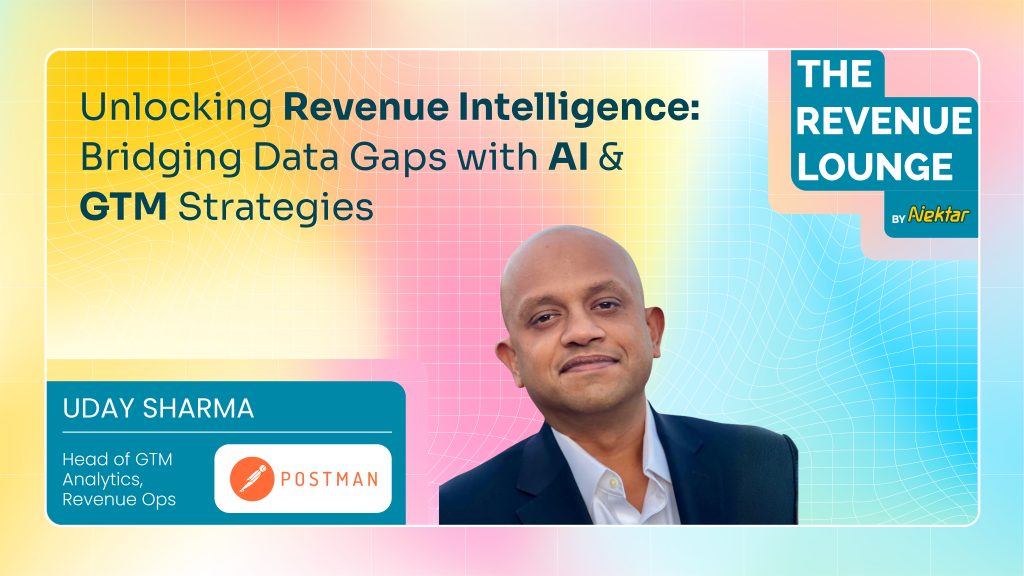
In this episode of the Revenue Lounge Podcast, host Randy Likas and guest Uday Sharma discuss the critical importance of data trust and hygiene in modern revenue operations. They explore how fragmented data can lead to poor decision-making and the necessity of building a centralized data system to enhance revenue intelligence. Uday emphasizes the role of analytics in shaping strategy rather than merely reporting metrics, and the conversation also delves into the implications of AI on data quality and governance. Uday shares insights on how to effectively advocate for funding data initiatives and the importance of changing organizational behavior to improve data practices.
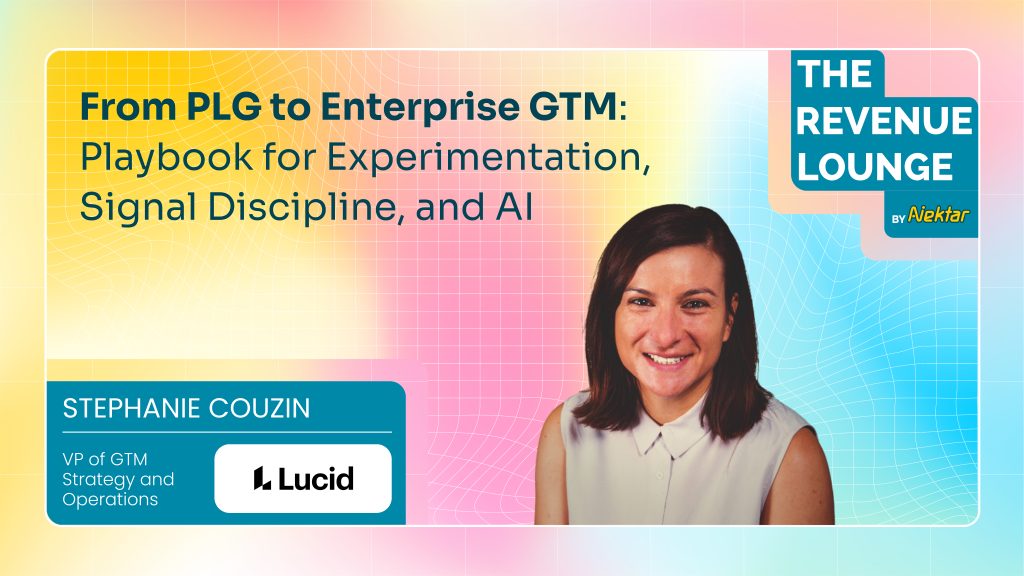
PLG to Enterprise GTM: RevOps Playbook for Experimentation, Signal Discipline, and AI That Actually Works A conversation with Stephanie Couzin. Executive Summary Lucid’s GTM evolution is not a “PLG vs Sales” story. It’s an operating model story. In this episode, Stephanie Couzin (VP, GTM Strategy & Ops at Lucid) breaks down how modern revenue teams can scale experimentation, build enterprise sales muscle, and adopt AI without turning their tech stack into a Frankenmonster. Readers will learn: PLG → Enterprise is a signal shift: you move from optimizing for users to optimizing for accounts, buying committees, and expansion readiness. Experimentation only works if comp risk is managed: GTM tests touch variable pay, so pilots must be designed as true win-wins. Psychological safety is a growth lever: teams ship better ideas faster when people can speak up, fail fast, and share learnings without fear. Data is the cost of entry for GTM testing: if upper-funnel metrics and activity data are messy, your “experiments” turn into opinions. Standardize AI or suffer whack-a-mole: pick a core AI platform to reduce tool sprawl and enable repeatable adoption. Agentic vs Copilot AI are different games: agentic is replacement (parity + cost savings), copilot is augmentation (productivity + more customer time). Start with the use case, not the tool: the fastest path to value is defining the workflow problem first, then deciding buy/build. One priority beats twelve “priorities”: focus drives execution, and execution is the only feature that matters. Facebook Twitter Youtube The Hidden Shift: From “Users” to “Accounts” Early Lucid was deeply product-led, built on a mature self-serve engine. Then came the layering: Sales motion Segmentation Enterprise complexity Multi-threaded post-sales workflows Stephanie describes it as moving from user-centric growth to account-centric expansion. PLG gives you usage.Enterprise GTM demands orchestration. The real challenge isn’t adding sales reps.It’s building the infrastructure to know when, where, and why sales engagement should happen. Experimentation Built Lucid’s Sales Muscle Stephanie points to Lucid’s early experimentation with a Product Qualified Motion. Most PLG companies start with lead scoring at the user level. Lucid evolved it further: Not just which user is engaged But what is the account telling us? And who should we reach out to now? That shift is everything. “Where that really evolved over time was identifying at the account level, what are the signals we need to outreach at the right time with the right messaging.” — Stephanie Couzin That’s the marriage of: First-party product signals Third-party intent and context Segment-aware targeting Persona-aware outreach Stephanie calls it the “special sauce” of modern lead scoring. The Account Expansion Checklist (Lucid’s Internal Recipe) Stephanie hints at what many GTM teams lack: an internal definition of “ready.” Lucid has an internal checklist: “A set of account signals where we say: this account is locked and ready to expand.” If the checklist isn’t met, Lucid doesn’t stop. They reverse-engineer value: You use Slack? You use documentation tools? You have workflows Lucid integrates into? Then Lucid doesn’t sell harder. They sell smarter: “This is how you get more value.” Cross-Functional Alignment: Experimentation Without Chaos Testing in GTM is not like testing in product. Because in revenue… someone’s commission is always involved. Stephanie puts it bluntly: “Testing something new will impact someone’s variable compensation.” — Stephanie Couzin So experimentation requires designing for buy-in. Lucid ran a coverage pilot by: Using lower-risk accounts Making rep trades fair Ensuring nobody felt punished for participating A GTM experiment only works if it’s a win-win. Otherwise reps sandbag, ignore, or resist. And your “pilot” becomes theater. Psychological Safety Is the Real GTM Scaling Lever Stephanie goes deep here, referencing Google’s Project Aristotle – Google studied what makes teams high-performing. The #1 factor wasn’t IQ.It wasn’t experience.It wasn’t process. It was: psychological safety. “They could speak up without fear of consequence. They felt freedom to fail fast.” — Stephanie Couzin Stephanie teaches this internally at Lucid. And she’s clear: This isn’t about politeness.It’s about intentional leadership. Practical mechanisms Lucid uses: Weekly project show-and-tells “Smart Fridays” where reps share plays Normalizing learnings over perfection The GTM Psychological Safety Loop Safe to speak → More ideas → Faster experiments → Better learning → Higher trust → Stronger execution Data Discipline: The Unsexy Requirement for GTM Experiments Stephanie delivers one of the hardest truths in RevOps: Lower funnel data is solid. Upper funnel data is… suspicious “As you move further up funnel… fewer eyes are on those metrics.” — Stephanie Couzin Testing requires: Full-funnel accuracy Integrated activity capture Shared KPI definitions Governance (tagging, segmentation discipline) AI in GTM: Standardize or Suffer Stephanie’s AI governance advice is refreshingly simple: “Standardize on something. Otherwise you’re in whack-a-mole.” Lucid standardized on Google Gemini. Not because it solves every revenue use case. But because: It reduces fragmentation It sparks shared experimentation It creates repeatable workflows It prevents reps from duct-taping random tools together The goal is not AI everywhere. The goal is AI that fits into systems. The Most Important GTM AI Rule: Start With Use Cases, Not Tools Stephanie nails this: “What use case are you trying to solve, not what tool do you want?” Because shiny object syndrome is real. Most orgs buy AI like toddlers choosing cereal: “Ooh, the box is shiny.” Lucid forces the opposite: Define workflow pain first.Then evaluate tooling. AI Use Case Intake Form What GTM workflow breaks today? What manual effort exists? What does “better” look like? Is this assistive or agentic? Can current stack solve 80% already? What data sensitivity is involved? What adoption friction will occur? Agentic AI vs Copilot AI: Stop Confusing the Two Agentic AI Replaces human work Measured in cost savings Goal is parity (“do no harm”) Copilot / Assistive AI Enhances workflows Measured in productivity and customer time Harder to quantify, but more transformative “Most AI we adopt for revenue teams is assistive. It makes teams more productive.” That’s where the real gains are: Better prep Faster follow-up Less manual CRM work More customer-facing time The GTM Takeaway Stephanie Couzin’s playbook isn’t about
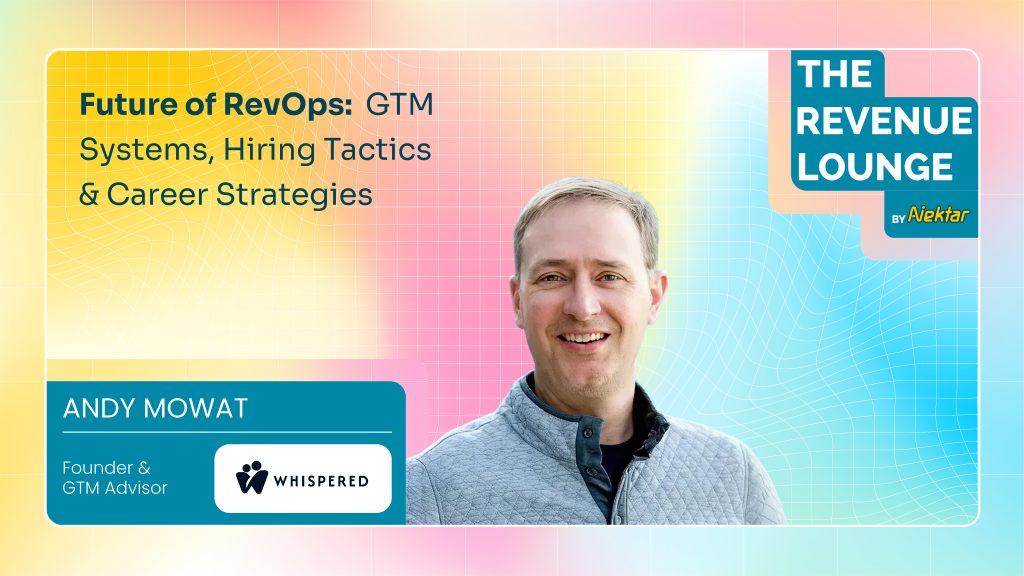
A RevOps Playbook on the GTM Power, Careers and Hiring Strategies A conversation with Andy Mowat Executive Summary Andy Mowat has navigated the go-to-market journey from every angle—entrepreneur, operator at four tech unicorns (Box, Culture Amp, Carta), and now founder of Whispered. In this conversation, Andy shares hard-earned lessons on what separates strategic RevOps leaders from tactical executors, why the GTM tech stack is dying, how to take control of executive interviews, and why most people are dangerously cheap about investing in their careers. This isn’t theory. It’s a playbook built from someone who’s been the “wrong person for the job” four times and figured out how to win anyway. Readers will learn: RevOps is evolving from an execution function into a strategic GTM decision engine. The best RevOps leaders earn trust by forcing trade-offs, not by saying yes to everything. Legacy GTM stacks are breaking. Data fluency and AI-ready systems are becoming mandatory. GTM engineers are emerging under RevOps to automate execution and scale insight. Most executive roles are never posted. Senior hiring happens through networks and backchannels. Hiring favors builders who can get into the weeds, not just managers of managers. Strong candidates take control of interviews and show how they think, not just what they’ve done. Career leverage now comes from networks, reputation, and visible thinking, not applications. Facebook Twitter Youtube From Accidental RevOps to GTM Architect: Andy’s Career Arc Andy did not plan to end up in revenue operations. He stumbled into it the way many of the best RevOps leaders do. Early in his tech career, he joined Upwork. There was no CRM. So he built one. There was no outbound engine. So he figured out how to send a million emails. There was no formal RevOps function. So he became it. This pattern repeated. At Box, post-IPO, he took over post-sales operations, then marketing ops. At Culture Amp, he helped scale revenue from roughly $5M to $150M. At Carta, he entered during another inflection point, surrounded by leaders who understood that GTM decisions compound quickly, for better or worse. Across these roles, Andy learned something that most operators learn too late. RevOps is not a service desk. It is the economic engine room. The Real Difference between Tactical & Strategic RevOps Most RevOps leaders think their job is to execute requests efficiently. Andy believes that is how RevOps loses credibility. The inflection point in his thinking came at Box, when the company’s CCO told him “he’s not getting headcount unless the business gives it to him”. Instead of asking for budget, Andy began forcing trade-offs. He showed Sales, Support, and Customer Success how RevOps leverage could outperform incremental hiring. When leaders realized that one RevOps hire could unlock more growth than two frontline hires, budget appeared quickly. Andy’s rule is simple. If RevOps says yes to everything, it is not strategic.If RevOps forces prioritization conversations with executives, it is. “The wrong answer is ‘We got it.’The right answer is ‘Here’s the priority order I see. If we disagree, let’s take it to the CRO.” — Andy Mowat Where RevOps is Actually Headed Andy does not believe today’s GTM stack survives the next five years. He is tracking more than a dozen “CRM 2.0” challengers. His core criticism of legacy tools is structural, not cosmetic. Current GTM systems have: Clunky user experiences Data models not designed for AI Endless bolt-ons that fragment signal quality The Non-Negotiable Skills a RevOps pro Must Have Data literacy. Know what ETL and DBT actually do. Tight partnership with product and data teams. Embedded analytics and BI inside RevOps. Automation ownership, not tool babysitting. He also pushes back on the myth of the “GTM Engineer” as a shortcut. There is no shortcut. But there is a new function emerging. “GTM Engineers should live under RevOps.Their job is to automate the business and innovate for the reps.” — Andy Mowat https://youtu.be/H3CesaCmKWA What is Whispered? Whispered did not start as a company. It started as a survival mechanism. After a failed startup, Andy found himself asking a question many senior leaders never admit out loud.“Will anyone Hire me again?” At senior levels: Roles are rarely posted. Recruiters control access. Company quality is opaque. Networks go stale quietly. “Your next role won’t be posted. It’ll be whispered.” — Andy Mowat Whispered is designed for VP+ GTM leaders who are curious but cautious. It combines: Career playbooks Company backstory intelligence Unposted role discovery Network swarming across 300,000+ first-degree connections A private community that trades signal, not hype People join for roles. They stay for the network. Strategies for Hiring Senior Executives Through Whispered Hiring, Andy has interviewed dozens of CEOs, CROs, and CMOs about how they evaluate senior talent. Several patterns repeat. 1. Back-Channels Are the Highest Signal Everyone uses them. Everyone admits it. The best advice he heard recently: “Back-channel before you fall in love with a candidate.” 2. Builders Are in Demand Even at senior levels, companies want leaders who can still get into the weeds.AI has increased this expectation, not reduced it. 3. Rigid Thinkers Lose Andy calls it anti-rigidism, not ageism. Leaders who cannot adapt get filtered out quickly. 4. Slope Matters, but Only with Pattern Recognition High-growth companies love people who can outgrow their role. But leadership teams need both: Builders with slope Operators with scars Out perform your next Interview call Andy comments, treat your interview as a Sales call. Andy’s favorite interview opener is disarming. “I’m excited to meet you. What questions do you have?” Then he watches. Great candidates take control. Weak candidates wait to be prompted. Lazy questions kill momentum. Deep questions reveal how someone thinks. Interview Question Upgrade Instead of:“What’s your strategy?” Ask:“Here are three GTM constraints I see. Which one worries you most right now?” The goal is not to impress. It is to create signal. Personal Brand Without Becoming an Influencer Andy draws a line between thought leadership and performance. He writes because he cares and because writing clarifies thinking. It