
Marketing

Marketing, RevOps

10 Best Account Based Marketing Tools for 2026

10 Best Account Based Marketing Tools for 2026 Marketing 10 min Updated: July 16, 2026 Account-based marketing tools have gotten better at execution but are not easier to run at scale. Multi-channel ABM campaigns still require real coordination between sales and marketing, and the tools in this category exist to make that coordination less painful, whether that means better targeting, better personalization, or better reporting on what’s actually working. Two things are worth knowing before you evaluate anything on this list. First, this category has consolidated meaningfully in the last few years, several tools that used to be independent are now part of larger platforms, and it’s worth knowing which is which before you sign a contract expecting the standalone product. Second, ABM’s underlying data problem has gotten a new dimension: as more marketing and sales tools add AI features on top of account and contact data, that data has to be genuinely accurate, not just directionally useful, or the AI layer amplifies whatever gaps are already there. Get our latest insights into your inbox What is ABM? Account-based marketing flips the traditional funnel. Instead of casting a wide net and qualifying leads down to a smaller set, marketing and sales work together from the start to: Identify high-value accounts that fit ICP criteria Engage them with personalized content Find and map the actual decision-makers involved Move them toward closure together Stay engaged post-sale to capture expansion opportunities ABM isn’t one-and-done selling. It’s built around customer lifetime value, which is also why the data behind it has to stay accurate well past the initial close. Marketing Attribution Usecase Uncover hidden first-party contacts to drive your ABM efforts with Nektar Map buyer group intelligence hidden in sales conversations Create personalized ABM Campaigns Discover hidden pipeline from first-arty contacts 10 ABM Tools for 2026 6sense Revenue AI, predictive account intelligence and journey orchestration HubSpot Marketing Hub, omnichannel personalization for HubSpot-native teams Demandbase, account-based experience across three integrated modules Terminus (now part of DemandScience), multi-channel ABM with native email-signature marketing RollWorks, ABM built around paid ad execution Foundry Intent (formerly Triblio), intent data and web personalization bundled with Foundry media Vainu, sales intelligence and account data for list building Apollo.io, prospecting, engagement, and ABM in one platform Uberflip, content personalization and distribution for ABM Alyce by Sendoso, AI-personalized corporate gifting for account engagement Overview of the 10 Best ABM Tools 1. 6sense revenue AI 6sense helps marketing teams identify high-value accounts, predict where they are in the buyer journey based on account activity, and engage them with the right message at the right touchpoint. Features: automatically updates contact lists with additional firmographic information, segments accounts into behavioral cohorts, tracks activity across channels and attributes it back to the account. Pricing: Custom, based on users and use case. 2. HubSpot Marketing Hub HubSpot Marketing Hub is an omnichannel marketing solution with particularly powerful personalization tools. You can use them to set up and automate hyper-targeted messaging across multiple touchpoints to reach and engage with specific prospects. Features: automatically segments contact lists based on customer criteria, spots prospects who mirror your top customers through lookalike lists, personalizes messaging across landing pages, emails, socials, and more. Pricing: Marketing Hub Starter: $7/user/month Marketing Hub Professional: $800/month Marketing Hub Enterprise: $3,600/month Free marketing tools with limited features are also available 3. Demandbase Demandbase runs on the Account-Based Experience concept across three connected modules: ABX Cloud for ABM strategy, Advertising Cloud for campaign management, and Data Cloud for integration support. Features: account-level insights for campaign execution, support for multiple ad formats across global markets, straightforward integration with existing stacks. Pricing: Custom, based on use case and team size. 4. Terminus (now part of DemandScience) Terminus merged into DemandScience in November 2024. The product continues to operate under the Terminus name, now backed by DemandScience’s broader B2B data and demand-generation assets, and still includes the native email-signature marketing (via its earlier Sigstr acquisition) that differentiates it from most other platforms on this list, turning every outbound employee email into an addressable ABM surface. Features: in-depth segmentation including buyer intent, multi-channel campaign support (ads, chat, email signatures, web personalization), a built-in B2B CDP. Pricing: Quote-based; third-party buyer data puts mid-market packages around $40,000 to $80,000 annually, with enterprise tiers higher. 5. AdRoll ABM (formerly RollWorks) RollWorks was fully rebranded to AdRoll ABM in August 2025, when parent company NextRoll unified its AdRoll and RollWorks brands into one platform. It’s the same product, team, data, and pricing as before, just operating under the AdRoll name, and remains a good fit for marketers who rely primarily on paid ads for account-based lead generation. Features: targeting recommendations based on historical campaign performance, account-to-decision-maker mapping with contact information, contextual account signals like org changes, mergers, and acquisitions. Pricing: Starter plan around $975/month; contact sales for other tiers. 6. Foundry Intent (formerly Triblio) Triblio was acquired by IDG, now Foundry, back in 2020, and the product has been sold as Foundry Intent for several years. If you’re evaluating this expecting the independent Triblio product, know upfront that pricing and packaging now tie more closely to Foundry media-spend commitments than the standalone product used to. It’s a strong fit specifically for enterprise tech and IT vendors already buying Foundry/IDG content syndication, since its intent data draws from IDG’s own editorial coverage areas (security, cloud, enterprise software) and is noticeably weaker outside them. Features: visual, drag-and-drop campaign builder, intent- and activity-based conversion probability scoring, web personalization bundled with Foundry’s media inventory. Pricing: Tied to media-spend commitments; contact Foundry directly. 7. Vainu Vainu is a sales intelligence tool for finding high-value accounts from its global company database, speeding up list-building with contextual account information. Features: targeted contact lists built from ICP filters, automatic updates as new contacts are found, a single consolidated view of contacts stored across other tools. Pricing: Free trial available. Team plan around €4,200/year, Business around €9,900/year, Global around €12,000/year, custom Enterprise pricing. 8. Apollo.io Apollo.io combines prospecting, campaign orchestration, and sales engagement, letting you

Buying Group, GTM, Marketing

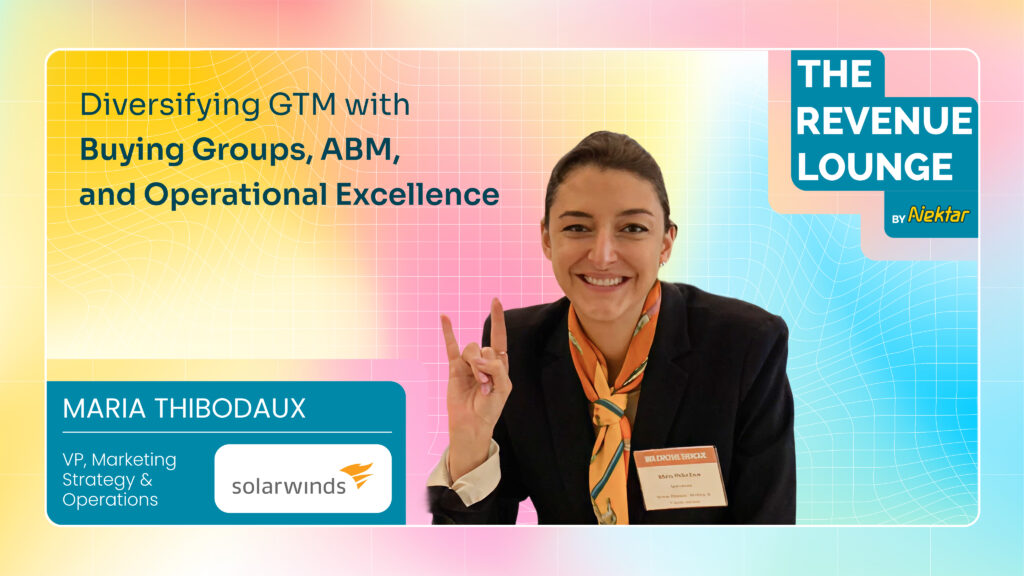
Diversifying GTM with Buying Groups, ABM, & Operational Excellence

Diversifying GTM With Buying Groups, ABM & Operational Excellence A conversation with Maria Thibodaux, Vice President, Marketing Strategy & Operations at Solarwinds. Executive Summary SolarWinds’ VP of Marketing Strategy & Operations, Maria Thibodaux, outlines how the company is modernizing B2B marketing without discarding proven levers. The MQL remains useful, but only as one node in a diversified system that also includes ABX and buying-group engagement, events and channel routes to market, and brand building to earn a spot in the consideration set long before form fills. The operating model leans on governed processes, interoperable tech, and data storytelling to connect disparate signals into decisions sales can act on. AI is applied pragmatically—first to reduce manual load in lead management and routing, then to pilot agents that support expansion and renewals. Throughout, sales and marketing co-own platforms and outcomes, trading “handoffs” for shared accountability. Key points at a glance MQLs evolve, not vanish: Treat them as demand capture while ABX and buying-group motions drive depth and coverage. Portfolio GTM: Balance always-on digital with targeted ABX, buying-group plays, in-person events, and channel to reach specific accounts and regions. Brand + demand balance: Protect brand investment so you are in the top-three consideration set when buyers self-educate. Data storytelling over dashboards: Custom schemas and connected data (CRM, MAP, intent, events) mirror the real GTM motion and explain outcomes credibly. Pragmatic AI: Start with high-impact efficiency (lead management, routing, follow-ups), then test agents for expansion and renewals. Tight sales–marketing loop: Marketing runs key platforms used by sales and stays engaged post-launch to ensure adoption and results. Governance matters: Standardized codes, budgets, and processes make multi-touch measurement and experimentation possible at scale. Facebook Twitter Youtube Introduction Marketing leaders today are redefining how they measure success, allocate budgets, and engage buyers. For Maria Thibodaux, Vice President of Marketing Strategy and Operations at SolarWinds, the key isn’t in abandoning legacy metrics like MQLs — it’s about integrating them into a broader, more intelligent revenue ecosystem that reflects how modern buyers actually behave. In this in-depth conversation with The Revenue Lounge, Maria shares how SolarWinds is evolving its marketing operations, blending ABX and buying group strategies, optimizing its tech stack, and leveraging AI to create a seamless bridge between marketing, sales, and customer success. From Corporate Communications to Data-Driven Marketing Leadership Maria’s career began in financial services, where she managed corporate communications before pursuing an MBA at the University of Texas at Austin. That move — and a growing fascination with data-driven storytelling — led her to SolarWinds 14 years ago. “I’ve always loved how data tells a story,” Maria reflects. “It’s not just about reporting numbers; it’s about connecting dots that influence go-to-market strategy and customer experience.” Today, Maria oversees four critical pillars of marketing operations at SolarWinds: Marketing Technology: Managing the GTM tech ecosystem and ensuring alignment with sales systems. Marketing Operations: Driving governance, budget management, and process efficiency. Marketing Analytics: Measuring digital performance and campaign outcomes across the funnel. Strategy: Leading annual planning, QBRs, and strategic alignment across the 200-person global marketing organization. The MQL Isn’t Dead. It’s Just One Piece of the Puzzle There’s an ongoing debate in B2B about whether the MQL (Marketing Qualified Lead) is obsolete. Maria doesn’t see it that way. “MQLs aren’t dead. They’re just one part of a diversified demand portfolio,” she explains. “The real challenge is not choosing between MQLs, ABX, or buying groups — it’s figuring out how to make them all work together.” At SolarWinds, the marketing team treats MQLs as the demand capture mechanism — the “always-on digital storefront” that continues to attract individual buyers. But diversification comes from layered strategies designed for deeper engagement. https://www.youtube.com/watch?v=tKUoI32hsMw Diversifying the GTM Playbook SolarWinds’ go-to-market model is primarily inside sales-driven, but diversification extends through channels, global events, and localized marketing. “Our in-person events have been a big bet,” Maria says. “They help us meet customers where they are — and that’s especially effective in global markets.” The company’s “World Tour” series brings together customers and prospects in regional hubs, driving face-to-face engagement that digital channels often can’t replicate. These events strengthen both the brand and buying-group engagement. Capturing Buying Groups Beyond the Click For Maria, the key to engaging buying groups lies in understanding their internal dynamics. “In our business, practitioners are usually the advocates,” she explains. “They drive the conversation internally, but we still need to appeal to finance, security, and leadership stakeholders.” SolarWinds uses ABX programs to engage each layer of the buying team — from hands-on IT professionals evaluating product functionality to C-level decision makers focused on cost, security, and scalability. ABM and ABX: Same Concept, Smarter Tools Maria believes the concept of ABM hasn’t fundamentally changed — what’s transformed is the tooling. “ABM itself hasn’t evolved as much as the tools that support it,” she notes. “What’s changed is how we touch buyers — more channels, more personalization, more opportunities for engagement.” The rise of intent data and signals has made ABX smarter, allowing SolarWinds to identify readiness earlier and fine-tune engagement sequences. But Maria cautions against over-reliance on automation. “Signals can get noisy,” she says. “The magic is in combining automation with human interpretation to make those signals actionable.” Buyer Fatigue and the Rebirth of Brand Building With inboxes overflowing and LinkedIn feeds saturated, buyer fatigue is real. “We see it in unsubscribes and opt-outs,” Maria says. “The automation overload has made outreach less personal, and buyers are tuning out.” SolarWinds is responding by rebalancing brand and demand efforts. While digital demand capture continues, there’s renewed focus on brand marketing, PR, and event presence — the levers that strengthen recall and trust. “Being present where customers already participate matters,” Maria adds. “It’s about showing up consistently, not just showing up when you need something.” Tech Stack Evolution: From Manual to Intelligent Maria’s team is evolving their tech stack around efficiency, automation, and interoperability. The essentials remain — CRM, ERP, automation tools — but the focus is on AI-driven optimization. “Every year it’s

Scroll to Top

Just one more step