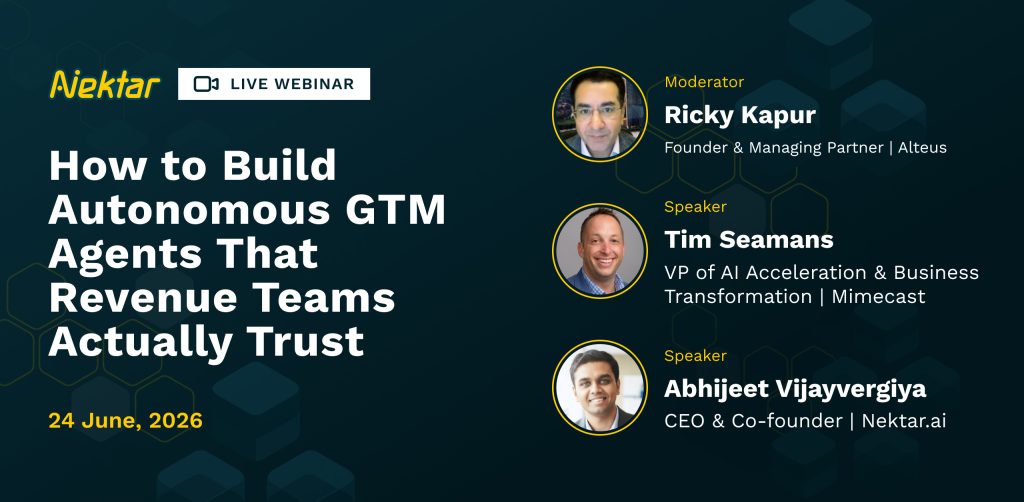
Building Autonomous GTM Agents
Discover why enterprise AI agents fail after pilot and how to build trusted GTM agents with the right context, data, and governance.
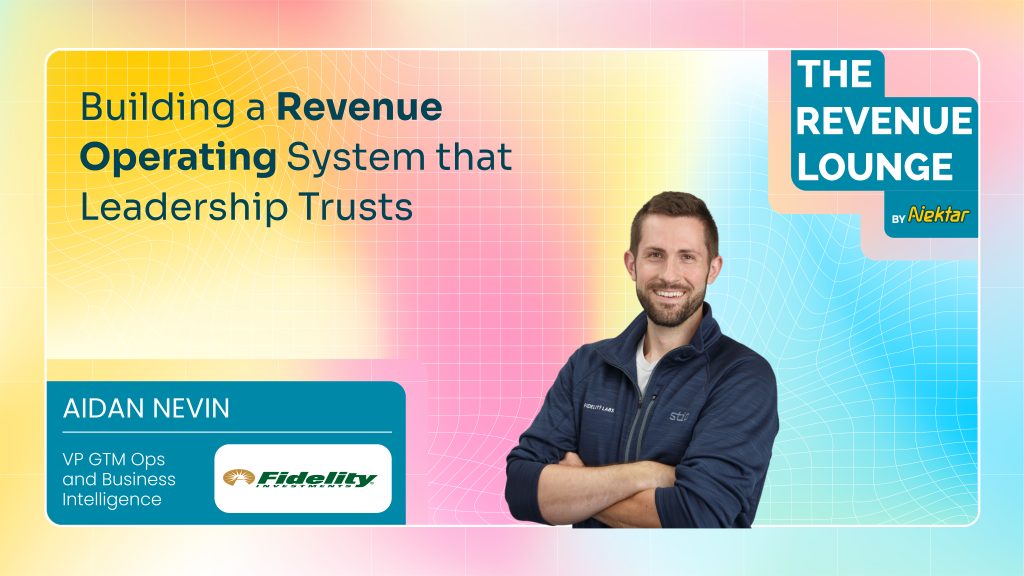
Discover how Fidelity’s VP of Go-To-Market Operations builds trusted, scalable revenue systems from scratch — including data governance, AI, and organizational alignment.
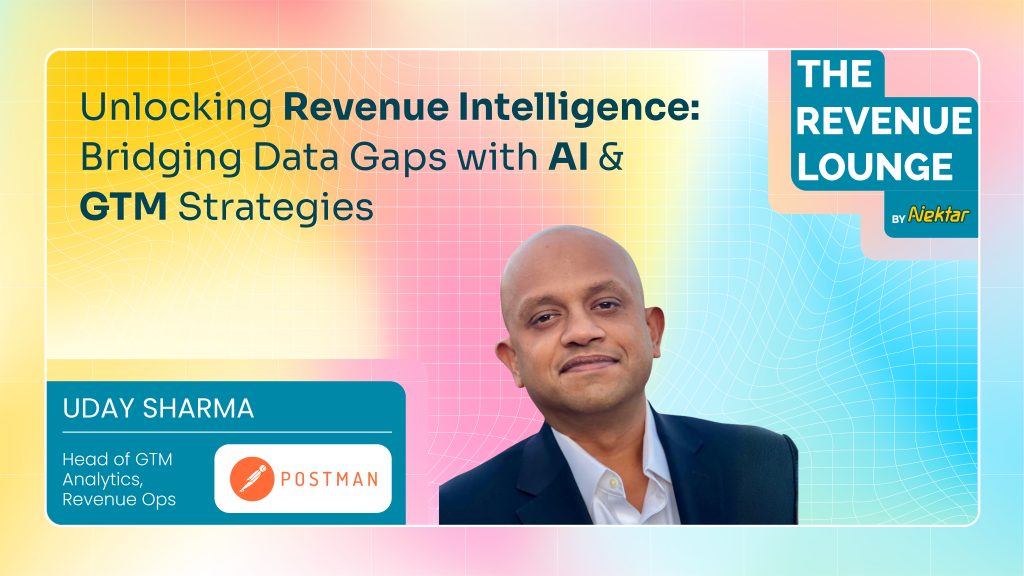
In this episode of the Revenue Lounge Podcast, host Randy Likas and guest Uday Sharma discuss the critical importance of data trust and hygiene in modern revenue operations. They explore how fragmented data can lead to poor decision-making and the necessity of building a centralized data system to enhance revenue intelligence. Uday emphasizes the role of analytics in shaping strategy rather than merely reporting metrics, and the conversation also delves into the implications of AI on data quality and governance. Uday shares insights on how to effectively advocate for funding data initiatives and the importance of changing organizational behavior to improve data practices.
How Nektar Helps AI Hypergrowth Companies Move Even Faster Artificial Intelligence 10 min Fast-moving AI companies are having a moment. Every week a new AI-native startup crosses $100M ARR in what feels like record time. Accel’s 2025 Globalscape report shows a “new breed of AI-native applications” hitting scale much faster than previous generations of SaaS, with some reaching $100M ARR in just a few years. That velocity is backed by unprecedented capital. Prominent AI companies like Cursor, Writer, Groq and Fireworks are raising huge rounds, hiring at triple-digit growth rates, and building products that spread virally from individual builders into the world’s largest enterprises. AI application categories like developer tools, finance, cybersecurity and vertical AI each attracted multiple billions of dollars in 2025 funding alone. Nektar sits right in the middle of this wave. Over the past year, we’ve partnered with some of the fastest-growing AI companies in the US – including Writer, Cursor, Groq, Chainguard and Fireworks to help them turn raw go-to-market activity into clean, structured, AI-ready data they can actually execute on. This blog looks at why AI companies grow differently, what that does to their GTM data, and how Nektar helps them grow even faster. The new AI growth curve: Speed, Efficiency and Youth Funding and company maturity Accel’s data makes one thing clear: AI is no longer a niche category. It’s the new centre of gravity for software investing. Total EU/US/IL cloud & AI funding (excluding models) has climbed into the ~$180B+ range annually, with 2025 setting fresh records. AI model funding is heavily concentrated in the US, but on the application side, EU/IL funding now represents roughly two-thirds of US levels, showing how global this wave has become. The winners look very different from the last SaaS cycle: over 65% of the Accel US & Europe AI 100 are 0–3 years old, and US winners skew especially young at 2.4 years on average. Put simply: AI companies are raising big, hiring fast, and still figuring out their GTM motion on the fly. Bottom-up adoption and insane efficiency AI-native tools are spreading from the bottom up: Developers using AI coding assistants jumped from 36% in 2023 to 90% in 2025 – in just two years. Tools like AI IDEs, agents and copilots are hitting milestones such as “$100M ARR in 8 months” and “10x YoY growth,” according to Accel’s case studies of leading AI-native apps. This isn’t just fast growth – it’s efficient growth. Accel estimates that leading AI applications now generate 3–10x more ARR per employee than prior generations of SaaS companies. But that speed and efficiency create a GTM paradox: You can scale product adoption and revenue incredibly fast. But your GTM data, process and tooling often lag badly behind. The hidden tax of hypergrowth: messy GTM data Most fast-growing AI companies share a few traits: They sell into large, multi-person buying committees (Fortune 500, Global 2000, high-growth tech). They run hybrid motions – PLG bottoms-up adoption plus enterprise sales, often with heavy founder-led or executive-led outbound. Their GTM stack is complex and evolving: Salesforce + Gong + Snowflake + ABM + sequencing tools, changing every few quarters. They are young – which means processes, definitions and data hygiene were rarely “designed,” they just happened. That shows up in four chronic problems: Invisible buying groups Activity sits at the account or activity object level, not tied to which humans are actually influencing a deal. Contact roles are incomplete, incorrect, or simply not used. Multi-threading that’s impossible to measure Leadership wants reps and CSMs to multi-thread. But nobody can answer basic questions like: “How many net new stakeholders did this SDR actually bring in?” “Which deals progressed because we pulled in the economic buyer early?” Broken marketing attribution for enterprise deals First-touch and last-touch models collapse when there are 10–20 stakeholders, dozens of events and campaigns, and long sales cycles. “Marketing sourced” covers only a small fraction of reality. No shared view of the customer journey Pre-pipeline engagement, in-pipeline meetings, onboarding, success reviews, expansion conversations – they live in different systems owned by different teams. This is exactly the gap Nektar is built to fill. Nektar as the data backbone for AI GTM At its core, Nektar is a revenue data platform that: Harvests metadata from communication tools (email, calendar, meetings, sequences). Cleans and transforms that data. Writes it into Salesforce against the right opportunities, accounts, contacts and leads. Automatically creates and updates Opportunity Contact Roles (OCRs) with accurate personas (economic buyer, champion, influencer, etc.). Generates revenue signals that help teams act – from “missing exec sponsor” to “multi-threading risk” to “QBR overdue.” Writer is a great illustration of how fast-moving AI companies use this foundation Writer: building an AI-ready GTM engine on top of Nektar Writer is an enterprise AI platform selling into Fortune 500 and Global 2000 organizations. Their GTM complexity is huge: multi-persona deals, long cycles, and a mix of PLG, partner, and enterprise motions. One activity capture layer for Sales, CS and Marketing Writer started with Nektar in sales, then expanded to sales engineering, customer success and now marketing. Nektar: Captures emails, meetings and other activities from tools like Gmail and calendar. Associates them correctly with accounts, opportunities and contacts in Salesforce. Backfills historical data by “travelling back in time” across past emails and calendars, so data isn’t limited to post-implementation activity. Creates missing contacts and writes them into Salesforce as OCRs with mapped personas. Compared with their previous setup (Gong plus internal workarounds), Writer’s RevOps leaders called out that Nektar simply does a better job of capturing and correctly associating activities, especially in complex account structures with multiple open opportunities. This gives Writer a single, reliable activity dataset they can push into their warehouse (GCP) and model in Omni for analytics – a critical enabler for AI-driven GTM. Making multi-threading measurable (and compensable) Writer wants SDRs and AEs to multi-thread aggressively – and they want to pay them for doing it. The problem: Nektar was so good
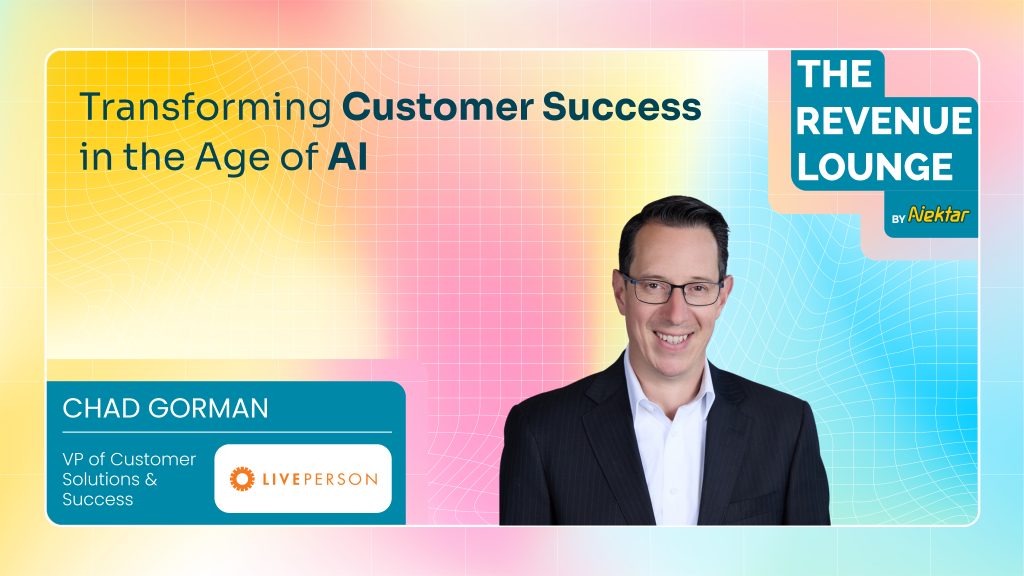
Rebuilding Customer Success for the AI Era: Lessons from a VP of Customer Success A conversation with Chad Gorman. Executive Summary This article examines how customer success leaders should rethink AI adoption, using insights from an in-depth conversation with Chad Gorman, VP of Customer Solutions and Success (North America) at LivePerson, on the Revenue Lounge Podcast hosted by Randy Likas. Rather than focusing on automation or AI features, Gorman argues that AI-ready customer success is fundamentally about visibility, data discipline, and relationship intelligence. Readers will learn: Why most AI initiatives in customer success fail before deployment How unifying fragmented CS data is a prerequisite for AI or automation What an effective early warning system looks like Why engagement and relationship depth are stronger leading indicators than product usage alone How AI can expose relationship “white space” across complex buying committees Where buy vs build decisions actually differ across enterprise and mid-market segments How to embed AI into CSM workflows over-relying on automation Which metrics matter when measuring AI’s impact on retention, risk, and productivity Why the real promise of AI in customer success is reclaimed time for strategic customer work Facebook Twitter Youtube From Call Centers to Customer Outcomes Gorman’s perspective is shaped by an unusual career arc. He started in contact center operations, moved into IT at DirecTV, and then crossed over to the vendor side after a colleague recruited him to Splunk. “I didn’t even know what a CSM was,” he admits. “But once I saw how customer success could be built as a scalable engine, I was hooked.” — Chad Gorman From Splunk, he went on to lead global cloud customer success at VMware, before joining LivePerson, where he now oversees customer success and professional services across North America. That mix of operator, builder, and enterprise leader shows up in how he thinks about AI. Practical. Outcome-driven. Skeptical of hype. AI Adoption Fails Before Deployment Most AI initiatives stumble long before a model is ever deployed. According to Gorman, the real friction points show up earlier in the buying and approval cycle. The Hidden Gates to AI Adoption Governance reviews and AI councils Legal, compliance, and security documentation Industry-specific scrutiny, especially in financial services Undefined success metrics “You can sell software all day long. But if you are not there to shepherd customers through governance, compliance, and approval gates, adoption will stall.” — Chad Gorman Customer Success Has Become Revenue Insurance In volatile markets, customer success is no longer a post-sale support function. It is a revenue protection layer. That shift forces CS leaders to answer harder questions: Where is risk building right now? Which accounts look healthy but are quietly disengaging? Where is expansion hiding in plain sight? The answer, Gorman says, is an early warning system built on stitched data. https://youtu.be/sDdV747jBJA?si=fVE8O2bqTcf2yTeN The Anatomy of an Early Warning System Gorman is blunt about the prerequisite. “Data is non-negotiable. Full stop.” — Chad Gorman Before AI enters the picture, organizations must understand what their book of business actually looks like. Engagement Is the Most Underrated Risk Signal Product usage is table stakes. Engagement is the differentiator. Gorman emphasizes that many churn events are preceded not by usage decline, but by relationship decay. “If engagement drops and you do not notice, you end up ghosted and surprised later.” — Chad Gorman What Engagement Actually Means Engagement is not email volume or meeting counts alone. It is relationship depth across the buying group. Who shows up to meetings? Who stopped showing up? Which roles are missing entirely? Who influences decisions but never engages directly? This is where Gorman believes AI has its most immediate impact. Relationship Intelligence: Where Art Meets Science Gorman describes relationship intelligence as the intersection of human judgment and system-derived insight. “We think we know our accounts. AI shows us the white space we missed.” — Chad Gorman AI-Assisted Relationship Mapping AI can analyze: Calendar data and meeting attendance Email and collaboration patterns Role changes and stakeholder turnover Sentiment from meeting notes and transcripts At LivePerson, Gorman’s team increasingly relies on workspace-level intelligence using Google Gemini to surface patterns across meetings, documents, and communications. You can literally ask, ‘Who used to attend and no longer does?’ and get an answer.” — Chad Gorman Buy vs Build Is No Longer Binary Enterprise customers increasingly want flexibility. Some bring their own LLMs. Others rely on vendor-provided AI. Most land somewhere in between. Enterprise: Build and bring your own models Upper mid-market: Hybrid Down-market: Out-of-the-box AI The common denominator remains the same: clean, structured, accessible data. Embedding AI Into CSM Workflows Even the best insights fail if CSMs do not trust them. Gorman stresses three adoption levers: Data transparency Always link insights back to source systems. Prescriptive guidance Do not just flag risk. Recommend next steps. Respect experienceAI should augment gut instinct, not override it. Measuring AI Impact in Customer Success AI success is not measured by novelty. It is measured by outcomes. What’s Next: Agentic AI and Time Reclaimed The next wave, according to Gorman, is not better summaries. It is execution. The thing CSMs hate most is admin. AI agents that actually do the work change everything.” — Chad Gorman Examples include: Auto-generated QBRs with live data Scheduled reporting without manual pulls Automated follow-ups and task execution The payoff is not speed. It is reclaimed time for strategic customer work. Leadership Lessons From the Field When asked what advice he would give his younger self, Gorman’s answer is simple. “Know your book. Be curious. Admit what you do not know.”” — Chad Gorman Growth mindset Curiosity within and beyond the “box” Meticulous organization Executive presence Tight partnership with the AE Want to hear more stories from revenue leaders? Subscribe to The Revenue Lounge podcast to never miss an episode! More Resources