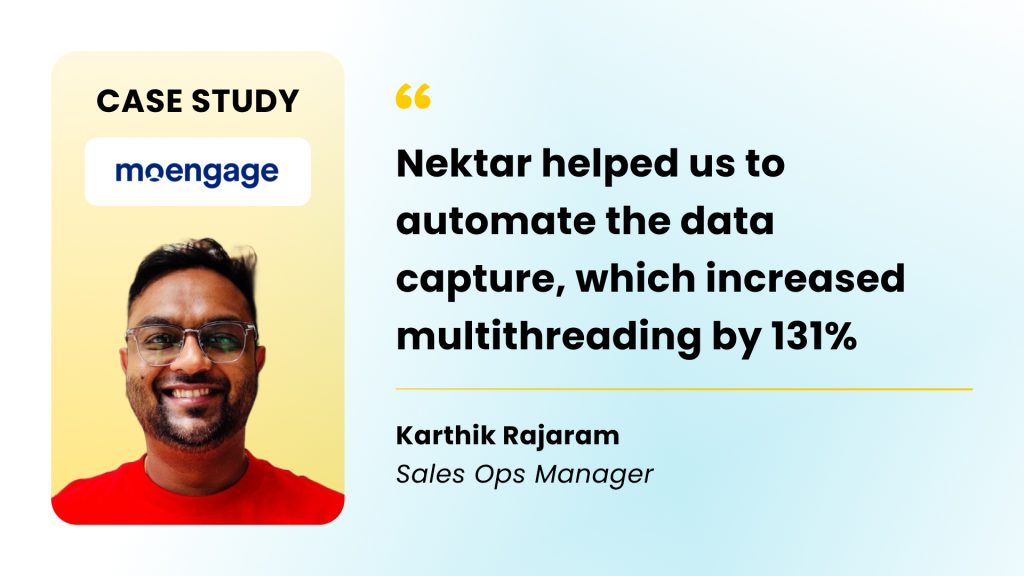
How MoEngage used Nektar to Increase Opportunity Multithreading by 131%
How MoEngage used Nektar to Increase Opportunity Multithreading by 131% INDUSTRY Enterprise Software HEADQUARTERS San Francisco, California WEBSITE https://www.moengage.com/ Book a Demo See Nektar in Action 131% increase in multithreading score 318+ relevant leads identified & added (QoQ) $932k+ added to qualified pipeline QoQ As sales organizations scale, one challenge becomes harder to ignore: maintaining complete and accurate CRM data. MoEngage was growing quickly, and measuring sales performance had become critical to improving rep productivity and accelerating revenue. But the data needed to understand pipeline health, buyer engagement, and sales execution was not fully available in Salesforce. Critical customer interactions were scattered across sales reps’ emails and calendars. Many contacts, activities, and engagement signals never made it into Salesforce. As a result, sales leaders did not have a complete view of which stakeholders reps were engaging, whether opportunities were properly multithreaded, or what was driving successful deals. That challenge made one thing clear: if MoEngage wanted better pipeline visibility and stronger sales coaching, it first needed a more reliable data foundation. The Challenge: Incomplete CRM data was limiting pipeline visibility MoEngage lacked the Salesforce data needed to accurately measure pipeline performance and understand whether sales reps were engaging the right stakeholders throughout the buying journey. A significant portion of customer interactions remained siloed in sales reps’ emails and calendars, leaving Salesforce incomplete and difficult to trust. As the sales team expanded, inconsistent CRM updates and process adherence made it increasingly challenging to: Measure the strength and depth of buyer relationships Identify whether opportunities were properly multithreaded Correlate seller activities with deal outcomes Coach reps based on objective engagement data instead of verbal updates Before switching to Nektar, MoEngage used a plugin-based solution that missed capturing ~75% of their data into Salesforce. It also did not attach contacts or activities to the opportunity level, only to the account. That made it difficult for the team to understand which opportunities reps were spending time on, whether deals were single-threaded, and the quality and frequency of interactions happening across active opportunities. MoEngage’s approach relied heavily on correlating data from spreadsheets, incomplete Salesforce records, and verbal updates from reps. For a fast-scaling sales organization, that was not sustainable. Why opportunity-level engagement data mattered For MoEngage, the problem was not just missing data. It was missing context. AEs were engaging with multiple prospects and stakeholders, but only a portion of those contacts were being added to Salesforce. This meant key buyers, decision-makers, and influencers were often missing from opportunity records. As Karthik R, Sales Ops Manager at MoEngage, explained: Karthik RajaramSales Ops Manager AEs engage with a lot of prospects, but sometimes they end up adding just one contact to an opportunity or a lead. They do not have the time or bandwidth to add every contact they’re speaking to. These were key contacts we were missing out on and Nektar helped us to automate this data capture, which enabled us to target our prospects with campaigns and tailored messaging. MoEngage partnered with Nektar to solve three immediate priorities: Add missing contacts into Salesforce Identify execution gaps across active opportunities Understand key indicators of successful sales execution The Solution: Turning fragmented GTM activity into structured Salesforce data Nektar helped MoEngage capture and structure GTM activity that was previously hidden across emails and calendars. With more than 50 reps, MoEngage had a significant number of contacts hidden in sales reps’ inboxes. Nektar mined these inboxes to identify missing buyers, decision-makers, and key influencers, and brought that data into Salesforce at the opportunity level. By leveraging Nektar’s data, including 3.6K Opportunity Contact Roles, MoEngage was able to test its hypotheses around buyer engagement, persona coverage, and multithreading. The analysis revealed that: High-performing reps had 3.8x higher multithreading scores compared to others High-performing reps engaged decision-makers in the early stages of the sales cycle Nektar also surfaced 318 leads quarter-over-quarter that reps were already in contact with. These leads were more likely to engage with marketing and sales efforts than cold leads from a third-party database, resulting in an additional qualified pipeline of $932K quarter-over-quarter. Nektar helped MoEngage move from scattered activity to actionable sales insights Automated data capture gave MoEngage a stronger foundation for tracking pipeline health and identifying execution gaps. Instead of relying on spreadsheets and verbal updates, MoEngage used Nektar data and insights to get a comprehensive view of account and opportunity-level engagement, including where reps were spending their time, which people were involved, and why certain deals were stalling. There’s a lot of opportunities, but we only have certain amount of time in the day… Nektar helped in breaking it down to 2 or 3 areas we can coach a rep on, and which deals matter… Nektar flags for me what I should spend my time on. Manohar NandigamSenior Director, Sales Enablement This helped managers focus on the deals and coaching areas that mattered most, instead of spending time chasing updates or manually piecing together activity data. Building sales performance leading indicators With buyer-seller activity tracked through Nektar, MoEngage managers were able to shift from verbal deal updates to objective coaching conversations. Nektar helped establish leading indicator benchmarks such as Multithreading Score and Hustle Score, based on top-performer analysis. These indicators gave managers a quantitative way to understand sales execution, follow-up cadence, stakeholder engagement, and process adherence. The best part of Nektar leaderboards is that it gives quantitative data on how the reps are pushing across deals, what’s their follow-up cadence, sales process adherence. Hastu KshitijSenior Vice President This gave MoEngage a clearer view of how reps were executing across opportunities and where managers could intervene earlier to improve outcomes. The Impact By partnering with Nektar, MoEngage was able to turn fragmented GTM activity into structured Salesforce data that sales leaders could trust. The impact included: 131% increase in opportunity multithreading 3.6K+ missing OCRs added to Salesforce 46K+ sales activities captured in Salesforce $932K in additional qualified pipeline generated QoQ Additionally, Nektar improved visibility into execution gaps and risks across in-flight opportunities, along